2013
Volume 3 Numéro 2
Violence conjugale et diversité culturelle
Éditrice invitée :
Ghayda Hassan
1 La culture comme un iceberg?
Y. Leanza
5 Violence conjugale et diversité culturelle G. Hassan
9 Nature of domestic/family violence and barriers to using services among Indian immigrant women
E. Colucci, M. O’Connor, K. Field, A. Baroni, R. Pryor et H. Minas
27 De la plainte aux soins : le parcours des victimes de violence conjugale au Brésil L. Martins-‐Borges, D. Sevegnani Mayorca et M. Silva Livramento
37 Sortir de la violence, sans sortir de l’autochtonie : l’importance de mieux comprendre les besoins des femmes autochtones en milieu urbain
C. Flynn, G. Lessard, L. Montminy et R. Brassard
51 Domestic violence, ethnic diversity, and political and economic change in an upland community of Vietnam
L. Kwiatkowski
67 Dépister et orienter les personnes d'origine étrangère usant de violence au sein du couple : un défi pour les professionnels du champ social
S. Lorenz et C. Fluehmann
81 Les enjeux de la survisibilisation/invisibilisation de la violence envers les femmes issues de l’immigration en contexte familial
C. Bouchard et S. Garneau
97 Politiques d’immigration : femmes et violence conjugale dans le contexte québécois S. Castro Zavala
Notes de lecture
111 Communication et interculturalité : cultures et interactions interpersonnelles, de A. Frame R. Rocque
Alterstice est publiée avec le soutien de l'Association internationale pour la Recherche Interculturelle (ARIC), l'équipe de recherche Migration et Ethnicité dans les Interventions en Santé et en Service social (METISS, Montréal) et le Centre interuniversitaire d'Études sur les Langues, les Arts et les Traditions (CÉLAT).
Alterstice est publiée uniquement en ligne : www.alterstice.org
La revue est gratuite.
Alterstice c/o Yvan Leanza Professeur agrégé École de psychologie Université Laval
2325, rue des Bibliothèques Québec (Qc)
G1V 0A6 Canada
Directeur : Yvan Leanza [email protected]
Responsable de la révision et de la mise en pages : Anna Olivier (Athéna Rédaction) [email protected]
Révision des manuscrits en anglais : Cynthia Gates ISSN : 1923-‐919X
© Alterstice, 2013. Toute reproduction du texte doit mentionner la source de l’article.
La culture comme un iceberg?
Yvan Leanza1
Il est parfois utile, voire nécessaire de revoir les métaphores que nous employons comme chercheurs ou enseignants pour transmettre le message qui nous semble le plus pertinent, ou encore le plus percutant. Ces figures de style associent une expérience ou une abstraction à un élément concret, ce qui a pour effet de rendre l’abstraction bien réelle et saisissable par ceux à qui est destiné le message. Lakoff et Johnson (2003) estiment que ceux dont les métaphores s’inscrivent de façon durable dans le discours commun imposent une lecture particulière de l’expérience humaine et, finalement, définissent une parcelle de vérité. Il ne s’agit donc pas seulement de se faire comprendre, mais de reconnaître qu’il y a bien là un enjeu de pouvoir : une interprétation métaphorique d’une partie de l’expérience humaine peut finir par dominer le discours commun, et par là même orienter les choix individuels et sociaux.
Il est une métaphore que les interculturalistes usent d’abondance dans leurs messages : la culture, c’est un iceberg.
La caractéristique principale de cette montagne de glace flottante est que 90 % de son volume est sous l’eau. Il est impossible de connaître sa forme exacte en se basant sur ce qui est visible. L’image de l’iceberg est employée dans le discours commun (en français du moins) pour désigner ce que l’on ne peut saisir a priori : la pointe de l’iceberg, qui renvoie ainsi à une situation dont on ne perçoit qu’une infime partie, à l’image de la partie émergée de la glace.
Par cette association entre culture et iceberg (que nous devons probablement à l’anthropologue Clyde Kluckhohn), on souhaite de la même façon mettre de l’avant le caractère partiellement invisible de la culture. La métaphore fait également de la culture une réalité dont l’importance peut facilement être minimisée si on ne s’attarde qu’à sa (petite) partie visible. On peut aussi la relier au contraste entre ce qui est conscient (visible) et inconscient (invisible).
Mais est-‐il heureux d’employer cette métaphore dans le cadre de la recherche ou de la formation interculturelle?
En choisissant un élément concret pour rendre compte d’une abstraction, c’est l’ensemble de l’univers symbolique attaché à cet élément qui est convoqué, et pas seulement une partie de celui-‐ci. Quelles sont donc les autres qualités symboliques de l’iceberg, outre son incarnation de l’ambivalence du visible et de l’invisible ? Avant d’être une montagne flottante, un iceberg est une montagne de glace, et c’est peut-‐être là une partie négligée de la fonction symbolique de cette métaphore.
La « glicité », ou encore la capacité à faire glisser, selon Daniel Chartier, directeur du laboratoire international d'étude multidisciplinaire comparée des représentations du Nord (Bertrand, 2013) est l’une des fonctions symboliques de la glace. Cette qualité de la glace est plutôt joyeuse, dans la mesure où elle est associée à une facilité de déplacement, une rapidité aussi de ce déplacement. Elle est synonyme d’amusement avec les sports d’hiver, et même d’un style de vie à la fois jeune, sain et aventurier (« la glisse »). Mais souhaitons-‐nous que la culture soit associée à une surface sur laquelle rien ne peut accrocher ? Et qui pourrait même s’avérer être une zone à risque ?
Une autre fonction symbolique de la glace, probablement la plus importante, est d’arrêter le temps. Cela se voit avec la conservation des aliments, mais aussi en science : l’analyse de carottes de glace permet de remonter le temps, la découverte d’animaux disparus congelés (en général des mammouths) nous permettant d’accéder à une époque révolue. La science-‐fiction est aussi riche en récits de monstres libérés des glaces qui sèment la désolation.
En employant la métaphore de l’iceberg, souhaitons-‐nous vraiment associer la culture à un temps passé, révolu, et parfois figé pour l’éternité?
Une autre fonction symbolique de la glace est sa dangerosité. La glace est dure, froide, coupante, piquante, mordante. Elle est capable de bloquer, de comprimer, d’écraser et de détruire, comme en témoignent les mésaventures de deux brise-‐glaces (russe et chinois) récemment bloqués en Antarctique. Elle grince, craque, attaque et tue, animaux comme humains. Le bruit de la glace qui se meut sur la mer et qui heurte les coques de bateaux est – nous apprend Daniel Chartier – la voix des damnés pour les Islandais. Elle peut être tout cela – soit dangereuse et en même temps sournoise – parce qu’invisible. Par exemple, la glace noire au Québec est cette fine couche de glace sur les routes, invisible, qui provoque des accidents. L’iceberg est l’archétype de cette sournoise dangerosité, à la fois celle de la montagne et celle de l’invisible : il a coulé le plus grand navire que l’humanité ait jamais construit et il a nécessité la constitution d’organismes internationaux pour mettre en place une surveillance systématique de la menace qu’il représente. Souhaitons-‐nous vraiment associer la culture à un danger (mortel) imminent qui pourrait détruire les réalisations les plus grandioses d’une société et qui nécessiterait une surveillance accrue?
Dans un autre ordre d’idées, la plus récente des fonctions symboliques de l’iceberg serait de concentrer les craintes environnementales suscitées par les changements climatiques : la disparition de la glace aux pôles et dans les montagnes est sujet d’inquiétude. Elle est considérée comme symptomatique de ces changements infligés par les humains à la planète. Elle est facilement mesurable grâce aux relevés des scientifiques du dernier siècle ou à des artistes qui ont immortalisé ces masses aujourd’hui évaporées. Ce changement climatique est visible, quasi palpable, en de nombreux points de la planète. Cette disparition présage d’un avenir sombre. Voulons-‐nous associer la culture cet ensemble d’émotions, de crainte et d’inquiétude pour l’avenir?
Finalement, la culture telle qu’elle est aujourd’hui définie – comme processus permanent de construction de sens – est l’antithèse de l’iceberg. Peut-‐être avons-‐nous, comme interculturalistes, abusé de cette métaphore, adoptée un peu vite. Croyant transmettre un message simple sans être simpliste, nous avons peut-‐être renforcé les craintes associées à la différence. Alors que la crise économique sévit, les identités se cristallisent facilement. Certains gouvernants ou décideurs n’hésitent pas, en faisant régulièrement preuve d’amnésie historique, à se servir de la peur de l’autre et à utiliser la culture de cet autre comme une menace à l’intégrité et à l’harmonie. Comme chercheur, il me semble important de rester proche de nos terrains et de nos données et de trouver des métaphores qui rendent compte de l’expérience humaine sans convoquer les peurs qui rigidifient les comportements et aboutissent à la rupture des liens plutôt qu’à leur constitution et leur renforcement. C’est ce que font les auteurs des divers articles de ce numéro, qui porte sur un sujet sensible pourtant traité avec tact, sous l’habile direction de Ghayda Hassan, de l’Université du Québec à Montréal.
Bonne lecture!
Références
Lakoff, G. et Johnson, M. (2003). Metaphors we live by (éd. revue). Chicago : The University of Chicago Press.
Bertrand, J. (2013). Entrevue avec Yves Bergeron et Daniel Chartier : La glace [entrevue]. Dans J. Bertrand (réalisateur), La tête ailleurs. Montréal, Québec : Société Radio-‐Canada. En ligne à http://www.radio-‐
canada.ca/emissions/la_tete_ailleurs/2013-‐2014/archives.asp?date=2013-‐12-‐28 (à 18h14 de l’audiofil du 28 décembre).
Rattachement de l’auteur
1Université Laval, Québec, Canada Correspondance
[email protected] Pour citer cet article :
Leanza, Y. (2013). La culture comme un iceberg? [Éditorial]. Alterstice, 3(2), 1-‐4.
Violence conjugale et diversité culturelle
Ghayda Hassan1
Résumé
La violence conjugale en contexte de diversité culturelle est un phénomène extrêmement complexe à aborder en prévention comme en intervention en raison de ses multiples composantes et qui demeure mal connu et peu documenté. Ce numéro thématique de la revue Alterstice tente de faire un premier pas pour combler ces multiples lacunes, en offrant un espace de réflexion et de partage des connaissances théoriques, cliniques et empiriques autour de la violence conjugale vécue par les femmes immigrantes, réfugiées ou issues des minorités ethnoculturelles. Notre sélection d’articles permet d’amorcer une réflexion complexe et critique sur l’expérience de la violence conjugale, réflexion qui porte sur les différentes sphères de l’intime de la culture familiale, qui touche aussi les cultures et les barrières propres au système de soins et qui atteint enfin les enjeux politiques liés à cette question. Nous espérons que ce numéro thématique constituera une passerelle de sens permettant de bâtir des ponts entre différents univers culturels, pour permettre de développer une relation d’aide fondée sur la complexité des sens et le souci d’assurer une sécurité culturelle, et non une relation de pouvoir, de menace et de contrainte additionnelle pour la femme victime de violence conjugale.
Rattachement des auteures
1Université du Québec à Montréal, Montréal, Canada Correspondance
[email protected] Mots clés
violence conjugale; immigration, culture, intervention, prévention, politique Pour citer cet article :
Hassan, G. (2013). Violence conjugale et diversité culturelle. Alterstice, 3(2), 5-‐7.
La violence conjugale, définie comme une violence physique, émotionnelle, financière ou sexuelle perpétrée par un partenaire conjugal, constitue l’un des problèmes de santé mondiale les plus importants. Même si certains hommes subissent de la violence conjugale, les femmes demeurent plus à risque d’en connaître les formes les plus sévères, ainsi que de souffrir de conséquences aiguës et chroniques. En effet, les statistiques internationales révèlent des taux de violence physique et sexuelle subie par des femmes dans le cadre de relations intimes allant de 3 % à 62 % selon le pays et la zone recensés (Organisation mondiale de la santé, 2012).
Le phénomène persiste et peut même être amplifié dans un contexte de déplacement forcé, de désastre (guerres, désastres naturels, etc.) ou de refuge (camps de réfugiés, demande de statut de réfugié, etc.) ainsi qu’en contexte migratoire, en raison des multiples facteurs de vulnérabilité rattachés à ces différentes réalités. Or la situation des femmes dans ces contextes demeure mal connue et peu documentée. La violence conjugale en contexte de diversité culturelle est en effet un phénomène extrêmement complexe à aborder en prévention comme en intervention, en raison de ses multiples composantes, dont celles liées à l’histoire prémigratoire, au parcours migratoire, aux défis de l’intégration dans la nouvelle société et aux violences structurelles de cette dernière envers les immigrants ou les réfugiés, auxquelles s’ajoutent des barrières d’accès aux soins liées à des caractéristiques culturelles, religieuses, intercommunautaires, sociales et politiques.
Les outils de dépistage de la violence conjugale, tout comme les différentes stratégies d’évaluation, de prévention et d’intervention qui ont été implantées en Amérique du Nord et en Europe, ont été principalement créés et évalués auprès d’une population non spécifique, et ils comportent parfois des stéréotypes et des préjugés essentialisants pour de nombreuses femmes immigrantes, réfugiées ou issues de minorités ethnoculturelles. Leur applicabilité et leur adéquation aux besoins des populations immigrantes demeurent inconnues, tout comme leur efficacité à réduire la violence conjugale et les conséquences qui y sont associées auprès de ces mêmes populations. Par exemple, même lorsqu’une histoire de violence conjugale est dépistée, on ne propose pas systématiquement à ces femmes un suivi psychosocial (Macmillan, Wathen, Jamieson et collab., 2009). On constate ainsi de nombreuses barrières à l’accès aux soins, et le risque de pathologisation de la souffrance et de vulnérabilisation accrue de ces femmes en est potentiellement multiplié.
Les questions demeurent donc nombreuses. Quel est l’état de la situation en ce qui a trait à la violence conjugale en contexte de diversité ethnoculturelle? Quels sont les facteurs de vulnérabilité propres aux femmes en situation de minorité ethnoculturelle? Quelles sont les conséquences de cette violence sur ces femmes et leurs familles?
Quels besoins expriment-‐elles? Comment conçoivent-‐elles cette violence en lien avec leur passé et leurs conditions de vie actuelles? Comment dépister ou évaluer cette violence? Quelles sont les barrières dans l’accès aux programmes de prévention et aux soins? Les programmes d’intervention offerts répondent-‐ils aux besoins de ces victimes ou les fragilisent-‐ils davantage? Ces questions ne constituent qu’un fragment des interrogations liées au manque de connaissances dans le domaine de la violence conjugale auprès des femmes immigrantes, réfugiées et issues des minorités ethnoculturelles.
Ce numéro thématique de la revue Alterstice tente de faire un premier pas pour combler ces multiples lacunes, en offrant un espace de réflexion et de partage des connaissances théoriques, cliniques et empiriques autour de la violence conjugale vécue par les femmes immigrantes, réfugiées ou issues des minorités ethnoculturelles. Notre sélection d’articles permet d’amorcer une réflexion complexe et critique sur l’expérience de la violence conjugale, réflexion qui porte sur les différentes sphères de l’intime de la culture familiale, qui touche aussi les cultures et les barrières propres au système de soins et qui atteint enfin les enjeux politiques liés à cette question.
Nous présentons d’abord quatre articles portant à la fois sur le commun de l’expérience subjective de la violence et sur les réalités spécifiques de femmes provenant d’horizons variés : le Brésil, l’Inde, le Vietnam et le Québec autochtone. Ainsi, dans « Nature of domestic/family violence and barriers to using services among Indian immigrant women », Colucci, O’Connor, Field, Baroni, Pryor et Minas nous renseignent sur la nature de la violence conjugale et les barrières dans l’accès aux soins pour des immigrantes d’origine indienne en Australie. Leur parole trouve sa source ici à travers une intervention de type théâtre forum, qui permet de lever le tabou associé à la violence conjugale et de rendre compte de cette dernière comme d’une réalité touchant l’ensemble des membres de la communauté et pas simplement la femme qui la subit. Dans « De la plainte aux soins : le parcours des
victimes de violence conjugale au Brésil », Martins-‐Borges, Sevegnani Mayorca et Silva Livramento nous font découvrir les nombreuses barrières parsemant le parcours de victimes de violence conjugale au Brésil. Par le biais d’un programme d’intervention psychologique, ces femmes réussissent à se réapproprier certains éléments de leur histoire personnelle, à revaloriser leur identité et à repérer les particularités culturelles leur ayant permis de faire face à ces situations et celles ayant parfois représenté un blocage dans leur processus de changement. Kwiatkowski démontre quant à elle l’importance d’examiner le problème de violence conjugale de manière complexe en tenant compte de la multidimensionnalité de ce phénomène et en évitant toute pensée simpliste. L’auteure le fait en intégrant dans son article « Domestic violence, ethnic diversity, and political and economic change in an upland community of Vietnam » une analyse des aspects politiques, sociaux et économiques dans la compréhension de la violence conjugale au Vietnam. Enfin, Flynn, Lessard, Brassad et Montminy abordent dans « Sortir de la violence, sans sortir de l’autochtonie : l’importance de mieux comprendre les besoins des femmes autochtones en milieu urbain » l’épineuse question de la violence conjugale chez les femmes autochtones en milieu urbain québécois, mettant en lumière les différentes manifestations des rapports de pouvoir en jeu dans la construction des difficultés et des demandes d’aide pour ce groupe de femmes doublement vulnérable.
Une seconde série d’articles touche la question, essentielle, de l’adéquation des services et de leur adaptation aux réalités et aux besoins des femmes immigrantes ou issues des minorités ethnoculturelles victimes de violence conjugale. Dans « Dépister et orienter les personnes d'origine étrangère usant de violence au sein du couple couple : un défi pour les professionnels du champ social », Lorenz et Fluehmann présentent le point de vue de professionnels travaillant au sein d'institutions sociales susceptibles d'orienter les personnes usant de violence conjugale vers les groupes thérapeutiques. Tout en dénonçant le risque de stéréotypie et de discrimination qui peut être associé au pairage entre origine socioculturelle et violence conjugale, les auteures soulignent la nécessité de renforcer les collaborations intersectorielles afin d’optimiser l’accès aux soins et d’améliorer la qualité des interventions.
Le rôle central que peuvent jouer les médias comme miroir et moteur de préjugés sociaux est souligné par Bouchard et Garneau dans leur article « Les enjeux de la survisibilisation/invisibilisation de la violence envers les femmes issues de l’immigration en contexte familial ». Dans cet article, les auteures illustrent l’excès de visibilité des populations immigrantes dans les journaux lorsqu’il est question de violence envers les femmes, mais leur invisibilité sociale lorsqu’il est question de soins. Enfin, les politiques migratoires touchent les femmes et les familles de manière beaucoup plus directe et vulnérabilisante que ne le laisse croire leur aspect macrosystémique.
Castro Zavala en fait l’éloquente démonstration dans « Politiques d’immigration : femmes et violence conjugale dans le contexte québécois », en analysant la manière dont les politiques d’immigration interagissent avec d’autres formes d’oppression dans la vie des femmes immigrantes, les rendant ainsi plus vulnérables à la violence conjugale.
Les défis à relever dans le domaine de la violence conjugale et de la diversité culturelle sont encore très nombreux et nous espérons que ce numéro thématique et la diversité des idées qui y sont partagées constitueront une passerelle de sens permettant de bâtir des ponts entre différents univers culturels, pour permettre de développer une relation d’aide fondée sur la complexité des sens et sur le souci d’assurer une sécurité culturelle, et non une relation de pouvoir, de menace et de contrainte additionnelle pour la femme victime de violence conjugale.
Références bibliographiques
Organisation mondiale de la santé. (2012). Comprendre et lutter contre la violence à l’égard des femmes : la violence exercée par un partenaire intime [en ligne]. Organisation mondiale de la santé. Fiche téléchargeable à partir du lien :
http://apps.who.int/iris/bitstream/10665/77432/1/WHO_RHR_12.36_fr.pdf?ua=1
Macmillan, H., Wathen, C., Jamieson, E. et collab. (2009). Screening for intimate partner violence in health care settings: a randomized trial. Journal of the American Medical Association, 302, 493-‐501.
Nature of domestic/family violence and barriers to using services among Indian immigrant women
Erminia Colucci1, Manjula O’Connor1, Karen Field1, Alice Baroni1, Reima Pryor1 et Harry Minas1
Abstract / Résumé
Domestic/family violence is a widespread major public health and human rights violation issue that runs across ethno-‐cultural affiliations and economic status. Relative to the actual incidence of family violence, use of services is low, and delayed for years after onset, within the broader Victorian and Australian community. Utilization is even lower for women from immigrant and refugee communities. It has been noted that family violence service utilization by Indian women immigrants in particular was especially low, relative to the size of the Indian population in Victoria. With the Indian culture understood to be traditionally a strongly male-‐dominated culture, it was deemed important to explore the nature of family violence experience of Indian women living in Australia, and culturally determined barriers to use of services. A partnership was formed to explore this issue through a participatory community theatre approach.
Forum Theatre is a powerful tool that uses theatre for generating community understanding around hard to address issues such as domestic violence. Using such theatre-‐based ethnography, we aimed to identify the key issues, challenges and needs of Indian immigrant families when accessing and using services that could assist in situations of domestic/family violence.
Rattachement des auteurs
1Centre for International Mental Health, School of Population and Global Health, University of Melbourne, Melbourne, Australie.
Correspondence / Correspondance [email protected]
Keywords / Mots clés
migration; domestic violence; family violence; violence against women; Indian; culture; arts-‐based research;
community theatre; participatory theatre; forum theatre; performance ethnography; service use; service utilization; access to services; violence prevention.
Pour citer cet article :
Colucci, E., O’Connor, M., Field, K., Baroni, A., Pryor, R. et Minas, H. (2013). Nature of domestic/family violence and barriers to using services among Indian immigrant women. Alterstice, 3(2), 9-‐26.
Introduction
Violence against women (VAW) is now widely recognized as a significant global problem, a major public health concern and one of the most widespread violations of human rights (Colucci, & Heredia Montesinos, 2013; Eng, Li, Mulsow, & Fischer, 2010; VicHealth, 2008). The perpetrators of the violence are often well known to their victims (WHO, 2005). Domestic violence (DV), which occurs within the context of families, can encompass a wide range of behaviors including verbal abuse, threats, coercion, harassment, intimidation, manipulation, physical and sexual abuse, criminal damage, rape, and homicide (Wilcox, 2006). Although women represent the overwhelming majority of victims of violence occurring in the home, men are sometimes victims too (VicHealth, 2011).
The landmark report published by the World Health Organization a decade ago (WHO, 2002) gave global relevance to the epidemic rates and serious and long-‐term impacts of violence by positioning it as a leading worldwide public health concern. In 2005, WHO set the prevention of violence against women as a high priority (WHO, 2005).
Violence against women is not only a serious breach of human rights, but has major health, social and economic consequences for women, their families and communities. Several studies have highlighted the impact of violence against women, particularly domestic/family violence, on physical and mental health (e.g.: Coker, Smith, Bethea, King, & McKeown, 2000; Ellsberg, Jansen, Heise, Watts, & Garcia-‐Moreno, 2008; VicHealth, 2008; WHO, 2005), including suicidal behavior (Chowdhary & Patel, 2008; Colucci, & Heredia Montesinos, 2013; Davar, 2003; Devries et al., 2011; Ellsberg, et al., 2008; WHO, 2005).
Violence against women, including DV, is a universal phenomenon that persists in all countries and societies of the world (WHO, 2005), affecting all communities irrespective of race, gender, class, religion, cultural background or ethnicity (Bannenberg, & Rossner, 2003). Nevertheless, there are cross-‐national and cultural variations. For instance, a review of 134 studies in different countries and ethnic communities showed that the prevalence of lifetime domestic violence varied from 1.9% to 70% (Alhabib, Nur, & Jones, 2010). Higher risk of VAW is found in societies with traditional gender norms and roles, unequal distribution of power and resources between men and women, a normative use of violence to resolve conflicts, and cultural approval of (or weak sanctions against) violence against women (VicHealth, 2011; WHO, 2011). In Australia, from the age of 15 years, well over one-‐third of women (40%) had experienced physical and/or sexual violence (VicHealth, 2011). In particular, in the state of Victoria (capital, Melbourne) intimate partner violence was found to be the leading contributor to illness, disability and premature death among women aged 15 to 44 years. Furthermore, there is evidence that domestic/family violence in this state is on the increase (Victoria Police, 2011).
As observed by Poljski (2011), only a few studies have been conducted in Australia that determine the prevalence and dynamics of violence against women across and within ethnic communities. Researchers and service providers have, however, brought attention to the higher levels of violence experienced by women from immigrant and refugee backgrounds (Bonar, & Roberts, 2006; Erez, 2000; O’Donnell, Smith, & Madison, 2002). For instance, a recent study in Hong Kong confirmed existing evidence that female marriage migrants are more vulnerable to spousal violence compared with local women (Choi, Cheung, & Cheung, 2012).
Women experiencing violence have been reported as being often emotionally involved with, and economically dependent on, those who victimize them, making it difficult to disclose their experiences, let alone to seek support (VicHealth, 2011; Lewis, Dobash, Dobash, & Cavanagh, 2000). A recent study in Melbourne showed that women from immigrant and refugee backgrounds face barriers in addition to those for the broader community, to seeking help (Intouch, 2010). In particular, immigrant women often feel trapped because of immigration laws and fear of deportation, language barriers, social isolation, and lack of financial resources (Orloff & Little, 1999; Raj &
Silverman, 2002). A similar study carried out in the U.S. with nine migrant communities showed that “for these women, domestic violence occurs against the backdrop of social and economic marginalization that is similar to and extremely different from women who are mainstream” (Bhuyan, & Senturia, 2005, p. 896).
As indicated previously, although violence against women and domestic/family violence affects every community, some groups are at higher risk. Indian women are among them. As observed by Satish, Gupta, and Abraham (2002),
“domestic violence is prevalent and [a] largely accepted part of family life in India” (p. 12). There is also some evidence of an increase over time of violence against Indian women (Enayatullah, & Zeba, 2003), partially attributed to increasingly “modern” attitudes among women (Simister, & Mehta, 2010). In spite of the greater acceptability and presence of domestic/family violence (DV)1 among Indian women, and higher risk of violence among immigrant women, Indian immigrant women seem to make particularly low use of the services available in Melbourne for victims of domestic/family violence. No official data is available in this regard, despite Indians being a growing and emerging community in Australia (Poljski, 2011).
The 5-‐yearly Australian Census conducted in 2011 (Australian Bureau of Statistics, 2011) indicated that within Australia, India is the fourth most prevalent country of birth (after Australia, England and China) and in Victoria, the third most prevalent (after Australia and England), comprising 2.3% of the Victorian population, with 47% of these being recent arrivals and 80% being first generation migrants. Despite being the largest migrant group (after the English who would be expected to access culturally mainstream services), of the 641 women who accessed the Immigrant Women's Domestic Violence Service in 2008-‐2009 in Melbourne, only 54 (8%) were of Indian background (IWDVS, 2010). In the same period, the Federation of Indian Association of Victoria (an association that provides support specifically to Indian victims of domestic violence) supported a total of 16 Indian males and females (AISV Taskforce, 2009). Meetings with other Melbourne-‐based stakeholders and service providers have also confirmed that Indian women barely access domestic/family violence services (e.g.: AISV Taskforce, 2009) relative to their proportion within the Victorian community.
Together with unequal power relations between men and women and the way gender roles, identities and relationships are constructed and defined within communities and societies, a lack of access to resources and systems of support has been identified as a key determinant of violence (VicHealth, 2009). However, a gap in the literature has been widely acknowledged among researchers and practitioners with regard to appropriate service delivery for ethnic minority people/migrant populations (see Sawrikar, & Katz, 2008). There is growing recognition that understanding how various communities perceive and respond to domestic violence is essential for designing effective, culturally competent interventions (Bhuyan, & Senturia, 2005). Thus, as also argued by Sawrikar and Katz (2008), examining how to improve access to and delivery of services for specific immigrant and refugee backgrounds communities is an important line of critical inquiry in multicultural countries such as Australia. No previous study of this kind had been carried out in Australia; the few studies carried out in other countries (such as Bhuyan, & Senturia, 2005) have not focused on Indian migrants.
For this reason, a partnership2 was established in Melbourne to explore Indian immigrant women’s perceptions of
“domestic/family violence” in their community and knowledge about the specific barriers that prevent disclosure and help-‐seeking. Through this, we aimed to deepen our understanding of the nature and dynamics of DV in the Indian community and provide suggestions to improve access to and delivery of DV and family relationship services to Indian immigrant women.
Methodology
DV is a sensitive area of research, which requires careful planning and consideration of the specific ethno-‐cultural context (Ellsberg, & Heise, 2005). Bhuyan and Senturia (2005) highlighted the importance of in-‐depth, culturally competent research as a means to allow women’s voices to be heard and integrated into our understanding of DV.
Previous research has also indicated that community members wanted to see tangible benefits from participating in research beyond simply documenting problems in their communities (Bhuyan, & Senturia, 2005). WHO emphasized the importance of action-‐oriented research to increase our understanding of DV and what to do about
1 For brevity, hereafter the acronym “DV” will be used to refer to domestic/family violence.
2 This project is a collaboration between an Indian community organization (Australia India society of Victoria), a University research Centre (Centre for International Mental Health, The University of Melbourne) and a service provider (Drummond Street Services). Assistance for the theatre workshops and performances was provided by the cultural collective Third Way Theatre.
it (WHO, 2005). Thus, in the same spirit of community-‐based participatory research we implemented an approach to research called participatory community theatre.
Practices of “theatre by the people and theatre for the people,” such as street theatre, have a long tradition in the Indian culture (see Capila, & Bhalla, 2010), thus this method can be regarded as a powerful means to engage the Indian community and to promote change through increasing awareness and agency.
Theatre and performance as ethnographic research methods
Over the past two decades, the use of theatre and performance within social science research has gained both popularity and critical attention (Rossiter, & Godderis, 2011). There is a growing scholarship that uses theatre as research (Dennis, 2009), including a handful of research-‐based theatre projects that have addressed a variety of health-‐related issues (Rossiter, & Godderis, 2011).
As observed by Dennis (2009), an analysis of the literature indicates that drama is currently involved in research on several levels (often using drama in multiple ways): as a data collection technique; to reflect data and analysis to a broader audience; to bring participants and others into dialogues that data collection has inspired; as disciplinary critique; and as a participatory form of analysis. Drama has also been used to complement and transfer knowledge gained through statistics (Mienczakowski, 2001) and as a participatory technique to address social concerns and explore potential social transformation (Conrad, 2004; Prentki, & Selman, 2000).
Denzin (2003) defined performance ethnography (also described as ethnodrama or ethnotheatre) as a form of social science methodology in which performers and audience are engaged reciprocally and democratically in performing common text. In a previous work, Denzin called ethnodrama “the single most powerful way for ethnography to recover yet interrogate the meaning of lived experience” (1997, p. 94, cited in Conrad, 2004).
Mienczakowski (2001) defined performance ethnography as co-‐constructed with research participants, a process that gives participants a forum they may not have in more traditional research.
In their research, performance ethnographers find or create opportunities to perform their cultural understandings by observing, participating in performances, and/or representing their findings to others through performance (Conrad, 2004).
Over the past century, new developments of the concept of “theatre” have allowed the definition of varied tools and intervention methods (Dragone, 2000, p.61). In such theatre forms, the main result is not so much connected with a final aesthetic production (as in the traditional theatre) as with the possibility for a community to explore collectively their issues and avenues of potential action (Prentki, & Selman, 2000).
Most of the interactive work genre draws on the Theatre of the Oppressed developed by the Brazilian theatre practitioner Augusto Boal (1985), under the influence of Paulo Freire’s Pedagogy of the Oppressed (1977/2000).
Theatre of the Oppressed is “a system of physical exercises, aesthetic games, image techniques and special improvisations whose goal is to safeguard, develop and reshape this human vocation, by turning the practice of theatre into an effective tool for the comprehension of social and personal problems and the search for their solutions” (Boal, 1995, p.14-‐15).
Between the specific set of theatrical techniques encompassing the Theatre of the Oppressed, his techniques of Imagine Theatre and Forum Theatre give the audience a part in the dramatic action. In Forum Theatre, the community of participants creates and acts out a symbolic representation in which they witness their struggle and highlight the forms of oppressive conflicts within society. The scenario runs once and is subsequently enacted again, encouraging the audience to stop the action and change the dramatic action replacing a character on the stage. Discussion is promoted by the facilitator, with the aim to create a deeper understanding of the scenario and gain a critical awareness about cultural assumptions, beliefs and values.
Theatre and domestic violence
Boal’s theatre techniques have been applied in a few studies that investigated and worked with communities on domestic violence issues, such as Lev-‐Aladgem (2003) in Israel, Mitchell, and Freitag (2011) in the U.S., Sliep, Weingarten, and Gilbert (2004) in Uganda and Wang (2010) in Taiwan. As Sliep and collaborators pointed out, working between individuals and society is crucial to improve strategies to address issues of social health, moving the locus of control from external agencies to the people who are directly experiencing it. By bringing the stories of marginalized people on stage, Forum Theatre offers a rare opportunity to people on the fringe to be in the center (Chilton, 2000 cited in Lev-‐Aladgem, 2003) where, being the experts of their own lives, they can be engaged in a dialogue with the audience to discover and explore collectively how to deal with their own problems.
Photo 1 Performance in a Sikh Temple, by E. Colucci, 2011
In conclusion, the Boalian techniques (including Forum Theatre and its adaptation such as the techniques used in this project) seemed an adequate and powerful tool to achieve the aims of this project. These aims were to increase our understanding of the nature of DV within Indian immigrant communities of Melbourne, and barriers to help-‐seeking among Indian immigrant women while, at the same time:
• breaking the silence around DV
• reducing isolation of victims of violence who volunteered in the project
• promoting social change through increasing awareness and agency.
Method
Sample and procedure
The participants in the project consisted of community members, key stakeholders and service workers3 who lived in Australia (temporarily or permanently) and were of Indian origins4. Based on Wang’s (2010, p. 426) experience of women tending to remain silent and voiceless in the public arena when men were present, the study included only Indian women. However, one of the final performances was opened also to male audience members, in order to enable the exploration of possible concepts not expressed by the women-‐only groups.
Participants were recruited by project partner organizations through flyers distributed at key venues and events for the Indian community (e.g.: International Women’s Day, Indian Consulate) and by snowball sampling. During the recruitment, we aimed to have a mixture of recently-‐arrived and more established migrants, younger and older women.
This performance ethnography comprised three stages: information/focus group sessions, theatre workshops, and community theatre performances.
Stage 1: Info/focus group sessions
The information/focus group sessions had duplicate aims: collect views about what women in the Indian migrant community identify as domestic/family violence and what might be some of the obstacles encountered by those women to seek help in case of violence, and introduce some of the forum theatre games and exercises to recruit participants for the theatre workshops and performances. More specifically, at the start of the session participants were asked to describe first what makes an Indian family a “happy family, a family that lives in harmony” and later an “unhappy family,” that lives in disharmony5. When the issue of domestic/family violence was brought up by participants, they were asked to describe what they meant by these terms and to provide examples. The sessions were semi-‐structured and only a limited number of questions were pre-‐defined by the researcher to prompt discussion (e.g.: “What does it look like when there is domestic violence, abuse?”). At the end of the session, participants were invited to provide their contact information if they wished to continue their participation in the project.
Four focus groups were held in four different locations over three weeks, with a total of 72 Indian women attending. Each Focus Group went for four hours, including dinner. First languages of participants included Hindi, Punjabi and English. Ages of participants ranged from 22-‐82 years of age. Participants had a range of timelines for their migration, from recently arrived to many years lived in Australia.
Stage 2: Theatre workshops
The participants who accepted to take part in the workshop were engaged in trust-‐building exercises and several theatre games as metaphors to initiate dialogue. These techniques were used as a means to get deeper understanding of the topic under investigation. Fourteen volunteers participated in six full-‐day (8-‐hours) workshops over a four-‐week period.
3 Mainly from legal, social/family, immigration or mental health services.
4 As mentioned before, victims of violence may have fears connected to disclosure of violence, including fear of isolation and re-‐
victimization. Thus, in accordance also with what emerged from community consultations, the project was opened to Indian women, independently from having direct or indirect experience of DV. In this way, it was not possible for the community and the audience at the performances to identify the volunteer actors as victims of violence.
5 Previous community consultations pointed out that talking about DV at the start of the session could be too confronting for some participants and suggested to start from the concept of “family harmony/disharmony,” which would most likely led to the topic of DV.
The principal investigator (EC) and the research assistant (AB), rather than just “observing,” actively took part in the games.
From the “theatrical investigation” and focus group discussions, a script was devised that aimed at supporting an interactive dialogue with community audiences. To protect the privacy of participants, the script did not represent specifically the personal experiences of the participants. In the last workshop, participants discussed the name of their performance and agreed for Ghungat, a Hindi word that means ‘veil’ or, symbolically, ‘hidden’. A flyer was then prepared to invite community member to attend the performances.
Stage 3: Community theatre performances
As for the info/focus group sessions, the interactive theatre performances were based on a community outreach model, i.e. they took place where the community was located. All performances were held in spaces open to the (invited) public. In this way, the play was performed to the women who were involved in the initial sessions (Stage 1), as well as others new to the project.
The primary task of the performances was to share understanding and perceptions of DV in the Indian community and to identify the key issues, challenges and needs of Indian families when accessing and using services.
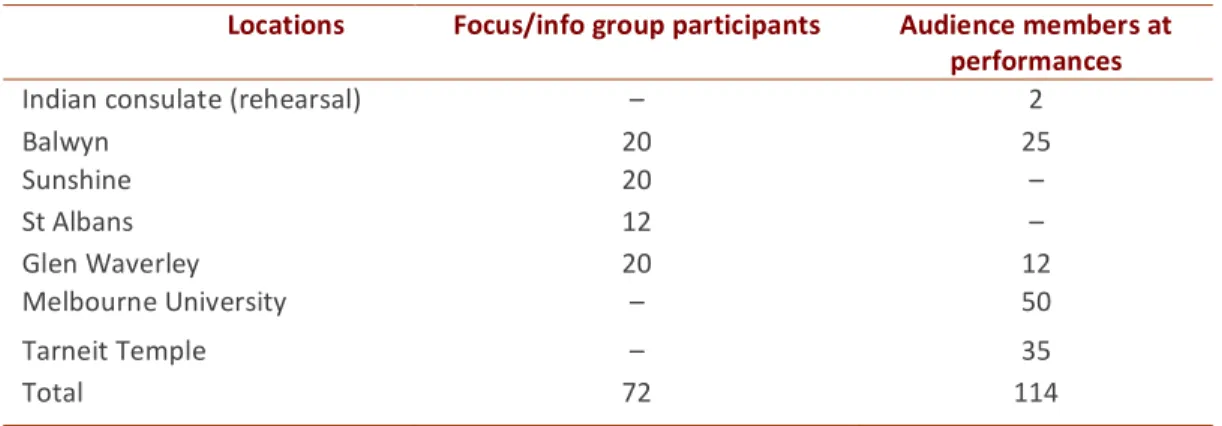
One hundred and fourteen participated as audience. The majority (92%) were women, with one male at the Tarneit Temple, and mixed men and women at the University of Melbourne performance. All were Indians except for the University of Melbourne forum when academics and professionals from diverse cultural backgrounds, several from Indian diaspora, were invited.
The table 1 below shows the total number of participants in the project across locations.
Table 1 Number of participants in the project
Locations Focus/info group participants Audience members at performances
Indian consulate (rehearsal) – 2
Balwyn 20 25
Sunshine 20 –
St Albans 12 –
Glen Waverley 20 12
Melbourne University – 50
Tarneit Temple – 35
Total 72 114
Data collection and analysis
The info/focus group sessions and the performances were audio-‐recorded and transcribed verbatim. In three instances, the researcher interviewed individually participants who appeared to have had no opportunity to share their thoughts. These interviews were also transcribed. These sets of data, together with the field-‐notes taken by the principal investigator and the assistant during these sessions and the theatre workshops, formed the basis for the qualitative data analysis.
Transcriptions and field-‐notes were analyzed using the principles of Interpretative Phenomenological Analysis (see Colucci, 2012).