It is a great opportunity to work with the Canadian Potato Zebra Chip and Psyllid Monitoring Network, led by Dr. Larry Kawchuk and Scott Meers, for allowing me to review the application of Species Distribution Models to potato psyllium. I would also like to thank Mahsa Miri, who helps me edit the potato psyllid photos and organize the data.
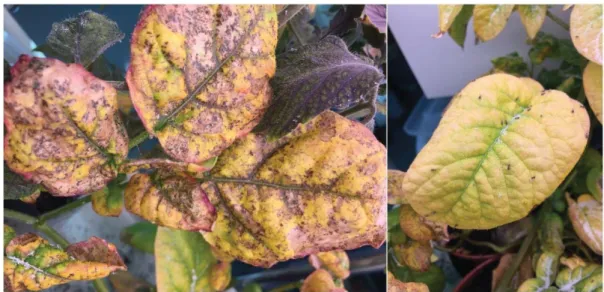
Potato leaves turn yellow and discolor due to potato borer feeding (Photo: Dan Johnson Figure 2.2 The process of backward reduction of variables, the out-of-bag (OOB) error decreases as the more variables used increase; the OOB error does not increase for long after 25 variables used to fit the model Random Forest…….………..40 Figure 2.3 Comparison of degree days and temperature indices in April between cases of the presence and absence of the yellow scaup (DD)………52 Figure 2.10 Temperature indices and degree days in June, compared between positive observations of yellow warbler and observations of yellow warbler without Figure 2.12.
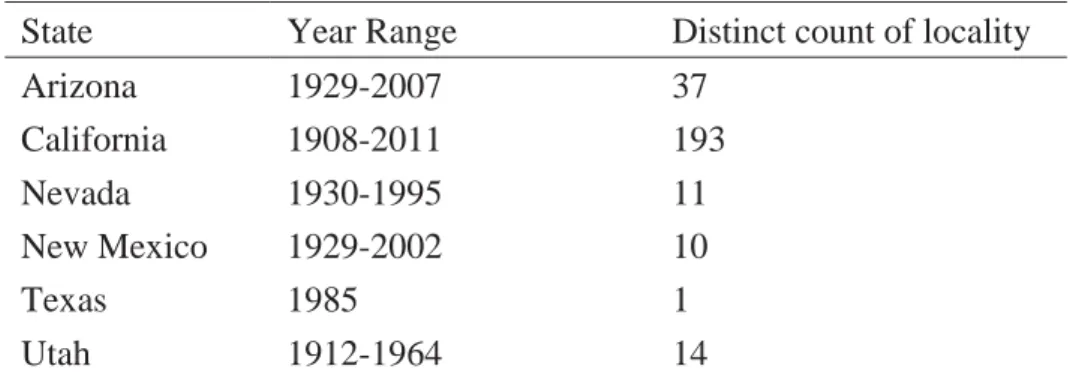
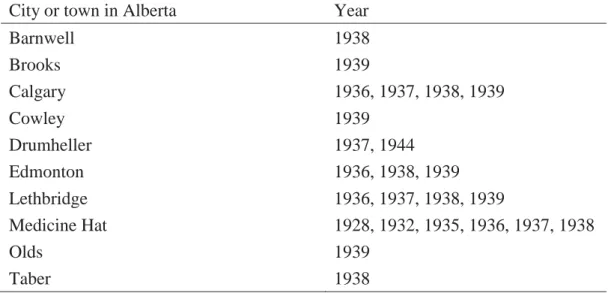
Geographical changes of average degree-day accumulation in June between positive and negative cases of yellow psyllids........58 Figure 2.14. Georeferenced museum records and literature records of potato psyllids (town, city and county) (data provided and compiled by: Qing Xia).
Introduction
Vectorization of the Lso pathogen by the potato psyllid is required for the spread of zebra chip disease among potato plants. Crosslin et al. 2012b), potato psyllid monitoring programs have been established in those states. Solanum dulcamara, which significantly increases the cold tolerance of potato psyllids compared to those feeding on potato plants (Murphy et al. 2013; Horton et al. 2015).
Potato psyllid adults were observed to have a 40% survival rate after exposure to -10℃ for 24 hours when feeding on potatoes (Henne et al. 2010). The northwestern haplotype is more cold tolerant than the central and western potato psyllid haplotype (Swisher et al. 2013). Among the literature of the time, the opinion that potato psyllids could spread to different states seemed to be a consensus.
The distribution pattern of potato leafhopper varies seasonally from south to north in the United States (Nelson et al. 2014). Evidence of the influence of climate and weather on the populations and distribution of scaly potatoes is evident in the historical and recent literature.
Historical analysis of psyllid yellows on potato using random forest model
Yellow chip symptoms do not include potato tuber necrosis (Sengoda et al. 2010) and differ from the pathology and symptoms of zebra chip disease. Initial explanations for the occurrence or yellowing of the scaup and the spread of scaup populations took into account the role of weather. Random Forest: Yellow warbler records for the Random Forest model in the northern United States and Canada.
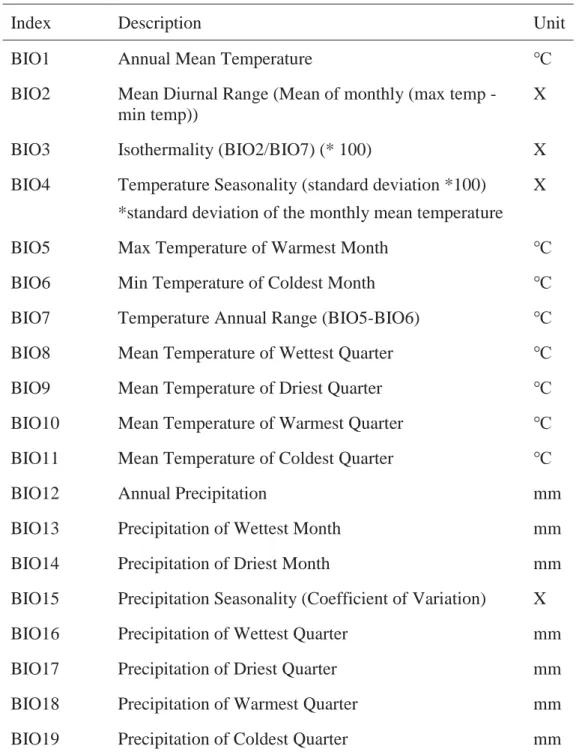
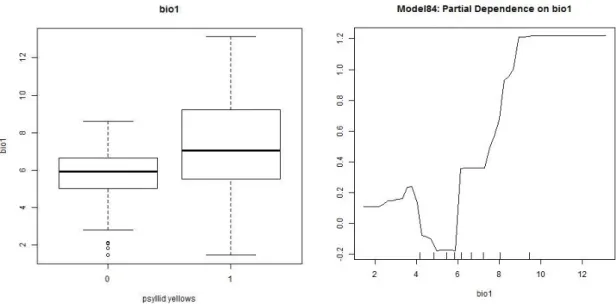
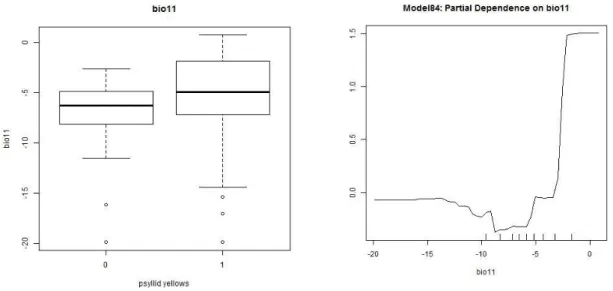
In the preliminary analysis of the psyllid yellow observation data set, the observations of psyllid yellow presence (observed and reported) have higher mean BIO1 value than those of psyllid yellow absence (observed as absent). In the plot of BIO11, the psyllid yellow incidents have a higher average BIO11 value than that of the no psyllid yellow incidents. Compare the means of the precipitation indices between the psyllid yellow incidents and no psyllid yellow observations using boxplots and partial plots.
The rapid increase of the potato psyllid population was observed in the field by Wallis (1955). The logit of the probability is close to zero (where the probability of psyllid yellow is 0.5), where the degree-days. As part of the monitoring program, I am working on a sub-project that examines the relationship between the potato psyllid and.
In the boxplot of BIO12, the BIO12 value of the potato psyllid data has a lower distribution than the background environment (Fig. 3.4).
Modelling potato psyllid distribution using Maxent
Conclusions
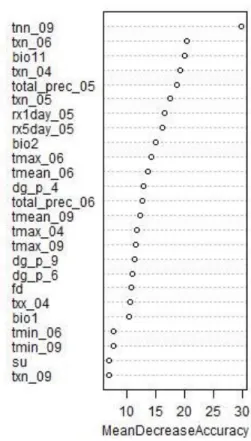
My thesis project analyzes the climate pattern for historical (and some current) locations of the potato psyllid population and psyllid yellows. I applied the Random Forest ensemble learning method to identify key climate indicators and visualize the relationship between the probability of psyllid yellows disease occurrence conditional on the climate variables of interest using the fitted Random Forest model. Compared to "no psyllid yellows" observations, psyllid yellows outbreak data show a warmer annual temperature and warmer winter conditions than "no psyllid yellow" records.
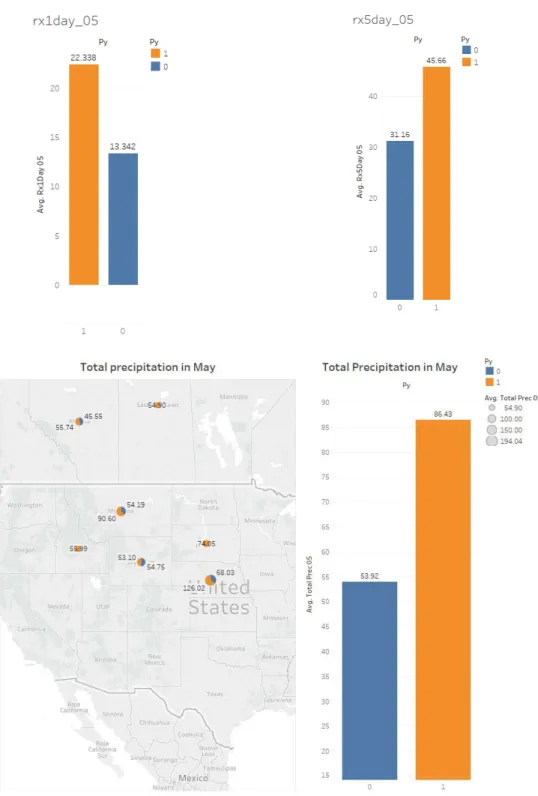
The psyllid yellow records have higher May precipitation amount and extremes than the no psyllid yellow records, while the psyllid yellow records have lower precipitation in June. The average of the total precipitation in May was 53.9 mm for the no psyllid yellow observations, and 86.4 mm for the psyllid yellow observations, while the average of the total precipitation in June is 91.7 mm for the no psyllid yellow observations. A pattern of higher heat accumulation in September and a higher temperature in September at the potato psyllid outbreak sites is evident in the data.
Psyllid yellow records also have fewer frosty days and more hot summer days than the no psyllid yellow records. Weather conditions are known to affect the seasonality and movement of potato psyllid field populations. I tested the use of the Maxent model to estimate the probability of potato psyllid presence by comparing species presence data with background environment.
However, a decrease in the area in Canada unsuitable for potato psyllid is predicted, and an expansion into a certain area. Differences in climate indices for psyllid yellow cases and no psyllid yellow cases, and differences in climate indices between potato psyllid presence and background data, indicate environmental constraints on insect population and distribution. More research needs to be done to investigate whether the models fitted to the psyllid yellow and potato psyllid data in this study can make consistent predictions by testing them with new data on potato psyllid presence and outbreaks.
Associated 'tomato vein greening' and tomato psyllid yellows diseases in commercial greenhouses in Arizona. Evaluation of potato psyllid cold tolerance, overwintering survival, sticky trap sampling and the effects of liberibacterium on potato psyllid alternative host plants. Emerging crop pests: Ecological modeling and analysis of the South American potato psyllid Russelliana solanicola (Hemiptera: Psylloidea) and its wild relatives.