See also John English, 'The Operational Art: Development in the Theories of War', chapter 1 in The Operational Art: Developments in the Theories of War, (Westport, Connecticut: Praeger Publishers, 1996), 7. Swain, 'Filling the Invalid: The Art of Operation and the American Romjue, “The Evolution of the Airland Battle Concept,” Air University Review.
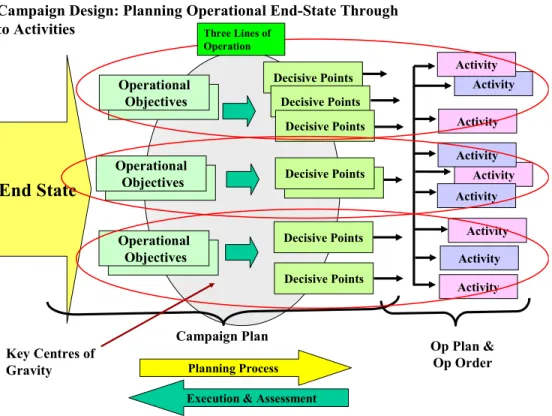
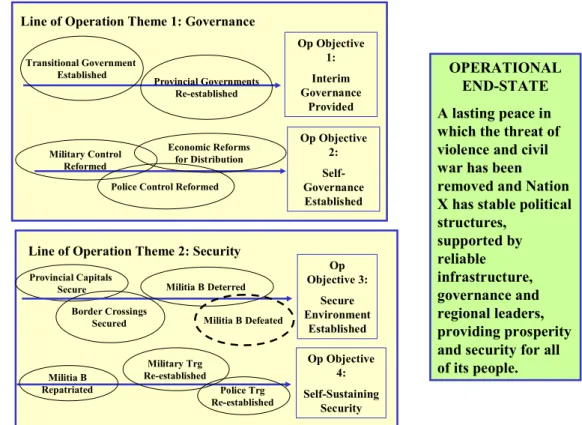
OPERATIONAL DESIGN AND CAMPAIGN PLANNING BEYOND THE COLD WAR
Their roles, power structures, objectives and the role they play in the current crisis or situation all need to be assessed in order to understand the environment and its constituent elements.50. Commanders must seek to understand the various influences and systems that govern the environment, the role they play in the outcome, and how to process these to achieve the end state of the campaign.
Environmental Complexity
By its very nature, the military cannot resolve many of the root causes that led to the crisis and the need for military intervention. 56 They often tackle the causes of the crisis and local grievances and do a lot to win the support of individuals and groups in the area.
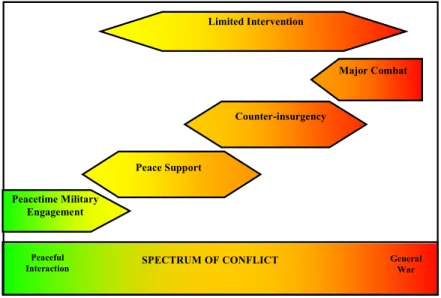
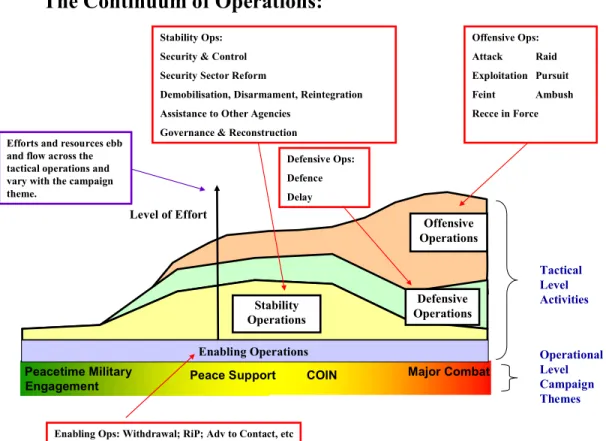
The Continuum of Operations
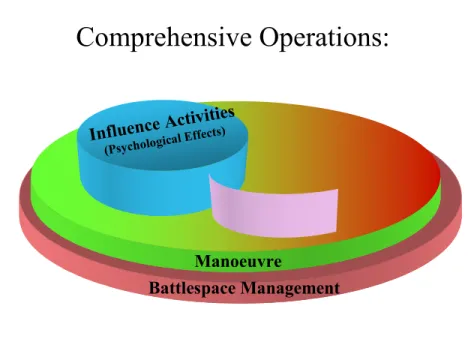
The development of the comprehensive approach and the conceptual nature of the elements of operational design. Influence activities and their direct influence on understanding will therefore become part of the maneuvering approach.
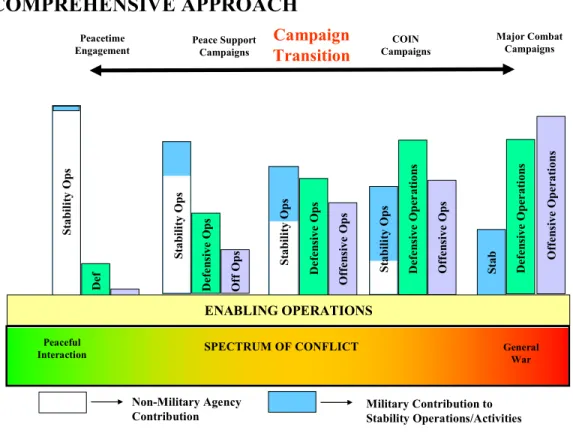
Activities as
Comprehensive Source
Department of National
Defence,
GL-300-001/FP-0.6 Land Operations - Final Draft July 2007
Private
Kingston: Army Publishing Office, 2007), 5-7
Rupert Smith,
The Utility of Force: The Art of War in the Modern World
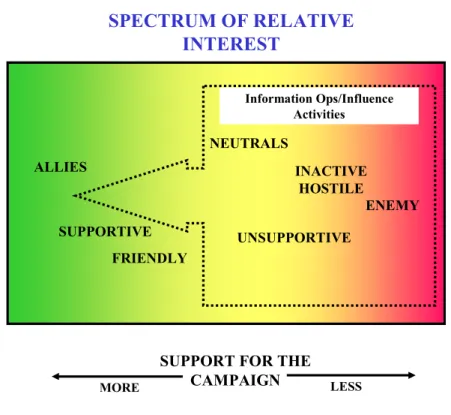
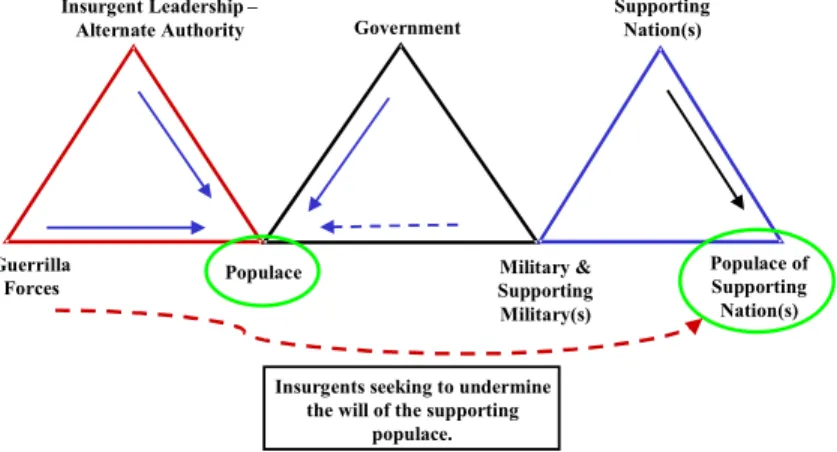
Thus, the prudent commander identifies the individuals and groups whose understanding and perception will influence the outcome of the campaign; in fact, various groups and their support can be regarded as centers of gravity, and as sources of strength for whichever side has their support.90 The commander will work through them as necessary, and as part of the operational art, to to guarantee the success of the campaign. This overall awareness of the crucial importance of the public and their perceptions in support of a campaign appears to have led to the inclusion of 'legitimacy' in the doctrine.91 A campaign or its resulting actions and demands can thus be considered legitimate in the sense that they can be considered legitimate. seen as justified in the eyes of specific target groups. It is clear that if individuals and groups are to support a campaign and its armed forces, they must regard the campaign as justified, that is, legitimate and therefore have legitimacy.92 After all, it is only through such support that conflict and violence can arise . will cease and stability will be achieved.
The US joint operations publication summarizes legitimacy as follows: the purpose of legitimacy is to create the will among groups and individuals necessary to achieve the strategic end state and is thus a crucial element of the campaign; is based on legal, moral issues and the "justice" of the actions taken; affected audiences will include. In short, the perceptions of the legitimacy of the campaign and its goals by the affected populations will influence the outcome; indeed, even commentators at the time of the Vietnam War noted that this is, in terms of campaign success, more important than the number of enemy dead bodies, despite the accepted wisdom of the time.94. This precaution against giving a sense of legitimacy to undeserving indigenous administrations reflects one of Vietnam's failings, namely, commitment to a government that was too corrupt and had no sense.
Therefore, all military activities must be carried out with the aim of gaining and maintaining the support of the local population and for this purpose creating and maintaining the legitimacy of the campaign. Both measures were probably intended to convince the target audience, in these cases the domestic population, that the campaigns were not legitimate in terms of the expenses paid.
Populations as Strategic Centres of Gravity
THE DEVELOPMENT OF CAMPAIGN AUTHORITY IN CURRENT DOCTRINE AND WRITING
The concept of Campaign Authority appeared in the doctrine in 2004, but mainly focused on peace-supporting campaigns. It therefore links Campaign Authority to the fulfillment of the natural expectations of an indigenous population. The campaign approach will increase campaign authority because it will meet expectations and thus build legitimacy.
The greater the campaign authority built during the campaign, the greater the likelihood of sustained success. Beyond Peace Support Doctrine - Ad Hoc Incorporation of Campaign Authority into British Doctrine and Writing. Summarizing the place of the campaign body concept in formal and evolving UK doctrine, we note that it has been rather patchy.
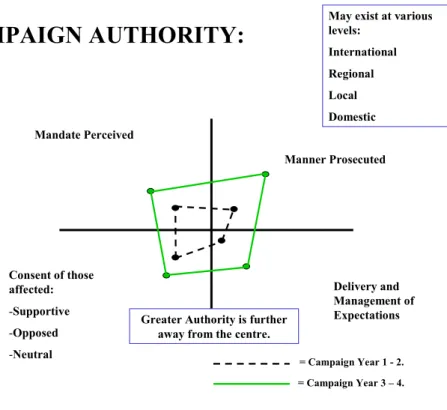
The doctrine of dealing with irregular threats has provided the most extensive discussion of Campaign Authority in most campaigns to be encountered. Thus, it reflects two aspects of the campaign authority model, that of the recognized mandate and the manner in which a campaign is conducted. Represented by this Campaign Authority illustration or model is an overall increase in the measurement or estimate of total Campaign Authority over time and/or.
The Campaign Authority model therefore provides a framework through which legitimacy can be conceived and constructed.
THE PLACE OF CAMPAIGN AUTHORITY IN OPERATIONAL DESIGN
Although the Campaign Authority has been introduced in some detail into British doctrine in the handling of peace support and other campaigns. Campaign Authority provides the nodes through which legitimacy can be created in the first place: establishing and advertising a legitimate mandate to campaign; the manner in which the campaign is prosecuted so that legitimacy is created and strengthened at all levels of command; as well as management and delivery of. Additionally, since Campaign Authority will reflect overall support for a campaign, it can be used as a measure of success.
Ultimately, Campaign Authority, as a framework for creating and measuring the legitimacy of a campaign, will provide operational and operational insight to the commander. Parallels in Business – Legitimacy through Social License Before the article explores how Campaign Authority can be deployed as an operational design tool, it will be useful to explore how a similar concept exists in business.175 INMET mining is an international mining industry. company based in Toronto. Leading company executives readily identify with the need to create perceptions of legitimacy in the countries and populations within which they operate.
It is similar to Campaign Authority and thus can be developed and evaluated over time and in different. Although there are few parallels between military campaigning and industrial mining, examining the framework of social license offers similar concepts: the success of an operation through the achievement of legitimacy in the perceptions of affected audiences.
CAMPAIGN AUTHORITY ACROSS THE LEVELS OF COMMAND
Within a theater, there may be particular groups or individual leaders who act as centers of gravity, physical in the former, moral centers of gravity in the latter.185 Thus, establishing and maintaining Campaign Authority at the operational level in this regard can involve obedience. a particular sect, tribal or religious leader of the legitimacy of a campaign and its worthiness of support. Afghanistan, if the particular Pashtun tribes can be convinced of the legitimacy of the current campaign of the Afghan coalition. Meyer, “The Peacemaker of the Pashtun Past,” The New York Times, December 7, 2001 [article on-line]; available from http://query.nytimes.com/gst/fullpage.html; Internet; accessed March 17, 2008.
The perception of legitimacy should focus on the force, the way it behaves and manages and delivers on local expectations, and the rationale for the overall mandate. In other words, they built legitimacy for the counterinsurgency campaign and gained the consent of the population and denied the consent of the enemy. At the tactical level, the increase in troop numbers and a change in tactics and methods reflecting the new US COIN doctrine have improved the security of the urban population and thus their credibility and legitimacy.
197 David Frum, "5th Anniversary of Iraq War: Success Finally Looks Possible," The National Post. 198 David Frum, "5th Anniversary of Iraq War: Success Finally Looks Possible," The National Post.
CREATION AND ASSESSMENT OF CAMPAIGN AUTHORITY ACROSS ITS CONSTITUENT DIMENSIONS
Independent Panel on Canada's Future Role in Afghanistan Final Report of the Independent Panel on Canada's Future Role in Afghanistan, (Ottawa: Minister of Public Works and Government Services, 2008), 32. Regardless of the formal mandate, the perceived mandate will be based on the perceptions evolved in the minds of various audiences. Independent Panel on Canada's Future Role in Afghanistan Final Report of the Independent Panel on Canada's Future Role in Afghanistan, (Ottawa: Minister of Public Works and Government Services, 2008), 76.
The mandate must of course be seen in the cultural context of the relevant audiences. Indeed, the narrative underlying the mandate must be supported by actions in the execution of the campaign. Regardless of the formal mandate and the justice of the activities undertaken in its name, legitimacy will not exist, especially in the perceptions of indigenous people.
Independent Panel on Canada's Future Role in Afghanistan, Final Report of the Independent Panel on Canada's Future Role in Afghanistan, (Ottawa: Minister of Public Works and Government Services, 2008), 16. 239 David Frum, “The 5-Year Iraq War: Success at Last seems possible,” The National Post.
CONCLUSION Review
This framework will enable the commander, through his operational design, to outmaneuver his adversary in the minds of individuals and groups, many of whom may be centers of gravity influencing the outcome of the campaign. Timely decision-making and speed of action will ensure that the decisions create legitimacy and their supportive messages will undermine those of the opponent and make them irrelevant. In light of the central role of legitimacy within a campaign, it is recommended to use Campaign Authority as a framework for achieving legitimacy during a campaign.
You come against me with a sword and a spear and a spear;" said David to Goliath, "but I come against you in the name of the Lord."247 Thus, before confronting Goliath, David first established his legitimacy and thus his advantage over his opponent . It exists in the minds (perceptions) and hearts (emotions) of the audience affected by the campaign. Crucible of War - The Seven Years' War and the Fate of the Empire in British North America, 1754 to 1766.
Counterinsurgency in a Test Tube: Analyzing the Success of the Regional Assistance Mission to the Solomon Islands (RAMSI). The Fort Ticonderoga Disaster: Musket Shortages During the Mobilization of 1758.” The Huntington Library Quarterly, 14, no.