CAML Review / Revue de l'ACBM : http://caml.journals.yorku.ca CAML / ACBM : https://www.caml-acbm.org. En cette période de renouveau, je souhaite une nouvelle fois souhaiter la bienvenue à la nouvelle équipe éditoriale d’ACBM Review. Fournir un aperçu du contenu qui devrait apparaître sur le site Web de l'ACBM.
CAMLREVIEW /REVUE DE L'ACBM 48, NO.1 (DECEMBER /DECEMBER 2020) PAGE 20 On Friday, November 22, 2019 (the feast day of St. Cecilia, patron saint of music), we held our meeting at the Webster Library, Concordia University , in Montreal.
Minutes of the 2019 CAML/ACBM Annual General Meeting
Joint NY/Quebec Chapter meeting in Montreal – many topics covered and a report was published in the CAML Review. Question (Desmond): Should we look to freeze prize funding pending our bank deed and how much is in the deed. Answer (TN): The proposed budget will not put us in the red because we have GIC and it is unlikely that we will spend all of the prize money.
Comment (Brian): Given our timelines and high turnover, we should ensure that this timeline is updated in the procedures manual.
Editor’s Column
The majority of the responses in the JSS edition were highly critical of Dr. The #BlackLivesMatter movement has sparked important conversations and actions in the practice of librarians and information specialists. In June, CAML endorsed the Canadian Federation of Library Associations – Féderation canadienne des association de bibliothèques Communiqué on Anti-Black Racism2, joining Canadian library professionals in the condemnation of racism and commitment to justice.
2 See the CFLA-FCAB statements are available on the organization's website in English (http://cfla-fcab.ca/wp- content/uploads/2020/06/EN_CFLA_FCAB_Communique_on_Anti_Black_Racism.pdf) and French (http://cfla -fcab).ca/wp-content/uploads/2020/06/FR_FCAB_CFLA_Communique_sur_le_racisme_envers_les_Noirs-1.pdf).
CAML Milestones
CAML held its first election in seven years in the summer of 2020, with two candidates running for Member-At-Large. CAML became an incorporated association in the Federation for the Humanities and Social Sciences in 2013, which requires us to follow federal and Ontario rules. The Federation explains that under Canada's Not-for-Profit Corporations Act, the organization needed to be able to verify the vote after the election while preserving the anonymity of the individual voter.1 In 2016, Jan Guise, in her capacity as Nominating Officer, investigated options to different and concluded that SurveyMonkey, which was also used by the MLA (Music Library Association) for elections at the time, met CAML's election needs.
Following the guidelines set out in the CAML constitution, we held the election a week after the CAML AGM and voting remained open for 2 weeks.
In Memoriam: Debra Begg (2019)
Spotlight on Music Collections
Over the next few months, we are looking at ways to host virtual performances, events or programs with Capital City Records artists. I just have to say, it's been amazing to see how Capital City Records has evolved over the years and the Rabble/MUSICat platform. CAMLREVIEW /REVUE DE L’ACBM 48, NO.1(DECEMBER /DÉCEMBRE 2020) PAGE 37 Edmonton Public Library concert events: https://www.epl.ca/capital-city-records/#events.
Song of the Week” podcast: https://www.epl.ca/capital-city-records/#vinyl Capital City Records playlists: https://capitalcityrecords.ca/featured.
Why a Canadian Musicologist Would Catalogue One Thousand Mexican Music Manuscripts
Pourquoi un musicologue canadien voudrait cataloguer mille manuscrits musicaux mexicains
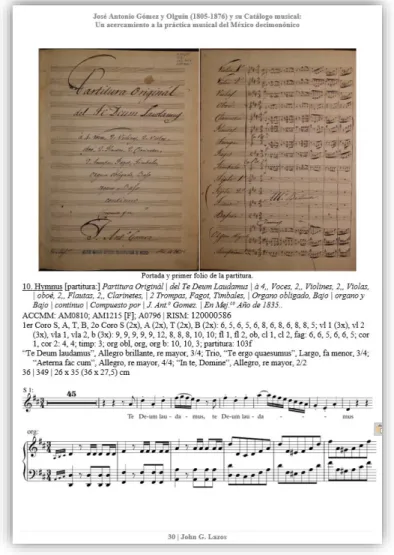
4 The theater in Mexico City became an extension of the structural society during the independent period. Through a project called MUSICAT, Music of the Cathedrals,6 I learned that there is music at the archive of the Cathedral of San Cristóbal de Las Casas in Chiapas. He spent the last forty years of his life in Chiapas, as director of the archives attached to the Cathedral of San Cristóbal de Las Casas.
CAMLREVIEW /REVUE DE L'ACBM 48, NO.1(DECEMBER /DÉCEMBRE 2020) PAGE 46 Table 1: An overall representation of the Mexican music entries found in RISM's database. In such cases, the people who copied the music probably did not consider the name of the composer to be a priority. One can only imagine that Santiago Chazumba had a simple way of life during the first part of the nineteenth century.
However, we know that this work belonged to the actual practice of music in Mexico City during the first part of the nineteenth century. In the rush to transcribe the work for the artists, I, like so many copyists before me, forgot to include the name of the composer. Vizcainas was founded by the Basque people of Mexico City at the end of the eighteenth century.
During the latter part of the nineteenth century, the Reform Acts were passed and the assets belonging to the church were appropriated by the state. My next and current cataloging project took me to the city of Querétaro, a stronghold of the nineteenth-century independence movement.

Acquiring, Preserving, and Exhibiting a Comprehensive Collection of Vocal Music Recordings from the Early- to Mid-Twentieth Century
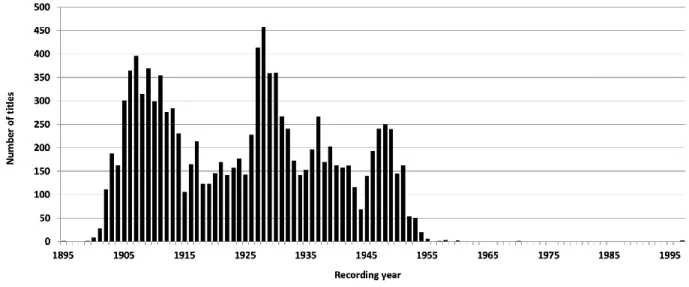
Record the scope and dimensions of the subject, including the size of the disc and playback speed. The Stratton-Clarke 78 collection speaks to the collecting practices of two individuals in the twentieth century and is a comprehensive—if not exhaustive—snapshot of historical recording and performance practices, the artists, repertoire, and record companies of the first half of the twentieth century. In addition to the physical part of the Stratton-Clarke Collection (the 78 rpm and the LP records), there is also a great deal of digital content which increases the value of the collection enormously.
7 Richard Bebb, “I will continue collecting until I die,” The Spectator, https://www.spectator.co.uk/article/-i-shall-go-on-collecting-until-i-die-. 9 See Alice Prael, “To Image or Copy – the Compact Disc Digital Audio Dilemma,” Saving Digital Stuff, December 20, 2016, http://campuspress.yale.edu/borndigital to-image-or-copy-the-compact - disk-digital-audio-dilemma/. The Faculty of Music no longer bears the burden of managing the library, and the Music Library has access to the much greater resources of the central system.
We also utilize the resources of the University of Toronto Archives and Records Management Services. Classroom instruction will be one of the core purposes of the Stratton-Clarke Collection and. We look forward to meeting the challenges and taking advantage of the opportunities offered by the Stratton-Clarke Collection.
One can also study vocal performance practice through the first half of the twentieth century, early recording technologies and. To image or to copy – the CD Digital Audio Dilemma.” Saving Digital Stuff, 20 Dec. 2016, http://campuspress.yale.edu/borndigital to-image-or-copy- the-compact-disc-digital-audio-dilemma/.
Listening to Music “in” the Library by Lucinda Johnston
CAMLREVIEW /REVUE DE L’ACBM 48, NO.1(DECEMBER /DÉCEMBRE 2020) PAGE 88 identify all the music formats2 and music playback equipment they use regularly. Older formats and related playback equipment include vinyl records (any format), cassette tapes, CDs, and DVDs. The first two multiple-choice questions asked respondents to indicate the extent to which they were aware of and used the available formats and playback equipment.
Older music formats (broadcast, streaming, and digital files) were increasingly used by undergraduate and graduate students (about ⅔ of all use of older music formats). CAMLREVIEW /REVUE DE L’ACBM 48, NO.1 (DECEMBER /DECEMBRE 2020) PAGE 92 Figure 3: Number of respondents who know and use library music formats. Q5) Experience with playback equipment available at UAL. Most occasional use of all equipment was by staff/lecturer; graduate and undergraduate students.
CAMLREVIEW /REVUE DE L'ACBM 48, NO.1(DECEMBER /DÉCEMBRE 2020) PAGE 93 Q6) Why respondents do not use music formats and playback equipment available at UAL When asked why they do not use UAL music formats or playback equipment, some respondents indicated that they already owned the equipment or physical material they needed. Q7) Assessed importance of music formats, playback equipment and group listening room Figure 5 breaks down how respondents rated the importance of music formats from one (least important) to four (most important). This can probably be attributed to both the evolutionary trends in music technology as well as the general difficulty of accessing physical formats and playback equipment at UAL.
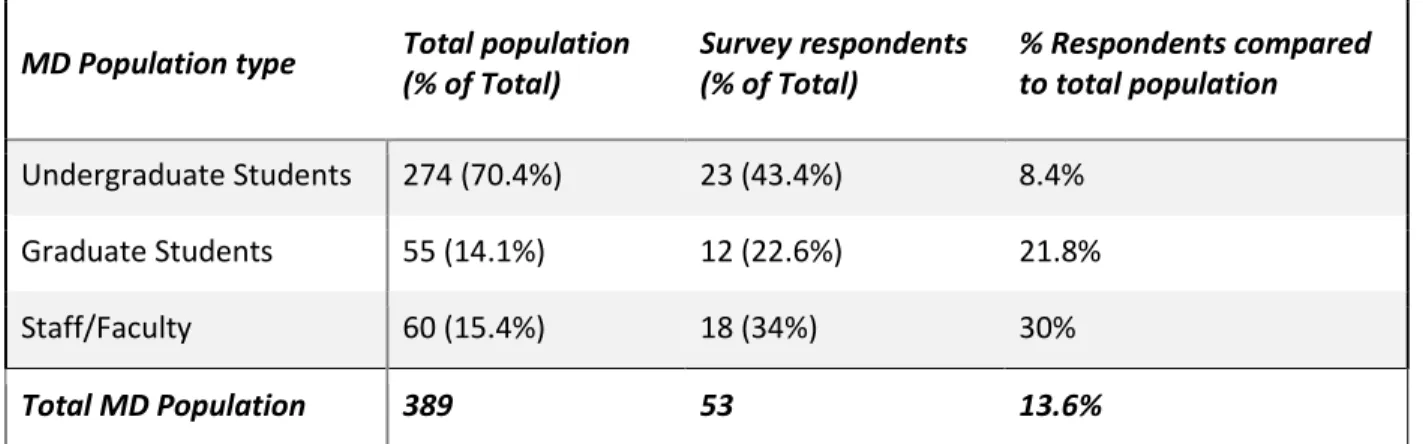
As indicated in the survey findings section, respondents reported that they did not use music formats and playback equipment available at UAL due to their unfamiliarity with and fear of accessing the resources offered by the library. CAMLREVIEW /REVUE DE L’ACBM 48, NO.1(DECEMBER /DÉCEMBRE 2020) PAGE 98 had some limitations, in particular that the responses were not fully representative of the MD population.
Conference Reports
Choose the platform that the majority of your planners are familiar with, so they can provide tech support
We assigned monitors to each session, then held practice sessions for the monitors to make sure they knew how to troubleshoot and answer any questions that arose. We also offered hands-on sessions with the presenters, which was especially helpful for those who hadn't used Zoom.
Change of platform does not necessarily equal change of program
Recognize that there is more that you cannot control, than you can control
Virtual attendance is something we should be regularly offering
There was a lot to keep up with, but it was a very engaging part of the conference. The lack of search and filtering capabilities represents one of the major weaknesses of the application. Another limitation of the platform is the restriction of access to content within the nkoda application.
CAMLREVIEW /REVUE DE L’ACBM 48, NO.1(DECEMBER / DÉCEMBRE 2020) PAGE 117 or right of the screen allows the user to easily scroll pages forward or backward. Scott's discussions of the various stages in the forty-year evolution of the theatrical Patria cycle are particularly valuable and illuminating. For example, Scott makes no mention of Schafer's friend and colleague Pauline Oliveros (to whom Schafer credits the evolution of the concept of "Deep Listening"), or Max Neuhaus (the musician, artist, activist, and educator who explored and established ) his influential conception of acoustic ecology alongside Schafer), or Pierre Schaeffer (whose introduction in 1966 of the concept "acousmatique" is essentially identical to Schafer's "schizophonia"), or Schafer's friend and patron Peter Schleifenbaum, the German born forester-ecologist who Schafer described as "my patron-king, my Ludwig of Bavaria," for the overwhelming support he gave in support of annual performances of The Enchanted Forest (Volume 9 of Schafer's mammoth 12-volume Patria- cycle), by borrowing his 60,000. acres of property – the Haliburton Forest and Wildlife Reserve near Algonquin Park – to the point.2.
And he sidesteps some of the more problematic aspects of Schafer's outlook on Canadian music, indigeneity and Canadian national identity. Murray Schafer, and the Challenges of Noise,” (PhD Dissertation, University of Kentucky, 2019); Megan Murph, “Max Neuhaus's Sound Works and the Politics of Noise,” Ecomusicology Review 5 (2017), https://ecomusicology.info/max-neuhauss-sound-works-and-the-politics-of-noise/; Ariel Bustamante, “Sound Art and Public Auditory Awareness,” Hz 12 (July 2008), https://www.hz-journal.org/n12/bustamante.html; Pierre Schaeffer, Traité des objets musicaux (Paris: Le Seuil, 1966); Ken Winters, "Grab your boots, baton," The Globe and Mail, August 24, 2005. Throughout the volume, however, the reader is always aware that he is engaged in the unfolding of "the most comprehensive study of Schafer and his lasting legacy ," as the book's back cover promises.
Murray Schafer, "The Limits of Nationalism in Canadian Music" (1960), in On Canadian Music (Bancroft, Ontario: Arcana Editions, 1984), 10. Hoffman's The Ghosts of Versailles (1991) fulfills this potential, as Beaumarchais's opera before for one the opera tries to save the ghostly Marie Antoinette from her own execution before allowing her to come to terms with her own past and accept the inevitability of her death.