Volume 23(1), 2020
The Canadian Journal of Environmental Education is a refereed journal published once a year. It seeks to further the study and practice of environmental educa- tion by providing a thoughtful forum for researchers, scholars, practitioners, and post-secondary students. The publication and distribution of articles and reviews should contribute to Canadian thought and practice in environmental education and/or issues and practices of international importance to this fi eld of study.
The views expressed in this journal are not necessarily those of the journal’s editors, advisory editors, or supporters. The Canadian Journal of Environmental Education publishes material that may represent divergent ideas, judgments, and opinions.
The production of Volume 23(1) has been made possible through the generous support of EECOM Standing Committee on Environmental and Sustainability Education in Teacher Education, Brock University, Université de Saint-Boniface, OISE at the University of Toronto, and Lakehead University.
Cover Artwork © by Sheila Karrow
Sheila Karrow is a visual artist and educator from Haida Gwaii, British Columbia.
Focusing on artist-teacher relationships in the classroom informed by place and culture, Karrow is currently in her second year of a PhD program in Curriculum Studies at the University of Victoria. Karrow's paintings communicate both a literal and metaphorical understanding of the natural world. She strives for an intimate connection with the subject yet also reveals the unknowable reality of such a form.
Carefully rendered images in acrylic and watercolour express a didactic blend of extreme detail with narrative, combining realism, symbolism and abstraction.
Copyright 2020 © Canadian Journal of Environmental Education inquiries: [email protected]
Environmental Education
Canadian Journal o ƒ
Guest Editors Douglas D. Karrow, Brock University, Ontario Hilary Inwood, OISE, University of Toronto, Ontario Laura Sims, Université de Saint-Boneiface, Manitoba.
Editors Pat Maher, Nipissing University, Ontario Blair Niblett, Trent University, Ontario
Greg Lowan-Trudeau, University of Calgary, Alberta Editors Emeritus Constance Russell, Lakehead University, Ontario Bob Jickling, Lakehead University, Ontario
Copyediting Julie Sutherland, Kingston, Ontario
Layout & Design Rusty Brown, Niagara Falls, Ontario
Advisory Editors Anne Bell, Ontario Nature, Ontario
Sean Blenkinsop, Simon Fraser University, British Columbia
Mary Breunig, California State University - Sacramento, United States Peter Cole, University of British Columbia, British Columbia
Pamela Courtenay-Hall, University of Prince Edward Island, PEI Justin Dillon, University of Exeter, United Kingdom
Janet Dyment, Acadia University, Nova Scotia Leesa Fawcett, York University, Ontario Jo-Anne Ferreira, La Trobe University, Australia Annette Gough, RMIT University, Australia David Greenwood, Lakehead University, Ontario Randy Haluza-Delay, King’s University College, Alberta Paul Hart, University of Regina, Saskatchewan Richard Kahn, Antioch University, United States Lisa Korteweg, Lakehead University, Ontario
Regula Kyburz-Graber, University of Zurich, Switzerland
John Chi-Kin Lee, Education University of Hong Kong, Hong Kong
Teresa Lloro-Bidart, California State Polytechnic University Pomona, United States Heila Lotz-Sisitka, Rhodes University, South Africa
Milton McClaren, Simon Fraser University, British Columbia Marcia McKenzie, University of Saskatchewan, Saskatchewan
Sarah Pashagumskum, Aanischaaukamikw Cree Cultural Institute, Quebec Christopher Reddy, Stellenbosch University, South Africa
Alan Reid, Monash University, Australia Joshua Russell, Canisius College, United States
Lucie Sauvé, Université du Québec à Montréal, Québec Bonnie Shapiro, University of Calgary, Alberta
Robert Stevenson, James Cook University, Australia Arjen Wals, Wageningen University, The Netherlands Dilafruz Williams, Portland State University, United States
Contents
Guest Editorial: Environmental and Sustainability Education in Teacher Education
Douglas D. Karrow, Hilary Inwood, and Laura Sims
Articles
Environmental and Sustainability Education Pedagogical Approaches in Pre-service Teacher Education
Laura Sims, Madeleine Asselin, and Thomas Falkenberg
Pathways, Philosophies, and Pedagogies: Conversations with Teacher Educators about Place-based Education
Janet McVittie, Geoffrey Webber, Laurie-Ann Michelle, and Dianne Miller Sustainability Learning Pathways in the UBC Teacher Education Program: Destination Cohort
Patrick Robertson, Robert VanWynsberghe, and Bruce Ford Creating a Climate of Change: Professional Development in Environmental and Sustainability Education through University and School Board Partnerships
Hilary Inwood and Alysse Kennedy
Activating Teacher Candidates in Community-wide Environmental Education: The Pathway to Stewardship and Kinship Project Paul Elliott, Cathy Dueck, and Jacob Rodenburg
Research Activities of the Canadian Standing Committee on Environmental and Sustainability Education in Teacher Education Douglas D. Karrow and Patrick Howard
5
14
33
50
68
85
102
Wilding Teacher Education: Responding to the Cries of Nature Bob Jickling and Sean Blenkinsop
Review
International Perspectives on the Theory and Practice of Environmental Education: A Reader
Rebecca L. Franzen Artist’s Statement
Paradoxes in Place-Based Curriculum Informed by Metaphor Sheila Karrow
Reviewers
Guidelines for Contributors
121
139
141
142 143
Guest Editorial
Environmental and Sustainability Education in Teacher Education
Douglas D. Karrow, Brock University, Canada, Hilary Inwood, Ontario Institute for Studies in Education of the University of Toronto, Canada, & Laura Sims, Université de St. Boniface, Canada
This volume of the Canadian Journal of Environmental Education (CJEE) is devoted to Environmental and Sustainability Education in Teacher Education (EST-TE). It was inspired during early conversations amongst organizers of the Research Symposium who wanted to ensure a reputable forum for the publication of research. The Research Symposium was organized and hosted by the Standing Committee on Environmental and Sustainability Education in Teacher Education (the “Standing Committee”) of the Canadian Network for Environmental Education and Communication (EECOM), fall 2018, in Cranbrook, British Columbia.
The ESE-TE Research Symposium, the first of its kind since the inception of the Standing Committee in 2017, had several purposes: to provide academic and non-academic participants (e.g., teachers, practitioners, NGOs, ministry personnel, not-for-profits) with the opportunity to share their research with a small but growing community of like-minded stakeholders; to inspire both formal and informal discussions on the status of ESE-TE as a developing field of studies; and to strengthen collaborations through networking. These purposes were derived from some of the strategic directions and actions of the Standing Committee after an inaugural National Roundtable on ESE in Pre- service Teacher Education held at Trent University in spring 2016. At this event, organizers and delegates crafted a National Action Plan on ESE-TE alongside the Otonabee Declaration, a signed agreement calling for mandatory components of environmental education in all Pre-service Teacher Education programs across Canada (http://eseinfacultiesofed.ca/practice-pages/history-ese.html).
Strategic directions and actions do not operate in a vacuum. Those created by the Standing Committee were informed by its mission to advance and sup- port the development of high-quality ESE through research, policy, and profes- sional development in Teacher Education across Canada. Research has always been central to the mission of the Standing Committee, as is reflected in its strategic directions and actions.
Research on the origins of knowledge and research on how disciplinary fields become established (Hirst, 1974; Goodson, 1987, 1985), such as the developing field of ESE-TE, demonstrate that cultivating, nurturing, and celebrating the diverse forms of research and their derivative activities are
critical to advancing a disciplinary field. The developing field of ESE-TE is no exception and is perfectly situated to benefit from such research initiatives.
Approximately 80 attendees, 27 of whom were presenters, participated in the fall 2018 Research Symposium, which was organized as follows: After a short plenary, there were two one-hour sessions to facilitate the sharing of research and practice (praxis) on ESE-TE. Within each of these sessions, there were three or four presentations (organized by common theme, e.g., place-based educa- tion) and subsequent discussions. These sessions were followed by breakout groups focussing on expanding work in ESE-TE, sharing resources, and making commitments to concrete actions.
Consistent with the Standing Committee’s strategic directions and actions of conducting, supporting, and disseminating ESE-TE research, attendees were invited to submit papers for consideration and review in this volume of CJEE. A general call to other members of the ESE-TE community beyond the Research Symposium was extended through traditional channels, e.g., the CJEE website and other media platforms.
This is the first time in the journal’s 23-year history that a volume has been dedicated exclusively to Teacher Education (https://cjee.lakeheadu.ca/issue/
archive). This speaks to the efforts of the Standing Committee to realize some of its strategic directions and actions in a relatively short period of time. We are serious about moving the field forward, and one way we will accomplish this is by more formally recognizing the important role research plays in doing this.
Research and teaching are coordinated through a dialectic, with one informing the other. For ESE-TE to become a credible disciplinary field, replete with all the qualities that determine a discipline (e.g., distinct history or tradition, unique body of knowledge, unique language and concepts, particular and internal quali- ties of assessment) (Goodson, 1987, 1985; Hirst, 1974), it must be driven by a vibrant and thriving ESE-TE research community. The fact that the CJEE was receptive to dedicating one of its annual volumes to Teacher Education also speaks to the importance that the editors attribute to this emerging field of ESE- TE. The CJEE realizes the impact teacher educators have on future generations of teachers and their students, and as such the editors felt it was time to dedi- cate a volume to the topic. We are grateful for this, as those of us who educate teachers about, for, and in ESE know how challenging and rewarding the task can be (Karrow & DiGiuseppe, 2019; Karrow, DiGiuseppe, Elliott, Gwekwerere,
& Inwood, 2016).
The Call for Proposals for this issue generated a healthy pool of manuscripts for review, out of which seven were selected for publication. As co-editors, we volunteered to edit the volume under the direction and oversight of editors Pat Maher (Nipissing University) and Blair Niblett (Trent University). A number of experts drawn from the broader community of ESE-TE academics served as reviewers and are recognized as such within the Front Matter of this volume.
The seven manuscripts represent a diversity of authors, each doing research in the developing field of ESE-TE. While much of the authors’ research are
completed, some is still in progress. The research itself reflects a variety of methodological approaches, topics, problems, contexts, theoretical perspec- tives, ontological and epistemological stances, world views, and philosophies.
All corresponding authors are teacher educators working in faculties/schools of education across Canada. Some collaborating authors may be non-academics working in institutes or organizations supporting faculties of education. The authors and their collaborators come from British Columbia, Saskatchewan, Manitoba, Ontario, and Nova Scotia. We have widespread geographical rep- resentation from across Canada, encompassing both large and small faculties of education. The institutes and the faculty members who teach and research within them, though diverse, are united in their passion and commitment to educate future teachers about environmental and sustainability issues.
For a variety of political, philosophical and pragmatic reasons (Karrow &
Fazio, 2015), ESE is not typically recognized as a discipline but rather as an interdiscipline. Such claims for “interdisciplinarity” are commonly rationalized on historical, epistemological, and philosophical grounds (Palmer, 1998). This can pose challenges in K–12 schools and faculties of education that prepare teachers to teach distinct subject knowledge. Teacher educators navigate this terrain, with varying degrees of success, from within traditional school-based subjects, such as science, mathematics, social studies, the humanities, and physical education. Many of the contributing authors are teacher educators inte- grating ESE across these traditional school-based subjects.
In the first chapter, “Environmental and Sustainability Education Pedagogical Approaches in Pre-service Teacher Education,” authors Laura Sims, Madeleine Asselin, and Thomas Falkenberg introduce readers to a study reporting on the findings of the effectiveness of pedagogical strategies used in two Curriculum and Instruction courses as part of the pre-service Teacher Education program at Université de St. Boniface, Winnipeg, MB. The authors justifiably cite an appeal made by Evans, Stevenson, Lason, Ferreira, and Davis (2017) for more empirical research on ESE-TE pedagogical strategies because of its scarcity. In addressing the research gap to which Evans et al. point, the authors conduct a case study exploring former students’ perspectives on ESE pedagogical strategies employed in their courses and their experiences incorporating these strategies into their own teaching. In this case study, the researchers employed a semi-structured interview protocol to evaluate the experiences of 17 former student teachers.
Several themes were derived from the participant interview data: i) examples of community-based learning, providing opportunities to act; ii) facilitating experiential, inquiry-based learning; iii) importance of relationships; iv) sharing the responsibility of learning; and v) constraints or challenges to integrating ESE pedagogical strategies. Researchers found that “modelling, providing opportunities to practice the strategies through planning, experimentation, and facilitating community-based activities helped participants gain knowledge, skills, and confidence in their application and in exploring how to innovate with these strategies in different contexts” (Sims, Asselin, & Falkenberg, 2019, p. 6-27).
In the second chapter—”Pathways, Philosophies, and Pedagogies: Conver- sations with Teacher Educators about Place-based Education”—authors Janet McVittie, Geoffrey Webber, Laurie-Ann Michelle, and Dianne Miller provide a timely review of place-based education (PBE). They are specifically interested in, “How Canadian teacher educators are taking up [place-based education], their understanding of the philosophy and purpose of PBE, and their experi- ence of the rewards and challenges of PBE as they have infused it in their work”
(McVittie, Webber, Michelle, & Miller, 2019, p. 36). McVittie et al. report on the findings of a survey administered to eight Canadian PBE champions in faculties of education. The researchers’ initial surveys were followed up with individual and/or focus group interviews. Survey and interview data generated the fol- lowing themes: the participants’ pathways to PBE; terminologies for PBE; pur- poses for PBE; pedagogical practices used in PBE; structures in education and in society that affected faculty ability to incorporate PBE in their Teacher Education programs; and Indigenous knowledge of place. For a clear majority of partici- pants, pathways to PBE derive from environmental education, through their own research or practice. Further, their data seem to confirm the “elasticity of PBE as a term” itself. As for the purposes of PBE, participants provided compelling and passionate accounts of why PBE is so important to their practice; the authors observe: “participants’ life philosophies are illustrated in their approaches to PBE, which lead them to particular pedagogical practices” (McVittie et al., 2019, p. 41). Concluding, McVittie et al. add that PBE is amenable to a variety of pedagogical practices, including inquiry and experiential learning. Furthermore, PBE is essential to critically addressing environmental issues, and provoking creative and innovative ways of learning. What’s more, participants identified numerous institutional and social structural constraints to PBE, such as univer- sity, faculty of education, school division, ministry of education policies and procedures, and the political-economic ideology of neoliberalism. Participants also acknowledged the relationship between Indigenous knowledge and PBE, despite their contrasting ontological premises. In closing, the authors appeal to teacher educators to bring greater critical perspectives to Teacher Education by reasserting three important questions: What does it mean to be alive in the world?
What does it mean to be where you are? What does it mean to learn about the local environment that one is embedded in?
The third chapter, “Sustainability Learning Pathways in the UBC Teacher Education Program: Destination Cohort,” by authors Patrick Robertson, Robert VanWynsberghe, and Bruce Ford describes a unique program involving a dedicated cohort of student teachers in the faculty of education at the Univer- sity of British Columbia, Vancouver, BC. The cohort was launched fall 2018, and the authors’ case study describes the design, genesis, and pathways for infusing sustainability in their program. They also delineate specific activities, outcomes, and impacts of the program to date. The project consisted of three phases: Phase I: Making the Case; Phase 2: Shaping the Case; and Phase 3:
Piloting and Evaluating the Case. In their explanation of the first phase, the authors share the results of a scan of environmental education programs across Canadian faculties of education. A group of stakeholders discussed and identi- fied the pathways that have the greatest potential to impact Teacher Education at UBC; the pathways included: “professional development events and activi- ties, a cohort in the Teacher Education program, an extended practicum, and the community field experience” (Robertson, VanWynsberghe, & Ford, 2019, p.
56). Phase 2: Shaping the Case, the authors design and implement a series of professional development activities connected with the sustainability learning pathways. The success and momentum generated through the professional development pathways motivated authors to develop an application for a new Teacher Education-for-sustainability (EfS) Cohort as part of UBC’s Teacher Edu- cation program. Phase 3: Piloting and Evaluating the Case, once the cohort was established it was relatively easy to build on and extend UBC’s Teacher Educa- tion program and their existing community partnerships, e.g., schools, com- munities, school boards and districts, to galvanize the EfS Cohort. At its “time of writing” the authors acknowledge that a variety of formative and summative evaluation methods, including for example, pre-and post-surveys, teacher can- didates’ reflections and projects, and program evaluations are to be employed in a comprehensive evaluation strategy. The authors conclude their chapter by examining “successes, challenges, and lessons learned” (Robertson et al., p. 50).
In the fourth chapter, “Creating a Climate of Change: Professional Devel- opment in Environmental and Sustainability Education through University and School Board Partnerships,” authors Hilary Inwood and Alysse Kennedy describe a university–school board partnership that seeks to use the EcoSchools program as a template to bridge pre-service teacher with in-service teacher pro- fessional development. The initial findings of a three-year case study tracking and documenting early results are summarized. This summary is followed by a detailed description examining this partnership in professional development (PD) in ESE, beginning in 2017 between the Ontario Institute of Studies in Edu- cation (OISE) of the University of Toronto and the Sustainability Office at the Toronto District School Board (TDSB). The balance of the chapter outlines a three-year qualitative case study research collaboration between the two part- ners, examining the involvement of pre-service and in-service teacher partici- pants respectively. Specifically, the authors consider: “What are the learning expectations, experiences, and impacts of pre-service teachers and EcoSchools teachers involved in this TDSB/OISE collaboration?” (Inwood & Kennedy, 2019, p. 76) The three-year study, which is currently in its first year, consists of three phases. Phase 1: investigating the needs and expectations of those involved;
Phase 2: investigating participants’ experiences with the integrated approach to PD; and Phase 3: examining the impacts of this PD through the teaching and learning of both pre-service and in-service teachers engaged in the collabora- tion. The chapter summarizes the results of online surveys and focus groups
administered to pre-service and in-service students respectively. It concludes by suggesting that such collaborative PD partnerships could “serve to inspire more university and school board partnership in ESE” (p. 80).
In the fifth chapter, “Activating Teacher Candidates in Community-Wide Environmental Education: The Pathway to Stewardship and Kinship Project,”
authors Paul Elliott, Cathy Dueck, and Jacob Rodenburg argue that for ESE-TE
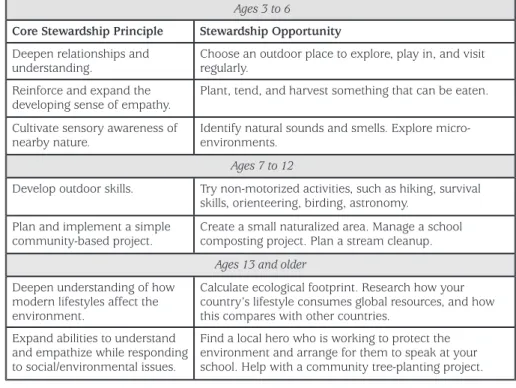
“to create a truly regenerative future . . . a holistic strategy involving commu- nity collaboration with Teacher Education” (Elliott, Dueck, & Rodenburg, 2019, p. 85) is absolutely necessary. They describe a community-wide environmental education program (“Pathways”) coordinated between Trent University’s School of Education, health and environmental sectors, parents, and a broad spectrum of community groups. The authors have developed a framework of environ- mental education principles reflecting childhood development stages and age- appropriate “Landmarks” that teachers can monitor. They devote the balance of their chapter to describing the rollout of the Pathways pilot project involving several local community schools. In addition to being exposed to the Pathways framework in their Teacher Education program, teacher candidates have the opportunity to comment on the Pathways program, and observe where feasible, participating school involvement in the program. Although in its early days, one can readily see how such a community-wide approach to ESE provides the important programmatic, philosophical, financial, and emotional support that teacher candidates and early career teachers would benefit from as they begin to infuse their classrooms with ESE. The authors emphasize that teachers are not alone in doing this important work.
In chapter six, “Research Activities of the Canadian Standing Committee on Environmental and Sustainability Education in Teacher Education,” authors Douglas D. Karrow and Patrick Howard summarize past and forecast future research activities of the Standing Committee as an ongoing case study of its activities from 2017 to the present. The chapter consists of a history of the Standing Committee’s research activities, a literature review comparing the Standing Committee’s ESE-TE research with international approaches to ESE-TE research, the identification and prioritization of the Standing Committee’s future ESE-TE research agenda, and a model for developing a research agenda among Standing Committee ESE-TE stakeholders. The authors begin by providing a his- tory of the Standing Committee from 2017 to today, highlighting specific actions that have materialized as a result of the coordinated efforts of Standing Com- mittee members, e.g., see: http://eseinfacultiesofed.ca/. In their conclusion to this first section, the authors outline the specific funding for which a Working Group of the Standing Committee has been applying in order to create a Teacher Environmental and Sustainability Consortium. The second and third sections of the chapter provide a literature review of international ESE research. As there is no comparable literature review for ESE-TE research in Canada, these sections anticipate what research gaps may exist between the field and its sub-field. The
remainder of the chapter is suggestive and anticipatory of future Standing Com- mittee research priorities. In the final section of the paper, the authors outline a model (Foster et al., 2018) for developing a consensus among Standing Com- munity stakeholders for an ESE-TE research agenda.
And finally, in the last chapter—”Wilding Teacher Education: Responding to the Cries of Nature”—Bob Jickling and Sean Blenkinsop make a powerful argument for revisioning Teacher Education and, furthermore, education as a whole. They pose two questions at the outset to frame the discussion: What will it take to nurture healers and restorers of the earth? And second, What holds us back? Their unqualified answer to these questions comes in the form of a radically different pedagogy, or “wild pedagogy” that seeks its inspiration from the vast array of teaching/learning experiences outside and beyond formal schooling. To this end they offer tentative answers to the question asked at the outset by outlining two “Teacher Education touchstones.” The first is “Learning That is Loving, Caring, and Compassionate.” To outline this touchstone, the authors consider the first-hand experience of Arne Naess, Aldo Leopald, and Rachel Carson, who each demonstrate, in contrasting ways, how early life experiences were fundamental in developing personal care, compassion, and love. Concluding their explanation of this touchstone, the authors develop an impressive list of “intertwined traits” and their educational implications for teacher educators. A thoughtful set of ensuing questions for prospective teacher educators and teachers to consider during their daily activities as pedagogues concludes the section. The second touchstone is “ Expanding the Imagination.” To develop this section, the authors explore the role of what they term “the self-limited imagination”—a “cultural constraint” making it difficult to imagine alternatives (Jickling & Blenkinsop, 2019, p. 131-132). As with the first touchstone, the authors conclude with several provocative questions for the pedagogue to consider during their daily practice. The authors conclude by arguing that a final appeal to deans of education and other leaders in the field to support “wild pedagogies” will be necessary to support teacher educators and the teachers themselves in “wilding Teacher Education.”
Acknowledgements
As guest editors of this volume of CJEE, we would like to thank several people and parties who contributed to its publication. Without their expertise, knowl- edge, skill, and financial support, the production and quality of this volume would not be what it is. The first acknowledgement is to editors Pat Maher and Blair Niblett. We are grateful that they have given us the opportunity to dedicate a volume of CJEE to ESE-TE. Doing so allows us to disseminate a vast array of research on ESE-TE, which is consistent not only with the mission of the Standing Committee but also with its strategic directions and activities to sup- port, nurture, and cultivate research on ESE-TE. This is vital to the emerging
field of ESE-TE and will ultimately help galvanize it as legitimate field of studies, particularly within Canadian faculties of education and, by extension, K–12 Education. We also thank Pat and Blair for their support and guidance throughout the editing and publication processes. Furthermore, without the dedicated efforts of our panel of ESE-TE reviewers (see Front Matter for a list of reviewers), the task of reviewing an initially large set of manuscripts in a timely fashion while maintaining the high publication standards of CJEE would have been unwieldy and ultimately delayed. As well, we wish to thank Sheila Karrow for her permission to use one of her paintings; she is an elementary school teacher on the islands of Haida Gwaii and a doctoral student in art education at the University of Victoria, BC. We chose this painting —entitled Anemone—as the image for our volume cover as it symbolizes the strong centre that we hope the ESE-TE Standing Committee will become for this work moving forward.
We would also like to thank Dr. Rebecca L. Franzen for her review of “Interna- tional Perspectives on the Theory and Practice of Environmental Education: A Reader,” edited by Dr. Giuliano Reis and Dr. Jeff Scott. We also wish to thank Dr.
Susan Docherty-Skippen who provided superb oversight and management of the project from start to finish. From receiving manuscripts, to corresponding with authors, to assisting with editing, Susan worked tirelessly, efficiently, and knowledgeably on the project while finalizing her doctoral dissertation. What’s more, none of this would have been possible without the financial support of a graduate student assistantship provided to Susan by Brock University’s Faculty of Education. Finally, we thank the Ktunaxa people, who through the St. Eugene Mission (formerly a residential school) provided a beautiful facility and location for us to hold our Research Symposium and the EECOM conference (https://
www.steugene.ca/en/about-us-culture-heritage/). We recognize the traditional territory of the Ktunaxa people, are inspired by their reverence for the land and its beings, and are receptive to their knowledge and teachings as antecedents to ESE-TE.
References
Canadian Journal of Environmental Education. (n.d.). Retrieved from: https://cjee.lakeheadu.
ca/issue/archive
Elliott, P., Dueck, C., & Rodenburg, J. (2019). Activating teacher candidates in community-wide environmental education: The pathway to stewardship and kinship project. Canadian Journal of Environmental Education, 23(1), 85-101.
Environmental and Sustainability in Teacher Education. (n.d.). Retrieved from: http://
eseinfacultiesofed.ca/practice-pages/history-ese.html
Evans, N., Stevenson, R.B., Lason, M., Ferreira, J.-A., & Davis, J. (2017). Approaches to embedding sustainability in teacher education: A synthesis of the literature. Teaching and Teacher Education, 63, 405-417.
Foster, J., Bautista, C., Ellstrom, K., Kalowes, P., Manning, J., & Pasek, T. A. (2018). Creating a research agenda and setting research priorities for clinical nurse specialists. Clinical Nurse Specialist, 21-28.
Goodson, I. (1985). Subjects for study. In I. Goodson (Ed.), Social Histories of the Secondary Curriculum: Subjects for Study (pp. 343-367). London: The Falmer Press.
Goodson, I. (1987). School subjects and curriculum change. London: The Falmer Press.
Greenwood, D. (2003). The best of both worlds: A critical pedagogy of place. Educational Researcher, 32(4), 3-12.
Hirst, P. (1974). Knowledge and the curriculum: A collection of philosophical papers. London:
Routledge and Kegan Paul.
Inwood, I., & Kennedy, A. (2019). Creating a climate of change: Professional development in environmental and sustainability education through university and school board partnerships. Canadian Journal of Environmental Education, 23(1), 68-84.
Jickling, B., & Blenkinsop, S. (2019). Wilding teacher education: Responding to the cries of nature. Canadian Journal of Environmental Education, 23 (1), 121-138.
Karrow, D., & DiGiuseppe, M. (Eds.). (2019). Environmental and sustainability education:
Canadian perspectives. Cham, Switzerland: Springer Nature AG. (327 pages). ISBN:
978-3-030-25015-7.
Karrow, D., DiGiuseppe, M., Elliott, P., Gwekwerere, Y., Inwood, H. (Eds.). (2016). Canadian perspectives on initial teacher environmental education praxis. Ottawa: Canadian Association for Teacher Education (CATE) (232 pages).
Karrow, D., & Howard, P. (2019). Research activities of the Canadian standing committee on environmental and sustainability education in teacher education. Canadian Journal of Environmental Education, 23, 100-118.
Karrow. D., & Fazio, X. (2015). Curricular critique of an environmental education policy:
Implications for practice. Brock Journal of Education. 24(2), 88-108.
McVittie, J., Webber, G., Michelle, L-A., & Miller, D. (2019). Pathways, philosophies and pedagogies: Conversations with teacher educators about place-based education. Canadian Journal of Environmental Education, 23(1), 33-49.
Palmer, J. (1998). Environmental education in the 21st century: Theory, practice, and promise. New York: Routledge.
Robertson, P., VanWynsberghe, R., & Ford, B. (2019). Sustainability learning pathways in the UBC teacher education program: Destination cohort. Canadian Journal of Environmental Education, 23(1), 50-67.
Sims, L., Asselin, M., & Falkenberg, T. (2019). Environmental and sustainability education pedagogical approaches in pre-service teacher education. Canadian Journal of Environmental Education, 23(1), 14-32.
St. Eugene: About Us, Culture, and Heritage. (n.d.). Retrieved from: https://www.steugene.ca/
en/about-us-culture-heritage/
Environmental and Sustainability Education Pedagogical Approaches in Pre-service Teacher Education
Laura Sims, Madeleine Asselin, Université de Saint-Boneiface, Canada, & Thomas Falkenberg, University of Manitoba, Canada
Abstract
This qualitative case study examines the effectiveness of environmental and sustainability education (ESE) pedagogical strategies used in two Université de Saint-Boniface pre-service teacher education Curriculum and Instruction courses.
The methods used to teach these ESE pedagogical strategies are described.
Findings from interviews with former students regarding their perspectives on the effectiveness of these strategies and how they are applying similar strategies in their teaching are presented. Findings suggest that these ESE pedagogical strategies are effective. Questions about efficacy of these strategies, the limitations of their implementation, and the study itself are reflected upon. This study contributes to Evans et al.’s (2017) call for empirical research into the effectiveness of ESE pedagogies and a critical reflection of such research by the researchers.
Résumé
La présente étude de cas qualitative examine l’efficacité des stratégies pédagogiques employées en éducation à l’environnement et au développement durable dans deux cours en enseignement et programmes d’études offerts aux étudiants en enseignement de l’Université de Saint-Boniface. L’article décrit la manière dont ces stratégies pédagogiques sont enseignées et présente les conclusions des entrevues réalisées auprès d’anciens étudiants dans le but de recueillir leurs points de vue sur l’efficacité de ces stratégies et la manière dont ils les appliquent dans leur pratique.
Selon les observations effectuées, ces stratégies pédagogiques d’éducation à l’environnement et au développement durable semblent efficaces. L’efficacité et les limites de la mise en œuvre de ces stratégies, de même que l’étude en tant que telle, font également l’objet de réflexions. La présente démarche s’inscrit à la suite des travaux d’Evans et collaborateurs (2017) sur la nécessité de mener des recherches empiriques pour évaluer l’efficacité des stratégies pédagogiques d’éducation à l’environnement et au développement durable et pour poser un regard critique sur le travail des chercheurs dans ce domaine.
Keywords: education for sustainability in faculties of education, pre-service teacher education, ESE in higher education
Mots-clés : éducation au développement durable dans les facultés d’éducation, formation des enseignants, éducation à l’environnement et au développement durable dans l’enseignement universitaire
Environmental and Sustainability Education Pedagogical Approaches in Pre-service Teacher Education
Environmental and sustainability education (ESE) emphasizes social and envi- ronmental well-being. It helps students develop knowledge, attitudes, and values so that they can become responsible, active citizens that contribute to a sustain- able future (Inwood & Jagger, 2014; O’Brien, 2016). As stated by Block, Sims and Beeman (2016), “[T]eacher education can be instrumental in developing values and practices so that teacher candidates may develop pedagogical approaches that support a transition towards sustainability (UNECE, 2012)” (p. 128). ESE is influenced by various learning traditions that share a belief in promoting a more sustainable and equitable world for all living beings on this planet, such as environmental education, sustainability education, eco-justice education, Indig- enous education, and peace education, among others (Anderson, Chiarotto, &
Comay, 2018; Karrow, DiGiuseppe, Elliot, Gwekwerere, & Inwood, 2016).
In 2017, Evans, Stevenson, Lasen, Ferreira, and Davis wrote that though sustainability may be mandated within school curricula, ESE is not a mandated component of pre-service teacher education in most countries. Their recent lit- erature review on programmatic approaches finds that:
There are four key approaches used to embed SE [sustainability education] in pre- service teacher education: (1) across whole curriculum areas, courses or an institu- tion; (2) through dedicated core/compulsory subjects; (3) a component of a core/
compulsory subject; or (4) a dedicated elective subject. (p. 411)
In terms of pedagogical strategies used to embed ESE into pre-service teacher education, Evans et al. (2017) identify: “place-based, experiential and/or inquiry methods, and modelling strategies for teaching SE that student teachers can apply in schools” (p. 412). These pedagogical strategies include: “discussion and reflection techniques . . . ; brainstorming . . . ; concept mapping . . . ; place- based outdoor experiences such as field investigations/inquiries or projects . . . ; values analysis; role plays . . . ; problem-based inquiries . . . and problem solving activities” (p. 412). Despite these programmatic and pedagogical strategies used to embed ESE in pre-service teacher education, the reviewers critically note that while “authors report the use of a diverse range of pedagogical strategies . . . they offer little or no critical reflection upon, or evaluation of, these strategies and approaches in terms of their effectiveness in developing the knowledge, skills, values and dispositions required to implement SE” (pp. 413–414). It is this particular finding that provides an important motivation for our research.
Purpose of the Study
Evans et al. (2017) identify a need for empirical research that evaluates the effectiveness of ESE pedagogical strategies used in pre-service teacher education
programs, as well as a critical reflection on this research. To address these needs, our case study examines and critically reflects on the effectiveness of various ESE pedagogical strategies used in two Curriculum and Instruction (C&I) courses in the pre-service teacher education program at the Université de St.
Boniface in Manitoba. The study’s specific research questions are: i) What are former students’ perspectives on the ESE pedagogical strategies used in these courses? and ii) What are their experiences incorporating these strategies in their classroom teaching? These research questions address Evans et al.’s (2017) effectiveness challenge. In the discussion section of this paper, we will address the critical reflection challenge that Evans et al. pose.
ESE Pedagogical Strategies Used in the Pre-service Teacher Education Program
As part of their pre-service teacher education program, study participants had taken curriculum and instruction (C&I) courses in their teachable subjects.
Some had taken the C&I Social Studies (Secondary) course (taught by Sims), while others had taken C&I Science (Elementary, Secondary) courses (taught by Asselin). In the following section, we describe the ESE pedagogical strategies that have been used in these courses for the last five years.
The C&I Social Studies (Secondary) Course
In this course, ESE pedagogical strategies are organized into two major assignments intended to model and explicitly teach these strategies to students.1 Initially, the focus is on using community-based teaching strategies: walking about the neighbourhood as well as brainstorming not only how community, environmental spaces can serve as settings for learning but also how these proposed ideas relate to curricular expectations. For the first assignment, students teach a curriculum- related lesson that integrates local community-as-classroom (Block et al., 2016;
Sims & Falkenberg, 2013). Following the lesson, all students analyze how the lesson’s activities reflect key ESE strategies as outlined by Kozak and Elliot (2011): learning locally; being integrated and making real-world connections;
considering alternative perspectives; learning inquiry-based strategies; providing opportunities to act on learning; and sharing responsibility for learning with students. We discuss how their proposed activities could be adapted to other situations. We also visit educational community-based resources/sites of their choice (e.g., Manitoba Museum) to learn about programs offered at those sites.
The second assignment focusses on engaging students in inquiry-based strategies (Chiarotto, 2011). We use strategic planning and essential questions2 (Wiggins & McTighe, 2005) to guide learning. To develop skills related to facili- tating inquiry-based learning, students are taught how to generate and refine
critical questions and then how to do research with pupils. Specifically, students must plan a curricular unit: they must propose learning-focussed activities that allow for students to explore essential questions coherently and must provide opportunities for meaningful experiences, inquiry-based activities, and oppor- tunities to act upon learning. As part of this process, students must outline how they would facilitate an inquiry-based research process that would be guided by their pupils’ questions. Throughout this process, students are invited to connect curriculum to real-world environmental and sustainability issues.
The C&I Science (Elementary and Secondary) Courses
In the C&I Science (elementary and secondary) courses, ESE pedagogical strate- gies are explicitly taught, and students are asked to practice them. Students learn to use their community and environment as a context and source for experiential learning by participating in field trips. The focus in these courses is on learning why, how, and when it is appropriate and valuable to use field trips for science learning. Experiential learning through scientific experiments is used to enhance students’ scientific literacy, curiosity, and engagement. When they are linked to an inquiry process and when real-world connections to multi- faceted science-technology-society-environment issues are made, these experi- ential learning strategies provide students with opportunities to ask questions and try to find answers in the laboratory and environment (Manitoba Education, Citizenship and Youth, 2006).
Methodology and Methods
This study used an embedded, single-case design with the two courses as the two units of analysis within the single case (Yin, 2009). A purposeful sampling procedure was used to identify study participants. To provide a broad range of perspectives, we invited former students who had taken at least one of the above-described courses within the last five years and who are now teaching in the Manitoba school system. In total, 17 former students participated. Of these, 8 had taken the Social Studies course, 6 had taken the secondary Science course, and 3 had taken the elementary science course. Of the 17 participants, 4 are teaching in their first year, 6 are teaching in their second year, 3 are teaching in their third year, 1 is teaching in their fourth year, and 3 are teaching in their fifth year. Of all participants, 3 have taught (or are currently teaching) early years (Grades K−4), 5 have taught middle years (Grades 5−9), and 10 have taught in senior years (Grades 10−12).
The participants were interviewed in French, in person or by phone, between November 2017 and February 2018, using semi-structured interviews.
Organized according to the two research questions, interview questions were tailored to the different C&I courses to explore specific ESE pedagogical
strategies: i) facilitating community-based strategies; ii) encouraging inquiry- based learning and making real-world connections; iii) applying and acting on learning; and iv) sharing responsibility for learning with students. Interviews were transcribed for later analysis.
Data analysis consisted of coding and interpretation processes (Cohen, Manion, & Morrison, 2018). Initially, data was analyzed for evidence of emergent themes. Then, each interview was coded according to these identified themes.
Larger domains of analysis were framed by the two research questions. Atlas-ti, a qualitative data analysis software program, was used to select and code data segments, create memos, and build families of codes based on the themes that emerged from the data.
Results
The results section describes research participants’ perspectives on specific ESE pedagogical strategies that are used in the C&I courses. This is followed by an exploration of the degree to which participants have applied similar strategies in their own teaching. The results are organized around dominant themes that emerged when analyzing the data. However, participants’ quotations are rich texts, often inclusive of various themes. These quotations represent majority viewpoints unless otherwise indicated. Upon participant request, real names were used unless otherwise stated. Participant quotations were translated from French by the authors.
Participants’ Perspectives on the ESE Pedagogical Strategies Used in the C&I Courses
When analyzing results, it quickly became apparent that participants were most interested in sharing their perspectives on the community-based, experiential, and inquiry-based strategies used in the courses. These experiences were the most memorable for them and the most transformative in their perceptions of possibility in their practice. Honouring their experiences, results are organized as follows: i) perspectives on learning community-based strategies; ii) perspec- tives on inquiry-based learning and making real-world connections; and iii) gen- eral recommendations for the C&I courses.
Learning community-based strategies. A major focus in the C&I Social Studies course is to experientially teach—and have students practice with each other—how to meaningfully integrate the local community into learning experi- ences. Significantly, seven of the eight participants stated that this approach was new to them, one said she learned it from her cooperating teacher (a former Social Studies C&I student), and four stated that this was the first time they had gone outside of the conventional classroom to learn.
Seven participants from the C&I Social Studies course remarked that this kind of pedagogical approach had to be lived to be conceived, that is, that they needed it modelled in order to imagine it for their teaching situations. For example:
We have to live it . . . we’re not going to know how to do it with our pupils if we just learn it theoretically. If we hadn’t actually gone outside, I never would’ve thought of doing something outside. It allowed us to think about the possibilities we have.
(Stephany)
Natasha revealed how these C&I activities taught her a theoretical and prac- tical structure for integrating her pedagogical practice with the community:
Learning how to teach in the community helped me understand how young people can relate/build relationship with people in the community, either people coming into the classroom or kids going to the community. . . . You just have to show kids how to do it. Without this course, I wouldn’t have known how to do it. (Natasha)
Six participants stated that this enlarged, or transformed, their concept of what “teaching” means. For instance:
I discovered the possibility and importance of getting outside the classroom . . . it was very interesting, engaging. The projects made me realize that there are different possible approaches with which one can play. . . . The course enabled us to get out of the classical vision with which we’ve been taught. . . . It’s a method you have to learn, for which you have to have some permission to practice. . . . It gives us the courage to try, it opens our eyes to what is possible: we must see an example to follow it. (Meghan)
Interestingly, this sentiment of needing courage or permission to teach in this non-conventional way was echoed by five of the seventeen participants.
With respect to learning how to use community-as-classroom, all eight par- ticipants from the C&I Social Studies course stated that having this strategy modelled and then creating and experiencing others’ activities enabled them to learn, or deepen, their understanding of this concept. Imagining how to adapt these activities for different contexts and levels was useful for many partici- pants. Learning the appropriate administrative steps to take pupils outside (e.g., the permission process needed to leave school grounds) was identified by one participant as useful.
In the C&I Science courses, as in C&I Social Studies, field trips to educational sites (e.g., FortWhyte Alive, St. Boniface Hospital Biolab) are used to learn how these kinds of resources could be employed to enrich and often contextualize students’ teaching of (scientific) concepts. All nine participants from the C&I Science courses stated that visiting these sites and experiencing the program- ming offered made it easier to use these resources and others like them in their teaching. For example:
We visited FortWhyte, I saw everything that they offered. It’s easier as a teacher afterwards because you’re already familiar with the site and programs, you take fewer risks. (Annick)
Overall, all participants from the C&I Science courses felt it was valuable to see examples of what a field trip might be for different subject areas. One participant commented on the value of experiencing what their pupils would experience. All seventeen participants highlighted these field trips and commu- nity experiences as very memorable and engaging.
Inviting guest speakers is another way to integrate the community into classrooms. Examples of what this might look like when teaching Social Studies and Science are explored in the C&I courses. Certainly, participants would have experienced this through previous education courses, notably when discussing sensitive and complex issues in courses (e.g., colonization and its impacts, LGBTQ issues). In having been exposed to alternative, authentic, informed perspectives, participants, particularly those teaching middle and senior years, commented that they learned the value of, and need for, hearing various perspectives when facing complex issues. They recognized that providing similar opportunities was important for developing critical thinking skills in their pupils.
Inquiry-based learning and making real-world connections. In the C&I Social Studies course, teaching inquiry-based strategies focus on developing critical thinking and research skills and are accompanied by learning to plan, guided by curricular outcomes as framed by essential questions.
Participants said that learning how to explore topics in this broad, integrated way was valuable as it helped them be more organized in facilitating learning that was guided by pupils’ questions. For example:
The C&I course made me better at grouping things together, organizing objectives into different steps. . . . The project we did led me to understand that it’s not just the teacher giving material and pupils creating something from it, but rather getting pupils to look for their own answers. We must be facilitators as much as teachers. (Rachèle)
All participants, to different degrees, recognized that providing opportuni- ties for inquiry-based activities engaged their pupils meaningfully in the learning process. Participants commented that bringing in a Social Studies teacher “from the trenches” to share how she facilitates an inquiry process with her pupils was worthwhile.
In the C&I Social Studies course, part of sharing the responsibility for learning involves students taking leadership roles, teaching each other, and sharing resources. A key aspect of this inquiry-based, focussed planning assignment is having students share and analyze each others’ proposed plans.
In the C&I Science courses, Asselin approaches the inquiry process in a few ways. First, at a broad level, in the secondary-level course, she discusses how to integrate research on science-technology-society-environment issues into students’ teaching. For example, she explores with the students the importance
of developing a scientific culture with their pupils, so that one day, as citizens, the pupils can make informed decisions about various subjects. Asselin suggests age-appropriate ways to guide learning so that pupils can ask critical questions and explore research topics related to pressing socio-scientific issues, such as climate change, environmental conservation, and health. When queried, all of the participants in the C&I Science courses recommended that she continue conceptualizing science learning within broader societal issues as they found this to be an important part of their learning experience. Of the seventeen participants, four commented that, time permitting, the learning of this concept could be further enriched if students were to receive even more concrete examples and if they were to be given a course assignment based on it.
Second, doing experiential learning activities (e.g., experiments, dissec- tions, demonstrations) in the courses shows students how hands-on activities can help their pupils’ understanding of scientific concepts and can contribute to scientific curiosity. All participants from the C&I Science courses commented that they found it very useful to plan, prepare, and share an experiment with their class colleagues as it made them more confident and gave them practical ideas and resources that they now use in their teaching. For instance:
Having to prepare an experiment . . . seeing that I’m able to do research, finding some- thing that works . . . that was encouraging. I think that actually experiencing/living the demonstrations, others’ experiments, reinforces the value of experiments. (Jaclyn)
General recommendations for the C&I courses. General recommendations by participants were to continue teaching in this aforementioned way and to make sure to: i) explicitly stress the importance of ESE, reminding students that we educate within the larger context of creating responsible citizens; ii) give many practical examples and resources; and iii) explore how to adapt these strategies for different age groups and environments (urban, rural).
Overall, all seventeen participants found that the ESE pedagogical strate- gies taught in the C&I courses have been worthwhile for them. In what follows, examples of how these former C&I students are integrating these ESE strategies into their teaching practices are shared.
Participants’ Experiences Incorporating These ESE Pedagogical Strategies Within Their Teaching
When participants were queried as to how they are using these ESE pedagogical strategies in their teaching practices, their examples show that they are inte- grating these strategies in various ways. Reflecting themes that emerged during data analysis, results are organized as follows: i) examples of community-based learning, providing opportunities to act; ii) facilitating experiential, inquiry- based learning; iii) importance of relationships; iv) sharing the responsibility of
learning with pupils; and v) constraints or challenges to integrating ESE peda- gogical strategies.
Community-based learning, providing opportunities to act. Participants are using their local natural and built environment and community as learning contexts in various ways in Social Studies, Science, and other classes.
All participants shared how they take pupils outside to learn. Examples of participants using specific locations and events to explore topics include:
Social Studies (high school):
• Walking to school division’s outdoor classroom, settling into the tipi, making a fire, preparing bannock. “The pupils loved it! They saw a real tipi after learning in class how to build one” (Meghan).
• Going to St. Boniface archives to study primary sources.
• Going to Brookside Military Cemetery where “we were greeted by five vet- erans. . . . The kids wanted to continue talking to them, it was concrete, human” (Meghan).
Science:
• Going to Planetarium, Science Gallery. “The kids were so invested. We’ve lots of newcomers, it’s so amazing to see their faces, kids who’ve never done something like that before” (Janelle; Grade 2).
• Retrieving samples for testing from the outdoors. “At Oak Hammock Marsh we took water samples to see the different organisms. . . . In the lab, we did lots of tests: pH, oxygen content . . . : it was really cool. In the afternoon, we snowshoed/hiked to observe different animal tracks” (Kelsey; Grade 10 Ecology).
Math (high school):
• Visiting FortWhyte to measure trees using trigonometry.
• Creative planning. Stephen plans to create an escape room to promote crit- ical thinking, group work.
Work-life (high school):
• Going to the mall to explore different jobs: “each place welcomed us with open arms . . . the pupils really enjoyed it” (Phil).
Media Studies (high school):
• In Stephany’s class, walking around their Francophone town to look at types of advertising, languages used (English/French). In December, going to Operation Red Nose (bilingual) press conference before beginning a journalism unit.
Some former students undertake activities outside, where the environ- ment (soil, snow, river) becomes part of the learning experience. (See examples
below.) Others participate in activities that otherwise they could do inside a conventional classroom (e.g., play language games).
• Going outside to create art with what could be found in nature (Danya; Grade 6).
• Planting the three sisters (squash, corn, beans); comparing Indigenous agri- cultural systems with imported European ones.
Outside, getting kids to work the soil, for some it’s a first . . . some are totally disconnected from nature. . . . Seeing this ancient practice, better in terms of respecting the earth, is something that I find important; . . . kids need to practice what they’re learning, it’s the best way to learn, it makes teaching more interesting. (Meghan; History 11)
• Walking along the Seine River, observing flora and fauna, appreciating nature, studying ecology (Phil; Science).
For participants, the benefits of learning in and from the community and the environment are numerous. These include pupils being able to live and wit- ness concepts in environments where they genuinely occur, which pupils find engaging. As one participant noted:
Getting out of the classroom is more inspiring, it’s better for creativity. Outings allow us to see unknown facets of some young people, sometimes who might be a little difficult in class, they give you a chance to create a bond that would be impossible to make in class. (Annick)
Their numerous examples, of which only a sample could be included here, show how these experiential, community-based strategies are transferable to teaching all sorts of things. Their words attest that community members are willing and even enthusiastic to participate in the learning process.
All participants invite community members to speak to their pupils. In their interviews, they explained how these guests allow for broader discussions to occur, exposing pupils to alternative perspectives. For example:
Inviting people from the community . . . was always something special. Normally they arrived with tools of their trade . . . the paramedic arrived with his ambulance bag-of-things, the young people get on board very quickly. (Phil)
The role of the community is also evident when it comes to pupils being able to act upon their learning, an important part of ESE. Occasions for pupils to act upon their learning often, if not always, occur in human or natural environ- ments; examples of these include: trying to influence their school community itself (e.g., awareness-raising campaigns around recycling or bullying) or trying to contribute with the more general public (e.g., community improvement ini- tiatives, fundraising for disaster relief). One participant identified this step to act-on-learning as challenging.
The authenticity of learning in and from the community can be used to influence pupils’ sense of identity and agency. Many participants noted that a fundamental part of learning in and from the community is relationships.
Meghan, Natasha, Rachèle, and Stephany all talked about how living mean- ingful experiences in a French community helps pupils—both immersion and Francophone by birth—develop a Francophone cultural identity and a sense of belonging. These experiences include volunteering with recently-arrived Francophone refugees, participating in the Francophone improvisation league, participating in the Conseil Jeunesse Provincial, and writing letters in French to municipalities and organizations. This building of relationships, and how it contributes to the development of a francophone cultural identity and a sense of belonging, are key factors for ensuring the longer-term viability of our minority Manitoban Francophone community.
Facilitating experiential, inquiry-based learning. For teaching con- cepts at all levels, all participants from C&I Science courses use experiential and hands-on activities, such as experiments, dissections, and technological problem-solving (design process).3 They notice that these pedagogical strate- gies help their pupils better understand concepts and enhance their scientific curiosity. They also observe how highly motivating these strategies are. One participant, who is now teaching middle years, talked about how she links brain development with adolescent well-being, a prevalent concern for her. Activities include doing a brain dissection with Biolab, building a model brain for their classroom, and doing workshops on anxiety (facilitated by the guidance coun- sellor). Other examples of applying experiential strategies to Science teaching include: hypothesizing and experimenting if air takes up space (Janelle; early years); exploring a unit on optics by using mirrors, light, colours, and by doing an eye dissection (Melissa; middle years); doing experiments on the five types of chemical reactions (Kelsey; senior years).
Relating science issues to society, many participants—particularly those teaching at middle and senior years—explicitly discuss ethical concerns pertaining to science with their pupils. For example, one participant does debates on bioge- netics, organ transplants, and other ethical issues with her biology class. Miguel, a high school teacher, discusses questions about “designer babies” in genetics;
when discussing ecosystems, he talks about ethical and human implications of climate change, exploring what we can and should do to help those affected.
In their Social Studies and Language classes, many participants use age- appropriate simulation games, role-playing and debates to explore multiple per- spectives on, and impacts of, historical events, topics, and current issues. These activities are experiential and provide opportunities for pupils to explore topics about which they are interested. Examples participants gave included: engaging in role-plays where pupils choose a stakeholder or affected group, research that perspective, and argue and present it; doing activities such as Kairos’
blanket exercise, which presents Canadian colonial history from Indigenous
perspectives; and debating controversial real-world issues chosen by the pupils.
Participants do research projects for which their pupils choose topics, create guiding questions, research these questions, and share their findings.
Importance of relationships. A fundamental underlying aspect that emerged during initial interviews was the importance of establishing healthy relation- ships to integrate these ESE pedagogical strategies and topics in a meaningful way. As is true with university-level learning contexts, participants stated that good, respectful relationships between teachers and pupils, and among pupils, help create healthy, safe, positive learning environments. Within these envi- ronments, diverse perspectives are more likely to be shared, which in turn enriches discussions and deepens understanding about complex issues. Three participants explained how good relationships with pupils enable teachers to tailor learning to meet pupils’ needs and interests. Natasha said: “Without a relationship of trust, learning won’t go far. We need to know our young people’s interests to be able to get them involved.” These three participants were not alone in feeling that fostering good relationships helps to provide meaningful learning experiences for pupils. Positive relationships with people and places in community help facilitate collaborations and, as Rachèle and Meghan noted, are more likely to result in getting their pupils to care about issues: “how can you feel concerned about something if you’ve no connection with it?” (Rachèle)
Sharing the responsibility of learning with pupils. Participants often share the responsibility of learning with their pupils. This sharing of responsibility is manifest in many ways depending on grade level and subject area. For co- constructing curriculum, nine participants provided examples where pupils have voice as to the topics to be explored. As for evaluation, seven participants shared, through discussion with their pupils, how they determine evaluation cri- teria, course content, forms of representation, and assignment due dates. Five participants explained how they create class rules and decide on classroom- management strategies together with their pupils.
Overall, participants communicated that when they teach in this sharing- responsibility way, their pupils are more engaged and more motivated to learn, resulting in a positive learning environment with fewer classroom-management problems. They remarked that this sharing of decision-making often makes pupils feel more responsible for their learning.
Constraints or challenges to integrating ESE pedagogical strategies.
Not surprisingly, participants identified challenges that inhibit teaching in the aforementioned ways. These include logistical constraints (e.g., lack of time, finances, transportation, supervision, cumbersome administrative process) and limited access to certain resources and opportunities (e.g., lab equipment, supplies; French-language programming at educational sites).
Contextual challenges include physical proximity to sites, resources, and teaching in an unsupportive climate (e.g., resistance from parents and/or