« C’EST CE QUE JE VOUS DIS » :
ESSAIS SUR L’ANALYSE ÉCONOMIQUE DE LA COMMUNICATION INTERPERSONNELLE
THÈSE PRÉSENTÉE
COMME EXIGENCE PARTIELLE DU DOCTORAT EN ÉCONOMIQUE
PAR ELI SPIEGELMAN
AOÛT 2012
“IT’S LIKE I TOLD YOU”:
ESSAYS ON THE ECONOMIC ANALYSIS OF INTERPERSONAL COMMUNICATION
DISSERTATION
PRESENTED IN PARTIAL REQUIREMENT FOR THE DEGREE OF
DOCTORATE IN ECONOMICS
BY
ELI SPIEGELMAN
AUGUST 2012
To Prisca
I gratefully acknowledge the guidance, encouragement and support of my supervisor, Claude Fluet. Many improvements to the work presented here are also due to Raúl López-Pérez, whose opinions and insight extend well beyond the chapter that bears his name. Discussions with Charles Bellemare, Matthieu Chemin, Sabine Kröger, Stephane Pallage, Christian Traxler and members of several conferences have also helped clarify ideas. Jacob Goeree and two anonymous reviewers gave useful insight on Chapter II. Especially helpful were the comments from the members of the defense jury: Bruno Deffains, Claude Fluet, Sean Horan and Pierre Laserre. I thank Vanier College for its policies which allowed me to take time off work to pursue professional development – but keep the office in the meanwhile. The VCTA’s generous provision of the staff lounge with fair trade coffee has been instrumental in achieving this work. I also benefitted from financial and material support from CIRPÉE, the latter including statistical software used in the thesis. I have been blessed with three generations of amazing family support: my children, who, mostly uncomplaining, saw so little of me (and piloted the experiment in chapter 2); my parents, in whose reflection I judge all my ideas, even on the rare occasions where we disagree; and my wife, touchstone for what is truly valuable, always ready to meet theory with good sense, who bore the weight of the project in equal measure to myself, and carried it forward with me. Thank you.
LISTE DES FIGURES ... VII LISTE DES TABLEAUX ... VIII RÉSUMÉ ... IX PROLEGOMENON
NORMATIVE INCENTIVES IN ECONOMIC CHOICE: A GENETIC
TAXONOMY ... 1
0.1 Introduction... 1
0.2 Axis I: The moments of an interaction ... 4
0.3 Axis 2: Intrinsic versus extrinsic ... 17
0.4 Conclusion ... 18
CHAPITRE I PRIDE, PREJUDICE, AND THE CREDIBILITY OF CHEAP TALK: THEORY AND EXPERIMENTAL EVIDENCE. ... 27
1.1 Introduction... 28
1.2 Previous Literature... 33
1.3 Model ... 40
1.4 A discrete version of the model. ... 51
1.5 Experimental Procedures ... 66
1.6 Data and results... 73
1.7 Conclusion ... 82
ANNEXE A IDIOSYNCRATIC K ... 89
ANNEXE B MONKEY IMAGE SELECTION ... 91
CHAPITRE II WHY DO PEOPLE TELL THE TRUTH? EXPERIMENTAL EVIDENCE FOR PURE LIE AVERSION ... 94
2.1 Introduction... 95
2.2 Related literature ... 98
2.3 Act-Based Guilt-Aversion ... 106
2.4 Experimental Design and Procedures ... 108
2.5 Results ... 114
2.6 Conclusion ... 121
ANNEXE C EXPERIMENTAL INSTRUCTIONS ... 127
ANNEXE D EXAMPLE EQUILIBRIUM ... 130
CHAPITRE III THE BLIND AND THE BLINKERED: WHEN SELF-DECEPTION FRAMES MORAL CHOICE ... 132
3.1 Introduction... 133
3.2 A model framework ... 137
3.3 The Entrant ... 153
3.4 Discussion and extensions ... 165
ANNEXE E SELECTED PROOFS ... 170
Figure page
1.1 Type t deviates from the equilibrium to send message m. ... 48
1.2 Message m different from true group affiliation i. ... 60
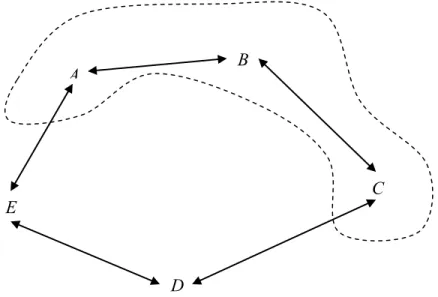
1.3 Diagram of the discrete case ... 63
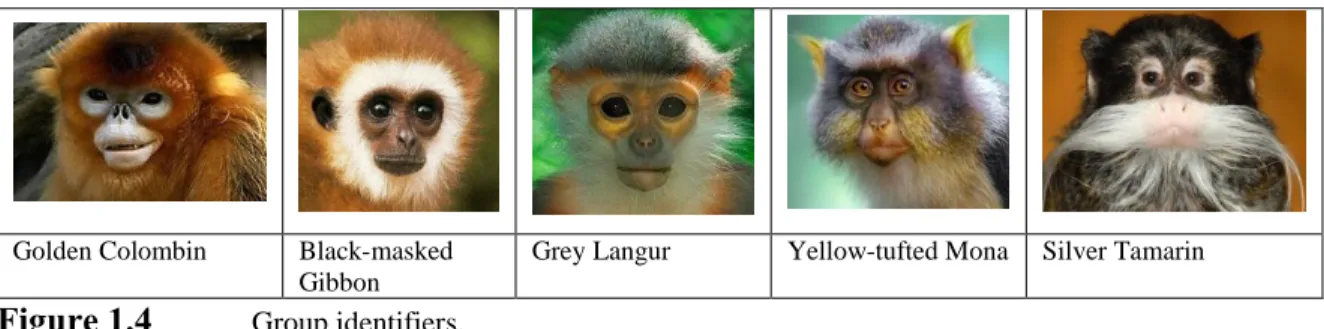
1.4 Group identifiers. ... 71
2.1 Beliefs on choosing each message after the blue signal ... 117
3.1 Timing of the game. ... 141
3.2 Separating function as changes. ... 148
3.3 Illustration of “bunching.” ... 150
3.4 The locus of max. ... 158
3.5 Strategies in m versus e ... 161
Table Page
0.1 Normative incentives in the taxonomy ... 18
1.1 Example payoff bi-matrix ... 62
1.2 Demographics of the sample ... 69
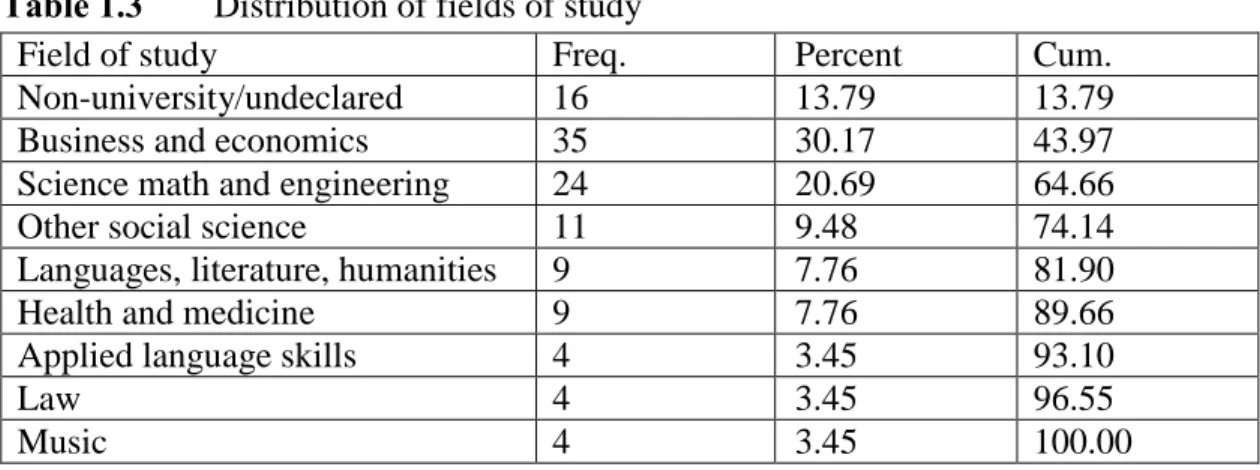
1.3 Distribution of fields of study ... 70
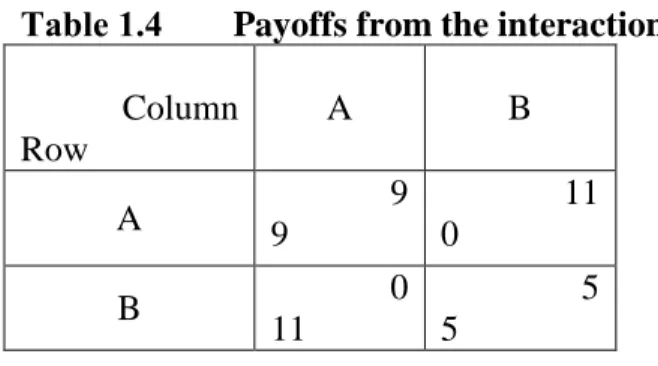
1.4 Payoffs from the interaction. ... 72
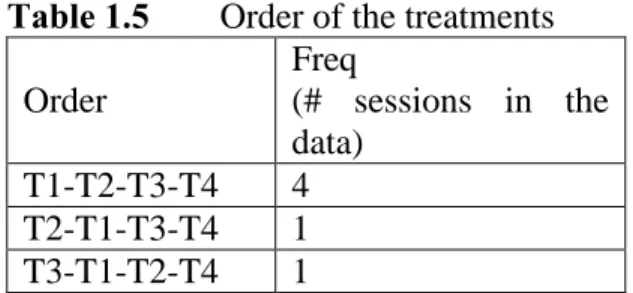
1.5 Order of the treatments ... 73
1.6 Pooled results for cooperation as a function of neighbor status. ... 74
1.7 In-group cooperation rates in each treatment. ... 75
1.9 Probit regression results ... 78
1.10 Lie rates across the message rounds ... 80
1.11 Lie rates by move order and first-movers team match ... 82
2.1 Percentage of choice of each strategy in each treatment ... 114
2.2 Average beliefs about deception in each treatment ... 115
2.3 Summary statistics on second-order beliefs, by strategy ... 116
2.4 Average beliefs, conditional on history of play ... 120
3.1 Summary of the main results ... 166
Les trois chapitres principaux de cette thèse ont pour point commun l’analyse économique de la communication interpersonnelle en tant que choix sous contrainte.
Or, comme on dit, talk is cheap. Pourtant, les trois chapitres élaborent trois contraintes différentes qui pourraient s’imposer à la communication interpersonnelle.
Dans le premier chapitre, la contrainte est de nature stratégique : en équilibre, les communications différentes suscitent des réactions différentes chez les interlocuteurs. Donc les individus choisissent leur communication en fonction de la réaction qu’ils espèrent susciter. Dans le deuxième chapitre, la contrainte est plus intrinsèque. On y recherche de manière expérimentale dans quelle mesure les gens se contraignent à dire la vérité pour la vérité. Dans le troisième chapitre, la contrainte est encore différente car elle est due cette fois au fait que le communicateur n’a pas pour but de communiquer quoi que ce soit. Il veut, en fait, se donner une idée faussée du sujet. Ainsi, un interlocuteur qui essaierait d’apprendre de la communication doit tenir en comte ces distorsions éventuelles, qui deviennent une contrainte sur la transmission de l’information.
Les trois chapitres s’inscrivent dans un courant d’économie comportementale.
Cette mouvance essaie d’ouvrir un peu la « boîte noire » des préférences, en soulevant des questions sur les facteurs qui motivent les choix réels. Ces questions sont dangereuses car elles risquent de supposer ce qu’il fallait démontrer, en réduisant l’explication d’un comportement à la simple volonté de le faire. Pour éviter ce piège, il faut se pencher sur une vision des motivations qu’on croit raisonnables avant de travailler sur les comportements spécifiques. Les prolégomènes de la thèse bâtissent donc un cadre d’analyse qui cherche à soutenir une réflexion précise sur la nature du comportement social qu’on essaie d’interpréter. Ce cadre est appliqué par la suite dans l’élaboration des modèles dans les trois chapitres.
Mots-clés : incitations normatives; communication; jeux; comportement; honnêteté
The three main chapters of this thesis share the common characteristic that each analyses interpersonal communication as an economic act; that is, as a problem of constrained choice. This raises an immediate problem: if, as they say, talk is cheap, what can the constraints on communication be? The three chapters develop three different kinds of constraint. In the first chapter, the constraint is strategic: in equilibrium, different communications elicit different reactions from the people who receive them. Thus, individuals choose their communication based on the reaction that they hope to elicit. In the second chapter, the constraint is more intrinsic. This paper studies the extent to which people constrain themselves to speak the truth for the truth’s sake. The paper describes an experiment that drains a communicative act of nearly all its significance save truth value, and asks subjects to forego monetary gain to preserve their truthfulness. In the third chapter, the constraint is again different, due in this case to the fact that the communicator’s goal is not actually to transmit information, but rather to distort her own idea of the truth. Thus, the interlocutor must try to disentangle the speaker’s self-deception from the unobservable truth she may have seen. This becomes a constraint on the extent to which information passes between the two individuals.
The three chapters fall into the domain of behavioral economics, construed widely as an attempt to open up somewhat the “black box” of economic preferences, by raising questions about what factors motivate actual choice. These questions can be dangerous, as they risk begging their own question, “explaining” behavior by assuming a preference to engage in it. To avoid this trap, it is important to give some attention to a vision of what might constitute reasonable motivations generally, before working on specific behaviors. The prolegomenon of the thesis outlines a conceptual framework to support more precise reflection on the nature of the social behavior under study. This framework provides a structure which is then applied in the elaboration of the models within the three chapters proper.
Keywords: normative incentives; honesty; communication; behavior; games
NORMATIVE INCENTIVES IN ECONOMIC CHOICE: A GENETIC
TAXONOMY1
Abstract: This essay introduces the concept of a normative incentive, a component of the economic choice process that explicitly reflects what people feel they “should”, as opposed to what they “want to” do. It elaborates an analytic framework for normative incentives based on two dimensions of categorization, and illustrates how important normative concepts such as reciprocity and morality seem to cut across the categories defined, suggesting that they may not be monolithic phenomena.
Résumé: Ce papier développe une taxonomie des « motivations normatives ».
Il propose que les individus fassent un arbitrage entre les coûts et avantages habituellement pris en compte dans le modèle de l’homo economicus et leurs motivations normatives. Celles-ci renvoient à ce que l’individu « pense qu’il devrait faire » par opposition ce qu’il « aurait envie de faire ». La taxonomie proposée est bidimensionnelle. Le premier axe fait référence aux intentions, aux actions ou aux conséquences; le second à la distinction entre motivations intrinsèques et extrinsèques, selon que le sentiment qui les soutient est la culpabilité ou la crainte de la désapprobation sociale. On montre que la plupart des modèles de motivations informelles peuvent être décrits par cette taxonomie.
0.1 Introduction
Economics has a famously impoverished view of human nature. Just what makes the science seem so thoroughly dismal may be the view it takes of the human objects of
1 This essay is an expanded form of Spiegelman (2011).
its investigations: the notorious Homo economicus2. In its most primal version, this strange species is portrayed as something of a comic book supervillain: the brilliant sociopath, with infinite intellectual capacity aimed only at satisfaction of his own desires3. In both aspects (limitless capacity and selfish intent), the caricature is, obviously, not just an illegitimate portrait of human experience, but also an unnecessarily simplistic interpretation of the theory that bore it. Justifications of the model have evolved from Mill’s (1874) restrictive argument that economic analysis is limited to domains where people are (a) mostly selfish and (b) capable of determining the optimal way to go about their business. The more current generalizing formulation, as expressed by Friedman (1966), is that (a) the agent’s “own desires”
can be taken to include whatever richer aspects of human nature the modeler – or more importantly, the economic actor in question – deems relevant, and (b) as long as people behave “as if” they maximized an objective function, it does not matter (to the theory) whether they are actually capable of doing so. It is therefore argued that what the H. economicus model provides is not content describing individual behavior, but rather an abstract framework for analysis.
To be at all useful in organizing discussion of social phenomena, the framework must be dressed in content. For instance, it is generally assumed that people prefer more consumption of marketable goods to less, ceteris paribus; that they dislike effort; and that future costs and benefits are discounted. It is often also assumed that risky prospects are evaluated differently from sure ones, for given material outcomes.
These elements of the content of preferences are probably justified on the grounds of their apparent universal relevance; they are considered to hold nearly as generally as the preference relation itself, though in a less “analogical” fashion. But another
2 Persky (1995) has noted that from its inception, this term has been one of criticism. It was apparently originally coined to differentiate the agents of John Stuart Mill’s (1836) economic analysis from actual human beings.
3 No accident, perhaps, that Oskar Morgenstern (1935) illustrates what we would today call an anti- coordination game with Dr Moriarty following Sherlock Holmes on the train to Dover!
common feature of the “standard” content of preferences emerges: it conforms curiously well to the Homo economicus carticature! Due, I believe, to the history of the exclusionary interpretation of H. econ., many economists would agree to a statement along the lines “we are on safer ground assuming that people are basically self-interested than assuming the contrary.” Fortunately, this (undeniably dismal) position is often patently false. Perhaps as universal as labor disutility are, for example, the tendency to seek distinction (a desire for rank, rather than level, of benefit), the tendency for reciprocity (a desire to respond to others in kind to their behavior), the tendency for altruism (a desire to help others) and the tendency for rule-following (a desire to do the “right” thing). Each of these tendencies has been the subject of a long and deep literature in economics, and it would be beyond the scope of any paper to survey them all. Rather, my point in this essay is to provide a rough taxonomy of the motivations that serve as the mechanisms by which these tendencies arise. The four tendencies above can perhaps be compared to the phenotype of social behavior, based on a “genetic code” of underlying mechanisms. Thus two instances of reciprocity, for instance, may be based on quite different choice mechanisms.
Conversely, there may be some underlying similarity of mechanism in the source of several different “phenotypic” regularities listed. My goal is to provide a classification for the “genetic building blocks of” types of mechanisms, which I call normative incentives. The specific variety of mechanism that operates in a specific instance is important because it may determine the empirical predictions the model generates. If so, it will be of significance for testing the theories, as several examples will show.
The point of departure is a basic proposition: When human actors are aware that their decisions are inter-related with those of other human actors, they trade material costs and benefits off against normative incentives. In this context, a normative incentive is a component of the choice process that makes a certain choice more appealing from a moral, personal or socially constructed perspective. If, in the
standard heuristic, human nature is to calculate and carry out the lowest-cost method of getting what you want, then in modest contrast the heuristic of normative incentives describes people factoring what they feel they should do into the equation.
The proposition that normative incentives are somehow primed by the awareness of the decision-makers that their choices interact with those of other human beings receives substantial support from the empirical literature on social distance, which attempts to experimentally manipulate the degree of this awareness (Leonard 1968; Charness, Haruvy et al. 2001; Dufwenberg and Muren 2006; Rankin 2006; Ahmed 2007; Charness and Gneezy 2008; Hoffman, McCabe et al. 2008;
Fiedler, Haruvy et al. 2011). It also implies that the appropriate theoretical construct for their analysis will usually take the form of a game of some kind, with the normative incentives providing some structure to specify the payoffs. The structure is chosen to represent social context effects in the interaction. These contextual effects are the “genes” in the biological analogy above, which combine into the unique DNA of a particular interaction. In the following, I propose a framework of sub-categories based on two aspects, or “axes” of the situation: first, the kind of social object to which they apply – intentions, actions or outcomes – and second, the social nature of the incentive – extrinsic versus intrinsic. These classifications correspond to ideas that have emerged in various places in the literature. As I go, I will illustrate the classification with references to some of the major work.
0.2 Axis I: The moments of an interaction
Analysis of the social object to which normative incentives are attached has focused generally on three chronological “moments,” or phases, of an interaction. In the first phase, prior to the interaction, the individuals in the interaction all have various intentions. The second phase commences once the interaction has begun. Some individuals act (through choices the make), and those actions constitute the second phase of the interaction. The third phase is the outcome for each individual, which is
produced by the choices made by all the acting individuals coming together. Each phase may be the object of a normative incentive, and together they represent the first axis of variation I will consider. I will say that normative incentives may be outcome- based, action-based or intention-based.
Let us begin with the end: the outcome. Rationality in economics is often characterized as instrumental in the sense that decisions are made so as to guide the actor towards some preferred end. This is certainly the case for H. economicus, for instance, who cares only for his own material ends. In general, however, the ends that the actor seeks need be neither material, nor his own. The simplest manner in which normative incentives might enter into consideration of the outcome of an interaction is what has been termed “benevolence”, formalised in economic models as long ago as Edgeworth (1880). For instance, suppose two players, i and j, (denoted by subscripts) are interacting. The utility of a benevolent player i might be represented as
i i j
U x a x
where x is the material payoff and a is the altruism term showing the strength of the benevolence. Ordinarily, one assumes that a < 1 (otherwise i would give all his money to j). Notice also that if a < 0, then i can be interpreted as being “spiteful” to j.4 This utility formulation means that i's preferences over any two values of xi will generally depend on the vector x = (xi, xj). Whether i prefers outcome vector x or outcome y depends, perhaps crucially, on how much j gets from the deal. Notice that this does not give one any grounds to assume that i would not behave as a Homo
4 Throughout, the “natural language” labels I give to various incentives will be, necessarily, as vague as the concepts behind them. Indeed, one finds that in the (economics) literature, the same incentive is often labeled differently in different papers, and different incentives often receive the same label. But these differences are semantic, not essential. As long as the meaning behind the term is clear, the disconcerted reader may, with apologies to Wittgenstein, substitute “bububu” for any term which seems misused.
economicus with regards to the function U. However, it does supply more descriptive structure for how people might make decisions in real situations.
Benevolence does not exhaust the possibilities for outcome-based normative incentives. Martin Dufwenberg and co-authors (Dufwenberg and Kirchsteiger 2004;
Battigalli and Dufwenberg 2007; Battigalli and Dufwenberg 2009) adapt the basic motivation into an outcome-based model of guilt, in which people care about the material payoffs of those with whom they interact only to the extent that they think those others are disappointed5. These are special cases of reference-dependent utility, since the perceived subjective benefit of a given payoff depends on how it is
“framed” by the second-order expectations. Such guilt aversion can perhaps be considered to approximate moral codes of appropriate conduct regarding other people. Another model of outcome-based moral behavior is that of Deffains and Fluet (2009), in which the moral code of “do no harm” only restricts the behavior or intentions of the actors inasmuch as these influence the probability of the harmful result.
Models of inequity aversion (Bolton and Ockenfels 2000; Fehr, Klein et al.
2001; Demougin and Fluet 2003)offer the related insight that often what people care about is not (only) the levels of the payoff they receive, but also their relative payoff, compared to other players. More generally, rank-based or positional utility (Frank 1985; Clark and Oswald 1998) suggests that individuals care about their standing overall among a potentially large group. Numerous laboratory tests of this kind of preference confirm the effect. Frank (ibid.) also adduces empirical field data to support this claim, suggesting that this positional utility accounts for shallower pay scales than would be otherwise predicted in many industries, as those low in the pay
5 The payoff that player i thinks player j expected to receive is called i’s “second-order expectation”
for j’s payoff. Of course, one could also define third- fourth- or any higher order of expectation, and indeed these are implicit in Nash equilibria. The difference in models of guilt is that these expectations enter explicitly into the utility function.
scale are “compensated” for their position, and those high in the pay scale “pay for the privilege” with lower material wages. It has also been noted since Keynes (1936) that this kind of comparison-based utility can lead to “arms races” in which people overexert themselves in order to “keep up with the Joneses.” This, of course, was one of Veblen’s (1899) main insights.
Notice that when the motive is “keeping up with the Jonses,” the payoff is no longer material. As Veblen says (p. 75)
…it is only when taken in a sense far removed from its naïve meaning that consumption of goods can be said to afford the incentive from which accumulation invariably proceeds. The motive that lies at the root of accumulation is emulation… The possession of wealth confers honor.
The implication of the argument is that the institution of property itself is primarily founded on normative, rather than purely instrumental, preferences. Once again, this is pedigree economics. Alfred Marshall (1994, p. 73) remarks with Nassau Senior that
Strong as is the desire for [goods consumption], it is weak compared with the desire for distinction: a feeling which if I consider its universality, and its constancy, that it affects all men and at all times, that it comes with us from the cradle and never leaves us till I go into the grave, may be pronounced to be the most powerful of human passions.
Gary Becker (1974) included preferences for the good opinion of one’s peers into a formal economic model. Schelling (1974), working in a sociological framework more ideologically amenable to the idea, also proposed an alternate conception of social influence. Akerlof (1980), Bernheim (1994) and more recently Bénabou and Tirole (2006), and Deffains and Fluet (2007) have formulated
asymmetric information models in which the reputation attendant on a certain choice is an endogenous feature. Such models are based on the different equilibrium actions of individuals with different, unobservable characteristics. Individuals tend to “shade”
their actions to resemble those of people with more favorable characteristics. An interesting wrinkle on these reputational models can be found in the work on self- esteem by Bénabou and Tirole (2010) and self-signaling by Botond Koszegi (2006).
In these models one meets the surprisingly intuitive idea that people don’t have perfect access to their own character. As a result, they make their choices partly in order to give themselves evidence that they have some favorable characteristics.
Notice that actions motivated by this “taste for reputation” are conceptually distinct from the usual “signaling” models (Spence 1973). In signalling models, the reputation is purely instrumental, whereas here, as Veblen points out, it represents a kind of “consumption” utility all its own.
In summary, “genotypically” outcome-based normative incentives can produce the “phenotypes” of altruism, reciprocity, moral rule-following or distinction. The outcomes of interactions that appear to exhibit these phenotypes can either be material payoffs or beliefs. Among outcome-relevant beliefs, we distinguish between posterior beliefs that are part of the outcome itself, and prior beliefs which serve to frame the evaluation of the outcome which eventually occurs. The uniting feature of all outcome-based normative incentives is that they are consequentialist in a strong sense that the process by which a result occurs does not directly matter to the evaluation it receives. It may indirectly matter, as when a person can generate different reputational effects by achieving the same material result in different ways.
But all different procedures which generate the same reputational result will, ipso facto, be evaluated as equivalent by a person who cares only for reputational outcomes. In this respect, outcome-based normative incentives do not represent a large divergence from the standard models of H. economicus. Actions, for instance, are still entirely instrumental in their value.
However, experimental evidence tends to agree with intuitive experience that such strongly consequentalist models are inherently insufficient to completely describe people’s preferences in an interaction. People don’t only care what happens, they also, for various non-instrumental reasons, care how (action) and for what reason (intention) it happens. That is, they may have preference over changes in the two other moments of an interaction; the acts themselves, and the intentions of the actors leading into the interaction.
Given the importance of consequences in economics, the proposal that actions have costs and benefits, independently of their consequences, is surprisingly common. The disutility of labor, for instance, is based on an action, not a consequence. Even consumption benefit, in fact, is not really an outcome, but rather an action.6. To build it into a consequentialist model of behavior requires a weaker kind of consequentialism, in which the “consequences” are expanded to include the process by which they are attained. In other words the consideration of the disutility of work requires an implicit formulation along the lines of “I prefer to eat a lot without having worked to get the food.”7 Formally, this is identical to the procedure by which we can consider act-based, non-consequentialist normative incentives. It is merely the source of the utility which changes.
If altruism seems particularly linked to outcome-based models, the idea of rule- following seems well suited to models of act-based normative incentives. This relates to the idea of social norms, which have been the subject of a rather extensive literature (Elster 1989; Bicchieri 2002; López-Pérez 2008; Tammi 2008; Adena 2011). One of the earliest formal introductions of act-based normative incentives was
6 Mill, , p. 321, recognized this in his formulation of the original Homo economicus, arguing that political economy is concerned with man “solely as a being who desires to possess wealth, … [and]
makes entire abstraction of every other human passion or motive; except … aversion to labour, and desire of the present enjoyment of costly indulgences” (emphasis added).
7 Notice that part of the problem with the analysis comes from modeling a fundamentally dynamic phenomenon (action) with a static design.
the work of Andreoni (1989; 1990), who described a “warm glow” of extra utility that agents feel in addition to material consequences of performing some “good” act.
López-Pérez (2008) introduces an elegant mechanism in extensive games, by which the final payoff is adjusted to take account for the normative impact of the actions taken in the history of that terminal node. As with outcomes, it may be the case that beliefs can frame the evaluation of actions. López-Pérez and Spiegelman (forthcoming) consider an application of the guilt aversion addressed in an outcome- based model by Charness and Dufwenberg (2006) to act-based models. They consider two players A and B, where A has an incentive to lie to B. The model focuses on lies, and predicts that A will refrain from lying only if A thinks that B expects the truth.
Generalized to any action, act-based guilt aversion yields a model of conditional norm-following, much like that described in Bicchieri (2006).
One might have expected that a primary normative incentive based purely on the act itself, with no regard for the consequences, would be morality. Indeed, that is usually what is meant by “deontological” concerns. Considering morality as a non- consequentialist incentive corresponds to Sen’s (1977) argument that principled behavior is counter-preferential: the outcomes involved are not the deciding factor.
White (2004) elaborates general arguments about the form that Kantian morality should take in preferences, and Karni and Safra (2002) characterize a utility representation of justice. Deffains and Fluet (2009) present a model where agents suffer disutility when they transgress a moral code comparable to Kant’s categorical imperative. Brekke, Kverndokk et al. (2003) have agents suffering disutility as their actions diverge from a social-welfare-maximizing level. Kaplow and Shavell (2007) develop a model of moral guilt and pride that keeps agents from taking some specified harmful acts. More on the mechanics of integrating morality into the utility function can be found in Spiegelman (2011).
One difficulty with treating morality from an economic perspective arises from the tension it creates with economics’ normative positions. It is not clear that the common strategy of equating moral strictures with utilitarian social benefit is justified. Problems such as the footbridge-and-trolley dilemma (Thomson 1976; Foot 1978) show that moral intuition goes beyond material outcomes. As Sen (1977) recognized, counterpreferential choice drives a potential wedge between the concepts – identical in the standard framework – of goal-oriented behaviour and welfare maximization. This wedge opens the “serious” questions that have to be answered before normative implications can be teased out of theoretical predictions (Hausman and McPherson 1993). The theorist and policy maker must make decisions about their own ethical positions, decisions which are implicit in the structure of the utility- based rules in the models above. For instance, Shiell and Rush (2003) find evidence suggesting that stated willingness to pay is influenced by “commitment” as well as by the more “consequentialist” considerations. The extent to which these should be considered in the cost-benefit analysis is an open question. Is it legitimate to maintain a utilitarian social welfare function when individuals are constrained by moral rules?
The answer depends on the metaphysical nature of the rule, and the nature of the constraint. If the “true” ethic is deontological, then social welfare must be recast in terms of violations of the rule. If the “true” ethic is utilitarian, and the rule is mostly a
“just” method of achieving it, then the basic social welfare principles of standard economic modeling remain justified.
Economic models have, for the most part, assumed the latter. It seems clear that moral behavior is at the very least not completely independent from social welfare.
Kant’s (2005 [1785]) Categorical Imperative (CI) requires choosing a “maxim” or rule of action that one could, at the same time, wish to become a universal law. This suggests socially optimal behaviour, and has been taken in several studies to imply it.
For instance, Brekke, Kverndokk et al. (2003) identify the Kantian ideal with the efficient production of a public good in their model of moral behaviour, which leads
to an equivalence between Kantian and Benthamite morality! Similarly, Kaplow and Shavell (2007) assume that a “policy maker” chooses the “guilt” or “pride” associated with a certain action to minimize the harm those actions cause, subject to various constraints8, and suggest that, in fact, existent moral codes seem to behave “as if”
they were so constructed. Bilodeau and Gravel (2004) show the equivalence between social optimum and categorical imperative-driven outcomes is not general. It does hold in public goods games, and other cases of similar structure, but in general there may not even exist any Categorical Imperative. For instance, in a “matching pennies”
game there is no rule that everyone could follow, while at the same time wishing that everyone else would do the same.
I have focused here on the rule-following phenotype. However, it is quite apparent that reciprocity could also be sparked by act-based incentives. Indeed, the Chapter I of this thesis develops just such a model. Summarizing act-based normative incentives, we see they can stem from (a) “pure” aversion to the act in question (potentially based on constraint to follow some “moralistic” rule), (b) the actor’s interpretation of other people’s prior expectations (guilt aversion) or (c) from observers’ approval or disapproval of the act itself, in which case, as in reputational concerns, the posterior beliefs of other people are the source of the utility. Indeed, the difference between stigma and disapproval is subtle. For disapproval to be operative, the source of the approval must be the act itself, and not the resultant inference. The admonition to “love the sinner, hate the sin” reflects the difference. Although the theoretical difference is clear, in many cases it may be difficult to distinguish empirically between stigma and disapproval as motivations. One empirical foothold may be that disapproval of the action itself, as an impersonal effect, should be relatively invariant to social distance. Stigma, on the other hand, may be much more
8 They note that this harm can, in principle, refer to non-material outcomes such as rights violations (an example of the generalizing solution to the H. economicus).
keenly felt when the interacting people are less anonymous. For instance, the effects of experimental treatments that alter social distance might be interpreted as identifying disapproval (base effect) and stigma (“slope”).
The final moment of the interaction is the intention of the interacting people going in. Informally, there can be no question that intentions matter. To give a few examples:
Someone cuts ahead of you in line at the cinema. Your reaction will be different, depending on whether you think the person didn’t see you, or whether they intentionally ignored you.
A new acquaintance doesn’t return a phone call. Are they busy, or are they avoiding you?
One of the key requirements in labor negotiations is often that the parties feel they are negotiating “in good faith”. This comes down to whether they really intend to find middle ground, or just to push through their preconceived expectations.
In all of the above examples, the actions and outcomes are the same, and yet a
“reasonable” evaluation of the behaviour varies widely with the perceived intention.
A significant difference between intention-based incentives and act- or outcome- based incentives is that while outcomes are observable more or less by definition, and actions may well be observable, unless they are hidden by the actor, intentions are, as a general rule, unobservable, and so will usually have to be inferred. This inference can be extracted mostly through observable signs, i.e., through actions or outcomes.
As a result, models of intention-based normative incentives must specify how people use observable outcomes and/or actions to infer intentions. Indeed, they must specify exactly what an “intention” is. In general, it seems that a person’s intention is closely related to the goal they are trying to attain. In other words, to some extent a person’s intentions may be the same thing as their preferences. Following this line of thought, a model of intention-based normative incentives would involve people who
intrinsically cared what other people’s preferences were. This is the approach developed by Levine (1998) and Rotemberg (2008). The specific intention is a generalized altruism, in which (in Levine) the a parameter noted above can be positive (altruism) or negative (spite). Notice that this means that the perceived intention in Levine (1998) is essentially same thing as a reputation, a posterior belief about an unobservable type based on the equilibrium distribution of actions. The model nevertheless is not an outcome-based reputational model, because the player whose reputation is established does not get any direct benefit from it. The reputation provides them with instrumental benefit, because the normative incentive acting on the others (who assess the reputation) leads these others to act favorably towards those whom they perceive to have good intentions, and unfavorably towards those whom they perceive to be spiteful. Rotemberg’s formulation formalizes an emotional response (anger) which is triggered when the perceived type of the interacting agent is below a certain threshold. Actions suggesting “good” (altruistic) characteristics lead to esteem, and this esteem generates a material benefit. Actions suggesting “bad”
(spiteful) characteristics lead to stigmatization, and generate a material harm.
However, the normative incentive is the component of the system that leads people to engage in this “reciprocal” behavior, and this depends on the perceived intentions of the actor.
This tendency to model the character of intention-based normative incentives as a kind of reciprocity is pervasive (Rabin 1993; Dufwenberg and Kirchsteiger 2004;
Falk and Fischbacher 2006)9. As a general term, reciprocity is usually defined as the tendency of people to do unto others as they have had done unto themselves
9 One exception is Battigalli and Dufwenberg (2009), which includes an intention-based theory of guilt. In this model, player A will be more generous with player B if A’s second-order expectations are that she believes player B thinks player A had bad intentions, regardless of what A thinks B’s intentions are. Thus there is no reciprocity, but (second-order) perceived intentions do enter the deliberative process.
(Dohmen, Falk et al. 2009)10. As shown above, this definition does not imply that reciprocity is intention-based. In principle, one could define a reciprocal tendency over outcomes (so that A will try to give B about the same outcome that B gave A, regardless of how that comes about, or why A believes B did what she did), or over acts themselves (in which case, if B did x to A, then A will tend to want to do x back, regardless of the consequences or of the interpreted intentions). However, as an empirical matter, it seems that intention-based models of reciprocity offer significantly more explanatory power than other models. In empirical settings, perceived intentions have been identified by comparing reactions to human players with reactions to computerized players in a dictator game (Falk, Fehr et al. 2003), by direct elicitation of beliefs (Falk and Fischbacher 2006), and by modifying the action set possible (McCabe, Rigdon et al. 2003; Cox and Deck 2006; Falk, Fischbacher et al. 2008; Hoffman, McCabe et al. 2008). It has been robustly suggested that people’s preferences include consideration of the intentions of the other people with whom they interact.
The models described above are all normative because they explicitly include considerations of interests that go beyond personal preferences. Outcome-based normative incentives dictate how we “should” respond to different posterior beliefs about payoffs or unobservable types, or what kinds of posterior beliefs we “should”
try to instil. Act-based normative incentives dictate how we “should” respond to certain actions, or what actions we “should” take. Finally, intention-based incentives dictate how people “should” think of or act towards each other, and how we “should”
respond when they do or don’t.
10 The literature on reciprocity has developed into a very large field of its own, and in the process distinctions have arisen. For instance, positive reciprocity – rewards for “good” behavior – has been distinguished from negative reciprocity – punishment for “bad” behavior. In a similar vein, one can distinguish between weak reciprocity – which is restricted to good or bad behavior directed at the reciprocator herself – and strong reciprocity, in which the reciprocator may reward or (more often) punish a third party
To illustrate, one subject that has received particular attention is dishonesty.11 It is frequently observed that people do not lie as much as a naive interpretation of H.
economicus would predict. Why not? One can distinguish, in principle, between several different reasons based on the axis of moments elaborated above. For instance, lies have an outcome, which is sowing false beliefs in others. If people feel
“bad” about this, or about the subsequent decisions that the deceived other might make, then such outcomes will attenuate any gain that might be had from lying. On the other hand, “pure” lie aversion posits a disutility experienced merely by uttering an untruth. (Lundquist, Ellingsen et al. 2007; Kartik 2009; Lundquist, Ellingsen et al.
2009). One might say that people suffer from some sort of “cognitive dissonance”
when they make statements they believe to be untrue, or that it is inherently displeasing to them to violate a social or moral rule against lies. López-Pérez and Spiegelman (2011) test a theory that players feel bad for lying only if they believe that the person being lied to expected the truth. This theory, for instance, explains the exculpable nature of the “bluff” in poker, and is an application of models of guilt (Battigalli and Dufwenberg 2007; Battigalli and Dufwenberg 2009) to act-based, rather than outcome-based incentives. Finally, it should be noted that an inadvertent lie – in which person A may say something to person B that he believes (in error) to be true – does not have nearly the normative force of an intentional one. Thus the intention to cause others to believe things that the speaker does not believe seems to be a key part of what lying means. This is also consistent with the acceptability of the poker bluff. These different models of lie-aversion have quite different empirical implications, which could be susceptible to experimental manipulation.
11 See Gneezy (2005), and attendant literature, including the modest contribution in the second chapter of this thesis (López-Pérez and Spiegelman, 2011).
0.3 Axis 2: Intrinsic versus extrinsic
There are other alternative classifications for incentives which can be made. For instance, several authors distinguish intrinsic from extrinsic incentives (Kreps 1997).
It should be noted that, all incentives are fundamentally intrinsic. Even Homo economicus has an intrinsic desire for consumption and leisure, which mediates the way he interacts with his environment. On the other hand, no motivation is wholly an island. People always seek information from their environment to help them determine how to apply their standards of behavior. In practice, many authors refer to extrinsic incentives as material incentives, and intrinsic incentives as a one of a variety of normative incentives. I will categorise normative incentives as intrinsic or extrinsic in the following way. If a person requires information about the outcome, action or intention to be transmitted to others in order for the incentive to bind, then it is extrinsic. If the incentive binds even when no information is transmitted to others, then it is intrinsic. The definition that the dichotomy rests on the importance of information to other people reflects the fundamentally social aspect of normative incentives (and human behaviour). It has the advantage of separating incentives which can be manipulated through dissimulation or exaggeration from those which cannot, which in turn has useful empirical implications.
The main extrinsic normative incentives are esteem versus stigmatization (outcome), approval versus disapproval (act) and some kinds of reciprocity (intention). Intrinsic incentives include personal and moral opinions, and social norms that have been internalized. Guilt and pride, moral outrage or duty, benevolence, self- esteem and ego-utility and aversion to norm-breaking are intrinsic incentives. Models of inequity aversion and positional or rank-based utility appear to pose something of a challenge to these definitions, since in these cases the incentive is defined only in terms of the outside relationships. Such considerations show again the empirical usefulness of the classification scheme. The question, which can be experimentally identified, turns upon a simple point: must information pass to others in order for the
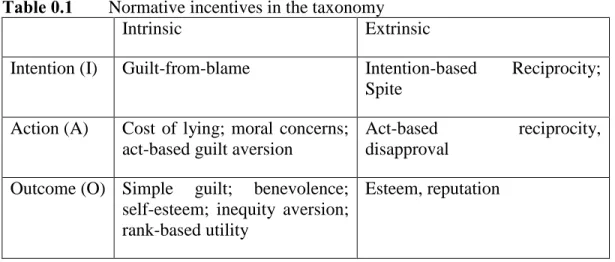
incentives to bind? To the extent that players cannot diminish their rank-based utility or disutility (which is an internal opinion) by hiding their rank from others, the incentives are intrinsic. The distinction therefore permits a closer analysis of the phenomenon, both theoretically and in its empirical predictions. The table below classifies some of the more common normative incentives along the two axes I propose.
Table 0.1 Normative incentives in the taxonomy
Intrinsic Extrinsic
Intention (I) Guilt-from-blame Intention-based Reciprocity;
Spite Action (A) Cost of lying; moral concerns;
act-based guilt aversion
Act-based reciprocity, disapproval
Outcome (O) Simple guilt; benevolence;
self-esteem; inequity aversion;
rank-based utility
Esteem, reputation
0.4 Conclusion
The classification system that I propose in this paper diverges from the standard interpretation of “economic man”, but more importantly it diverges from the main sources of normative feeling that are observed in social interactions. I argue that familiar goals such as distinction, reciprocity, altruism and rule-following are analogous to phenotypes, outward expressions of motivational mechanisms that can be profitably explained at a “genotypic” level. The genotypic and phenotypic classification systems do not have a one-to-one relationship, in general. Distinction may be intrinsic or extrinsic, but is largely outcome-based. An intention-based distinction might be conceived as a motivation to, for example, moral one upmanship.
This could be empirically discriminated from the (outcome-based) incentive to have the greatest moral reputation by testing to see whether it was sensitive to privacy.
Considering altruism, outcome-based motivations could be empirically disentangled from non-consequentialist motivations by cutting any sure link between altruistic actions and their expected results. If altruism is intention-based, for example, “it’s the thought that counts”, so a costly action that ended up having no impact would fulfill the obligation that the normative incentive generates. The distinction between extrinsic and intrinsic altruism can be considered as a parallel to Sen’s (1977) discussion of commitment and sympathy. In the latter, decision-maker A chooses to help decision-maker B because B’s welfare gives benefit to A. Such sympathy is described by the altruism model that goes back to Edgeworth, cited earlier. In cases of commitment, by contrast, A helps B even though there is no personal benefit from doing so. In Sen’s example, appeals to send aid for a famine would be more effective on the sympathetic if they contain information about the suffering of the hunger- stricken. The committed, on the other hand, would give anyway.
Reciprocity and rule-following, for their parts, can bind at intentions (I), actions (A) or outcomes (O). Examples of familiar moral rules of the three kinds include: do no harm (O); do not kill (A); and do not lie (I). The classification of the last two can be justified with the claim that even killing accidentally is traumatic; however, the culpability from lying is tied to the intention to instil a false belief – lying by accident carries no blame. Of course, the relevance of these motivations in any particular case is an empirical issue. Indeed, the principal use of the taxonomy may be to generate empirical predictions such as those above. To take the example of reciprocity, suppose some process generates an allocation in which A receives more than B, and then B has the opportunity to generate allocations that are equal (no reciprocity) or that favor B (reciprocity). If the initial process were a lottery, it would incite reciprocity in case (O), but less in case (I) and (A). If the initial process were one which A chose over another, the availability of such alternative courses of action might affect reciprocity in case (A) or (I) but not in case (O).
I have found the “genetic taxonomy” elaborated in this paper to be a useful analytical tool for developing models of normative incentives. Its use for identifying empirical predictions has also been demonstrated, for instance, in Chapter III of this thesis. Economics has resisted the explicit introduction of normative incentives in large part because of the well known fact that any observed behavior can be explained by assuming the “right” utility function. My goal here has been to try to establish some guidelines for determining whether the “right” utility function is really right. The development of experimental methods in economics has from the start held promise of this sort of identification, but for that to work, the experiment should be based on clear predictions. The taxonomy I propose supplies such predictions, and will, I hope, therefore be useful in the further work of identifying a more behaviorally descriptive content to the kind preference relation that guide economic choice in Homo sapiens.
Bibliography
Adena, M. (2011). Accounting for norms in game theoretical models. Berlin, Department of Economics, Free University of Berlin.
Ahmed, A. M. (2007). "Group identity, social distance and intergroup bias." Journal of Economic Psychology 28(3): 324-337.
Akerlof, G. (1980). "A theory of social custom, of which involuntary unemployment may be one consequence." Quarterly Journal of Economics 94(4): 749-775.
Andreoni, J. (1989). "Giving with impure altruism: applications to charity and Ricardian equivalence." Journal of Political Economy 97(6): 1447-1458.
Andreoni, J. (1990). "Impure altruism and donations to public goods: a theory of warm-glow giving?" Economic Journal 100(401): 464-477.
Battigalli, P. and M. Dufwenberg (2007). "Guilt in games." American Economic Review 97(2): 170-176.
Battigalli, P. and M. Dufwenberg (2009). "Dynamic psychological games." Journal of Economic Theory 144(1): 1-35.
Becker, G. (1974). "A theory of social interactions." Journal of Political Economy 82(6): 1063-1093.
Bénabou, R. and J. Tirole (2006). "Incentives and prosocial behavior." American Economic Review 96(5): 1652-1678.
Bénabou, R. and J. Tirole (2010). Identity, Morals and Taboos: Beliefs as Assets.
IDEI Working Papers, Institut d'Économie Industrielle (IDEI), Toulouse: 49 p.
Bernheim, B. D. (1994). "A theory of conformity." Journal of Political Economy 102(5): 841-877.
Bicchieri, C. (2002). "Covenants without swords: Group identity, norms and competition." Rationality and Society 14(2): 192-228.
Bicchieri, C. (2006). The Grammar of Society New York, Cambridge University Press.
Bikhchandani, S., D. Hirshleifer, et al. (1992). "A Theory of Fads, Fashion, Custom, and Cultural Change in Informational Cascades." Journal of Political Economy 100(5): 992-1026.
Bilodeau, M. and N. Gravel (2004). "Voluntary provision of a public good and individual morality." Journal of Public Economics 88(2004): 645-666.
Bolton, G. and A. Ockenfels (2000). "ERC: A theory of equity, reciprocity and competition." The American Economic Review 90(1): 166-193.
Brekke, K. A., S. Kverndokk, et al. (2003). "An economic model of moral motivation." Journal of Public Economics 87(9-10): 1967-1983.
Charness, G. and U. Gneezy (2008). "What's in a name? Anonymity and social distance in dictator and ultimatum games." Journal of Economic Behavior &
Organization 68(1): 29-35.
Charness, G., E. Haruvy, et al. (2001). Social Distance and Reciprocity: The Internet vs. the Laboratory. University of California at Santa Barbara, Economics Working Paper Series, Department of Economics, UC Santa Barbara.
Clark, A. E. and A. J. Oswald (1998). "Comparison-concave utility and following behavior in social and economic settings." Journal of Public Economics 70(1998): 133-155.
Cox, J. C. and C. A. Deck (2006). "Assigning intentions when actions are unobservable: the impact of trembling in the trust game." The Southern Economic Journal 73(2): 307-314.
Deffains, B. and C. Fluet (2007). Legal versus normative incentives under judicial error. CIRPEE Working Paper 07-18: 32 pgs.
Deffains, B. and C. Fluet (2009). Legal liability when individuals have moral concerns. CIRPEE Working Paper 09-51: 42 pgs.
Demougin, D. and C.-D. Fluet (2003). Inequity Aversion in Tournaments, SSRN.
Dohmen, T., A. Falk, et al. (2009). "Homo reciprocans: Survey of evidence on behavioral outcomes." The Economic Journal 19(March , 2009): 592-612.
Dufwenberg, M. and G. Kirchsteiger (2004). "A theory of sequential reciprocity."
Games and Economic Behavior 47: 268-298.
Dufwenberg, M. and A. Muren (2006). "Generosity, anonymity, gender." Journal of Economic Behavior & Organization 61(1): 42-49.
Edgeworth, F. Y. (1880). Mathematical Psychics: An Essay on the Application of Mathematics to the Moral Sciences London.
Elster, J. (1989). "Social norms and economic theory." Journal of Economic Perspectives 3(4): 99-117.
Falk, A., E. Fehr, et al. (2003). "On the nature of fair behavior." Economic Inquiry 41(1): 20-26.
Falk, A. and U. Fischbacher (2006). "A theory of reciprocity." Games and Economic Behavior 54: 293-315.
Falk, A., U. Fischbacher, et al. (2008). "Testing theories of fairness -- Intentions matter." Games and Economic Behavior 62(1): 328-303.
Fehr, E., A. Klein, et al. (2001). Theories of fairness and reciprocity: evidence and economic applications. Working Paper, Institute for Empirical Research in Economics, University of Zurich.
Fiedler, M., E. Haruvy, et al. (2011). "Social distance in a virtual world experiment."
Games and Economic Behavior 72(2): 400-426.
Foot, P. (1978). The Problem of Abortion and the Doctrine of the Double Effect.
Virtues and Vices. Oxford, Basil Blackwell.
Frank, R. H. (1985). Choosing the Right Pond: Human behavior and the quest for status. Toronto, Oxford University Press.
Friedman, M. (1966). The methodology of positive economics. Essays in Positive Economics. Chicago, University of Chicago Press: pp, 3-16, 30-43.
Hausman, D. M. and M. S. McPherson (1993). "Taking Ethics Seriously: Economics and Contemporary Moral Philosophy." Journal of Economic Literature 31(2):
671-731.
Hoffman, E., K. McCabe, et al. (2008). Chapter 49 Social Distance and Reciprocity in Dictator Games. Handbook of Experimental Economics Results, Elsevier.
Volume 1: 429-435.
Kant, I. (2005). Groundwork for the Metaphysics of Morals. Peterborough, ON, Broadview Press.
Kaplow, L. and S. Shavell (2007). "Moral Rules, the Moral Sentiments, and Behavior: Toward a Theory of an Optimal Moral System." Journal of Political Economy 115(3): 494-514.
Karni, E. and Z. Safra (2002). "Individual sense of justice: a utility representation."
Econometrica 70(1): 263-274.
Kartik, N. (2009). "Strategic Communication with Lying Costs." Review of Economic Studies 76(4): 1359-1395.
Keynes, J. M. (1936). The General Theory of Employment, Interest and Money.
Cambridge, Macmillan Cambridge University Press.
Koszegi, B. (2006). "Ego utility, overconfidence and task choice." Journal of the European Economics Association 4(4): 673-707.
Kreps, D. M. (1997). "Intrinsic motivation and extrinsic incentives." American Economic Review 87(2): 359-364.
Leonard, B. (1968). "Responsibility, reciprocity, and social distance in help-giving:
An experimental investigation of english social class differences." Journal of Experimental Social Psychology 4(1): 46-63.
Levine, D. (1998). "Modeling altruism and spite in experiments." Review of Economic Studies 1(3): 593-622.
López-Pérez, R. (2008). Introducing social norms in game theory. Games, Rationality and Behavior. A. Innocenti and P. Sbriglia, Palgrave McMillian: 26-46.
López-Pérez, R. and E. Spiegelman (2011). Why do people tell the truth?
Experimental evidence for pure lie aversion, Universidad Autonoma de Madrid.
Lundquist, T., T. Ellingsen, et al. (2007). The cost of Lying. SSE/EFI Working Paper Series in Economics and Finance. Stockholm, Stockholm School of Economics:
40.
Lundquist, T., T. Ellingsen, et al. (2009). "The aversion to lying." Journal of Economic Behavior & Organization 70(1-2): 81-92.
Marshall, A. (1994). Principles of Economics. Philadelphia, Porcupine Press.
McCabe, K., M. Rigdon, et al. (2003). "Positive reciprocity and intentions in trust games." Journal of Economic Behavior & Organization 52(2003): 267-275.
Mill, J. S. (1874). Essays on Some Unsettled Questions of Political Economy, Library of Economics and Liberty.
Persky, Joseph. "Retrospectives: The Ethology of Homo Economicus." The Journal of Economic Perspectives, Vol. 9, No. 2 (Spring, 1995), 221-231
Rabin, M. (1993). "Incorporating fairness into game theory and economics."
American Economic Review 83(5): 1281-1302.
Rankin, F. W. (2006). "Requests and social distance in dictator games." Journal of Economic Behavior & Organization 60(1): 27-36.
Rotemberg, J. J. (2008). "Minimally acceptable altruism." Journal of Economic Behavior & Organization 66(3-4): 457-476.
Schelling, T. (1974). Micromotives and macrobehavior. New York, W.W. Norton &
Co.
Sen, A. K. (1977). "Rational Fools: A Critique of the Behavioral Foundations of Economic Theory." Philosophy & Public Affairs 6(4): 317-344.
Shiell, A. and B. Rush (2003). "Can willingness to pay capture the value of altruism?
An exploration of Sen's notion of commitment." Journal of Socio-Economics 32(2003): 647-660.
Spence, M. (1973). "Job Market Signaling." Quarterly Journal of Economics 87(3):
355-374.
Spiegelman, E. (2011a). Moral decision-making and self-deception: theoretical premises and grounding observations. Mimeo.
Spiegelman, E. (2011b). “The (Human) Nature of economic choice.” Ithaque Special issue: Colloque de ADEPUM. http://www.revueithaque.org/colloque-de- ladepum/
Tammi, T. (2008). Do norms and procedures speak louder than outcomes? An explorative analysis of an exclusion game. Discussion Papers, Department of Economics, University of Joensuu.
Thomson, J. J. (1976). "Killing, letting die, and the trolley problem." The Monist 59(April, 1976): 204-217.
Vanberg, C. (2008). "Why do people keep their promises? An experimental test of two explanations." Econometrica 76(6): 1467-1480.
White, M. D. (2004). "Can homo economicus follow Kant's categorial imperative?"
The Journal of Socio-Economics 33(2004): 89-106.
PRIDE, PREJUDICE, AND THE CREDIBILITY OF CHEAP TALK:
THEORY AND EXPERIMENTAL EVIDENCE.
Equation Chapter (Next) Section 1
Abstract: This paper presents a simple application and experimental test of a theoretical model of discriminatory social preferences. First, it establishes conditions under which a combination of “guilt and pride” can support an equilibrium in which costless messages engender cooperative strategies in a one-shot Prisoners’ Dilemma (PD) game. The main result is a signaling equilibrium with full separation of signals, and cooperation whenever the social distance is less than a certain threshold level.
The second part of the paper is an experimental application and test of a discrete version of the theory.
Using the minimal group paradigm, subjects are put into a set of interlocking groups. 116 subjects played 4 games each (within-subjects) under different informational (treatment) contexts. Results are broadly consistent with the theory: people cooperate more when faced with group members. They are also less “honest” with their messages when messages are sequential than when they are simultaneous, which suggests a strategic motivation to the messages.
Résumé: Ce chapitre présente un modèle et un test expérimental d’une théorie de préférences sociales discriminatoires. Le premier consiste en un jeu de dilemme de prisonnier (DP) où l’avantage de faire défection est affecté par le sentiment de culpabilité que donne au joueur le fait de faire du mal à autrui.
Si l’on ajoute que ce sentiment diminue avec la distance sociale perçue entre les joueurs, on peut définir des groupes sociaux comportementaux comme les individus suffisamment proches en distance sociale pour qu’ils coopèrent dans le DP. Le résultat principal théorique consiste à un équilibre de signaux où les individus révèlent leur véritable distance sociale en « cheap talk » simultanée, avant de jouer.
La deuxième partie du papier construit un test expérimental de la théorie, en appliquant le paradigme des groupes minimaux (PGM). 116 sujets ont été assignés à des groupes qui reflètent la structure du modèle théorique et ont joué au DP sous 4 traitements, qui varient dans l’information donnée sur l’identité de l’opposant. Les prédictions du modèle sont globalement confirmées.