
This study correctly classified 66% of the students as persisters or non-persisters in their Athabasca University distance course. The creativity and humor subscale is a measure of the following sub-skills: creative thinking, creating to express feelings, humor. The general resilience subscale is a measure of the following subskills: persistence, ability to get along.
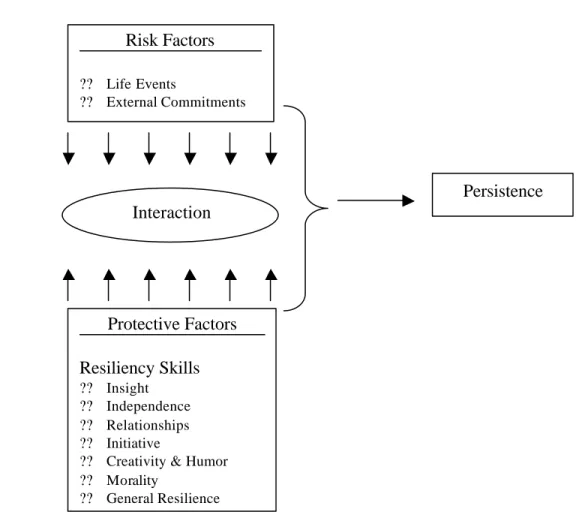
Life events are defined as noteworthy events, the occurrence of which either indicates or requires a significant change in an individual's current life pattern (Hultsch & Deutsch, 1981). To improve understanding of the variables associated with persistence and nonpersistence, this study investigated the relationship between persistence in undergraduate distance education and resilience, life events, and external commitments. The focus of this chapter is to review the literature on (a) resilience with related constructs of risk and protective factors; (b) risk and resilience in education; (c) an adult.
McCombs asserted that "the degree to which one chooses to be self-determining is a function of one's awareness of the source of agency and personal control" (p. 7). Subjects were asked to assess the effects of the following six types of external connections on their time and energy: family (core and extended); Scores were summed for each of the six questions, yielding a total score for external commitments.
In this study, persistence was defined as successful course completion (Gibson, 1990) of the student's first undergraduate course at Athabasca University. Students were asked to assess each of the six external connections using a five-point Likert scale. The subjects were sent a questionnaire packet which contained a Letter of Introduction (Appendix A) describing the confidentiality of the research and the students.
CHAPTER 1V
About half of the respondents (n = 61) had previously taken a distance course at a university or college other than Athabasca University. None of the students enrolled in a six-credit course completed their course; three did not start work on their course and one withdrew from the course. More than half of the students in the non-completed group (53%) had previously followed a distance course.
Of the 57 students who successfully completed their Athabasca University course, 16 were male and 41 were female (28% and 72%, respectively). A stepwise analysis, as opposed to the simultaneous entry of all discriminant variables, was used because of the large number of variables selected for analysis. In the first step, this procedure selects the variable with the highest predictive value and then calculates p-values, which describe the additional predictive power of each of the remaining variables.
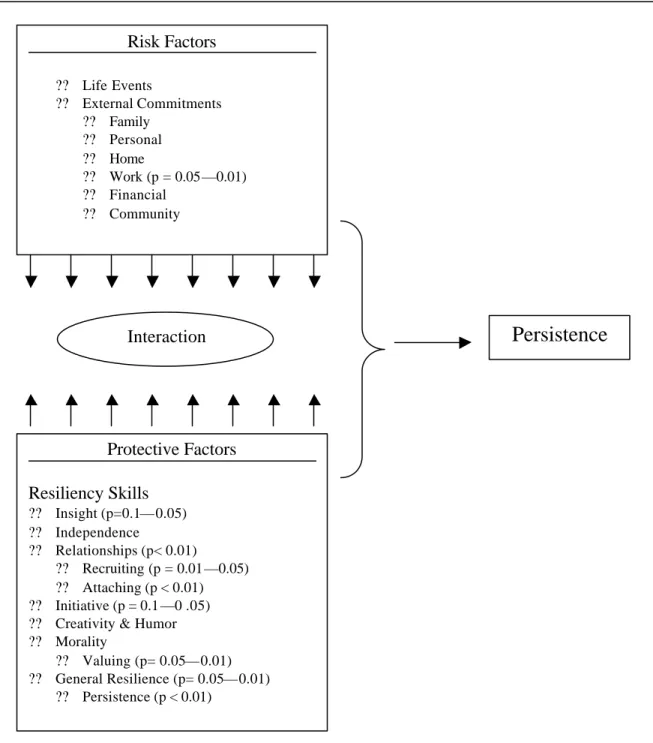
The process continues until none of the remaining variables contribute significantly to the model as defined by the list of selected predictors. As shown in Table 6, no significant differences between groups were found for five of the six external obligations, with the exception of work obligations. As mentioned earlier, stepwise discriminant analysis selects the variable with the highest predictive value and then calculates p-values describing the additional predictive power for each of the remaining variables.
Furthermore, this study contributes to the understanding of the application and limitations that prominent theories of persistence have in relation to populations of distant learners. These findings are not surprising in light of the research on self-efficacy and academic motivation (e.g., Bandura, 1988). Based on these significant predictors, the final discriminant function correctly classified two out of three students in terms of the successful completion of their studies. first course at Athabasca University.
The educator can then suggest to the student to include some remedial coursework to support the student's learning of the material. The final discriminant function correctly classified 66% of the students in terms of successfully completing their first Athabasca University course. A substantial part of the difference between students who successfully completed their course and those who did not was explained by resilience skills and work commitments.
Paper presented at the annual convention of the Western Social Science Association, Tempe, AZ (ERIC Document Reproduction Service No. ED 156 971). Comparing the study habits and preferences of high-achieving and low-achieving Open University students. Paper presented at the 13th Annual Conference of the Asian Association of Open Universities, Beijing, China.
The role of mathematics self-efficacy in college women's and men's choice of mathematics-related majors: A path analysis. Paper presented at the Southern Association of Community College Researchers Regional Meeting (Nashville, TN). I am a fellow Athabasca University student enrolled in the Master of Distance Education program and I am currently working on the thesis component of my studies.
In the box to the left of each statement below, write the number that best describes how you feel about that statement. The Life Events Inventory (LEI) is a 62-item self-report psychometric test developed to assess the number of events frequently experienced by individuals in general. Listed below are a number of events that sometimes cause changes in the lives of those who experience them, necessitating readjustment.
Be sure to include all events that apply to you as you experienced them. We are only interested in the total number of life events you have experienced. Enter the total number of life events from your adult life in the space provided, and then OMIT the Life Events Inventory from your questionnaire packet.
In the space provided, write only the total number of life events you have experienced in your adult life. For each question, you are asked to place an X in the space next to the answer that best describes how often you need to spend time and energy to fulfill each commitment. Please indicate the total number of 62 life events (from the Life Events Inventory above) that you have experienced in your adult life (age 18 and older).
Please remember to remove the Life Events Inventory from your package before mailing the completed questionnaire. For each of the questions below, please rate how often you have to spend time and energy fulfilling the external commitments described in the question.

