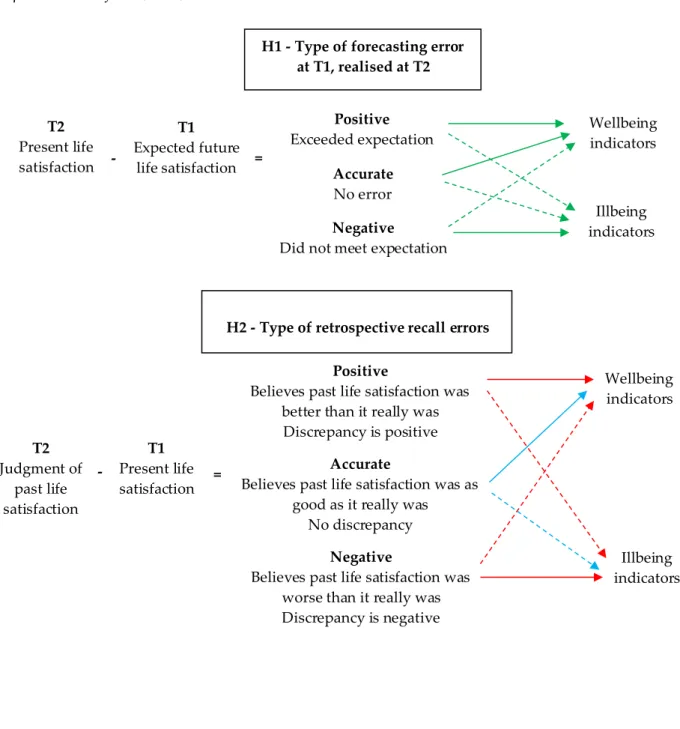
They investigated how overestimation, underestimation and accurate estimation of future life satisfaction (a cognitive assessment according to Bertoni & Corazzini) affect subsequent levels of subjective well-being. As such, a positive forecast error occurs when a person exceeds their prior expectation of future life satisfaction. Conversely, a negative forecast error occurs when a person's expectations about future life satisfaction are not met.
An accurate prediction is when the same value was produced (i.e., they expected a 6/10 in the future at Time 2, and at Time 2 they reported current life satisfaction as 6/10). On the other hand, a negative retrospective recall error is defined as the belief that satisfaction with a past life was worse than in reality (i.e., the individual was reasonably satisfied with life at Time 1 or 6/10, but now believes Time 2 that his or her satisfaction with past lives at Time 1 was poor or 4/10). Finally, accurate retrospective recall occurs when the same value was produced (i.e., the individual was reasonably satisfied with life at time 1 or 6/10, and now believes at time 2 that satisfaction with his previous life is at time point 1 was moderate or 6/10). 10).
More specifically, we determine whether someone is more optimistic (favorable), realistic (neither favorable nor unfavorable), or less optimistic (unfavorable) in their predictions of their future life satisfaction given their current evaluations. Wenze et al., 2012), we expect that individuals will also not be accurate in recalling past life satisfaction. We expected that accurate retrospective recall of life satisfaction would be positively related to well-being indicators (i.e., happiness, hope, meaning in life, etc.) and negatively related to disease state indicators (i.e., depressed mood, rumination, etc.).
The TSWLS assesses past, present, and future life satisfaction with 15 items (five for each time dimension). 4 Although we report total life satisfaction scores (as a combination of past, present, and future life satisfaction), it is not the focus of the current study. A realistic forecast is an estimate of future life satisfaction that is the same as the current level of life satisfaction (eg, the individual is currently moderately satisfied with life or 6/10 and expects to also be moderately satisfied or 6/10 in the future ).
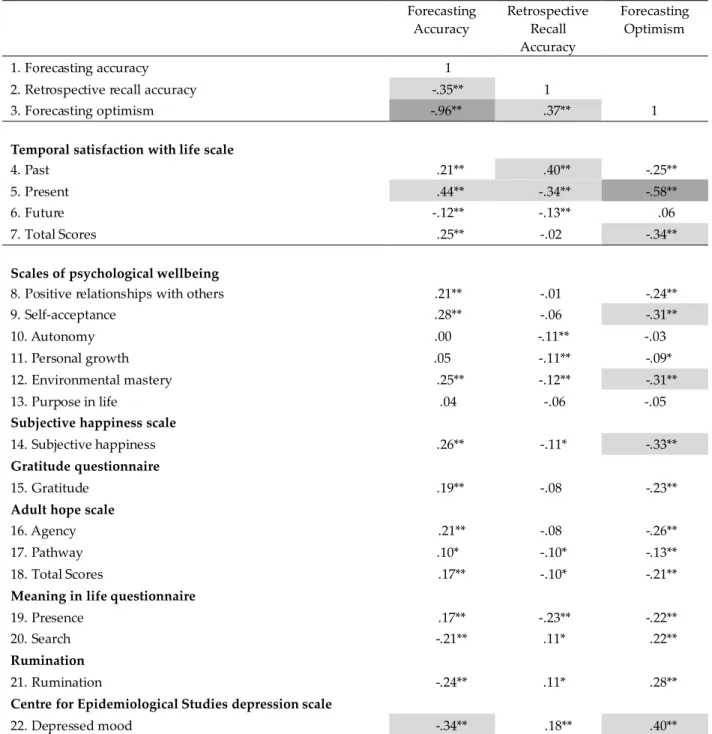
In other words, individuals who were optimistic about their future life satisfaction were less likely to achieve. Retrospective recall accuracy was moderately positively related to past life satisfaction (r = 0.40, p < 0.01) and moderately negatively related to current life satisfaction (r = -0.34, p < 0.01). These results indicate that individuals who had highly optimistic predictions of life satisfaction had a more negative relationship with indicators of well-being and were less satisfied with their current life.
Retrospective recall accuracy was also moderately positively correlated with forecast optimism (r = .37, p < .01), meaning that individuals rated their past life satisfaction as better. Additionally, and providing mixed support for H2b, retrospective recall accuracy was positively related to past life satisfaction (r = .40, p < .01) and negatively related to current life satisfaction (r = - .34, p < .01). These results suggest that individuals who rated their past life satisfaction as better than reported higher past life satisfaction scores but also reported lower current satisfaction scores.
These results suggest that individuals who had a greater optimistic bias in their life satisfaction predictions had a greater negative relationship with well-being indicators, and were less satisfied with their current lives.
Discussion
It is possible that these results can be interpreted according to the relative standard model (Diener & Lucas, 2000; Parducci, 1995), which states that satisfaction (including life satisfaction) is determined not by objective conditions but by comparisons of individuals' own situation (e.g. in terms of satisfaction with life in the present) in relation to relevant standards (e.g. individual's satisfaction in past life, perception of life satisfaction of family or friends, etc.; Campbell et al., 1976; Diener & Lucas, 2000; Michalos, 1985). The discrepancy between one's own position and their standard can affect the level of satisfaction in the present (eg, satisfaction with current life). As noted by Diener and Lucas (2000, p. 47), “a discrepancy involving an upward comparison (when the standard of comparison is higher) would result in lower satisfaction, whereas a downward comparison should lead to higher satisfaction”.
Individuals who remembered their past life satisfaction as better than reality set themselves an unrealistically high standard that involves an upward comparison, thus resulting in lower current life satisfaction as well as more negative impacts on well-being. On the other hand, individuals who recall their past life satisfaction as worse than reality create a standard for themselves that is low and involves a downward comparison, leading to better well-being and higher current life satisfaction. Regarding optimism of predictions, we could not make a prediction about the proportion of individuals who could be highly optimistic, realistic, and low optimistic, since our study was the first one to assess data in that way.
Our results showed that 39.4% of the individuals in our sample were highly optimistic, 22% were realistic, and 38.5% were lowly optimistic about their future life satisfaction. Regarding H3b, that highly optimistic forecasts would report more well-being and less ill health (and vice versa for low optimistic forecasts), our hypothesis was rejected. The results showed that highly optimistic individuals generally scored lower on well-being measures and higher on illness measures compared to low optimistic individuals and secondly to realistic individuals.
Additionally, individuals with a realistic forecasting style also scored higher on some measures of illness (such as sleepiness and depressed mood) and lower on some measures of well-being (such as current life satisfaction, positive relationships , self-acceptance and gratitude) than individuals with a low optimistic forecasting style. Therefore, in terms of optimism about future life satisfaction, there may be an advantage to being lowly optimistic compared to being realistic, or very optimistic. Individuals who are highly optimistic have a standard for the future that is, by definition here, too high, thus entailing an upward comparison that lowers their current well-being and life satisfaction, while the standards of low-optimistic individuals entail a comparison downward, leading to higher well-being and satisfaction from life in the present.
Limitations, future studies, and summary
Individuals who are highly optimistic have a standard for the future that is by definition very high, and therefore involve an upward comparison that lowers well-being and their current life satisfaction, while the standards of low optimistic individuals involve downward comparison which leads to greater well-being and life satisfaction in the present. measures such as the Day Reconstruction Method to assess retrospective memory), and also consider whether there are developmental or age differences in such judgments across the lifespan. However, the results regarding the accuracy of retrospective recall, and the optimism of life satisfaction predictions, and their links to well-being and disease, may necessitate a reorientation in our thinking if they can be replicated. The results indicated that both high optimism about future life satisfaction and positive errors in recalling life satisfaction were differentially associated with higher feelings of illness and lower well-being.
Worse than I expected' or 'That's not so bad'?: The influence of affective forecast accuracy on self-reported task performance. The Meaning in Life Questionnaire: Assessing the presence and search for meaning in life. Nine measures were used for analysis and included 1) the Temporal Satisfaction with Life Scale (explained above in the methods section), 2) the Psychological Well-Being Scale - 18-item version, 3) the Subjective Happiness Scale, 4) the Hope for adults, 5) Gratitude Questionnaire-6, 6) Meaning in Life Questionnaire, 7) Rumination Scale, and 8) Center for Epidemiologic Studies Depression Scale.
Items are answered on a seven-point Likert-type scale ranging from 1 - strongly disagree to 7 - strongly agree. There are four agency items that measure successful goal-directed determination (e.g., “I have been quite successful in life”). The GQ-6 is a unidimensional measure that assesses how grateful individuals are in general (eg, “I have so much in life to be grateful for”).
Items are answered on a 7-point Likert scale, ranging from 1 - Strongly disagree to 7 - Strongly agree. The Meaning in Life Questionnaire (MLQ; Steger et al., 2006) assesses the presence and search for meaning in life with ten items; five for each subscale. The presence subscale assesses the degree to which individuals feel they live a meaningful life (eg, “I understand the meaning of my life”), and the exploration subscale assesses individuals' motivation and commitment to finding or deepening meaning in their lives. meaning of their life (eg, "I am looking for a purpose or mission for my life").
In the current study, both the presence and the search subscales had good internal consistency, both with alphas of α = .92. The next three tables present the results of Levene's test of equality of variance for the three MANOVAs calculated in the results section. Levene's test results for the MANOVA were calculated on positive, accurate and negative prediction error groups.
Levene's test results for the MANOVA calculated based on positive, accurate, and negative retrospective recall error groups.