Bryan Sokol, Saint Louis University, USA Mary Beckie, University of Alberta, Canada Keith Carlson, University of Saskatchewan, Canada Sarah Dorow, University of Alberta, Canada. Catherine Etmanski, Royal Roads University, Canada Jean Marc Fontan, Université du Québec i Montréal, Canada Budd Hall, University of Victoria, Canada. Jackson, Carleton University, Canada Tania Kajner, University of Alberta, Canada Heather McRae, MacEwan University, Canada.
Engaged Scholar Journal: Community-Engaged Research, Teaching, and Learning is a Canadian online, peer-reviewed, multidisciplinary journal dedicated to profiling best practices in 'engaged scholarship' based on community-academic partnerships in research, teaching and learning . Financial and logistical support: Office of the Vice-President - Research, University of Saskatchewan Published by the University of Saskatchewan.
Assessing the Outcomes of Community-University Engagement Networks in a Canadian Context
Without these, the value of the network cannot be portrayed to new members, funders and the wider public. This reciprocal relationship then fosters the growth of the social movement to which the network aims to contribute. As one interviewee articulated, “it's helpful to know other people online and to be able to get things done.
In each of the interviews, it was stated that the leaders within the networks show true commitment to the network. While each of the networks has a formal governance structure, those members who are actively participating in the network lead the networks.
How the Distribution of Resources Supported the Project’s Community of Learners and Contributed to Community
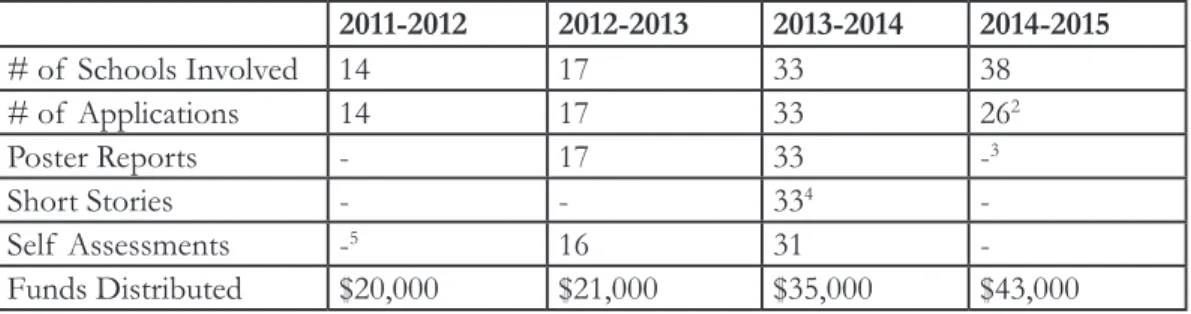
The TEGS Small Grants Initiative was established in the second year of the TEGS research project. This section describes the impact the small grants initiative has had on one of the key community nonprofits working in the TEGS student community. During the first year of the Small Grants initiative, Matthew Kemshaw worked with the Environmental Youth Alliance (EYA) to redesign EYA's Growing Kids program.
Elena Orrego is an anthropologist and co-founder of the Think&EatGreen@School project. Engaged scholarship in action: The School Board Journey – University Research Exchange Network (SURE).
Engaged Scholarship in Action: The Journey of the School Board – University Research Exchange (SURE) Network
As a result, the school board research sub-committee of the London regional MISA PNC proposed a school board-university partnership to the deans of education in the London region. The impetus for SURE (originally known as Research Exchange) was the result of a MISA PNC action research grant for which four school board researchers from the London region applied for and received funding in 2008. According to the mutual agreement, participation in the SURE fellowship was voluntary and funded by MISA PNC from the start, so none of the participating organizations were expected to contribute funds to SURE.
The steering group meetings were initially "designed to inspire open thinking" (SURE, minutes, 10 March 2009). Since the inception of the SURE Steering Committee, we have struggled with our various timelines and logistics. Our original purpose/mission was about aligning education students' teaching and research priorities; to make the educational faculties aware of the realities in the classroom.
At the same time, some committee members did not see SURE's dual identity as problematic; they felt fully integrated and contributing members of the SURE community. One of our key initial accomplishments was the completion of a teacher-researcher study and the dissemination of these results (Martinović, Wiebe, Ratkovic, Willard-Holt, Spencer, & Cantalini-Williams, 2012). We became even more aware of the values we share and the partnership activities that are recognized on the ground.
She is a member of the Board of School-University Research Exchange Network (SURE) and the Brock-Golden Horseshoe Educational Consortium (BGHEC). Paper presented at the annual meeting of the American Educational Research Association (AERA), San Diego, CA. Evaluation of the SURE (School Board University Exchange) Partnership and its impact on research capacity building in schools.
Developing an Evaluation Capacity Building Network in the Field of Early Childhood Development
First, we describe the context for the development of the Evaluation Capacity Network (ECN)1 and the reason for focusing on early childhood development. The group decided that the focus of the initiative would be on early childhood development (ECD) evaluation. Much of the group's discussion focused on the need to promote and support "evaluative thinking" in the ECD sector.
The core research team met monthly and was responsible for the design, development and implementation of the research component of the ECN. What are the essential elements of the community-university partnership that will contribute to developing a successful ECN. The focus groups provided an important opportunity to not only identify key principles to guide the partnership, but also to give meaning to these principles in the context of ECN.
Finally, a number of initiatives were identified that partners believed would contribute to ECN's success. In addition, many of the steering group members were high-level decision makers and leaders in the field. Graduate student engagement has been fundamental to ECN's success as they have provided significant capacity.
In ECN's three-year course so far, eleven master's students and one postdoctoral fellow have been guided through and given support to ECN. Karen Edwards, MD, is director of the Community-University Partnership (CUP) at the University of Alberta. The story of the Community-University Partnership for the Study of Children, Youth and Families (CUP).
Doing Indigenous Community-University Research Partnerships: A Cautionary Tale
Our commitment to participating in the project of understanding the prevention of violence in indigenous communities is deeply embedded in our personal and professional lives. The principles we articulated in our research plan state, “we are drawing on Aboriginal approaches and collaborating to respect Aboriginal values, meaning, methods of research and decision-making” (Cardinal and Peplar, 2011, p. 2). The presence of this package represented our commitment to honor indigenous knowledge and the spirit of the project.
All team members are included in all aspects of the research process, in decision making and all planning, regarding the direction of the project. They are involved in all aspects of the project, including creating meaning and presenting the results to their community. By the end of the second year, we had hoped to have two CBRs working in each of the seven indigenous communities involved in the project.
Delays due to community events took precedence over research project timelines. Engaged Scholar Journal: Community-Based Research, Teaching, and Learning. nor were we invited to travel to and meet the communities involved in the project. Progress on the project came to a standstill and we didn't know what was happening in the communities.
Challenges experienced in this project are also rooted in the worldviews, experiences and perspectives team members bring to work. We reflect on how limitations on our time affected the project and contributed to the issues and challenges. Is there room in the project budget to support you and the commitments that are crucial to nurturing authentic relationship building over time and distance by all members of the research team.
How are Educational Researchers Interacting with End-users to Increase Impact?
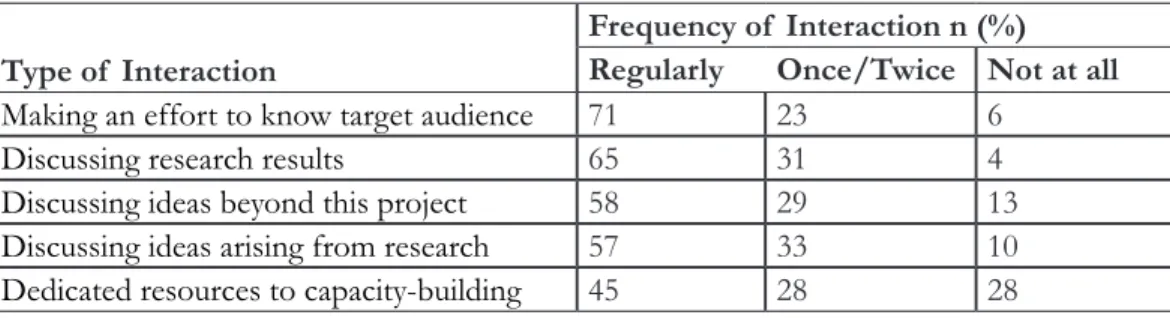
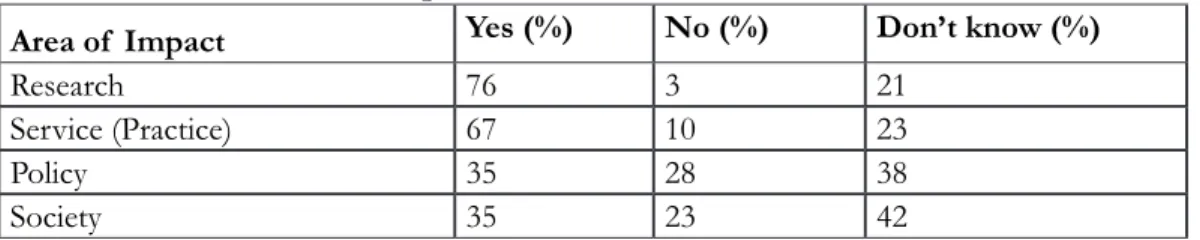
In this survey, researchers were asked how often researchers interacted with end users at different stages of the project (Table 3). More than half of the sample also had regular contact with target groups to discuss ideas arising from the research (57%) and to discuss ideas outside the research project (58%). Another limitation of the study is that the data from the study relies on self-reporting.
The Bribri people are one of the eight indigenous groups living in Costa Rica. Alí is a Bribri researcher from the Së́bliwak clan and works in the language department at the University of Costa Rica. Alí met with members of the women's group and there were three important outcomes of these meetings.
First, all members of the Së́bliwak group expressed interest in collaborating and working with us on how best to do so. Third, members of the Së́bliwak group themselves chose their roles in the project and some of their desired outcomes. Members of the Së́bliwak group would receive funding and other forms of support with one of their food harvesting projects.
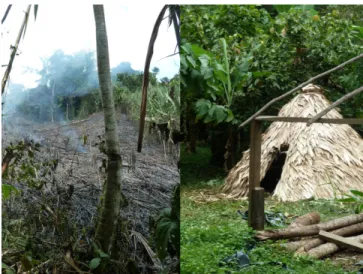
The seeds were bought from elders in Bajo Coen (left) and the seedlings were raised by members of the Së́bliwak group. Working with a family gives the research participant the opportunity to ask the family mediator direct questions about the nature of the research and its motives, and to refuse to cooperate with the mediator (Wilson paraphrases Webber-Pillwax). Members of the Së́bliwak group said that this lack of interest in the life, work and culture of Bribri women made them feel reluctant to share Bribri teachings with researchers.
Specifically, on a given day, Olivia was a researcher, an English teacher and a member of the Së́bliwak group. The use of tropical forest (agrosystems and harvesting of wild plants) as a food source in the Bribri and Cabécar cultures of Costa Rica's Caribbean coast.
Exchanges
Relationship, Accountability, Justice
A Conversation about Community-Engaged Research
We also wanted to be involved in a project that could affect change and after many discussions regarding some of the challenges in different institutions. First, it taps into the expertise of community agencies that come around the table. Sarah: For me, I have had previous relationships with most of the people and organizations involved in this project.
Amanda: Did you feel to the community agencies around the table that you could steer the ship in the direction of the investigation? Stan: But I think, from my perspective, it's just because of the relationships we already had. What do you think are the main advantages and disadvantages of university research involvement in community-based research projects?
Amanda: I thought one of the real benefits of working with the university was the ethics approval process for the interviews we did. Jason: Especially when you're talking about what happens to the results of the research. Sarah: I think what was really interesting and worked really well on this project was the actual design of the study.
Amanda: I will add to that the importance of the commitment of the people at the table. There must be a tangible benefit that the community experiences as a result of the research. Now, how do you make sure that happens from the very beginning of the project when you don't know if you will be successful.
Community-Engaged Research, Teaching, and Learning