Comparing the Political Representation of Ethnic Minorities in Advanced Democracies
Karen Bird
Department of Political Science McMaster University Hamilton, Ontario, Canada
L8S 4M4
Paper Presented at the Annual Meeting of the Canadian Political Science Association Winnipeg, Manitoba, 3 June 2004.
For further information, or for a revised version, contact [email protected]
Comparing the Political Representation of Ethnic Minorities in Advanced Democracies
The mechanisms of representative democracy have never offered up elected assemblies that are a mirror image of the general public they are supposed to represent. Many would argue that this was never their intent (Pitkin 1967). Nevertheless, the distortions of representative democracy have become more apparent of late, and there is mounting pressure to correct them. One group that has been attracting particular attention, especially among the political parties competing for voter support, is ethnic minorities. Historically under- represented throughout many if not most of the world’s established democracies, ethnic minorities have not yet made spectacular gains towards more equitable political representation, but small improvements are apparent in many countries. While it remains intrinsically difficult to measure the level or the quality of political representation enjoyed by ethnic minorities, what interests us most in this paper is why ethnic minorities are beginning to attract attention in terms of political representation, what factors tend to produce better levels of representation for ethnic minorities in some places than in others, as well as the characteristics of ethnic minorities who tend to fill the elected positions in these countries.
Introduction
While many groups are statistically under-represented in the parliaments of established democracies, explanations for the patterns of representation among these groups remain theoretically underdeveloped. Too much of the theoretical literature on descriptive representation fails to differentiate between women and ethnic minorities. Women and ethnic minorities often face candidate selection processes that discriminate against them (Norris and Lovenduski 1995). However, the dynamics of group identity, differences in residential patterns, and the consequences for political mobilization arguably create very different political opportunities and obstacles to the representation of ethnic minorities than is the case for women. This paper argues that political parties in many countries are increasingly interested in selecting ethnic candidates, in the hope of reaping electoral rewards from associated ethnic electorates. Ethnic minorities can be quite well represented, especially at the local level and in larger urban centers where a group’s spatial concentration and its ability to mobilize ethnic bloc voting make ethnic candidates an attractive choice for political parties. Differences in electoral rules are also crucial.
This paper examines political representation among ethnic minorities in France, Denmark, and Canada. The opportunity structure for the political representation of ethnic groups is different across and within these countries. Conceptually, the opportunity structure for ethnic representation includes both the degree of collective identity within ethnic groups and their capacity to mobilize members politically, and the responsiveness of the party and political system to ethnic groups. Across the three countries examined in this paper, several factors appear to influence the political opportunity structure for ethnic representation. There are, first of all, different “citizenship regimes” across these countries. France and Denmark have relatively
assimilationist citizenship regimes, while Canada has a multicultural regime. Also, Denmark and Canada have granted newcomers relatively quick access to voting rights at various levels, while France has not. Second, there are different “institutional features” across these countries. In particular, different electoral rules (single member districts, proportional representation, and proportional representation with preference voting features) are employed at different levels across these countries. Also, France has a narrowly elite political culture, while the Danish and Canadian structures are more open and participatory. Third, local variations in “interest constellations” of ethnic groups can lead traditional parties to assume particular electoral strategies with respect to ethnic voters, with ethnic candidacies playing a key role in such strategies. While these features can be understood as shaping the opportunities for ethnic representation in a general sense, we must not neglect the role of individual candidates. While parties may be using ethnic candidates instrumentally as part of vote- winning strategy, many ethnic candidates themselves use ethnicity in a highly selective and entrepreneurial fashion, both in seeking party support for their candidacy, and in mobilizing support from minority and/or majority voters. The different features described above also shape the electoral strategies of ethnic candidates, and play some part in determining the style and substance of ethnic representation in each country.
Challenges facing comparative research on ethnic minority representation
While there has been growing attention over the past decade to the question of descriptive representation in democratic assemblies, there remain a number of conceptual problems that plague the analysis – and especially the comparative analysis – of ethnic minority representation.
To begin, much of the literature on descriptive representation has been theoretical in orientation, addressing the question of whether quotas and similar measures to enhance the descriptive representation of politically marginalized groups can be justified in modern democracies. Arising out of research on theories of multiculturalism, this work addresses the value of group representation in terms of democratic equality and civic inclusiveness (Young 1990, 2000, Kymlicka 1995, 1998), or considers the effects of such measures upon the processes of democratic representation, deliberation and accountability (Williams 1998, 2000, Mansbridge 1999, 2000 Phillips 1995). Collectively, these authors argue in favour of special mechanisms for enhanced group representation, on the grounds that certain groups have been consistently under-represented in legislative bodies, and that without their presence it is extremely likely that their interests will be overlooked and that policies will be biased against them.1 However, there is little distinction in this work among descriptive representation for ethnic minorities, women, disabled people, the poor, gays and lesbians, and so on. While it has made an important contribution to understanding the principles of group representation within a democratic framework, this research has provided little help in understanding the political features that may promote or obstruct the representation of ethnic minorities.
1 In addition, this research suggests that by including members of subordinate groups in a reflective, deliberative, democratic body, the horizons of understanding among all groups will be broadened, thereby avoiding the potential pitfalls of group ghettoization and essentialism.
It is not incidental that this body of research has been dominant within Anglo-America. There are, in North America and in Britain, important similarities in the political situations of ethnic minorities and women.
Women since 1918, African-Americans (northerners since 1865 and southerners since the Voting Rights Act of 1965), pre-WW II economic migrants to Canada and the US (and their descendants), and migrants from Commonwealth countries to Britain – all enjoy formal citizenship with its associated rights. Access to citizenship for newer migrants is also easier in these countries than in many continental European states. Thus the demands made by these groups have been very similar. In the U.S., in particular, affirmative action programmes developed through the 1970s for African Americans were easily generalized to women, and to other ethnic minority groups. In addition to “similar groups,” these countries also share many similarities across their political systems and citizenship regimes and so, to some degree, the role of institutions has faded into the background, while the normative imperatives of a broadly shared approach of cultural pluralism have come to the foreground. Framed by these “most similar systems,” this theoretical work pays scant attention, beyond examples drawn selectively from a few countries, to the implications of descriptive representation across existing societies, given their at times quite distinctive citizenship regimes, institutions and political dynamics. This problem of “disconnect” between multicultural theory and empirical realities is challenged by Adrian Favell (1998, 12), who argues that there is an urgent need in this research for closer attention to the actual responses across different political systems to ethnic diversity:
“There is a notorious disconnect between the ideal world of contemporary political philosophy – its happy discourse of rights and justice, or the idealisations of cultural difference and radical democracy – and the actual institutional and technocratic practice of liberal politics…. An explicit connection between liberal reflection and liberal practice is generally missing, a fact which distorts the reality philosophers see through their theory.”
A second conceptual problem facing comparative research on ethnic representation is that the so- called “ethnic minority” in any country is comprised of very different groups. In some countries, with very recent immigration, much of the ethnic minority population is comprised of newcomers with limited language abilities or familiarity with the political system of their new country. In countries with a longer experience of immigration, a greater proportion of the ethnic minority will be native-born descendents of parents or grandparents who were born abroad. Among these ethnic minorities, there will have been different migration experiences, different patterns of economic and geographic location within the host country, as well as different levels of discrimination and exclusion. Some ethnic groups are more numerous, or have settled in a more concentrated way, with denser social networks that may promote political mobilization. Some enjoy resources that make it easier or more natural for them to participate in democratic politics, while others may suffer an accumulation of social and economic handicaps that work against their capacity for political mobilization. In addition to these differences among groups, there are also differences in the citizen regimes
of host societies, such that newcomers in some states obtain full citizenship and voting rights quite quickly.2 All of these factors affect the ability of a group to attain descriptive political representation. These fairly obvious differences make it very difficult to compare levels of ethnic minority representation across countries, or even to assess ethnic minority representation in a general way within a country.3
A third challenge lies in the specification of the political opportunities and constraints facing ethnic minorities who seek to become candidates and, eventually, political representatives of their group. Political opportunities and constraints may be structured by macro-level factors, such as the candidate selection processes of political parties, the electoral system, and legislative turnover rates – all of which differ from country to country (though they may also differ across political levels within a country). These macro-level factors are presumed to operate in a similar way upon political aspirants, making it relatively easy or difficult for them to seek and attain elected office.
However, the structure of opportunities and constraints is also shaped by micro-level factors, which play out differently depending on local circumstances. Important micro-level factors include the degree of concentration of ethnic groups in particular constituencies, the degree of collective political mobilization within an ethnic community, the level of party competition for the support of ethnic voters, the existence of ethnic rivalries within the local community, as well as the characteristics of individual candidates, the nature of their ties to a given ethnic community, and the electoral strategies they may employ to win voter support.
Micro-level factors tend to be particularly decisive in determining the electoral success of ethnic minority candidates. Studying these factors requires deep familiarity with not only national but also local race politics.
Speaking of ethnic minority political representation in the UK, Saggar and Geddes (2000, 28) write: “It is the local dynamics of race politics in the UK that are fundamental… because it is at the local level that the complex tapestry of British race politics has been woven.”
In order to better understand these micro-level dynamics we require better data, particularly at the local level (within neighbourhoods and polling stations), that allow us to measure the level of electoral support for ethnic minority candidates, both among ethnic minorities and among majorities. We need large enough samples of ethnic minorities, in order to examine differences in voting preferences within ethnic
2 In Canada, regardless of one’s country of origin, the acquisition of citizenship takes three consecutive years of residence in Canada. Citizenship confers voting rights at the municipal, provincial and federal level.
However, one need only be a resident to have the right to vote and run in local school board elections. In the countries of the European Union, all European nationals enjoy the right to vote in municipal elections, in whatever country they are resident. Third-country nationals residing in Europe do not enjoy local voting rights, except in six countries: Denmark, Sweden, Finland, Norway, the Netherlands, and Belgium (plus to some extent, Ireland). There are also some regional agreements – for example among the Scandinavian countries – that extend full voting rights to citizens of those countries within these regions.
3 In contrast, it is a relatively easy task to assess and compare the political representation of women across states. Given that women make up roughly 50 percent of the population in every country, and are evenly dispersed throughout each country, it is a simple matter of assessing the extent to which a legislative body is numerically representative of women. Counting and assessing the political representation of ethnic minorities is a far more challenging task.
subgroups (according to gender or social class, for example). We need to examine differences in voting behaviour among ethnic groups in areas where they are densely concentrated, compared to areas where they are more spatially integrated. Other information on ethnic networks and how these serve to mobilize political participation among various groups is also essential (Fennema and Tillie 1999).
A fourth conceptual problem concerns how to assess normatively statistical increases in ethnic minority representation. While pressure for increased political representation and actual increases over time in the number of ethnic minority representatives is a positive sign, Adrian Favell (1998) has rightly warned us about the “pathologies of a progressive idiom,” and the need to be cautious in our evaluation of descriptive representation. A number of problems are apparent. One is the tendency of political parties to nominate ethnic candidates almost exclusively in areas with large ethnic minority populations. On this note, the Parekh Report in Britain (2000) recommended that political parties should seek to select ethnic minority candidates in ridings where more than 25 per cent of the population are from ethnic minorities. Yet this political logic does not necessarily produce a more just and inclusive society. Rather, it may consign ethnic minority
representation to those areas where race is deemed to matter and away from those where it does not, thereby enhancing the notion that ethnic minority representation is of relevance only for ethnic minorities, and is not a more general representational dilemma for the whole population – a minority rather than a mainstream issue (Saggar and Geddes 2000).
We also need to consider the possibility that parties are using ethnic minority candidates simply as
“tokens” or “alibis” intended to mobilize voter support, without policy responsiveness in return (Geisser 1997). In comparing ethnic representation across countries, it is important to assess both the number of ethnic minorities in elected office, and the extent to which the individuals selected as candidates and eventually as representatives will be effective substantive representatives of ethnic minority interests. Are differences in the effectiveness or “authenticity” of ethnic minority representation related to specific features of the political system of a given country? Of course, the definition of ethnic minority “interests” is itself a complex matter.
Ethnic minorities in established democracies are increasingly diverse with respect to social-economic status, and political ideology and interests (Saggar 2000). Nevertheless, there appears to be a tendency for parties to select as ethnic candidates, individuals who are models of entrepreneurial and economic success. While these may be more appealing candidates from the perspective of the party, it is not clear that they have any strong relationship with or share any of the substantive concerns of the dispossessed portions of the minority group most in need of political representation (Dovi 2002).
A fifth and final challenge to cross-national comparisons of ethnic representation also merits discussion here. The problem concerns how to count ethnic minorities, in order to assess their statistical representation. Conceptualizations of ethnicity remain rooted in nationally specific contexts, and are difficult to translate meaningfully into other national contexts. Who counts as an “ethnic” or “visible” minority will differ from one country to another, depending on patterns of immigration to that country and the historical relationships between sending and receiving societies. For example, the troubled colonial and post-colonial
relationship between France and Algeria, as well as growing incompatibilities between secular French republicanism and the Muslim religion, make second- and third-generation citizens of North African descent a more visible ethnic group in France, than new immigrants from Turkey or from former Soviet states. In addition to different social perceptions of ethnicity, there are national differences in the official classification and measurement of ethnicity that make the collection and comparison of data across countries especially challenging. For example, Belgium and France refuse any official distinction among citizen along ethnic lines, and their census bureaus collect no data on ethnicity (only on nationality) for the general population.4 In other countries, fully integrated second- and even third-generation descendants of migrants are counted as members of the ethnic minority.
Where population statistics on ethnicity are available, they usually take one of two forms. Ethnicity may be measured through self-identification, as is the case in Canada, where one’s ethnicity refers to one’s subjective identification with the ethnic or cultural group of one’s ancestors.5 Or it may be based on a series of objective criteria including one’s place of birth, birth country of parents, mother tongue, ethnic origin, and even religion. While we may debate the finer points of adopting either of these measures for counting ethnic minorities in the population, the ethnic identity of political representatives raises a further issue: How do voters perceive the ethnicity of the candidate? Beyond objective and subjective definitions of ethnic identity, politicians are able to construct a public identity (or identities) in the minds of voters, and our classifications are poorly adapted to capturing these.6 Impression management of one’s identity is a particularly important element of political strategy for ethnic minority candidates. Whether an ethnic candidate seeks to address his or her own minority group, or the majority population, or (a more difficult undertaking) both, is a strategic choice shaped by the political opportunity structure in a given country (Necef 2002, Saalfeld 2002).
4 Thus French statistics treat the French-born children or grandchildren of immigrants, as well as Black citizens born in the hexagon or originating from French overseas departments and territories, as simply
“French” without any other distinction.
5 The Canadian census question asks, in open-ended form, “To which ethnic or cultural group(s) did [your]
ancestors belong? For example, Canadian, French, English, Chinese, Italian, German, Scottish, Irish, Cree, Micmac, Métis, Inuit (Eskimo), East Indian, Ukrainian, Dutch, Polish, Portuguese, Filipino, Jewish, Greek, Jamaican, Vietnamese, Lebanese, Chilean, Somali, etc.” Respondents are invited to specify as many groups as applicable, and are given four blank spaces. Furthermore, since 1996, the census has included a question designed to gather information directly from respondents on whether or not they are a member of a visible minority. This question asks respondents whether they are White, Chinese, South Asian, Black, Filipino, Latin American, Southeast Asian, Arab, West Asian, Japanese, Korean, or Other.
6 Necef (2002) describes the case of Naser Khader, the first ethnic minority member of parliament in the Danish national assembly. Khader, who is of Syrian background, has succeeded in constructing an identity and addressing issues that are particularly appealing to ethnic Danish voters. While he was recently polled as the most popular politician in Denmark and one of the most popular role models in the country, he is largely rejected by voters and community leaders of non-Danish ethnic background. In contrast, Siemiatycki and Saloojee (2002) describe the case of Jack Layton, the leader of the New Democratic Party in Canada.
Ostensibly a White, Anglo-Saxon, Layton’s speaking ability in Cantonese, as well as his marriage to a Chinese-origin Toronto city councillor, have led him to be literally adopted by the large Chinese community in Toronto, where he currently seeks a federal seat.
Conceptual framework
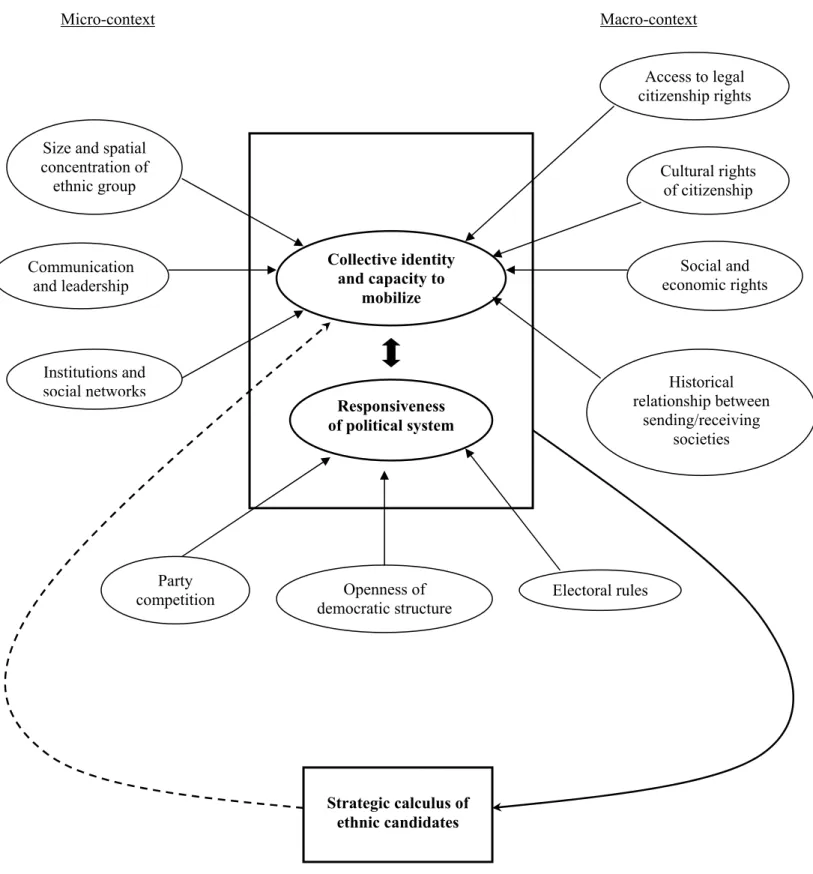
With these challenges in mind, Figure 1 presents a preliminary framework for explaining differences in levels of ethnic representation across countries, and across different localities within countries. At the centre of this figure lies the “political opportunity structure” for ethnic minority representation, a concept that includes both the degree of collective identity within ethnic groups and their capacity to mobilize members politically, and the responsiveness of the party and political system to ethnic mobilization. The recursive arrow between collective identity/capacity to mobilize and responsiveness of the political system suggests stronger ethnic mobilization will produce greater political responsiveness, but also that a more responsive system will tend to generate greater ethnic mobilization. The political opportunity structure for ethnic
minority representation is shaped, on the one hand by the characteristics of ethnic minority society, and on the other by the formal rules of citizenship, political participation and representation. These features shaping the political opportunity structure can be summarized in terms of “citizenship regimes,” “interest constellations,”
and “institutions.” Some features – like the rules of access to citizenship – vary at the national level. Some – like electoral rules – vary at the national level, but also across political levels within a country. In addition, many features vary locally, producing quite different structures of opportunity for ethnic political
representation in different communities and constituencies.
“Citizenship regimes” includes the rules of access to citizenship (legal rights), and the cultural rights of citizenship (cultural assimilation or cultural pluralism). Together, these two dimensions comprise a conventional typology. Regimes may offer easy access to citizenship, with expectations that immigrants will assimilate to a national culture (e.g., France), or that they may maintain their cultural identity (e.g., Canada).
Or regimes may make access to citizenship more difficult, with limited expectations of assimilation (e.g., Germany). In countries where immigrants enjoy easy access to citizenship and voting rights, and where ethnic minorities are recognized as possessing a distinct culture and set of interests, they should be more likely to mobilize and achieve political representation as a group. Countries that are officially multicultural may even have formal measures in place to promote ethnic minority participation and representation in politics. Within regimes, patterns of political mobilization and representation may vary significantly for different groups, even when they are subject to the same formal rules and rights of citizenship. One important consideration is the principle source of immigration and ethnic diversity, and the historical relationship between receiving and sending societies. For example, post-colonial migrants and their descendants may be subject to old colonial stereotypes, and may be viewed by the majority population and by party leaders as less qualified to participate in the task of government. Another important element of a citizenship regime is the extent to which it
produces equal social and economic rights. Where large portions of the ethnic minority in a country are unemployed or segmented within the labour force, if they are poor, or lacking in basic educational and health services, they are less likely to enjoy the resources necessary to achieve political representation.
“Interest constellations” refers largely to the characteristics of ethnic groups themselves. Included here are the size, spatial density and location of the ethnic minority population, the completeness of its social institutions, and resources such as communication networks and leadership (McAdam 1982). All things equal, larger ethnic groups are more likely to achieve representation than smaller groups. Ethnic groups may do especially well if their spatial location corresponds with electoral boundaries, if they have a strong social network and can be mobilized to vote as a bloc, and if they are located in a competitive constituency where they can deliver seats for one party at the expense of another (Crewe 1983, 268). Yet parties will also be cautious to avoid being identified exclusively with the interests of ethnic minorities. In order to win elections, they need to garner votes not only from the ethnic community but also from the rest of the population. Thus the presence of competitive anti-immigrant parties probably reduces the likelihood that other left- and right- wing parties will seek ethnic minority candidates.
Important “institutional features” which impact the responsiveness of the political system to ethnic mobilization include electoral rules, the cost of political campaigns, the level of party competition, and the openness of the democratic structure. Electoral rules are a crucial feature. Elections run using single member districts (SMD) can produce ethnic minority candidacies, but only where minorities are spatially concentrated within the boundaries of those districts. Proportional representation (PR) combined with preference voting features – where voters are allowed to alter the position of candidates on a party’s list – is probably the most advantageous electoral system for ethnic minorities. Within this system, parties understand that it is useful to include ethnic minority candidates, because of their ability to attract a large number of personal votes among ethnic communities, plus the system has the additional merit of promoting political mobilization among ethnic groups. Countries with a more participatory democratic culture may be more likely to draw upon the
leadership resources of ethnic communities, while those with a more elite culture may be resistant to promoting political outsiders as candidates. Factors such as strong party competition and a high degree of legislative turnover may also make political systems more open to ethnic candidates.
While these features can be understood as shaping the opportunities for ethnic representation in a general sense, we must not neglect the role of individual candidates. While parties may be using ethnic candidates instrumentally as part of vote-winning strategy, many ethnic candidates themselves use ethnicity in a selective and entrepreneurial fashion. Impression management of one’s identity is a particularly important element of political strategy for ethnic minority candidates. Whether an ethnic candidate seeks to mobilize support among his or her own minority group, or among the majority population, or both, is a strategic choice (Necef 2002, Saalfeld 2002). As conceptualised within Figure 1, ethnic candidates will develop an electoral strategy based upon the political opportunity structure within their country and/or local community.
Especially if they choose to address themselves to the ethnic minority community, these candidates in turn become a factor in the political identity and mobilization of those groups. However, ethnic candidacies are rarely pitched exclusively toward ethnic voters. One of the most interesting characteristics of successful ethnic minority candidates is the way they manage the multiple and sometimes contradictory demands of their
political party, their own ethnic community, and majority voters. Our research also suggests that ethnic minority candidates may adopt different strategies, and enjoy different avenues of access to political office, depending on whether they are male or female.
Figure 1: Conceptual Framework for the Comparative Analysis of Ethnic Minority Representation
Micro-context Macro-context
POLITICAL OPPORTUNITY
STRUCTURE
POLITICAL OPPORTUNITY STRUCTURE
Collective identity and capacity to
mobilize
Responsiveness of political system Size and spatial
concentration of ethnic group
Institutions and social networks Communication
and leadership
Access to legal citizenship rights
Cultural rights of citizenship
Social and economic rights
Historical relationship between
sending/receiving societies
Electoral rules Openness of
democratic structure Party
competition
Strategic calculus of ethnic candidates
The French case
French law makes it impossible to count the size of the country’s ethnic minority population, though estimates place the total number of non-European foreigners, immigrants and their descendants, along with migrants from over-seas departments living within the French “hexagon” at over 7 million (or about 12 per cent). In contrast, it is quite easy to count the number of ethnic minorities elected to French political office.
There is none among the 574 representatives in the National Assembly.7 Nor is there a single ethnic minority among the 321 members of the French Senate.8 Until the most recent cantonal and regional elections held in March 2004, there were just 3 ethnic minorities among more than 4,500 conseillers généraux seated within the 96 departmental parliaments across France, and just 5 ethnic minorities among the more than 1,700 conseillers régionaux seated across 22 regional parliaments.9 Of more than 36,000 French cities and towns, just three are led by a mayor of minority ethnic background. Regardless of the evidently complex relationship between numerical and substantive representation (Stasiulis 1997), or of the difficulties of comparing ethnic minority representation across countries, the French statistics on ethnic minority representation signal a dire situation. It would be an understatement to suggest that ethnic minorities in France tend to be politically marginalized. There is likely no democratic state in the world where ethnic minorities are excluded from formal political office to a greater extent than they are in France. What are the reasons for this level of political under-representation?
The French approach to citizenship and integration. Of the three countries examined in this paper, France has the least open citizenship regime. Access to French nationality is based on a mixture of jus soli and jus sanguinis: most children born on French soil to immigrants or non-citizens are granted French nationality immediately, as are children born outside of France where at least one parent is a French citizen. For others, nationality can be granted after five uninterrupted years of legal residency (compared to seven years residency in Denmark, and three years in Canada). With legal citizenship come full political – including voting – rights.
7 In fact, in the history of France, there has been just one parliamentary representative who was a visible minority. This was Kofi Yamgnagne, the Togolese-born Socialist deputy for Finistère from 1997 to 2002. We are not counting the representatives of French over-seas departments, territories and collectivities
(Guadeloupe, Martinique, Guyana, Reunion, Mayotte, Wallis and Futuna, French Polynesia, New Caledonia, Saint Pierre and Miquelon, and Mayotte). The populations of these constituencies are over 90 per cent indigenous origin and less than 10 per cent European origin. Fifteen of the 22 members representing these constituencies could be considered “visible minorities” in the French legislature.
8 However the Socialist Party is set to promote a woman of Algerian origin, Bariza Khiari, to the Senate in the next election.
9 Conseillers généraux are directly elected by canton, using SMD majority rules (the winner must receive at least 50 per cent of the vote, in elections taking place over two rounds), for a term of 6 years. Conseillers régionaux are elected by list, using PR, with the additional requirement that an equal number of male and female candidates be included in alternating order on every list. Following elections held in March 2004, the number of ethnic minorities elected at the cantonal level remained constant, while the number at the regional level appears to have increased to approximately 20.
Increasingly however, legal citizenship is not an exclusive precondition of political rights (Hammar 1990). In Europe, the terms of the 1991 Treaty of Maastricht, have established the legal notion of citizenship of the European Union. From this principle, non-citizens living in France who are citizens of another EU- member country enjoy the right to vote and stand for office in local and European elections in France. Non- European foreigners in France do not enjoy this right. Throughout the 1980s and 90s, immigration
organizations called for municipal voting rights for non-Europeans, but this demand has been continually rejected by the French state. The strongest political resistance to local voting rights for non-European residents has come from the Senate. While granting foreigners the right to vote at the local level in France would likely alter the composition of local governments, the more significant political impact would be at the Senate, whose members are elected indirectly; they are chosen by an electorate comprised mainly of locally elected representatives. French parties may voice support for local voting rights for foreigners in the National Assembly, as the Socialist government did throughout the 1980s, in comfortable assurance that the necessary constitutional changes would never be approved by the Senate.
In theory, the length of residency requirement for nationality and the lack of voting rights for third- country nationals dilutes the size of the politically eligible ethnic minority, and limits the capacity for political mobilization among this group. However, France is in fact a relatively “old” immigration society, such that a large proportion of visible minorities are now second- and third-generation citizens. Also, a sizeable number of visible minorities are internal migrants from French colonies or overseas territories, and these people have always been, in a legal sense at least, full French citizens.
More significant than limited legal rights are the limited cultural rights granted ethnic minorities under France’s assimilationist model of citizenship. Immigrants to France, and their descendants, are expected to give up their cultural identity, linguistic distinctiveness, and so on, in order to become full members of civic society, and France has traditionally viewed the retention of ethnic identity as an obstacle to both integration and national solidarity. In the past, this has meant limited rights of association for ethnic minorities.10 France's long tradition of equating French citizenship with equal treatment has also meant that the state has not tracked ethnic origins in official statistics, unlike in Canada, the United States or Great Britain. This has made it legally difficult to track and punish acts of racial discrimination. It has also meant that, until recently, there has been little attention in France to the problem of descriptive under-representation in political assemblies.
The parity law, passed in 2000, and requiring an equal number of male and female candidates for most French elections, has produced something of a shift in the traditional French approach to
undifferentiated representation.11 As well, since the mid-1990s, discrimination has become a new
10 For example, until 1972, the basic 1901 law on the right of association did not allow ethnic groups to form their own associations.
11 Other events as well suggest that the traditional French republican principles of non-differentiation among citizens are increasingly unworkable. There is, for example, the introduction of the PaCS, allowing the right
preoccupation of French authorities and scholars. Slowly breaking with the French model of integration that emphasized French identity over ethnic identities, new terms have emerged to help identify these
communities, such as the “second generation” or “persons born in France of immigrant parents,” and new movements are arising to challenge the political marginalization of these groups. While these terms have helped to bring to light issues of discrimination and political marginalization, neither of them is fully appropriate to define the particular groups still denied social and political equality in France.12 This marginalization is a consequence of French colonial history, and the particular patterns of migration and settlement that occurred in the wake of de-colonization. Stéphane Pocrain has coined the term “the children of colonization” to describe those – principally North African Arabs, Blacks, and Asians – who have been relegated by the colour of their skin, the national origin of their ancestors, or the sound of their names to the periphery of French citizenship.13
Political competition for ethnic votes. Political events since April-May 2002 have also begun to propel the problem of under-representation of ethnic minorities out of the shadows. In the national presidential elections at that time, France and much of the rest of the world were shocked as the extreme right-wing candidate Jean- Marie Le Pen reached the second-round for a run-off against incumbent Jacques Chirac. Chirac claimed victory over Le Pen by an overwhelming 82 percent majority, a result that led to throngs of young citizens of ethnic minority descent to celebrate in the streets. Chirac’s elevated score in the second round reflected the votes of traditional left-wing voters, as well as a significant mobilization ethnic minorities, registering their opposition against the extreme right. This moment of massive support from ethnic minority voters presented a window of opportunity for the moderate right, and wakened the left to the realization that they could not necessarily count on ethnic minority votes (Bernard 2003, Bourtel 2003, Laurence 2003).
The response thus far among French parties has been largely symbolic. On the government side, a handful of ethnic minorities have been appointed to visible government and bureaucratic posts in a clearly of civil unions for homosexual couples. We would also include here the new “positive discrimination” policy adopted by the prestigious Institut d’Etudes Politiques in Paris of exempting from competitive entry
examinations applicants who have graduated from a high school within a designated geographical zone. These so called “ZEPs” or education priority zones are determined in part by the proportion of immigrants and foreigners living in a neighbourhood.
12 The term “second generation” obscures the fact that these citizens – increasing numbers of whom are now the grandchildren of immigrants – are fully French in terms of nationality and formal education. How many generations, ask the political movements defending these groups, will it take for them to be considered French? Neither is the term “persons born in France of immigrant parents,” an accurate description of the most marginalized groups in French society. While Nicolas Sarkozy (the French minister of finance and an aspiring presidential candidate) is the son of a Hungarian immigrant, he is clearly not what most French mean when they speak of persons of immigrant origin.
13 Pocrain is the initiator of Égalité effective, an equal rights movement explicitly for ethnic minorities. The movement has launched a national petition, 100,000 pour l’égalité effective, which can be viewed at http://www.egalite-effective.com.
opportunistic effort to focus the expectations and frustrations of the ethnic community, and to encourage it to support the governing UMP (Union pour la Majorité Presidentielle).14 Yet these individuals tend to lack influence within policy circles, and to enjoy little credibility among the minority population. A new openness has also begun to develop within the UMP over affirmative action – a policy generally considered
incompatible in France with equal citizenship.15 The Socialist Party has responded differently. On the one hand, its response to ethnic diversity has been more democratic. At the party’s annual congress in May 2003, members generated a thematic contribution, entitled Lutter contre les discriminations politiques au sein du Parti socialiste, intended to promote more ethnic minorities within the party leadership. Following the approval of this text, the party elected two people of French-Arab origin as national secretaries (there had been none). It has also selected one of these individuals, Bariza Khiari, as a candidate for Senate, making her likely to become the very first ethnic minority in that body. On the other hand, the Socialist Party seeks to uphold its popular image as the more republican, egalitarian, and anti-clerical alternative to the traditional right, and is more austere in the face of emerging ethnic identities – especially religious identities. The Socialist Party has supported, more strongly than the right, the new law banning headscarves in public schools.
During regional elections held across France in March 2004 there was, for the first time,
considerable attention paid by all parties and by the mainstream media to the inclusion of ethnic minorities as electoral candidates (Hassoux 2003, Lahouri 2004). Attempting to capitalize upon ethnic minority support generated during the presidential election, the UMP promised a strong showing of “candidates of foreign origin” in eligible positions across its lists. Tokia Saifi, with her ministerial advisor (and spouse) Amo Ferhati, vetted 300 local councillors of visible minority background to prepare of a list of potential candidates, which they presented to the party leadership. Yet the party bowed to its local barons who largely control the
candidate selection process, and the UMP lists for regional elections ultimately included fewer than six visible minorities in eligible positions (none was elected). Several immigrant-origin candidates who were not in a position to be elected abandoned their candidacies in protest (Askolovitch 2004, Auffray 2004). Tokia Saifi expressed her deception with the party, but was then quickly silenced. The Socialist Party also failed to
14 A few days after the presidential elections, and to great media attention, the government named the first ever ministers of French-Arab origin. Tokia Saifi – the daughter of Algerian immigrants – became the new Secretary of State for sustainable development; and Hamlaoui Mekachera – a former Algerian officer in the French army – was named minister for veterans. The government also named four people of French-Arab origin to ministerial advisory positions. And in the UMP, five of 81 national secretaries are now visible minorities. Yet still, in the parliamentary elections in June 2002 – carried by the UMP – not a single person from the North African community won a seat.
15 Nicolas Sarkozy, now the finance minister but formerly the interior minister, has taken a nuanced but clearly pro-affirmative action position, as one prong of a strategy to increase his personal popularity, as he looks forward to presidential elections slated for 2007. As interior minister, Sarkozy also appointed the first French-Arab prefect to administer national policy at the departmental level.
nominate significant numbers of visible minorities yet managed, thanks to the party’s overwhelming victory in these elections, to elect approximately 20 to regional council seats across France.
The Communist Party was most proactive in the selection of visible minority candidates. Reeling from deep losses in the 2002 parliamentary elections, the Communist strategy in Ile-de-France (Paris) and five other regions was to form an alliance across a multitude of civic associations, including many devoted to anti- racism and human rights. Running under the banner “Parti Communiste – Alternatif Citoyen” the party selected one-third of its candidates from among community leaders, and a large number of these were visible minorities. Most notably, the party placed Mouloud Aounit, the leader of the anti-racist association MRAP, at the head of its list for Seine-Saint-Denis, a Parisian suburb with a large ethnic population. Aounit’s list won over 14 per cent of the popular vote in the first round, and excellent score for the Communist Party.16
Another interesting feature of recent French elections has been the formation of a growing number of
“ethnic” lists, largely as a symbolic statement of protest at the exclusion of ethnic minorities by the traditional parties. The most newsworthy of these was the Liste Motivé(e)s in Toulouse during municipal elections in 2001,17 but similar independent lists sprang up throughout the suburbs of major French cities during this time.
Frequently, these lists are organized by young ethnic men and women who have refused a position (often near the bottom) on the major parties’ lists, where they feel they are used as token minorities – “Arabes de service”
– intended to mobilize minority youth support for the party. In many cases, these youths have achieved leadership experience working as mediators for their city government within the local housing estates, yet feel that their views and perspectives are ignored by city leaders (Masclet 2003). The increasingly hostile climate for practicing Muslims in France may lead to a greater number of such ethnic protest lists. For example, the cantonal elections in March 2004 (run simultaneously with regional elections) saw for the first time an independent slate of Franco-Arab candidates.18 Within major parties, especially the Socialist Party, it is clear that ethnic candidates are expected to obscure their particular identity (especially their religion) and align themselves completely with republican discourse (Gessier 2004). It would be unthinkable for any major
16 The Aounit story is an interesting one. In the second round, the Socialists won Ile-de-France, leading an alliance of left-wing parties. As a condition of this political coalition, the Communists had been promised four (of 15) of the vice-president positions on regional council. But when the Communists nominated Aounit to one of these seats, the Socialists refused to approve him, citing his opposition to the headscarf ban as well as inflammatory pro-Islamic remarks that Aounit had made while head of MRAP. The Communists held firm, refusing the fourth seat rather than replacing Aounit. There are still no visible minorities among the executive council for Ile-de-France, and there are just five among all 209 councillors (2.4 per cent). Visible minorities make up over 20 per cent of the population of the Ile-de-France region.
17 That the Liste Motivé(e)s was co-founded by a popular rock group certainly added to its media interest.
18 The party presenting these candidates, the Union Française pour la Cohésion Nationale, described these candidates as representing “those without a voice…who are being shunted socially, politically, economically, those victims of everyday racism who are characterized as mistreating their wives and daughters, who irrespective of their personal horizons live in social, professional and cultural insecurity…” The party also presented a list for European elections in June 2004. The head of this list, Faouzia Zebdi-Ghorab, is an observant Mulsim woman.
French party to nominate a woman wearing the hijab (headscarf). Conversely, these parties view as particularly attractive candidates, Franco-Arab women who have publicly criticized the headscarf and therefore stand as models of successful integration.
Interest constellations. This level of competition for the ethnic minority vote in France is a very recent phenomenon. It is a consequence of the political emergence of a spatially concentrated generation of relatively youthful, (principally) Franco-Arab citizens, many of them in their mid-20s to 30s. But what is interesting about the French story is how little the parties responded to this population in the past. Olivier Masclet (2003) suggests that there has been, from the mid-1970s, a deep fracture between political parties and the inhabitants of the working class and increasingly ethnic housing estates on the outskirts of large cities like Paris, Lyon and Marseilles. Despite their numbers, and despite the fact that an increasing proportion of ethnic minorities in France enjoy citizenship and formal voting rights, this population has become more deeply marginalized, politically and socially, over the last 30 years. Especially where we would hope to see politically accountable visible minority representatives – within local governments across the banlieus of major cities, where there are dense concentrations of citizens of immigrant origin – they have been almost completely marginalized from politics. Yet this is not because the population of the banlieus has been lacking in associative life and organizational capacity. Rather, there has been a failure – by the left in particular – to capitalize upon the rich and lively associative life within these neighbourhoods. Many of the youth of the banlieus are highly active in associative society – organizing local clubs and associations (all generously supported by the French state), and working to mobilize other youths. They are quite deliberately making full use of the democratic tools they have acquired in French schools. According to Masclet (2003), the left has missed its “rendez-vous” with ethnic minority voters, and with this youthful cadre of ethnic leaders. Today, many young ethnic voters are turning their backs on the left-wing parties their parents supported. They are shifting to the right, and – certainly more worrisome from the French perspective – they are moving into the influence of less secular leadership. There appears to be a notable growth of cultural identity, a return to ethnic and religious origins, among the Franco-Arab youth of the banlieus. Having been rejected by the parties and traditional political class, these young citizens are increasingly seeking other resources for their collective mobilization.
A key element of the political alienation of the ethnic minority population in France lies in the history of social housing development in the impoverished suburbs. During the immediate post-war period of reconstruction, left-wing city governments developed these banlieus into thriving subsidized housing estates (known as HLM or habitation à loyer moderé), inhabited by French workers and their families. In some cities, as many as four in five dwellings might be subsidized housing allocated by the city. Through this “first age of municipal communism” left-wing parties relied on the HLM-dwellers for political support; indeed many of the cities throughout the so-called “red ring” around major urban centres had uninterrupted Socialist or Communist governments for several decades.
But the coincidence of French decolonisation and the rapidly expanding needs of French industry led to a transformation of these neighbourhoods. By the 1980s, the HLM environment had shifted significantly from being housing for workers to being housing for immigrants, and with this came a delegitimization of these areas (Silverman 1992). There was significant physical deterioration of the buildings – in part due to their age, in part to absentee landlords renting to a largely captive population – for which immigrants were viewed as entirely responsible. The banlieus have come to be seen as crime-ridden ghettos and, increasingly, as harbours of religious fundamentalism. The FN has capitalized upon growing anti-immigrant sentiment, to become the number-two party in local politics in many cities. In turn, the left has sought to distance itself from immigrants, apparently convinced that voters would never accept elected representatives of immigrant- origin. In many of these cities then, where the ethnic population runs as high as 30 to 40 per cent, there have been virtually no ethnic minorities elected to local council.
A closed political system. A further part of the problem is that the electoral system and structure of local politics in France tends concentrate power in the office of the mayor (Malibeau 1995), and to afford anyone outside of this narrow elite – including visible minorities – few opportunities for political representation or policy influence. Local candidates run in slates, and elections are determined using a system of semi-
proportional representation.19 The system produces solid, stable majorities, and a particularly powerful mayor – the head of the winning list – who enjoys a six-year term. In addition, most French mayors practice the cumul des mandates (holding different political offices simultaneously at various levels), an advantage that produces considerable pork-barreling for local projects, and that tends to make incumbents quite difficult to defeat. The selection of candidates is largely controlled by the mayor and his local power barons. While the
“tête de liste” may make some effort to include ethnic minorities on his list, they are rarely given key positions (these are usually reserved those very close to the mayor, who are normally intended to succeed him). Power is so centralized around the mayor and a few key adjuncts that token ethnic minority councillors – indeed all other councillors – are almost completely without political influence.
By contrast, the organization of local political institutions in Britain offers many more opportunities for ethnic minorities to participate and formulate policy demands (Garbaye 2000). Local elections take place in three years out of four, providing many opportunities for outsiders to run. In addition, the first-past-the-post system facilitates the election of ethnic minority candidates in wards where they make up a large percentage of the population. Once elected to council, small groups of councillors outside of the mayor’s immediate circle can participate fully in the decision-making process, as decisions are taken by various “parliamentary style” committees organized around policy sectors. In short, the opportunities for ethnic minority
19 Under this system, the winning list receives the first 50 per cent of all council seats, and the remaining half are distributed proportionally. Thus a winning list that receives 60 per cent of the popular vote will actually receive 50 per cent of the first half, plus 60 per cent of the remaining half – for a total of 80 per cent of all seats. The remaining 20 per cent of seats are split proportionally among the losing parties.
representation, and for policy influence are considerably stronger under Britain’s local system of ward-based elections, than under France’s local list system.
The French political system thus remains largely closed to visible minorities, both at the national and local level. The limited cultural rights of ethnic minorities in France, as well as the poor responsiveness of the political system, have tended to diminish their capacity for political mobilization, such that other features – the size and spatial concentration of the minority community, its social networks and leadership capacity – have had little impact on the opportunity structure for effective political representation. Indeed, the French case appears to refute several common assumptions about the factors that may promote ethnic minority representation. The geographic concentration of ethnic minorities has not led to greater representation of their interests, principally because the left-wing governments in those areas faced little serious electoral
competition. Where competition did arise from anti-immigrant parties, the left sought to further distance itself from the immigrant vote. The local electoral system – run using lists and proportional methods of
representation – has not produced more than a few “token” ethnic minority candidates, and most of these are placed in electorally ineligible positions.
This structure also presents limited opportunity for ethnic entrepreneurs. Those who do emerge to obtain some degree of power do so through the traditional party apparatus, and are largely beholden to party and republican doctrine (Gessier 2004). Leaders within the ethnic minority community rarely view them as credible representatives. We have thus seen – in spite of strong cultural and political norms against this strategy – the formation of exclusively or mostly ethnic minority lists for French elections. This is not an effective political strategy in France; it is rather a cry of protest against the almost complete exclusion of ethnic minorities from traditional party politics.
The Danish case
For the first time ever, in November 2001, two visible minority representatives were elected among the 179 members of the Danish parliament. As well, the number of ethnic minorities elected in Denmark’s largest cities has approached proportionality to their number in the population. Statistically, at least, this makes the Danish record on ethnic minority representation better than that in most European states (rivaled only by Belgium and the Netherlands).
Yet, while the statistical representation of visible minorities in politics has risen, the tone of politics – particularly at the national level – has expressed increasing animosity toward immigrants. The present
Liberal-Conservative government that came to office in 2001 ousted the old Social Democratic/Radical coalition. The issue of immigration had dominated the general election campaign. The general tone of the debate was acrimonious, bordering on vengeful. Immigration was projected as the most imminent and serious threat to the history, culture, identity and homogeneity of “little Denmark.” The governing coalition found itself on the defensive, in spite of having pushed through an array of proposals, policies and practices over the previous five to six years which all contributed toward a tighter Danish immigration and integration regime.
The opposition astutely capitalized on a political climate pervaded by diffuse fears, moral panic and
unspecified enemy images. They created expectations that they could not only put a virtual stop to any further inflows of undesirable foreigners, but also that they would be able to reinstate Denmark to its former status as a peaceful, ethnically homogeneous and politically sovereign welfare state. In an important sense, the present Danish government owes its life to the question of immigration, and depends for its continued popular backing largely on its policies and successes in this field. The government has passed a number of laws since 2001 with the effect of restricting immigration and the rights of immigrants. Among them, they have applied a new threshold for transnational marriages, intended to curb family reunifications: marriages between young persons of immigrant origin settled in Denmark can take place only if both parties are over 24 years old (the age of consent to marriage for Danes is 18). And they have abolished national funding for mother tongue education, though the state allows municipalities to fund and offer such courses.
The Danish case then raises a puzzle. Ethnic minority representation appears to be increasing, but this comes in the context of growing animosity toward immigrants and public fear that cultural difference is eroding the universalistic structures and shared ideological presumptions of the Danish state. How were ethnic minority representatives elected in this context? What is their role and their relationship to the ethnic minority population?
The Danish approach to citizenship and integration. Access to nationality and formal citizenship is slightly more restrictive in Denmark than it is in France. However, Denmark does grant local voting rights and the right to stand as a candidate to foreigners. Third-country nationals are eligible to vote in local elections on the condition that they have been resident in the realm for three years prior to election day. European citizens as well as citizens from the Nordic countries enjoy this right on the same basis as Danish citizens, that is without the three-year residency requirement. Denmark thus joins Sweden, Finland, Norway, the Netherlands, Ireland and (most recently) Belgium, as the only countries to offer local voting rights to non-Europeans. The number of third-country immigrants and foreign nationals living in Denmark is rising, mostly through the influx of refugees. Immigrants and their descendents comprise 780,000 of Denmark’s 5.4 million inhabitants, while resident foreign nationals make up another 271,000. Approximately three-quarters of these – or about 15 per cent of the total population – are visible minorities. By far, the largest source country of immigrants and foreign nationals is Turkey, followed by Iraq. Together, the number of migrants from non-European countries is now larger than the number of all EC migrants to Denmark.20 However, the demographic trends and the recentness of Danish immigration are such that a significant portion of immigrants and their descendents (probably over half) are youth. This fact, along with a seven-year residency requirement for nationality, means that as few as 2 per cent of eligible voters for national elections in Denmark are visible minorities. For
20 Denmark population statistics 2004. See http://www.dst.dk/HomeUK/Statistics/Publications/dod.aspx.
local elections – where foreigners may vote after three years of residency – the percentage of visible minorities among the eligible electorate is higher, though the numbers vary from city to city.
Similar to the French system, the Danish political system does not base itself on the recognition of minorities and makes no juridical or political allowance for minority rights and cultural claims based on minority status. However, Denmark has been somewhat less insistent than France on the idea of cultural universalism. For example, Denmark has – until very recently – funded supplementary maternal language education for immigrant school children where numbers warrant.
A key feature of the Danish approach to citizenship lies in the development of its very specific form of universalistic welfare state, based on a high level of public provisions and accessible to all citizens and residents in the country. These costly programs are based on conceptions of social egalitarianism and universalism, but also on the assumption that citizens earn their entitlements by contributing (through taxation) over a lifetime of active work to the maintenance and growth of the national wealth. Cultural belonging and political rights in Denmark are thus entwined, and equality is interpreted to mean two things simultaneously: “cultural similarity” and “political sameness” (with respect to civic rights). In the Danish language, one word – lighed – covers both these meanings. As for immigration and integration, the emphasis in Denmark has been on trying to acculturate immigrants as speedily as possible, by means of public control and regulation, and on extending egalitarian universalism to cover newcomers as well as “old” citizens. The welfare state has long been viewed as a key instrument for the smooth integration of newcomers.
However, over time, immigrants have come to be seen as an increasingly uncomfortable challenge to the welfare state, and cultural assimilation has revealed itself to be more difficult to bring about than
originally imagined. Claims for some sort of multicultural policies have picked up speed, and “old” Danish citizens as well as political actors have started to focus on (and often to ideologically exaggerate) the extensive financial burden which newcomers place on the provisions of the welfare system. This has led to a strengthening of negative immigrant stereotyping: immigrants – especially the newer refugees that make up most of Denmark’s current immigration – are routinely branded as “welfare scroungers” who illegitimately take advantage of a system that was never intended for their benefit.
The perceived breakdown in cultural homogeneity, and the threat that this presents to the
universalistic structures and ideological presumptions of the Danish welfare state, are key to understanding the current politics of immigration/integration in Denmark. Moreover, the growing discomfort with
immigration is partly a product of the Danish conceptual approach to integration. The relatively high level of welfare benefits mean that many immigrants stand to gain little or nothing in terms of real income by getting a job. The state regulated integration process tends to have a passifying effect on immigrants, and to impede their geographical mobility. As well, the close-knit nature of Danish civic society has tended to exclude culturally distinct immigrants from the social and informational networks that are frequently the gateway to participation in both the labour market, and in civic and political institutions. In terms of the macro-contextual features outlined in Figure 1, the picture for Denmark is less clear than was the case for France. The capacity
for political mobilization of ethnic minorities in Denmark is curtailed by restrictive access to nationality, by (somewhat) limited cultural rights, and by certain passifying tendencies of the Danish welfare state. However, it is strengthened significantly by voting rights at the local level. These voting rights, combined with Danish electoral rules, appear to be the most important feature affecting the opportunity structure for ethnic minority representation in Danish politics.
Electoral rules. Elections for Danish parliament and for city councils throughout the country are run using proportional methods (PR) with preferential voting features.21 Unlike the Canadian system of single-member- districts (SMD), candidates in a proportional system run as part of a list that is presented to voters across the whole city. Each list is awarded a proportion of seats equal to the proportion of votes it receives. Within the PR systems used by most countries, including France, the order of candidates on each list is fixed; seats are awarded beginning with the top candidate on each list and working down, until each list has received its proportion of seats. Within such a system, the party selection process is paramount in determining who gets elected; candidates whose parties have positioned them near the bottom of a list are rarely elected. In contrast, the system of preferential voting used in Denmark allows voters to alter the order of candidates on the list.
They may give their vote either to the whole list (a list vote), or to a single candidate (a personal vote).
Candidates with more personal votes move up the list, while those with fewer personal votes are shifted down. Within such a system, it is important for candidates to mobilize voters to participate in the election and to cast their personal vote for them. Ethnic minority candidates in Danish elections generally undertake this strategy, and frequently focus their mobilization efforts on immigrant communities.
There are three positive consequences for ethnic minority representation. First, the turnout for local elections among immigrant voters tends to be exceptionally high in these elections, sometimes even higher than the turnout among indigenous citizens (Togeby 1999, 673). Second, ethnic minority candidates tend to receive higher than average numbers of personal votes, and thus move up the list, often winning city council seats. 22 For example, following the 2001 elections in Copenhagen, the Social Democratic Party obtained 16 seats. Two candidates of non-European origin were placed by the party in 16th and 22nd position (marginal or ineligible positions), but scored 7th and 8th respectively in preference voting. Both were elected. Finally, parties understand that it is politically advantageous to include ethnic minority candidates on the list, because
21 This is also the method used in Belgian local elections, though with slight variations from the Danish rules.
Note that a number of major cities in Belgium have also achieved nearly proportional political representation of ethnic minorities (Jacobs, Martiniello and Rea 2001). This occurred before Belgium adopted (in 2004) its new law granting local voting rights to third-country nationals.
22 It is not necessarily the case that the personal votes received by ethnic minority candidates are cast predominantly by ethnic minority voters. This appears to vary from candidate to candidate, and depends largely upon the electoral and impression management strategy of the candidate. Necef (2002) and Togeby (2003) show that some ethnic minority candidates in Denmark are in fact more popular among ethnic Danes than among ethnic minority voters. As discussed below, there also appear to be gender differences in this respect.