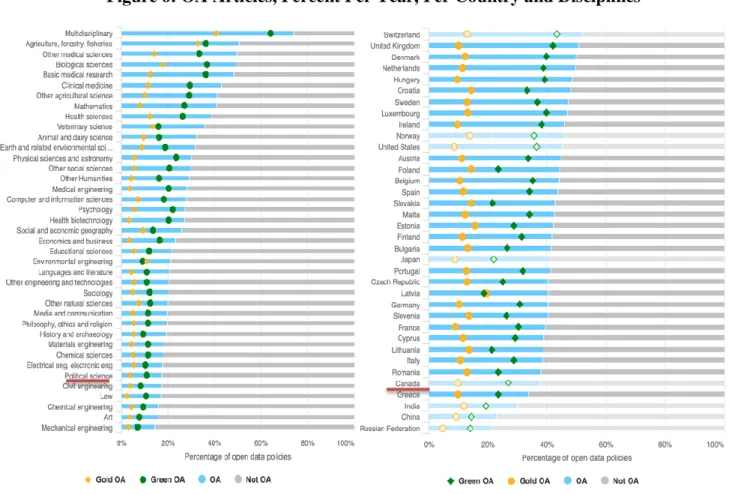
La plus faible prévalence de l’AL dans les sciences humaines et sociales peut s’expliquer par une plus forte résistance au modèle de la voie d’or basé sur les frais de traitement des articles. Il s’agit d’un scénario à haut risque compte tenu de la faible prévalence des frais de traitement des articles dans les revues scientifiques des sciences humaines et sociales.
A Primarily Canadian Journal
This report provides an overview of recent trends in OA and discusses their implications for the Journal, the CPSA and SQSP, as well as for the Canadian political science community at large. The existence of a respected, peer-reviewed, bilingual journal is fundamental to the Canadian political science community. In-depth interviews with members of Canada's political science community in 2016 revealed that the journal is generally highly regarded (Marland 2017).
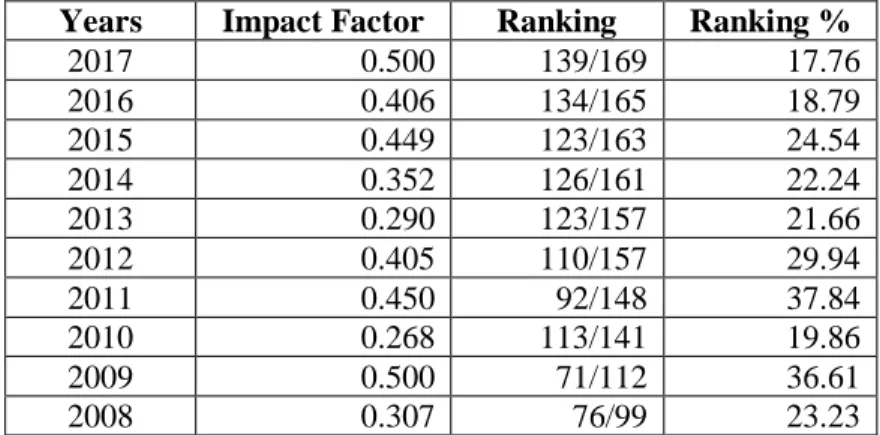
The number of political science journals indexed in Journal Citation Reports (InCites) grew by 59% between 2008 and 2017 (Table 1). CUP is a well-respected not-for-profit publisher that produces and publishes several key social science journals, including the flagship journal of the American Political Science Association and several Canadian journals. As Table 1 shows, the Impact Factor (IF) of CJPS varies considerably from year to year, but its relative ranking among political science journals is slowly declining over time.
It is currently ranked 134th out of 165 political science journals in Journal Citation Reports (InCites).
The Journal’s Business Model
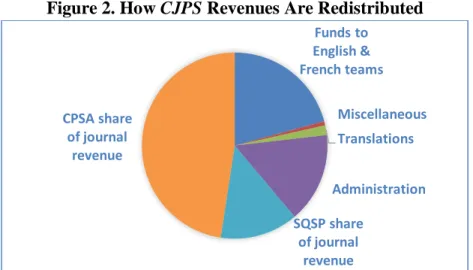
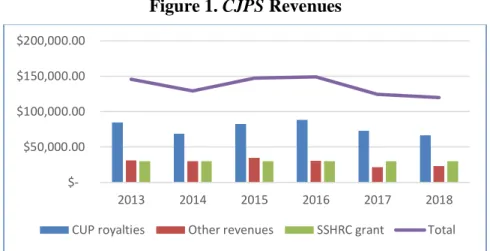
On the expenditure side, in addition to production costs received from CUP, CPSA provides an annual direct transfer of $20,000 to support the English-language editorial team and general management of the Journal, with limited additional funding provided for specific projects and/or or has requested support on an annual basis. In addition to CPSA funding, the English language editorial team's host university provides an equivalent or greater subsidy to cover course tuition and other expenses. Without the dedicated work of the French and English teams, it would be impossible to produce a high-quality and reliable journal dedicated to supporting the Canadian political science community.
For the CPSA, then, the Journal is not only an important platform for supporting the dissemination of Canadian political science research, but is also an important source of revenue that supports a variety of activities beneficial to its members (e.g. , organizing the annual conference, student travel grants [for a total amount of $30,000], POLCAN2 newsletter [with more than 4000 subscribers], PRAXIS Blog, Part-time Internship for Graduate-Students at CPSA Communications, departmental services, meeting presidents' annual, cooperation with sister associations, etc.). The impact of the changing landscape of scholarly publishing and, more specifically, the growing push for OA, will be significant. While it is extremely difficult to predict future subscription trends in light of the changing OA market, CUP's projections for the next five years indicate that overall Journal revenue is likely to continue to decline due to the nature in its changing environment, including increasing pressure for alternatives to the subscription-based model of access to scholarly publications.
Therefore, maintaining the status quo may be difficult in the medium to long term and may not be in the interest of the CPSA/SQSP and their members.
What is OA?
APC (Author Processing Charge): Payment by the author, author's institution, or grant agency to the publisher to cover all or part of production costs. Depending on the publisher, the version of the article that can be published and the time of publication will vary. Several publishers allow publication of an Accepted Manuscript (AM) as revised after peer review.
The Tri Council Statement on OA in Canada supports delayed OA, as does SSHRC's revised ASJ program, but embargoes are not accepted under the current version of European Plan S. The financial viability of this model naturally depends on the willingness to pay for immediate access to compared to simply waiting out the embargo period. Essentially, R&Ps are negotiated agreements between a publisher and an institution (or group of institutions) that enable researchers and students at that institution to access all publications and publish in the publisher's journals without paying APC. It also has agreements with major indexers (Scopus, WoS and Google Scholar), although many of the journals on the platform are not indexed.
La revue de la Société québécoise de science politique, Politique et société, est publiée sur la plateforme Érudit.
Trends in OA Publishing
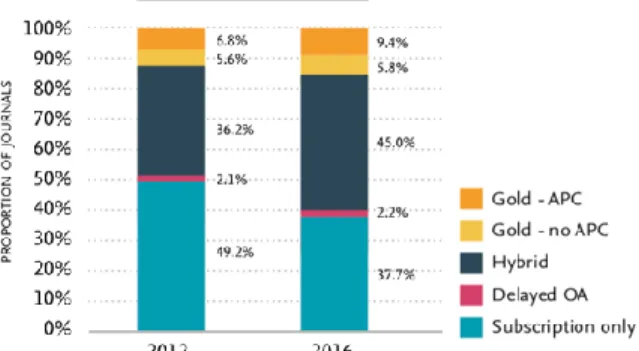
Our own analysis of some of the major Canadian-based HSS journals and international political science journals confirms these trends, with a clear predominance of the hybrid model (Table 3). Only one major HSS journal in Canada, the Canadian Journal of Sociology, operates under a full OA model without APC. Focusing on the share of articles instead of journals, we observe a similar uptake of OA, although the growth is somewhat slower over time.
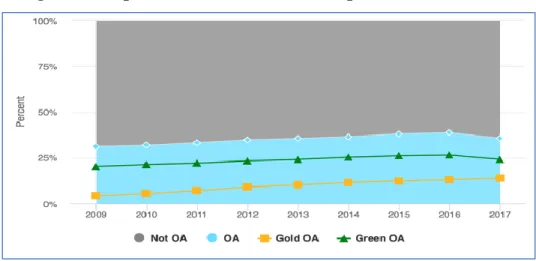
Depending on the methodology used, studies put the total percentage of OA articles at 30% to 40%. Its most recent report found that in 2017, 14% of articles in Scopus published between 2009 and 2017 were available through gold OA (through pure or hybrid journals) and 24% of articles were available through Green OA. Sixty-three percent of articles from the Scopus database published between 2009 and 2017 were not freely available.
Looking at country-specific data, we see that 9.8% of articles published by authors affiliated with Canadian institutions in all disciplines between 2009 and 2017 were available via gold OA and 26.3% via green OA.

Is There an OA Advantage?
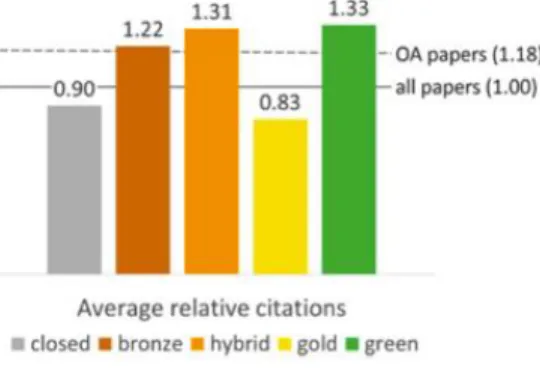
Sixty-two percent of the 514,008 analyzed articles from Canada were behind a paywall, ranking Canada 32nd out of 36 countries surveyed. The lower proportion of gold OA products in Canada in recent years could be explained in part by the tri-agency mandate allowing a 12-month embargo on OA. A recent study by Piwowar et al. 2018) found that OD articles were generally cited 18% more often than non-OD articles.
While articles under green OA and articles in hybrid journals are cited more often on average (Figure 7), articles in gold OA journals are cited 17% less often than average and even 8% less often than articles found only behind a paywall . 2018) notes that the citation impact of gold OA is actually declining in recent years. This poor performance can be partly explained by the rise of smaller and newer gold OA journals, which may be considered less prestigious than other journals and may not be indexed in WoS. There are few studies that focus specifically on political science journals, but Atchison and Bull (2015) find a clear citation advantage for articles published in top-ranked political science journals with a liberal green OA compared to those with a more restrictive approach to self-archiving.
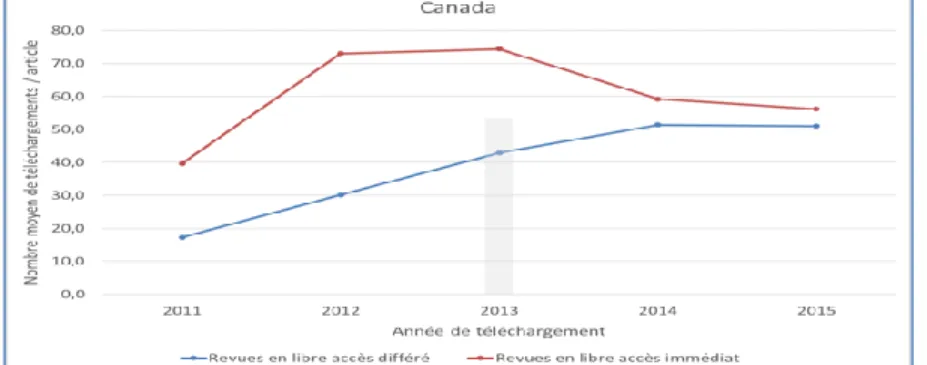
Articles with immediate OA were downloaded an average of 40 times in the first year of publication, compared to 17 times for articles with delayed OA (i.e. still under a paywall).
OA Mandates
The consultations carried out by this committee with the support of the Humanities and Social Sciences Association confirm that many of our sister associations question the lack of flexibility and a unified approach of the new policy. Some of the strongest criticism of Plan S comes from scientific associations and publishers of journals in the humanities and social sciences. At this point, it is difficult to assess the mid- to long-term impact of SSHRC's new ASJ grant requirements or the even more ambitious Plan S.
This information is essential to provide a complete portrait of the journal and assess our options for the future. As mentioned, only two authors have made use of the APC-based gold OA option to date. Is the CPSA membership prepared to take on a larger share of the association's budget through direct membership dues or other indirect fees.
This is a conversation that needs to take place with the wider membership of CPSA and SQSP.
Reinvent the CJPS as a Freely Available, Gold OA Journal
This leads to fundamental questions: should the CJPS and its parent associations be more proactive in promoting OD. If so, how can we achieve this without compromising the reputation of the journal, its quality and business model, and the ability of potential authors who may not be able to pay APCs to publish in the journal. On the other hand, we must be realistic about our ability to reinvent the Journal without affecting its financial position and, consequently, that of its parent associations.
If not, it is willing to accept a reduced role for the association given budgetary constraints. While the final report of this committee will provide some long-term recommendations for the journal itself, these are fundamental questions that go beyond our committee's mandate. For now, we conclude with a number of short-term scenarios for consideration in light of our immediate concerns with SSHRC's new ASJ requirements.
To our knowledge, no major Canadian HSS journal is considering a full transition to gold OA given SSHRC's new requirements.
Move to an OA Friendly, Canadian-Based, Platform
Status Quo
That being said, this option would not only put CJPS under immediate financial stress, it would put us in the camp of resistance, so to speak. If we stay this way, it could potentially put us on a collision course with a growing number of funding agency mandates that could be inspired by Plan S, not just AJS SSHRC policy. Doubling down on a subscription model under these circumstances could put us at a much greater disadvantage.
OA is not a temporary phenomenon and while maintaining the status quo may make sense in the short term, it is unlikely to be a good option in the long term.
Incrementalism
Proportion of open access articles published in peer-reviewed journals at European and worldwide level—1996-2013. At the intersection of open access to research, An assessment of Plan S's possible consequences for publication, research quality and research environments. We've failed: Pirate black open access trumps green and gold, and we must change our approach.
The state of OA: A large-scale analysis of the prevalence and impact of Open Access articles. Will the world accept Plan S, the radical proposal to mandate open access to scientific papers.