A critical review of the literature on the comfort of hearing protective devices: Analysis of comfort measurement variability. Results: The literature indicates that multiple sources of variability in the measurement of perceived comfort are related to the complexity of the concept of comfort and to the different physical and psychosocial characteristics of the triad. Therefore, the aspects of concern should be understood and ideally related to the characteristics of the CPD, the user and his/her work environment.
In the context of the current work, the triad consists of the work environment, the person (the HPD user) and the HPD. A second issue relates to the complexity of the comfort concept for which attributes may examine more than one dimension. Nevertheless, if one wishes to progress in understanding the HPD comfort at present, it will require that the largest possible number of attributes belonging to the various comfort dimensions be included.
As a final example of the importance of a global approach, one can cite the 'occlusion effect' [15]. To the authors' knowledge, to date, only few field studies provide these analyzes by including objective measurements of the environment as independent or control variables [10,17,18]. As confirmation of the potential impact of the acoustic environment on perceived comfort, the National Institute for Occupational Safety and Health (NIOSH) team mentions that their field study should have dissociated workstations subjected to continuous or impulse noise [24].
This positive effect is independent of the surrounding noise spectrum or of the HPD attenuation function. Their study evaluates the effect of physical load on HPD comfort using naive HPD users before and after two exercise modalities: jaw movement (participants read aloud, chew gum, and eat snacks for 30 minutes) and activity movement (participants use a work simulator and perform highly kinematic movements for another 30 minutes). It is worth mentioning that in their study the CI is composed of 4 characteristics of the physical and functional dimensions of comfort and is therefore more likely.
Although this reduces the complexity and cost of the experimental procedure, it may also introduce a bias related to the lack of familiarity with HPDs. These two periods are part of the process of gaining experience in a given earplug and the perceived comfort. A medium-term habituation, also referred to as acclimatization, is also pointed out in the literature and especially for characteristics of the acoustic dimension of comfort.
Regarding the acoustic environment, the listening condition is expected to mainly influence the attributes of the acoustic dimension of comfort. Studies that rigorously analyze the interactions between the user's hearing acuity, HPD properties, and the acoustic environment are primarily interested in the awareness of sounds in an ambient environment (eg, speech intelligibility, sound localization, perception of warning signals. For individuals with hearing loss, important and useful sounds from the acoustic environment may be inaudible or masked due to the combination of (1) the severity of the hearing loss, (2) the attenuating properties of HPD, and (3) the spectral content of ambient noise.
However, other musicians in the same study "found fitting the custom-molded earplugs to be more time-consuming" (p.163) (compared to disposable earplugs) and.
Effect of earplug fitting and attenuation on comfort evaluation
This discomfort is attributed to the silicone used, which "was not flexible enough to cope with the movement of the ear canal and tragus caused by jaw movement" [7, p.83]. The first phase occurs before any interaction between the earplug and the ear canal and can affect the fit quality due to various characteristics of the triad, such as (1) the use of HLPP (including training in the correct use of the HPD or not) or the necessity of regular insertion/removal of the HPD during work, (2) the person with HPD's previous experience or his/her manual dexterity, and (3) the material and shape of the earplugs (eg, difficulty in rolling or inadequate expansion time for roll-down foam earplugs, the presence or absence of a carrier , earplug with or without cable) or the quality of the manufacturer's instructions. The second stage occurs when the earplug is placed in the ear canal (the interaction is effective).
The quality of the fit and its stability over time are then influenced by multiple characteristics of the triad such as (1) work activities, physical load (which includes body, head, or jaw movements), ambient temperature, or the need to wear other personal protective equipment. devices that may interact with the earplug, (2) the size, shape, elasticity or flexibility of the ear canal or the tendency to generate earwax or sweat, and (3) the material and design of the plug (e.g., softness, weight, texture). Fit quality is rarely reported by comfort studies, most likely due to the complex assessment of earplug/ear interaction properties. For this earplug, the subject's fitting procedure is associated with greater physical comfort, most likely because "the plugs were inserted deeper into the trained fitting state and caused more (physical) discomfort as a result" [9, p. 161] .
As mentioned before, the quality of the fit is usually assessed indirectly by the fitting procedure (subject fit vs. trained fit), but a more direct method can also be considered. Visual cues are much more difficult for other families, such as preformed foam or foam earplugs, for which the connection between the plug and the ear canal is internal. The visible part of the earplug (eg the stem) may not give enough information about the quality of the fit.
These systems assess the achieved damping and thus indirectly estimate the quality of the acoustic seal or 'acoustic fit'. FAES systems are promising tools to train employees in the correct insertion of earplugs or to monitor the quality of the acoustic fit during the shift [75,78,79]. This observation confirms results from previous comfort studies that evaluated comfort as a function of fit type (subject-fit versus trained fit) [9,80]: comfort was found to be greater in the subject-fit condition, although this also occurred in was associated with poorer attenuation efficiency of the earplugs.
Due to the high variability of earlobe morphology (see section 3.2.1) and earplug assembly, the attenuation provided by a given plug is subject to significant measurement dispersion as commented on in the extensive literature on this topic [76,81-83]. This inter-individual variability, inherent to the calculation of the attenuation efficiency, is even reported by [1] as a limit for a reliable prediction of the exposure level according to HPD. According to section 3.2.4, the effect of this variability can affect the assessment of acoustic comfort attributes, mainly for individuals with hearing loss for whom situational awareness is more affected by HPD attenuation characteristics (global attenuation and attenuation slope ) [34,35].
Conclusion
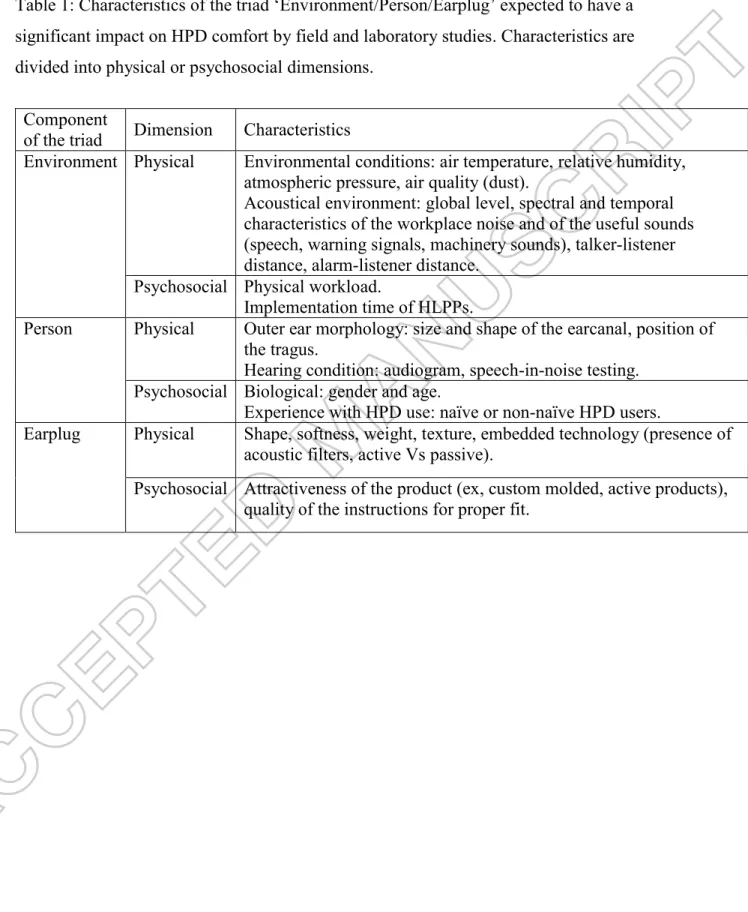
Acoustic environment: global level, spectral and temporal characteristics of the workplace noise and of the useful sounds (speech, warning signals, machinery sounds), speaker-listener distance, alarm-listener distance. Person Physical Outer ear morphology: size and shape of the ear canal, position of the tragus. Psychosocial appeal of the product (e.g. customized, active products), quality of the instructions for proper fitting.
A critical review of the literature on hearing protection comfort: defining comfort and identifying its key attributes for earplug types. An empirical study of comfort provided by different hearing protectors: Laboratory versus field results. Theoretical investigation of the low-frequency fundamental mechanism of the objective occlusion effect induced by bone-conducted stimulation.
Effects of active and passive hearing protection devices on the localization of sound sources, speech recognition and tone detection. Modeling speech intelligibility in a noisy workplace for normal-hearing and hearing-impaired listeners using hearing protectors. Modeling the interaction between the attenuation function of the hearing protector and the hearing loss profile during sound detection in noise.
Effects of fluctuating noise and disturbing speech on the speech reception threshold of impaired and normal hearing. Effects of working conditions simulated in a laboratory environment and user fit on attenuation of slow recovery foam earplugs. Analysis of deformation of the human ear and canal caused by mandibular movement. ed.) Medical Image Computing and Computer-Assisted Intervention – MICCAI 2007.
Symphony orchestra musicians' use of hearing protection and attenuation of custom hearing protectors as measured with two different real-ear attenuation at threshold methods. Effects of noise exposure on auditory brainstem response and speech-in-noise tasks: a review of the literature. Questionnaire investigates musicians' use of hearing protectors, self-reported hearing disorders and their experience of their working environment.
Performance criteria for systems that evaluate the attenuation of passive hearing protectors for individual users. Personal assessment of ear plug attenuation (PAR) in noise-exposed workers: evolution during a five-week follow-up.