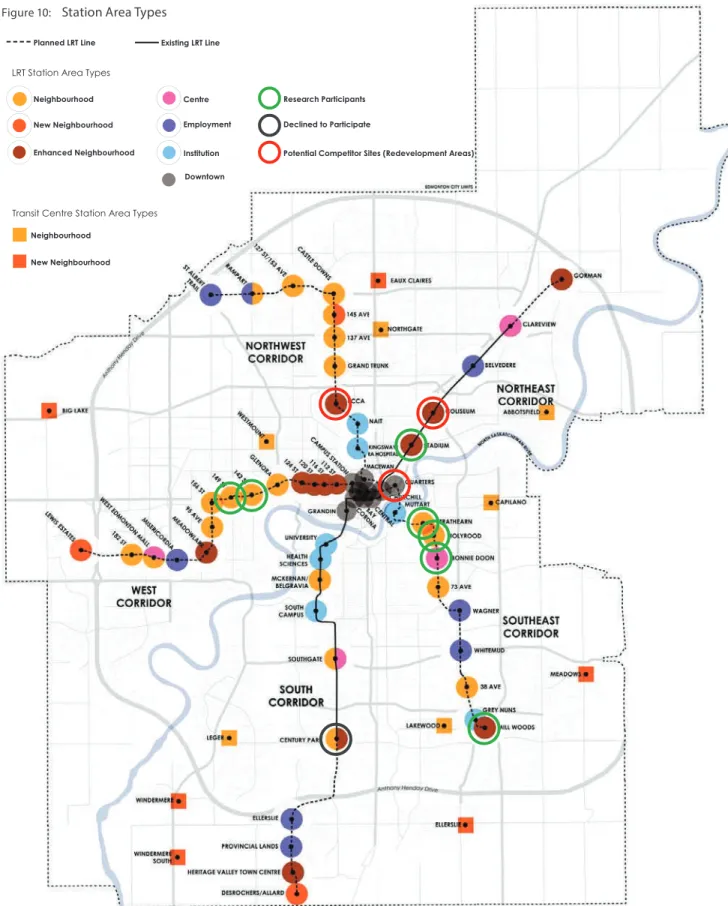
Transit expansion is part of a larger plan to encourage transit-oriented development (TOD) around new and existing transit stations and precipitate a shift toward more dense, efficient land use. This research aims to understand how effectively the City of Edmonton facilitates transit-oriented development (TOD) along existing and planned transit routes and precipitates a shift to more dense, efficient land use patterns.
Facilitating TOD
Developers also identify a lack of effective TOD-specific policy that is integrated with other plans and policies (Utter, 2009; Guthrie & Fan, 2016; Higgins et al., 2014). Factors Influencing Rapid Transit Land Use Change (Higgins et al., 2014) Transit Accessibility Easy access to transit and to various destinations from.
Development Corporations and TOD Authorities
Similar to Denver, Perth, Australia expanded its regional rail transit system in the mid-1990s, and as part of the. Brisbane, Australia has also used a municipal development agency called Urban Renewal Brisbane with great success (James, 2009).
Methodology 3.1 Research Question
Methods
The fourth element of the TOD strategy was the establishment of the post of TOD manager. TOD Guidelines Development of TOD Guidelines that serve as the primary TOD policy document and guide developers, municipal administration and City Council decisions regarding rezoning plans and rezoning applications.
Participants
The ethics review process made it clear to participants that their name and position will be provided, they will be quoted directly, and the research will be made publicly available. Calvin McCourt, director of development at Morguard Investments regarding Bonnie Doon Town Center at Bonnie Doon Station.
Theoretical Framework
Jones' framework focuses specifically on planning and municipal policies that will facilitate TOD rather than broader conditions for success. Understanding how these two frameworks will fit together, with the Higgins et al. 2014) framework used to identify the necessary enabling conditions for TOD and Jones (2006) framework criteria effectively categorized as 'complementary planning' to further explore that issue is essential to understanding the methodology.
Limitations
Findings and Analysis
Background
In the early 2000s, another attempt was made at Belvedere station with the Station Pointe TOD, where a tax increment financing system was implemented in the station area and significant resources were invested in improving the physical conditions of the site, but the poor social conditions in the area, incompatible land use and poor transit integration. Century Park was put on hold after the global recession of 2008, in the following years the original developer of the West Block went bankrupt. At about this time, key elements of the city's TOD strategy were adopted or implemented, such as approval of the Long-Term LRT Network Plan, decision to use low-floor LRT for the Valley Line, and the creation of the TOD Guidelines (City of Edmonton, 2012); City of Edmonton, March 2012; City of Edmonton, May 2009).
Secondly, it is the awareness of the participants about the prolonged and controversial public consultation of Holyrood (Regency) Gardens and the rezoning process that almost caused the developer to abandon the project. All participants spoke of the Holyrood Gardens approval process as an example from which the City, communities and developers can learn.
Transit Technology and Route Selection
I think the mode coming here, which is more of a road car, will move somewhat with the traffic in certain locations, and the track design will be less obtrusive. It has a little bit more of a neighborhood feel and I think that was probably the key for us, especially on that corner we understood that it took away some of the risk of the negative. That's one of the reasons why I mentioned [Valley Line Phase 2], because I'm not sure where that's going to happen along that new line.
Two developers also commented on the fact that ride comfort compared to LRT limits the possibility of a modal shift, which is part of the broader goal of expanding transit and TOD. These concerns center on the fact that some dense areas with visible destinations are not prioritized and that ground assembly may be difficult along some of the routes.
TOD Guidelines and Area Redevelopment Plans
Our overall vision is kind of consistent with what many of the guidelines have said. We were aware of the TOD requirements and we included them in our package and we shaped our language in our proposal to match the TOD requirements of the city. The Holyrood project probably took a year longer than it should and one of the big reasons was misunderstandings around the TOD guidelines.
There was confusion over some of the nomenclature and labeling the city used on both policies. The TOD guidelines provide some necessary guidance at key locations at various stages through the development application process, but developers' indifference to the policy aligns with public sector participants who are skeptic about the policy's effectiveness.
Social and Physical Site Conditions
That's one of the biggest factors in terms of getting people to buy into this area, knowing that it might get some transients flowing through. That park has gone from a very unsafe place to one of the better parks in Calgary” – Stuart Craig (RioCan). Questions were also asked about the physical conditions of the site and station area and the extent to which there was public investment in these aspects of the site.
The city] took a strip of land from us at the facade to house the station's actual platform, and so their platform design was up for debate. We still rely heavily on private developers to step up and take on much of the risk and cost.
Market Conditions
You look at the old municipal airport site, the fairgrounds … all the available spaces that are currently in our market that are vacant … where are these people going to come from that are going to move into these areas. You do site-wide zoning first, and then you proceed with individual phases of development as the market demands.” This downsizing market never really existed, but also because they didn't want to move out of the neighborhood and there wasn't an opportunity for them.
What you're starting to see is some of the older demographics, some of the seniors and the baby boomers are moving out of the homes that they've lived in for so long." – Raj Dhunna (Regency). The reality is that I can still buy a bungalow a block out of the center for less than I can buy a condominium.
The Blatchford Redevelopment and Municipal Development Corporations
Blatchford, a former airport, is now a 217-hectare site managed and developed by the City of Edmonton. I don't think the city taxpayers should foot the bill if they start going over budget and stuff” – Warren Ollis (Brookfield). I think the city definitely needs to have an overlay of its guidelines because you want certain principles to be followed by everyone.
I was in college when these lands were studied by the City about what to do with them. I wouldn't mind the idea of the City having a separate development corporation if it was run separately similar to EPCOR (Edmonton Power Corporation).
TOD Manager and Municipal Administration
I would say one of the big problems with the city is a lack of vision and understanding of the issues associated with large-scale infill development. Probably the city could do more to encourage that kind of thing." – Andrew McLellan (Urban Planner). I think the city actually needs to have someone focused on big products and we actually asked them to do that.
And again, usually it's the developer who is in charge, who brings a concept, and then this is a lot of review and negotiation by the city. We just negotiated a lot and we're trying to pare things down and then find a balance that works for the developer and for the city.
Summary of Findings
This was due to the long time horizon that major projects focus on, at least on the part of large Toronto-based developers, and the perception that changing generational preferences will generate demand. There was strong opposition among all developers aware of Blatchford's redevelopment to the city's approach there, and skepticism among those unfamiliar with Blatchford. This contributed to the skepticism and hostility expressed by most participants towards a potential municipal development/land corporation.
However, some developers were open to the idea because it functioned differently and said they would be open to a company that functioned similarly to the Calgary Municipal Land Corporation, the Canada Lands Corporation or Waterfront Toronto. All participants were open to or expressed a desire for the TOD Manager to take action in this area.
Recommendations Recommendation 1
Review TOD policies
Create a TOD Strategy
Appendices
Appendix 1 – Terms of Reference
Appendix 2 – Redevelopment Areas Ice District
A master plan was selected through an international design competition. Once completed, the site is expected to house 30,000 residents and feature low-emission geothermal energy. The City of Edmonton maintains the site, builds the utility and manages the redevelopment. Due to the nature of the project and the extent of public sector involvement, it was not included in this study, despite being considered a TOD site.
Since the site must accommodate 30,000 residents, this represents a significant intensification (Perkins+Will, 2012; City of Edmonton, n.d.). Given the public ownership of the land and buildings on the land, this was not included in this project (City of Edmonton, n.d.).
Redevelopment Areas
Blatchford
The Quarters Ice District
Source: Esri, DigitalGlobe, GeoEye, Earthstar Geographics, CNES/Airbus DS, USDA, USGS, AeroGRID, IGN and GIS User Community. Sources: Esri, HERE, Garmin, Intermap, increment P Corp., GEBCO, USGS, FAO, NPS, NRCAN, GeoBase, IGN, Kadaster NL, Ordnance Survey, Esri Japan, METI, Esri China (Hong Kong), swisstopo, © OpenStreetMap contributors and the GIS user community.
Redevelopment Area Map Context
Appendix 3 - Station Area Map and LRT Network Plan
Retrieved February 20, 2019, from https://www.theglobeandmail.com/real-estate/calgary-and-edmonton/edmontons-century- park-gets-a-long-awaitedreboot/article33347548/. Policy support for and barriers to transit-oriented inner-city development: Literature review. Retrieved March 19, 2019, from Canada Mortgage and Housing Corporation website:. https://www.cmhc-schl.gc.ca/en/data-and-research/publications-and-reports/housing-mar ket-assessment.
Rediscovering Light Rail: Assessing the Potential Impact of a Light Rail Transit Line on Transit-Oriented Development and Transit Ridership. Identifying and conceptualizing context-specific barriers for transit-oriented development strategies: the case of the Netherlands.