You provided me with very helpful background information: Karen Darch, Mayor of Barrington, who generously gave of her time and shared her story; staff and former employees of the various railways, especially CN and CP; and the trade unions, the Railway Association of Canada and the Association of American Railroads. The objectives of the research include the following: 1) assessment of the scope and quality of NACI's sustainability disclosures.
1 Chapter I: Introduction
2 Background
3 performance. Further research of a holistic nature that looks at proprietary costs and beneficial outcomes
4 relationship change (as shaped by stakeholder theory) that impact the disclosure-engagement dyad in
5 who, in publishing his research on the relationships between social performance, social disclosure and
There is a lack of empirical evidence to support an understanding of the current dynamics in the highly politicized environment of the rail industry. Assuming that residents, local communities and civil society are interested in maintaining community spirit and in truly participating in a well-coordinated consultation and negotiation process (Sénécal & Reyburn, 2006), this research project seeks to explore the characteristics of social sustainability reporting in the recent past with sides of North American railroads as they worked with communities.
7 engagement approaches by highlighting exemplars with good sustainability practices. These
8 Chapter II, Literature Review, provides an overview of the most important literature, which is mostly,.
8 Chapter II, Review of the Literature, provides a review of the most relevant literature, which is mostly,
8 Chapter II, Literature Review, provides an overview of the most important literature, which is mostly . 9 by CN as a strategic maneuver intended to reduce freight traffic through the densest metropolitan area).
10 Research Context
11 Figure 1
12 three policy styles, having benefited from both public and private capitalization as well as both cartel and
13 relevance even in situations where their interests have not been balanced with that of other stakeholder
14 The bureaucratic complexities associated with obtaining environmental approvals on
15 In keeping with this position, a brief overview of the research setting is provided, followed by a
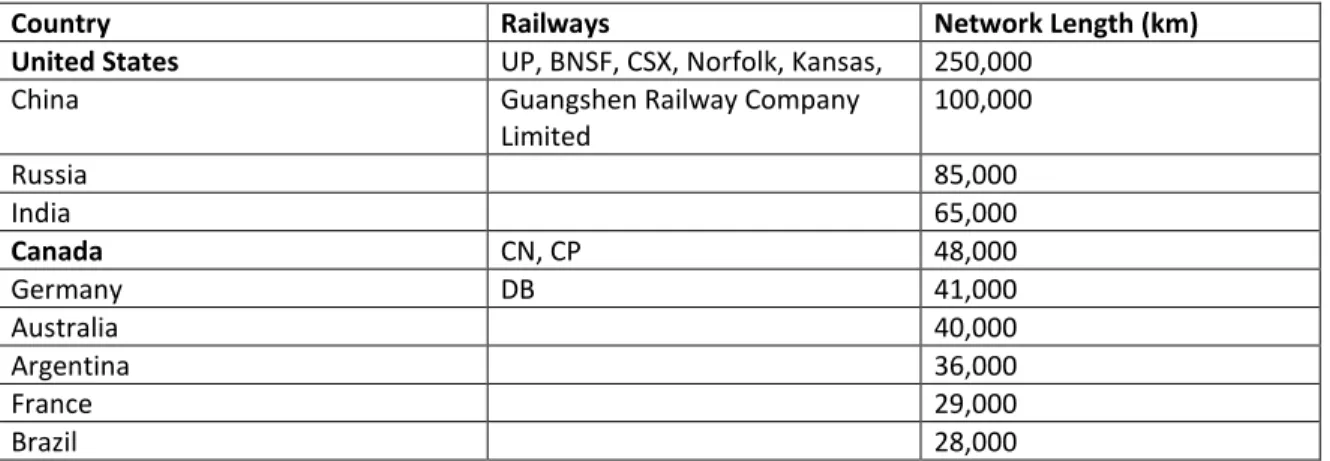
16 Research Setting
17 comprehensive database or listing by the major trade organizations for the NACI—either the Association
18 railway infrastructure in the United States alone, while CN reported having committed $3 billion CAD16
19 One common feature of large infrastructure projects (and perhaps a contributing factor in
20 nature of its involvement, and potential involvement of the private parties in financing, operating, and
21 The challenges of implementing effective strategies and the resources required for collaboration
22 Economic factors such as return on investment, competitive potential, and market forces, in
23 Sustainability
24 focused on the harm to natural systems caused by economic development. To advance meaningful and
In the 11th Annual Business for Social Responsibility (BSR)/GlobeScan of Sustainable Business Survey (bsr.org), they did just that by reporting on some insights into sustainable business as gleaned from the lenses and practices of 125 professionals. of corporate sustainability (of BSR member companies)27. In addition to looking at sustainability priorities, management and sustainable development goals, four focus areas were surveyed which included: climate change, human rights, inclusive economy, supply chain and women's empowerment (bsr.org).
26 sustainability into business which poses a tremendous challenge (CN, Management, 2018; Business for
The survey data are then linked into a matrix (typically four quadrants) with stakeholder interests ranging from low to high on the X-axis and railway interests on the Y-axis. Each quadrant allows for clear distinctions in terms of priority and alignment of issues, allowing comparisons between different perspectives of stakeholder groups.
29 engagement process, making it into a communications or public relations project as opposed to a chance
30 the role of these assessments is becoming more important to the future of CSR reporting” (Greenbiz,
31 Table 3
See also geotechnical events in and the safety of LCs (Canadian Rail Research Laboratory, CaRRL, n.d.). See also geotechnical events in Chapter IV Analysis and Findings section). The GRI is harmonized with other guidelines, such as Organization for Economic Co-operation and Development (OECD) guidelines for multinational enterprises (2019), ISO 26 00033 and the UN Global Compact.
33 financial resources—but also if an obvious linkage between business profitability, stakeholder relations
34 Chapter II: Review of the Literature
35 Strategic Management
37 considered a moral obligation, duty or “nice to do,” where benefits flowed toward constituents (hence
38 engage local communities (and unleash the sustainable benefits of LCs), while others have not achieved
Interactive effects that contribute to a stakeholder's salience and that can be independent of, or borrowed from, other allies. These include the characteristics of a stakeholder's ability to influence a company (power), the stakeholder's relationship with the company (legitimacy), and the extent to which a stakeholder has a claim (urgency) on a company's actions.
40 Stakeholder theory, therefore, emerged out of the following four ideas: the separation fallacy (the idea
41 extends to acknowledgement that LCs are unique audiences deserving of a communication channel that
42 Institutional Theory: A Secondary Role
43 connections between successful sustainability initiatives and specific stakeholder groups, and between
44 Moratis and Brandt (2017) developed a stakeholder engagement checklist to examine the quality
45 Sisodia (2018) argue that “both stakeholder management and stakeholder theory could benefit from a
46 various political and socio-economic realities have contributed to the challenges we see today: the
47 increasingly being viewed as catalysts of change—though few studies have addressed the intersection of
48 stakeholders across the full project lifecycle should be considered if the entire project is to be appreciated
49 all levels of the Canadian economy, were quite severe. We are increasingly experiencing the insistence of
50 Differential Engagement
52 of the quality of disclosure being linked to sustainability performance. A disclosed positive association
Regardless of how content is analyzed (per word, sentence, or paragraph), we recognize that the amount of referencing or reporting may (but does not necessarily) represent the quality of reporting. Using the materiality matrix as a basis for comparison, one area of insight into the quality of the company's reporting can be determined. 54 of simple frequency counts (although that is a starting point) and measured the quality of reporting.
54 from simple frequency counts (although that is a starting point) and has measured quality of reporting
55 engagement (external)—a factor also known to impact the quality of corporate sustainability performance
56 sustainability/corporate responsibility/corporate social responsibility; and one geared to their community
57 Reporting Initiative’s (GRI) sustainability reporting guidelines (standards) to develop a content analysis
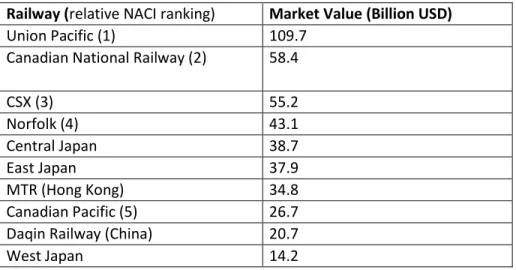
58 top 10 railways (five belong to the NACI45 industry). Perhaps the most salient method of promoting and
59 Motivational Influences
60 performance by complying with more reporting standards rather than by directly improving their
The relationship between environmental and social performance has been linked to financial performance in terms of legitimizing corporate social performance. Margolis, Elfenbein, and Walsh (2009), through their meta-analysis of 192 effects within 167 studies, found that the relationship between corporate social performance (CSP) and corporate financial performance is "strongest for the analysis of specific contribution dimensions charitable. disclosed wrongdoing and environmental performance and when CSP is assessed more broadly through observer perceptions and self-reported social performance" (Margolis et al, 2009: p.2). A positive relationship between social and financial performance tends to legitimize performance corporate social, and this.
62 link is among the strongest when environmental performance and corporate social performance are
The nature of the disclosure may also be linked to the importance attached to the stakeholder group. A close, albeit understudied, relationship exists between sustainability disclosure and stakeholder engagement (Mahmoudian, Lu, Yu, Nazari & Herremans, 2020). The nature of the information can also be linked to commitment via the prominence attributed to the stakeholder group (Mitchell, Agle & . Wood, 1997).
64 information disclosed in sustainability reports. Therefore, developing a greater understanding of the
65 Olcina-Sempere (2018) that an inverted U function describes the relationship between the percentage of
66 Magnan (2016) found that in response to the financial market’s need for information, firms were pressed
67 classified as ‘material’ (to the detriment of each other stakeholder group), but the quality and quantity of
68 as disclosed by North American Class I railways? To provide some context in building the framework, it is
69 negatively impacted (Native American) is mirrored today because of neoinstitutionalism and racism
70 telecommunications, and resource industries, they have maintained their core business activities and
Stakeholder engagement is the practice of identifying and incorporating stakeholders' concerns, needs, and values into the transportation decision-making process. Harrison, Bosse el al (2010) argued that when value creation is approached from a stakeholder welfare perspective, there is additional potential for value creation. Henisz's (2016) approach provides a unique and useful perspective on the role of stakeholders in fulfilling corporate strategy.
73 5) the involvement of senior executives outside the organization for trust-building SE and legitimacy
74 stakeholders (Hahn, 2013). ISO 26000 connects sustainable development with social responsibility and
76 Figure 4
77 Thirdly, Stakeholder Engagement: A good practice handbook for companies doing business in
78 stakeholder engagement (SE) as part of usual business practice has given rise to mixed opinions regarding.
78 stakeholder engagement (SE) as part of usual business practice has prompted mixed opinions related to
79 The concepts of innovation and learning, as influenced by LCs, and techniques and approaches to
80 Project Stakeholder Management
81 processes of project management, including stakeholder engagement and stakeholder management, are
82 The project management maturity model (PMMM) is a tool used to measure the developmental
83 in project management. The SPM3 is based in part on peer input from the 2010 IPMA conference (Silvius
84 incorporated to help in better understanding the relationship between value for local communities and
85 Table 8
86 Figure 7
87 Research on the precipitating factors and outcomes of stakeholder/local community engagement
88 Figure 8
89 Chapter III: Methodology
90 environmental impact assessment and mitigation and stakeholder engagement with 33 local
91 Thirdly, the information asymmetry and differential treatment of local communities by the
92 my postulation of key underpinnings that support the relational structure of NACI and LCs, their outcomes
93 then transformed, with the aid of many conversations with industry professionals, into this study that
94 assurance55 (by external firms), exists. The result of these efforts is the representative nature of the
95 vi. Content analysis—reduction of report content based on codes and compared to other
96 My rationale for using content analysis precedes the detailed explanation
98 (2014) (social sustainability variables, and levels of project management maturity); Moratis and Brandt
100 documents). The three Eurasian railways were selected based on availability of their sustainability reports
101 Table 9
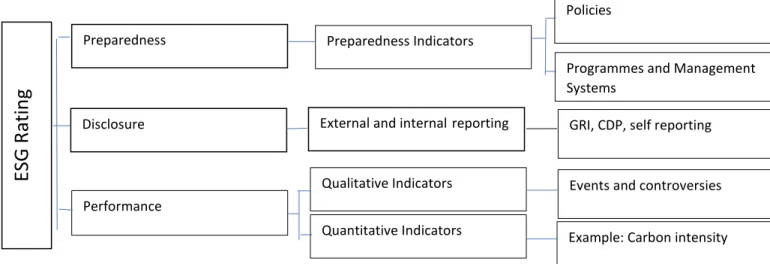
Refinitiv S&P/TSX Composite and S&P/TSX60) that have shown utility in the investment market. Environmental and societal impacts are both considerations in Sustainalytics' assessment of major controversies or incidents. 57 Sustainalytics' website indicates that they create reports of controversies based on incidents that may negatively impact "stakeholders, the environment" and operations, and "how the controversy is likely to evolve" over the next year (www.sustainalytics.com).
104 Figure 10
105 which was based on a defined sample of 2,400 corporations (pre-selected from high performers on the
106 Table 10
107 Sample (iii). The North American sample is comprised of seven railways that produced 5058
108 Eurasian railways whose data contributed to understanding disclosure and SE published their
109 There were intrinsic disadvantages in using secondary data because the information is presented
110 rounds of reviewing, scanning, and reading the reports in greater detail following the first exploratory
The initial round of reading provided a general assessment of the operational context and reporting style, an insight into organizational culture and any progress in social sustainability reporting. Then, according to the topics, the sufficiency of the data volume is checked to determine the need for additional information. Therefore, the process begins inductively, but deductive thinking becomes increasingly important as the analysis progresses (Creswell & Creswell, 2018).
113 associated with a theory that focuses one’s attention for the reduction of information (Wilson, 2014)
114 chosen. If there were any conflicts, we explained our respective choices and clarified the context of the
115 Table 12
116 borrowed quality benchmark variables for reporting from reading reports external to the NACI (other
117 The stakeholder engagement list of methods, and the material topics checklist developed as the
118 examining their context in a holistic manner. Again, content was coded if relevant to any of the variables
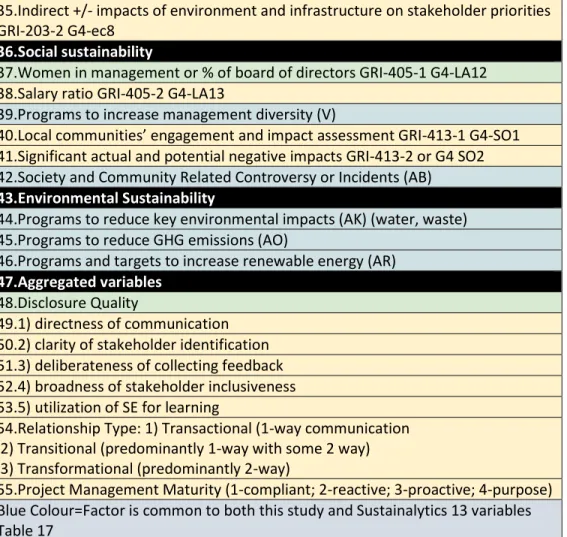
119 Table 13
120 35.Indirect +/- impacts of environment and infrastructure on stakeholder priorities
They recognized them differently from the private sector, where SE is seen as an antecedent to inform the content of quality reports (and post-reporting feedback); however, discussion regarding quality reporting used as an approach to SE is also included (eg legitimacy, corporate capture, trust building, power dynamics). Resulting trends were then broadly contrasted with three Eurasian railways—DB (Germany), Network Rail (UK) and MTR (Hong Kong). These Eurasian railroads have mandatory social disclosure reporting requirements that are not required or standardized for North American railroads.
122 Chapter IV: Analysis and Findings
124 Bahn (DB) of Germany; for engagement, I relied on Network Rail (NR) from the United Kingdom; and for
125 geotechnical events. Several other themes that became evident were excluded for reasons such as if they
126 There was a lack of a publicly available policy (or charter) relating to social sustainability for each
127 greater quality disclosure and effective stakeholder engagement between NACI and LCs occur in
128 for the reporting on significant actual and potential negative impacts. Information related to these
129 Figure 11
130 135) there has generally been small positive change, on average, across the sustainability reporting within
Risk management of dangerous goods (CP), risk and crisis management (CN), risks in the transport of dangerous goods. CSX), Hazardous Waste Transportation (KCS) TRUE TRUE TRUE TRUE.
134 The year 2016 was the last year that all NACI disclosed using structured sustainability reports
For degree of change for each NACI, percentage improvement was calculated as follows: (most recent score-oldest score/oldest score) x 100. For degree of change for each NACI, percentage improvement was calculated as follows: .. most recent available score – oldest available score/oldest available score) x 100.
136 Table 18
137 the Review Panel for the Joint Process, released the 443-page Milton Logistics Hub Project report
138 Table 19
139 Disclosures: Question One
140 cost an estimated $45 million. A remarkable percentage of those derailments happened in small
141 in accordance with federal law that had been in effect since October 16, 2010. The referencing of the
143 CSX, in its Corporate Social Responsibility report, made specific mention linking their safety measures to
144 sustainability report, credited itself with leading the redevelopment of a tank car construction that could
145 Equipment and inspection vehicles that promote technical safety of the infrastructure were
146 railway crossings (on its acquired EJ&E line north of Chicago in the suburb of Barrington) and access points
One of the results of the acquisition was that more freight traffic was redirected.
147 region. One of the outcomes of the purchase was to be that more freight traffic would be rerouted
148 around reduction of crossings in the US was seemingly reported only once by CSX (CSR report, 2012: p.65)
Consequently, because the research is limited and the reporting is not specific enough, it is not possible to determine causality between improved community awareness through effective safety training measures and accidents at grade crossings. Another example involved CN's goal for safety, "a deep-rooted core value." Their 2016 sustainability report stated, “No one gets hurt, and there are no accidents that negatively impact our communities, our customers or the environment” (CN, Delivering Responsibly, 2016). GRI's guidelines and transparency will require CN's management approach on both that is shared.
151 occurred and any corrective action to be taken within a specified timeframe (GRI 403-2 [occupational
152 walking inspections on tracks with lag bolt fastening systems” (Union Pacific, Building America
153 challenge with safety formed part of my observation while participating on a tour of a CN
The Association of American Railroads asserted that, “The freight rail industry is a welcome sight, and its self-sufficiency gives policymakers room to address infrastructure challenges elsewhere. Through these improvements and efficiencies, freight railroads have been able to do more with less—increasing volume approximately 90% over the past 40 years despite a smaller network” (New York Timer, n.d.). The state has invested $287 million in rail projects over the past five years, a spokeswoman for Gov.
CN indicated in their 2018 annual report that their plan focused on creating value through the reinvestment of approximately $3.9 billion in a capital program with an additional “$1.6 billion dedicated to the maintenance of rail and rail infrastructure to support safe and efficient operations. A further $1.2 billion is expected to be spent on initiatives to increase capacity and enable growth, such as expanding rail infrastructure” (p.7). All seven NACI disclosed their philanthropic assistance in both financial terms and in-kind donations.
158 a) CN’s highest proportion of revenue (.0026) occurred in 2010 and has declined steadily to an
159 Table 20
160 It was common for NACI to aggregate the corporation’s giving with employees’ contributions,
161 Theme 5: Environmental Stewardship and Remediation
It's time to pave the way for new ways to help LCs create value. It is well known that the railway offers a sustainable solution to reduce the environmental impact of transport (Borda-de-Água, Barrientos, Beja & Pereira, 2017). In the US, this is essentially the same, at 28.2% – the largest of all contributors (Environmental Protection Agency, n.d.).
164 historic contamination; managing our present through diligent compliance with regulations and
165 management, resource consumption, water conservation, biodiversity protection and ecosystem
166 (b) the absence of any government authority, third-party orders, or claims with respect to sites;
167 In other instances, NACI made it clear that they were attempting to compensate for a previous
Others, including UP, Kansas and Norfolk, have simply stated that they recognize the importance of gender diversity among their workforces without any specific targets for women at the board level. In Canada, CN “adopted a target to have at least one third of the Board represented by women” (CN Delivering Responsibly, 2014). In their report, Diversity Disclosure Practices 2019: Women in Leadership Roles in TSX-Listed Companies, MacDougall, Valley, Jeffrey, Aziz, Black, Cao, Dick et al., (2019) indicated that women hold 18.1% of board seats of companies that disclose this statistic, but that number scales to 30% of S&P/TSX 60 companies.
169 on boards64, a concomitant increase in targeted sustainability experience is anticipated, as well as the
To notify the LC, CN advised that a 24-hour schedule is required to accommodate vessels in Port of Vancouver operations, but advised that they are committed to the LC to minimize impacts. Community mitigation efforts have not been systematically or widely reported by any NACI. In doing so, CN completely omitted to directly address this concern – which the LCs surveyed felt was important – in a direct manner.
171 guidelines’ effort with the Federation of Canadian Municipalities and Railways Association of Canada,
172 planned for an increase of quiet freight cars from 39,600 to 64,000 for 2017 to 2020; and remediation
Aboriginal Rights and Relations
173 Specific NACI Examples. The extent of work with Aboriginal populations is vast, and this would
174 the Columbia River Gorge Commission’s denial of Union Pacific’s rail expansion project67 in the Mosier
In addition to emissions, geotechnical events are partly an outcome of the climate, and due to their importance to the safety and health of LCs, they are included in this analysis. An ever-present reality affecting NACI and LC is the unpredictable and destructive nature of geotechnical events. When geotechnical events occur, affected communities have access points that are blocked for extended periods of time, posing safety and security concerns.
177 landslide-related service interruptions will likely take one or more decades.” Accordingly, at the top of
177 service disruptions associated with the landslide are likely to last for one or more decades.” Accordingly, at the top. 178 regarding communication standards between their supplier networks) indicates the types.
178 related to standards of communications among their network of suppliers) is indicative of the types of
178 regarding communication standards between their network of suppliers) is indicative of the types of. 179 The development of this representative was thought to be important due to the lack of any direct evidence.
179 The development of this proxy was felt to be important because of the absence of any direct testimony
180 various divisions and procedures. The idea of principles that permeate the organizational culture greatly
181 A disconnect exists between NACI disclosure reports and what is either found in the media, in
182 In all companies an opportunity for feedback was also provided. However, this engagement was
183 To appreciate the NACI-LC relationship, the endogenous nature of sustainability disclosures and
184 cumulative 10-year spending for supporting a region was without stating what their most recent progress
185 Table 21