I would like to acknowledge the financial support received from the Alberta Innovates – Technology Futures (AITF) Graduate Student Scholarship. Additionally, I would like to thank the Northern Alberta Institute of Technology (NAIT) and Kings University for their support in conducting the study.
Introduction
Background
In particular, we must consider individual differences in terms of the impact of motivation, prior knowledge and the need for cognition [Cacioppo 1982; Elmborg 2006; Weiler 2005]. While motivation is understood to be a fundamental driver of behavior in all people, the type of motivation, which may include the need for knowledge or cognition, the need for achievement, the need for affiliation, or the need for power, varies individually and influences information seeking strategies. in different ways [Weiler 2005].
Significance
Given the widespread use of web-based learning management systems, it has been noted that even small improvements to these systems can have large overall impacts [Hadwin 2007; Mott 2013]. However, to better understand the learning process, and improve electronic learning management systems, it is important to understand the impact of individual differences on the learning process [DeCaro 2015; Gabrielle 2016; Guthrie 2004; Jonassen 2012].
Research Plan Summary
The study of individual differences will help improve the understanding of self-directed, online learning and could help improve existing learning management systems or lead to new learning management systems [Jonassen 2012; Watson 2007]. The research conducted in this study presents the use of data visualization (concept maps) to help solve sense-making problems associated with self-directed learning in an online, web-based environment.
Literature Review
- Self-Directed and Self-Regulated Learning
- Sense-making and Exploratory Search
- Information Visualization
- Individual Differences
- Learning Evaluation
The COPES model defines conditions, actions, and standards as more malleable components of the self-regulatory learning process, while it defines products and evaluation as less malleable. These types of tasks tend to be more open-ended and require both a broader and deeper understanding of the subject.
Methodology
- Study Design
- Research Questions and Hypothesis
- Topic Selection
- Concept Map Creation and Usage
- Research Tool User Interface
- Data Collection and Questionnaires
- Essay Grading Rubric
- Statistical Analysis
Our study design allows participants to rely entirely on the concept map to complete the task, rely entirely on the search tool, or use a combination of the two tools. The topic provided to participants had to be relatively obscure, so most participants would need to use the research tool and concept map to learn enough about the topic to answer the questions. Similarly, clicking on the cross-link between two terms would display a set of links to the top 50 web pages for that particular cross-link, based on a ranking of the cross-links between the two terms.
21 The research tool pages consist of the login page with the research consent form (Figure 1), the tutorial pages (Figures 2 to 4), the pre-test questionnaire pages (Figures 5 to 7), the essay entry form and concept map page (Figure 8), the post-test questionnaire pages (Figures 9 and 10), and the final completion and logout page (Figure 11). A primary focus of the research was to measure the effects of individual differences on performance, as well as on perceived performance. In this way, an estimate can be made of the amount of time spent on a particular page.
The questions were adapted to suit the nature of the study, replacing general language with specific language referring to "the participants" and "the study". For our study, we used two Perceived Usefulness questionnaires, one to allow participants to evaluate the perceived usefulness of the concept map, and the other to evaluate the Google Custom Search Engine (CSE). The descriptive statistics were frequency measures for each of the four recorded actions (View-Search Link, Enter Search, View-Term Link and View-Term).
For the purposes of this work, the expected coverage of the representative set was set at 25%. As with research question one, t-tests will be used to compare the identified clusters across each of the six post-study variables.

Results
Analysis
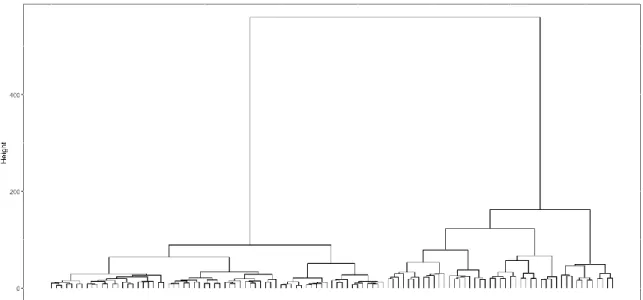
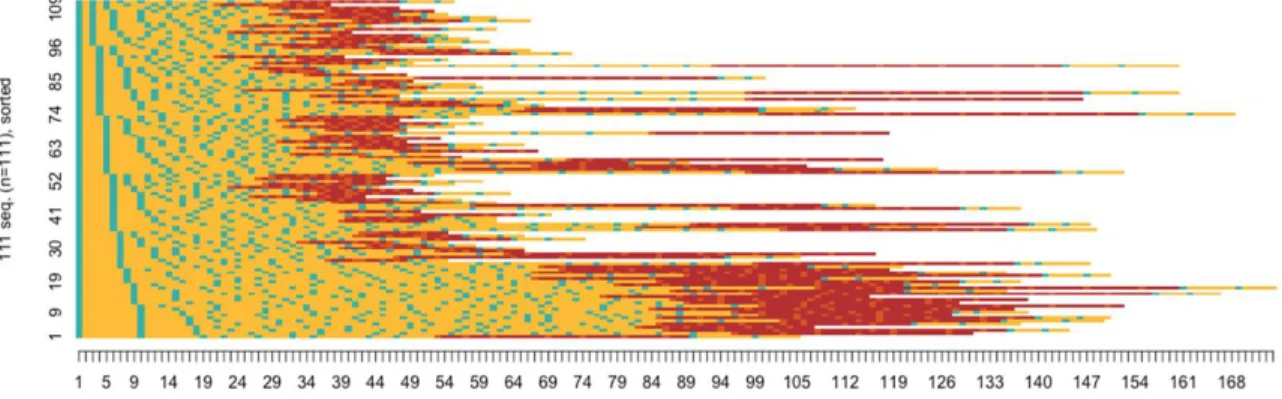
It wasn't until the end of the event sequences that the High Engagement group started displaying the Feed Search and View Search link actions. Although different in sequence length, compared to the High Involvement group, the Low Involvement group representative sequence was similar. For those in the High Involvement group, there was an .810 probability of continuing with the View-Term-Link action, which decreased to .669 for the Low Involvement group.
When switching from the View-Term-Link action back to the View-Term action, the Low Engagement group had a higher transition probability (.296) than the High Engagement group (.176). In terms of moving from the Perform-Search action to the See-Search-Link action, there was a transition probability of 1 for students in the High Engagement group; whereas the probability of remaining in the Perform-Search state was 0. Regarding the transition probabilities of switching from the Perform-Search action to either View-Term or View-Term-Link, these were 0 for High Engagement- the group; the low engagement group had transition probabilities of 0 and 0.018 for View-Term-Link and View-Term, respectively.
Finally, for the View-Search-Link action, the high-engagement group had transition probabilities and 0.020 for View-Search-Link, Perform-Search, View-Link-Term, and View-Term. Regarding the remaining variables, there were no significant differences between the two groups regarding the perceived usefulness of the search tool (high engagement group: M = 3.75, SD. In other words, students with higher perceived prior knowledge were more likely to be in the high engagement group ). Engagement band.
Discussion
In other words, the learner believes they have learned all they can from the concept map and now turn to the search tool to perform specific targeted searches. We predicted a correlation between the strategy participants use to research the topic and explore the concept map, and the essay scores (hypothesis 3). The first behavioral pattern, in which learners use both the concept map and search tools, was observed across all learners.
This indicates a positive correlation between the amount of time the task was completed (time-on-task), and the essay score achieved. Comparisons between the two groups on the four post-study variables (perceived usefulness of the concept map, perceived usefulness of search tool, perceived essay task accuracy and perceived essay task validity) showed that the Low Involvement group had a significantly higher score for perceived usefulness of the concept map than the High Engagement group, with no other significant differences between the two groups. Although there was no difference in the actual use of the concept map between the High and Low Involvement groups, the observed usability scores for the Low Involvement group may reflect the tendency for learners within this group to spend time on task is spent, to minimize.
The positive correlation between time taken to complete a task and essay score achieved reflects a choice to prioritize accuracy and correctness over task time. We hypothesized a correlation between the relative level of motivation and the time the participant spent completing the study (hypothesis 4), and a negative correlation between prior knowledge and the amount of time the participant spent completing the task (hypothesis 5). . In response to RQ2, we found a positive correlation between the time spent completing the task (time-on-task) and the achieved essay score, as well as a positive correlation between perceived prior knowledge and time on task.
Implications
However, in answering RQ1 and RQ2, there is a weak indirect relationship in that perceived prior knowledge is correlated with time on task, while time on task is correlated with essay score (Table 18 and 19).
Limitations and Future Work
Conclusions
57 We expected a positive relationship between student behavior focusing on the use of the concept map tool and student outcomes, with higher essay scores being associated with increased use of the concept map tool. Although we observed an overall higher use of the concept map tool compared to use of the search tool, we did not observe any correlation between the use of the concept map tool and improved performance on the assigned research learning task (ie, completing the essay), or between high use of the concept map tool and high grades usability. Greater use of the concept map tool compared to the search tool may indicate that students perceived some benefit from using the concept map tool compared to the search tool.
Proceedings of the 8th International Conference on Learning Analytics and Knowledge (in press), Tempe, AZ, USA. The effect of cognitive absorption on perceived usefulness and perceived ease of use in online learning: An extension of the technology acceptance model. In Proceedings of the 22nd Annual ACM SIGIR International Conference on Research and Development in Information Retrieval (pp. 3-10).
The committee, acting under the authority of the Athabasca University Research Ethics Board to provide an expedited review process for minimal-risk student researcher projects, has approved your project “Effects of Individual Differences and Visual Information in Search of Learning Strategies in essay writing' reviewed. The AUREB was established and operates in accordance with the current version of the Tri-Council Policy Statement: Ethical Conduct for Research Involving Humans (TCPS) and the policies and procedures of Athabasca University. 2 My goal is to get better search results than most other participants in this study.
4 Using the concept map improved my effectiveness on the task. 5 Using the concept map improved the quality of the work I do. 6 Overall, I found the concept map useful in my task. 4 Using the search function improved my effectiveness on the task 5 Using the search function improved the quality of the work I do 6 Overall, I found the concept map useful in my task.