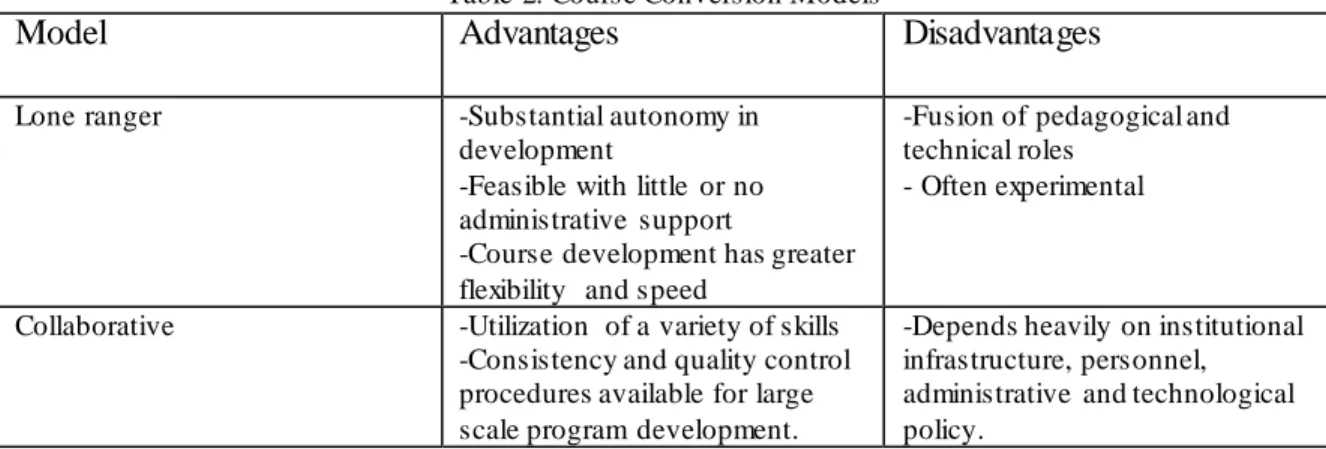
Thanks to my children Aurora and Sergio for their humor as well as their honest and inspiring questions about research. The results of this study provide a starting point toward the design of effective strategies for the development and/or conversion of applied piano courses and indicate the need for further research.
Introduction
Online delivery of applied piano instruction at the graduate level remains to be seen. The purpose of this grounded theory study was to develop a series of propositions that may be useful to instructional designers when working to develop and/or convert graduate-level applied piano courses to online environments.
Review of Related Literature
Research and education in the psychomotor domain can be divided into two lines of research. He defined skill “as the ability to perform some type of task or activity with some degree of effectiveness, efficiency, speed, or some other measure of quantity or quality.” The diagram below shows it. Ferris and Aziz (2005, p. 5) emphasized the importance of designing the practical work component of engineering programs “in a coherent manner to provide experiences that lead to target levels of competency for [specific] practical skills.” The authors concluded that an instructional design framework based on a taxonomy of outcomes for the psychomotor domain will enable more efficient use of laboratory time and instructional resources in engineering programs.
The authors argue that there has been a decline in the study of planning and teaching distance education. Therefore, the debate about the impact on the systematic development of reproductive and productive psychomotor skills in online environments is not discussed. He presented a vision of the study of music that was more closely aligned with the American trend of the time.
Music education in higher education has its roots in the conservatory tradition, of which the student model from the 17th century was the most important starting point. The first generation of academics in music departments most likely trained at conservatories, which allowed for the continuity of the apprenticeship model in higher education. According to the National Association of Schools of Music in the US (NASM) handbook, graduate studies in performance are aimed at developing advanced competencies in applied music.

Methodology
This is consistent with the work of Strauss and Corbin, and the work of Charmaz in developing the methodology. Although there may be differences in how each of these authors approaches some of the stages in the methodology, they all share an overarching constructivist view. Therefore, the position of the master pianist as the leader in the sessions is extremely important.
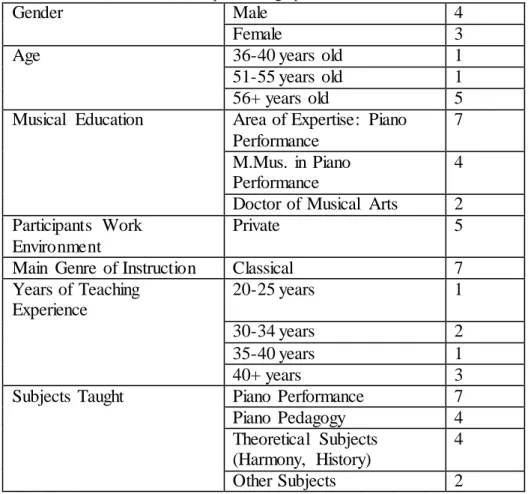
Membership in the Alberta Music Teachers; The association consists of approximately 145 members from various disciplines, including piano, violin, singing, guitar, theory, etc. Such in vivo codes were identified during the analysis of the interviews and are presented in the results section of this paper. In data triangulation, the researcher considered participants who could provide information about the phenomenon from multiple perspectives (Guion, 2002 p. 1).
By stating that this study was conducted as part of the researcher's DE master's degree, prospective participants were able to assess the scientific value of this study and any thoughts of conflict of interest were also dispelled.
Results
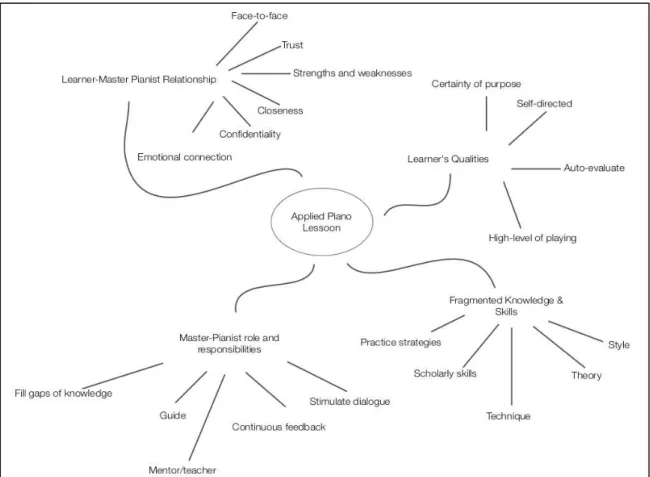
The applied piano lesson is a hub to articulate and apply the learner’s knowledge
The master pianist builds a relationship with the learner that allows both of them to reveal their strengths and weaknesses. These form a framework on which the learner builds, constructs and develops his own understanding and interpretation of the score. The Master Pianist assumes various roles as required to enable the student to retrieve and apply his/her previous knowledge in applied piano and other subjects as well as new knowledge gained during the lesson and other courses through insight, feedback, and lecture- demonstration.
An intellectual person needs explanation, logically in words, and that helps him.” [Associated categories: role and responsibilities of master pianist, qualities of student]. Then experience is very valuable and having done it many times is very valuable, because people are really different” [Associated categories: role and responsibilities of master pianist, qualities of the student, fragmented knowledge and skills].
Barriers
P1: “I learned several lessons over the phone that are not the same but similar (distance learning). I know technology works very hard to get this improved (sound quality) but can't quite say if the sound quality and sometimes the balance but otherwise you can give a pretty general assessment. And of course you can give them encouragement and confidence so they can go to the festival and they played for their teacher." [Associated categories: Technological limitations, Reduced ability to discriminate].
I think it is possible, you can handle many aspects, their game, intellectual development, understanding of the music. Sometimes we have to be in the same room to really understand why they have such a hard time with this passage.”. I think that online you can help them technically, you can help them in some way musically, but sometimes there's that personal connection that all of a sudden you think that if you're a good teacher, you have the kind of intuition where you can sense there is something holding them back.
And I think it's easier when you're in the same room, but it's not impossible at a distance just to teach a lesson (face-to-face) once a month.”
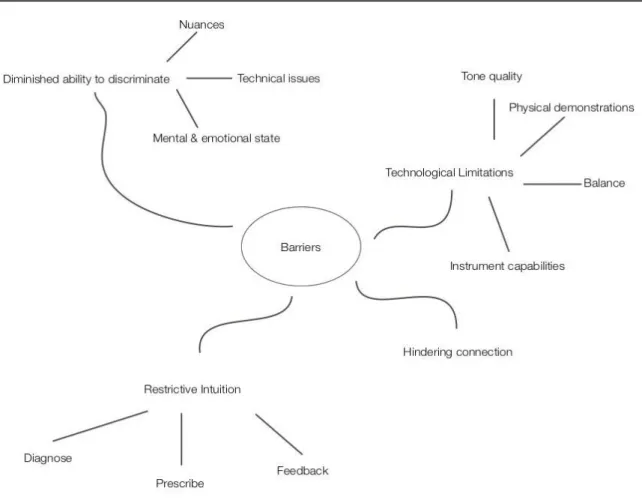
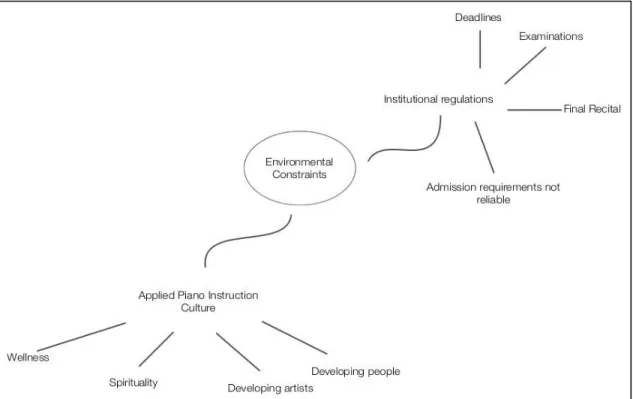
Environmental constraints
P4: “What I find very useful about learning the piano is that when you play the piano you are essentially looking into a mirror. The problem is here (pointing to the head) and it always is.” [Associated categories: Applied piano instruction culture]. P7: “there may be additional ways to obtain a final rating besides the final recital, such as evidence from professional performances, competitions, recordings, newspaper clippings, which may be a percentage of the final rating.” [Associated categories: Institutional regulations].
Tone: Term used to refer to the sound produced when playing the piano and which has specific characteristics such as quality, warmth, roundness and color. Intuition: Term used by master pianists to express that they know something but are unable to articulate how they come to know it. Demonstration: Term used to refer to the performance of a musical fragment by the master pianist, or to the performance of a physical movement that may or may not involve physical contact between the student and the master pianist.
Playing: refers to the performance of an excerpt of music or a complete composition by the learner in a class, audition or exam setting.
Conclusions and Recommendations
Environmental constrains
P6 said: “One of the most important things for me in terms of my work is to ensure that they [learners]. The design of applied piano courses in online environments must take into account the culture and values of the master pianist. The results of this research show that there is a lot to do to get involved in the design/conversion of applied piano courses: from exploring and piloting different models of teaching and assessment to developing new technologies (software and hardware).
Teaching research instruction in the graduate pedagogy curriculum: Providing new tools for future researchers and university faculty. The development of music programs at English-language universities in Central and Eastern Canada, dissertation, University of Toronto, 1983. Using constructivism in technology-mediated learning: constructing order from chaos in literature.
The Place of Music in a University Curriculum,” Proceedings of the National Conference of Canadian Universities (1927) Retrieved July 20, 2012 http://www.thecanadianencyclopedia.com/index.cfm?PgNm=TCE&Params=U1A RTU0003520.
Interview protocol sketch
What an individual can do, execute, with a degree of effectiveness or any other measure of his quality. Skills can be classified based on the proportion of cognitive, motor or emotional requirements for their execution. In your opinion, what are the goals of advanced applied piano instruction at the graduate level.
Based on your experience, what would be the psychomotor, cognitive, and affective skills that potential graduate students should possess. What are the aspects or topics of the lesson used that could be delivered online. Are there any aspects or topics of applied piano teaching that could be taught in a group.
Would you say that most of the challenges students at the university level face when learning new repertoire had to do with interpretation of the score or a lack of psychomotor development.
Recruiting script
Preliminary informed consent form
You are encouraged to ask questions or raise concerns at any time about the nature of the study or the procedures I am using. Our interview and lesson observations will be audio and video recorded respectively to help me accurately capture your knowledge in your own words. If you are uncomfortable with the recorder, you can ask to have it turned off at any time.
If you decide to withdraw from the research, all information you provide (including audio tapes) will be destroyed and omitted from the final paper. The insights from the interviews are used to write a thesis, which is read by the supervisors and the jury. Although direct quotes from you may be used in the newspaper, your name and other identifying information will be kept anonymous.
I authorize the Athabasca University Research Ethics Committee to review all my records pertaining to this study for quality assurance purposes.
Ethics Approval