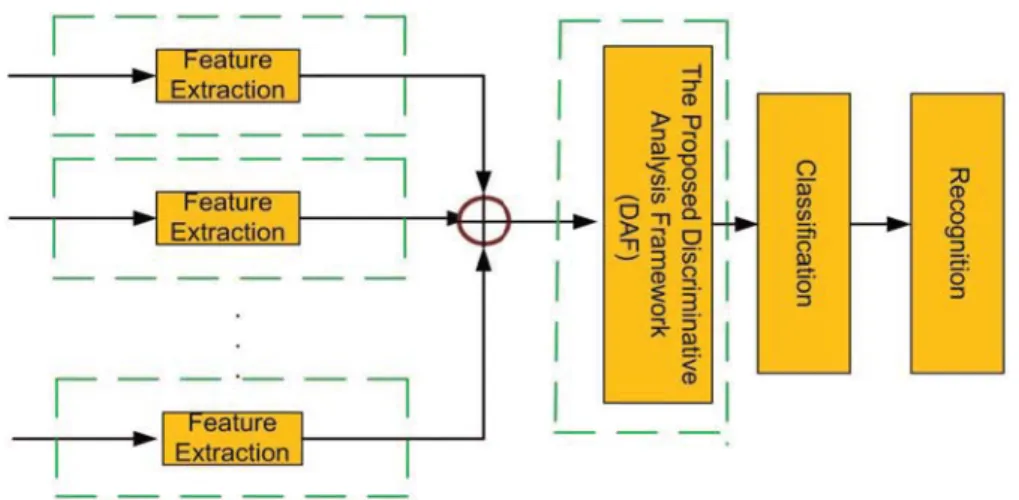
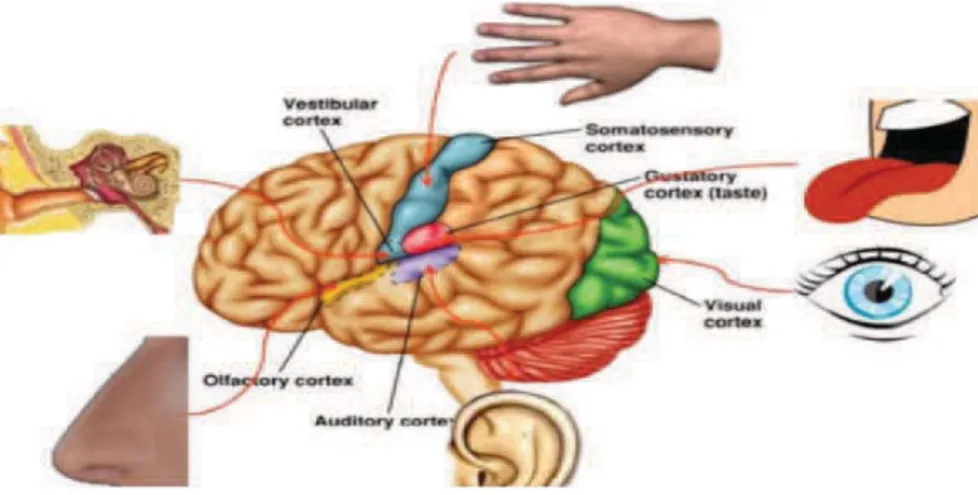
Multimodal information analysis is thus becoming an increasingly important research topic in the multimedia community. To address the challenges, in this thesis we propose a discriminant analysis framework (DAF) for high-performance multimodal information fusion.
LVWRI$FURQ\PV
Introduction
- Motivation
- Objective
- Challenges
- First, although intuition indicates that fusion of multi-modal data should help in many information processing tasks, it is not necessarily al-
- It is important for a fusion method to be able to identify the dis- criminatory representation amongst different modalities. Most existing
- Finally, although there are numerous methods proposed for informa- tion fusion, the theoretical foundation of these methods largely depend on
- Main Contributions
- We present the DMCCA as the first realization of the DAF for
- We further verify that canonical correlation analysis (CCA), mul- tiple canonical correlation analysis (MCCA) and discriminative canonical
- Taking into consideration of the limitations of existing fusion meth- ods, we propose a novel graphic approach for selecting optimal projection
- Thesis Organization
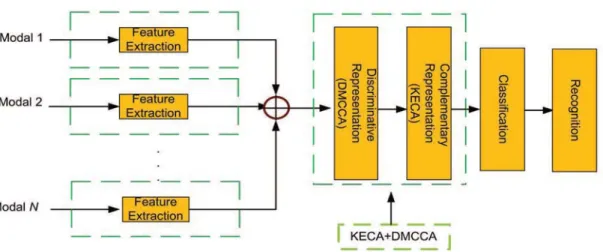
It is necessary to extract a more discriminating description of the intrinsic characteristics from the multimodal data. We then propose KECA plus DMCCA (KECA+DMCCA) as another realization of DAF for multimodal information fusion.
Background
- An Overview on Information Fusion
- Intelligent Feature Level Fusion
- Information Theoretic Learning
- Applications
- Summary
In general, decision-level fusion requires employment of independent classifiers for each modality and integration of the probability scores based on the strategies of reliability estimation. Local direction pattern (LDP) global features of the whole face are extracted, which can guarantee basic expression difference and the.
Discriminative Multiple Canonical Correlation Analysis for
Multi-modal Information Fusion
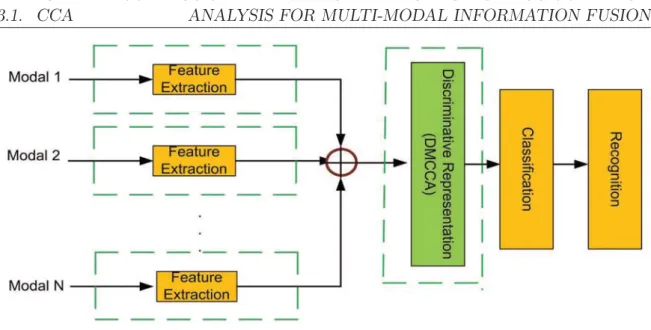
Benefiting from the discriminative characteristic of DMCCA, we can identify and extract the discriminatory representation among differ-
An important property of DMCCA is analytically verified. It shows that the number of projected dimensions corresponding to the optimal
Canonical correlation analysis (CCA), multiple canonical correlation analysis (MCCA) and discriminative canonical correlation analysis (DC-
CA) are special cases of DMCCA and thus establish a unified framework for canonical correlation analysis for information fusion in the transformed domain. We propose a new graphical representation approach for optimal projection selection in multimodal information fusion, which is essential.
We propose a novel graph representation approach for selecting optimal projection in multi-modal information fusion which substantially
- Canonical Correlation Analysis
- Discriminative Canonical Correlation Analysis
- Multiple Canonical Correlation Analysis
- Concept of Discriminative Multiple Canonical Correlation Analysis
DISCRIMINATIVE MULTIPLE CANONIC CORRELATION ANALYSIS FOR MULTI-MODAL INFORMATION FUSION ANALYSIS FOR MULTI-MODAL INFORMATION FUSION. In this section, we introduce discriminative multiple canonical correlation analysis (DM-CCA) to address this problem.
In GMA, the discriminability is obtained within each feature, while in DMCCA it is achieved by using all features
One of the major challenges in information fusion is to identify the discriminative representation between different modalities. Although generalized multi-view analysis (GMA) [96] and multi-view discriminant analysis (MDA) [97] are also proposed to solve the multi-view (multimodal) problem, there are clear differences between them .
In GMA, the cross-view correlation is obtained only from observa- tions corresponding to the same underlying sample, while in DMCCA it
GMA has to deal with has a great number of parameters especially when the number of features is large. However, DMCCA works with a
DMCCA involves modalities/features having a mixture of correlated (modality-common information) components and achieving the maximum
The within-class and the between-class correlations of all modali- ties/features are considered jointly to extract more discriminative infor-
- Derivation of the DMCCA
T ∈ Rn, (3.14) where i is a numerical sequence of random features, n is the total number of training samples, xij(d) denotes the j-th sample in the d-th class and nil is the number of samples in l. string class xi. DISCRIMINATIVE MULTICANONICAL CORRELATION ANALYSIS FOR MULTIMODAL INFORMATION FUSION Since (1 +δ/P −1) is a constant, it has no effect on the projection matrix ω, so it will be neglected in the following analysis. Based on the definition of Cx∼kxm and equation (3.23), the value of ρ plays a key role in estimating the relationship between intraclass and interclass correlation matrices.
To achieve the optimal recognition accuracy, we select the c projected vectors from the eigenvectors associated with the c different largest eigenvalues in equation (3.23). Txi has no contribution to the optimal fused result of Yi, the optimal performance obtained by DM-CCA, when d, the projected dimension is less than or equal to c, as expressed in (3.52). Specifically, if the feature space dimension is equal to Q, the computational complexity of DMCCA is of the order of O(Q*c), instead of O(Q*Q) as required by other transform-based methods (such as MCCA).
Extract information from multi-modal sources to form the training sample spaces
Convert the extracted information into the normalized form and compute the matrices C and D
Compute the eigenvalues and eigenvectors of equation (3.23)
Obtain the fused information expression from equation (3.52), which is used for classification
- Relation Between CCA, DCCA, MCCA, and DMCCA
- A Novel Graph Representation Approach for Selecting Optimal ProjectionOptimal Projection
- Summary
DISCRIMINATIVE MULTIPLE CANONICAL CORRELATION ANALYSIS FOR MULTI-MODAL INFORMATION FUSION 3.4. C and D of the DMCCA can be written as: However, identifying the optimal projection of the multi-modal features onto the projected space remains a difficult task. Therefore, it is reasonable to evaluate the final multi-modal information fusion results by measure J(η).
In this chapter, we introduce a discriminant multiple canonical correlation analysis approach for multi-modal analysis and fusion. Then, we establish a unified framework for canonical correlation analysis for information fusion in the transformed domain. Finally, we present a graph representation method to select optimal projection in multi-modal information fusion.
KECA plus DMCCA for
Introduction
It is a well-known fact that the second order statistics such as variance and correlation are the theoretical foundation of the majority of existing information fusion methods [26]. Since the second order statistic is only optimal for Gaussian-like distribution, it can be a poor estimator, if the distribution of multiple modalities is very different from Gaussian. It is known that entropy can quantify the statistical structure of a data set more precisely compared to the second order statistics which are still the mainstream of statistical signal processing [104].
As a recently proposed entropy measurement method, KECA has been studied to obtain more appropriate representations for information fusion than the second order statistics. However, as an unsupervised method, KECA only retains the maximum Renyi entropy of the input data with the smallest number of extracted features without considering the similarity between the samples in the same class or the dissimilarity between the samples in different classes, which leads to loss discriminative representation of the multi-modal information [105]. Based on entropy estimation, we review the method of KECA in multi-modal information fusion in Section 4.3.
Entropy Estimation
- Shannon Entropy
- Renyi Entropy
- Kernel Method
This entropy is believed to be able to measure the amount of information contained in a set of events, which can be expressed as follows. Furthermore, the entropy measure has been shown to be a suitable descriptor of the hyperspace spanned by the high dimensional probability density. In practical applications, Renyi entropy is one of the commonly used generalizations of information entropy [108].
Kernel method is widely used in non-linear problem of data analysis, and one of the most famous applications is support vector machine [110]. Therefore, kernel method is used to develop nonlinear generalization of any algorithm that can be cast in terms of inner products. For example, kernel principal component analysis (KPCA) and kernel linear discriminant analysis (KLDA) are typical extensions of the corresponding linear algorithms by applying the kernel method to each inner product evaluation.
Kernel Entropy Component Analysis
- Parzen Window Density Estimator
- KECA with Application to Information Fusion
The entropy value is shown to be a scalar, but one of the intermediate steps is to estimate the PDF, which is much more difficult in high-dimensional spaces. By using the continuous Renyi squared entropy, we can bypass the explicit need to estimate the PDF and obtain an entropy estimate of the data using algebraic operations. Furthermore, the Renyi entropy estimate can be expressed in terms of the eigenvalues and eigenvectors of the kernel matrix with an eigendecomposition.
Therefore, the empirical Renyi entropy estimator is equal to the elements of the corresponding kernel matrix. Information fusion based on KECA can reduce the dimensionality of input feature vector while preserving most of the useful information content of the original data. It is important to take full advantage of the correlation between them and extract the most discriminative and representative patterns from the input data.
The Proposed KECA+DMCCA
The proposed method reduces the dimensionality of the features by eliminating data redundancy and exploits data complementarity in the form of entropy measures. To solve these problems, the second realization of DAF, KECA plus DMCCA (KECA+DMCCA) is proposed in Section 4.4. Based on the definition of KECA, KECA+DMCCA is formulated as V(p The projection of KECA+DMCCA on the ide major axis in the kernel property space is defined as.
We can obtain the total information entropy of DMCCA with the first c projected vectors corresponding to largest eigenvalues to form the maximal linearly independent group. Specifically, taking advantage of this property, if the dimension of the feature space is equal to Q and the number of training examples is n, the computational complexity of KECA+DMCCA is of the order of O(n2∗c), instead of O( n2 ∗ Q). Thus, this property is not only analytically elegant, but practically significant when c is small compared to the feature space dimension.
Convert the extracted information into the normalized form and compute the matrices C and D in equations (3.20) and (3.21)
Examples include emotion recognition, number recognition and many others, where c varies from a handful to a few tens, but the dimension of the feature space can be hundreds or even thousands.
Find the discriminative projections of the original multi-modal feature/data in DMCCA space
KECA is applied to the discriminative projections achieving information fusion of KECA+DMCCA
- Summary
- Introduction
- Handwritten Digit Recognition
- Face Recognition
- Emotion Recognition
- Feature Extraction
- Handwritten Digit Feature Extraction
- Face Feature Extraction
- Audio Feature Extraction
- Visual Feature Extraction
- Classification Method
- Experimental Performance Evaluation and Anal- ysis on DMCCAysis on DMCCA
- Handwritten Digit Recognition
- Face Recognition
- Emotion Recognition
- Computational Efficiency
- Comparison with the Method of Embedding DCCA (ED- CCA)CCA)
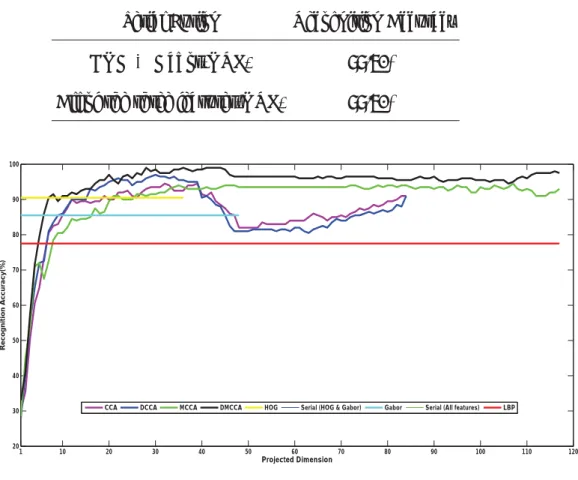
- Graphical Identification of The Optimal Performance by DMCCADMCCA
- Performance Evaluation and Analysis with KE- CA plus DMCCA
- Handwritten Digit Recognition
- Face Recognition
- Emotion Recognition
- Summary
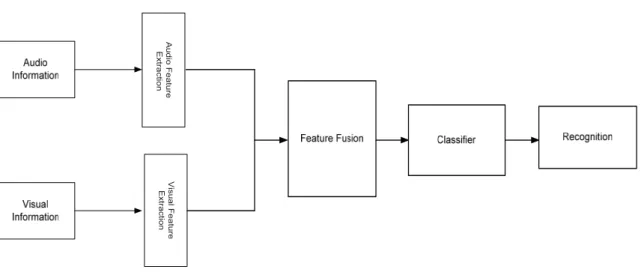
In what follows, we first present the extraction and implementation of the proposed DAF in handwritten digit recognition, face recognition and human emotion recognition. Moreover, there are two challenges in handwritten digit recognition due to the nature of handwriting style [117]. A detailed review of the pioneering works in audio emotion recognition can be found in [131].
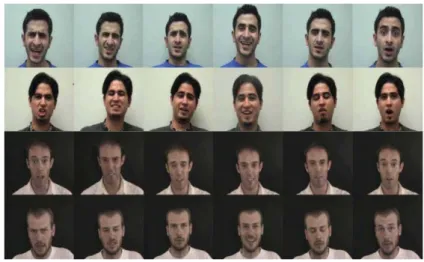
However, the length of the utterances is different, and so the total number of coefficients is also different. As shown in Figure 5.4 [91], the detected facial region is placed back on the original image and cropped so that the main components of the face are visible. 24-dimensional Gabor transform features: The standard deviation of the facial images transformed by each filter.
In this section, we evaluate the effectiveness of the proposed DAF with DMCCA as the fusion function on the MNIST handwritten digit database. It is clear that the discrimination power of DMCCA provides a more effective modeling of the relationship between different features and achieves better performance than the other methods.
Conclusions and Future Work
Conclusions
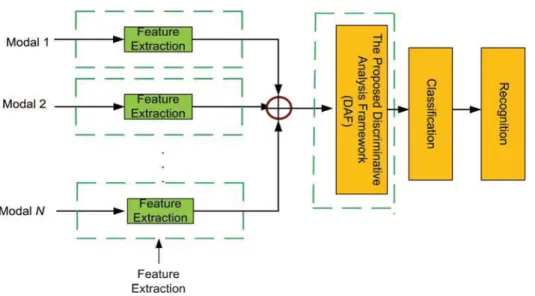
This thesis introduces a discriminant analysis framework (DAF) to address multimodal information fusion. Firstly, discriminative multimodal canonical correlation analysis (DMCCA) is proposed for multimodal information fusion to extract the discriminative representation from the multimodal input data. Then, DMCCA is integrated with kernel entropy component analysis (KECA) to further improve the performance of the DAF for multimodal information fusion.
After a comprehensive background survey in Chapter 2, we introduce DMCCA for multi-modal analysis and fusion in Chapter 3. Finally, we present a graph representation method for selecting the optimal projection in multi-modal information fusion. In Chapter 5, we evaluate the effectiveness of the proposed framework on the MNIST handwritten digit database, the ORL face database, the RML emotion database, and the eNTERFACE emotion database.
Future Work
Therefore, we should pay attention to how to effectively realize information fusion for massive multimedia data from widely distributed data sources. Moreover, based on the above discussions, it is clear that research on information fusion algorithms and systems is becoming increasingly common. There are a number of areas in the information fusion community that are likely to be very active in the near future.
With information fusion algorithms expanding their applications from the statistics domain to many other fields such as robotics, sensor networks, and image processing, the need for standard fusion evaluation strategies that are appropriate independent of the given application domain will increase more than ever. Undoubtedly, this trend will motivate more extensive research on topics related to the performance of information fusion systems. We believe that multi-modal information fusion for multimedia analysis is a promising research area and will play increasingly important roles in our future life.
Calhoun, “Joint blind source separation by multiset canonical correlation analysis,” IEEE Transactions on Signal Processing, vol. Jenssen, “Kernel entropy component analysis,” IEEE Transactions on Pattern Analysis and Machine Intelligence, vol. Srihari, “Online and offline handwriting recognition: a comprehensive survey,” IEEE Transactions on Pattern Analysis and Machine Intelligence, vol.
Hinton, “Using Generative Models for Handwritten Digit Recognition,” IEEE Transactions on Pattern Analysis and Machine Intelligence, vol. Zongker, “Representation and recognition of handwritten digits using deformable templates,” IEEE Transactions on Pattern Analysis and Machine Intelligence, vol. Ma, “Texture features for image data browsing and retrieval,” IEEE Transactions on Pattern Analysis and Machine Intelligence , vol.