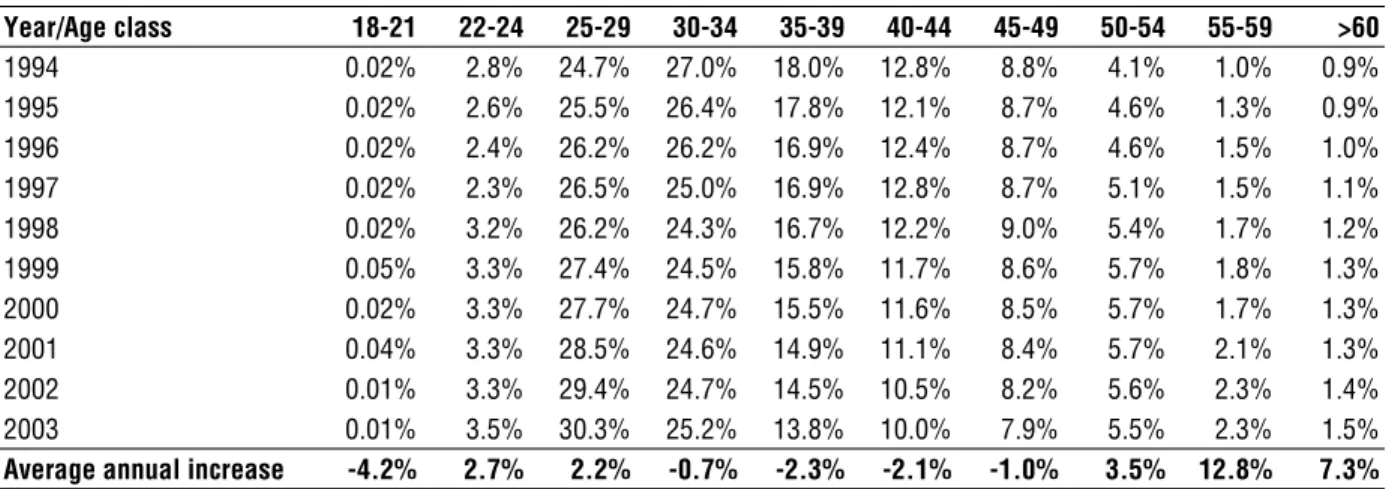
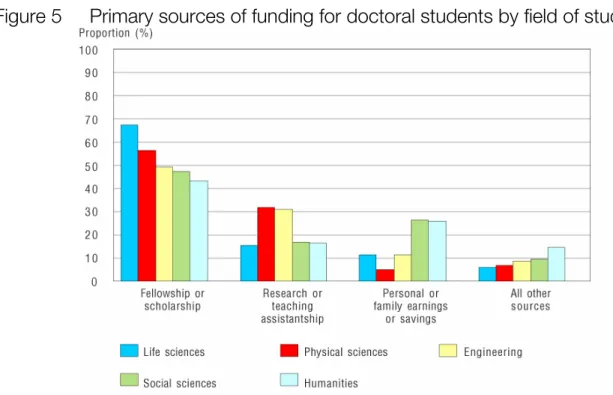
2 Table II Distribution of doctoral student enrollment in SSH in Canada by age group, 1994-. We examined all the main issues discussed in order to determine their impact on the funding of doctoral students in the SDH.
Demographics
Age
Not surprisingly, the proportion of the youngest students (i.e. age range 18-21) within the total population of PhD students enrolling in PhD programs at SSH in 1994 was marginal, and their number showed a decrease in 2003 (Table II). In parallel, the proportion of both younger (i.e. age range 22-29) and older (i.e. age range 50 plus) students enrolling in PhD programs in SSH increased.
Gender
Although the average age has not changed over the period, the composition of the population of students registering for a PhD program at SSH has changed in terms of the number of students within certain age categories. Middle-aged students (i.e. age ranges 30–49), who constituted almost 67% of the entire population in 1994, remained in the majority, although their share of the total population of PhD students enrolled in doctoral programs in the SSH decreased to about 57% in 2003.
Mode of Study
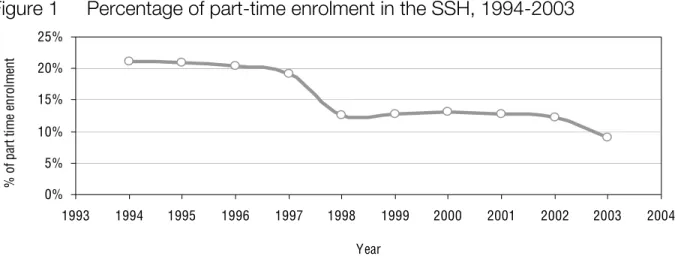
However, data indicate a worrying trend that part-time doctoral students are far less likely to complete their degree programs (Martin, Maclachlan, & Karmel, 2001). This study also found that very few part-time PhD students in the UK were sponsored by research councils, 58% received no financial support at all and that any financial support received was clearly linked to the level of achievement.
Time-to-completion and Attrition
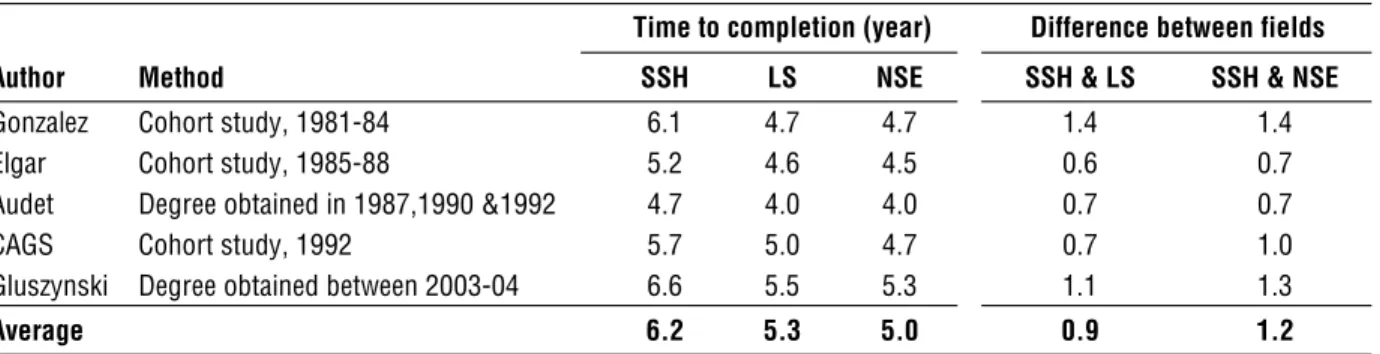
This more limited funding for students in the SSH is linked to SSH students' longer times-to-completion and higher dropout rates (Leroux, 2001). At the same time, most informants interviewed for this study agreed that insufficient funding of doctoral students in the SSH is a cause of longer time-to-completion.
Interaction between Supervisors and Students
In contrast, 82% of 28 respondents believed that research collaboration in the humanities has not become more prominent in the last decade. Ultimately, according to Levine et al. 2004), the amount and nature of research and training support (e.g. the research model used and the level of mentorship) shape the research training of PhD students in SSH.
Fast-Track Option
Prevalence of the Fast-Track Option
In the same 17 institutions, the indirect fast-track option was offered by 15, and the direct option by 8. Other disciplines where fast-track admission is available are anthropology, linguistics, media studies and Quebec studies (études québécoises). Around 30% of key informants interviewed were unsure whether their institution offered the fast-track option (either as direct or indirect entry to PhD programmes).
Impact of the Fast-Track Option
Because this does not apply to students in SSH, there was less need to shorten the study period through accelerated programs. Some interviewees also saw a danger in the fact that students who used the accelerated route remained in the institution where they had completed their undergraduate studies. Overall, interviewees felt that the accelerated option, mainly due to its limited availability and lack of visibility as an alternative route, has had very little overall impact on doctoral education in SSH.
Funding Model to Support the Fast-Track Option
One respondent felt that the quality of master's education could decline if this option were widely offered, as master's programs would only attract students who "fail" to fast-track and thus experience a decline in popularity and public image. In fact, several respondents expressed concern that the fast-track option, if it became common, would render the master's degree irrelevant; this situation already exists in certain disciplines, such as psychology. Other respondents felt that fast-track students would actually take longer to complete their degrees, as they would not have the academic and research experience gained when doing a master's degree.
Online and Distance Education
Athabasca University, Canada's “leader in online and distance education”4 and one of the first universities in the world to offer an online MBA, has had extensive discussions about how to offer a doctorate online, and has identified a number of limitations . (Carr, 2000). It is also more difficult for online PhD students to experience membership in the academic community and research culture, and to receive the same level of supervision that traditional students typically receive. Currently, very few institutions offer doctoral degrees online, and according to Carr, these types of degrees are not well received by the academic community and employers.
Interdisciplinary Programs and Professional Degrees
Funding for Interdisciplinary Research
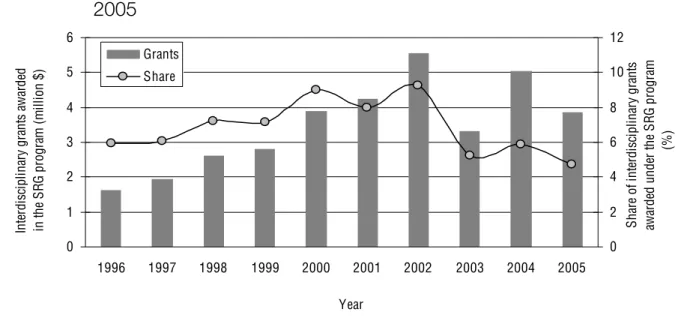
Based on SSHRC data, the amount of money awarded to interdisciplinary projects under the SRG program reached CDN$1.6 million in 1996 and increased steadily in subsequent years, reaching CDN$5.5 million in 2002. (Figure 2). Among all research projects funded by the SRG program, the percentage of interdisciplinary projects supported by SRG grants increased from 5.9%. Although it is true that an increasing number of interdisciplinary research teams in SSH were supported between 1996 and 2002, it is not clear whether this development is only a consequence of the improved availability of money to support interdisciplinary projects (reflecting one of up-down trend), or if it is the result of a movement in SSH towards greater interdisciplinary (a bottom-up trend).
Interdisciplinary Doctoral Programs
A university dean stated that interdisciplinary applications for internally administered awards are treated exactly the same as conventional applications. Another university dean claimed that SSHRC could look more favorably on interdisciplinary research, because of its relative novelty status and the increased interest and potential associated with it. While a majority of respondents (approximately 80%) believed that Canadian universities are increasingly integrating interdisciplinary programs into doctoral curricula, responses were divided regarding the funding of students in interdisciplinary programs.
Professional Doctoral Programs
Funding for students enrolled in professional doctoral programs may be less accessible than for students in traditional programs. It's a different market, in general." Another said that “there is less funding for students in vocational programs, but that's how it should be. Students in vocational programs tend to leave school and enter higher-paying careers.” While these students may be less able to obtain federal or provincial funding for their studies, as some respondents noted, some funding avenues may actually be more available to them than to traditional doctoral students, for example employee sponsored scholarships.
Responsiveness of Doctoral Programs to External Influence
Nevertheless, federal funding agencies are much more important sources of research funding, especially for students in SSH (AUCC, 2002). More interviewees believed that social science programs, rather than humanities programs, are increasingly responsive to private interests. Based on stakeholder perceptions, social science programs are more responsive to both social needs and private sector interest than humanities programs.
Inflows of Foreign Students to Canada
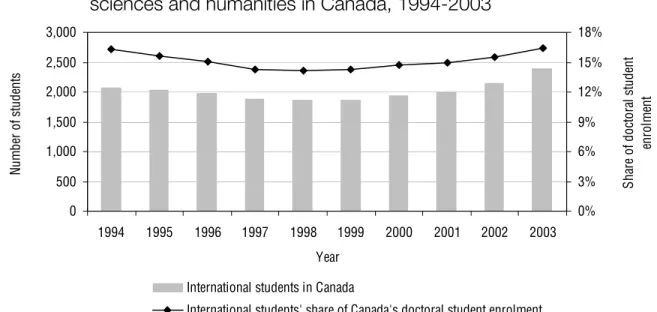
The largest Canadian universities are able to attract talented international students and provide them with financial support11. International students who choose to attend smaller universities, however, may need to be more creative in finding financing solutions for their education. Without a doubt, SSHRC has received suggestions to make its funding program accessible to international students who wish to obtain a PhD in Canada.
Outflows of Canadian Students
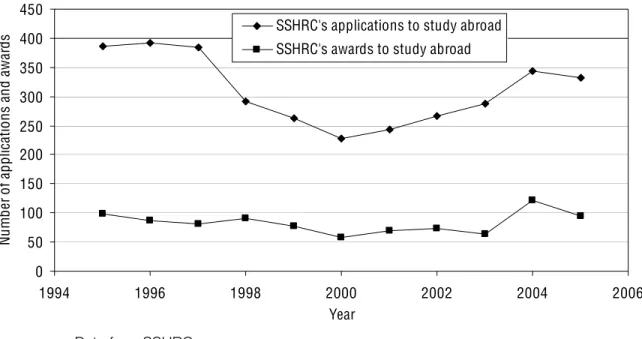
However, if SSHRC decided to support international students but could not obtain a larger budget, the current budget would have to be stretched to support international students at the expense of Canadian students. However, such sources of financial support are often small and not flexible enough to be useful to most students seeking a PhD in SSH from a foreign institution. A promising way to support Canadian students who want to pursue a PhD abroad at SSH would be to promote the development of joint PhD programs between Canadian and foreign universities, such as the agreements that already exist between Canada and France .
Exchange Programs
The main sources of financial support for doctoral students wishing to complete their PhD abroad at SSHC include the SSHRC Doctoral Scholarship Program; similar programs at the provincial level (eg, doctoral scholarships offered by the "Fond Québécois de la recherche sur la société et la Culture"); Commonwealth Scholarships (which offer Canadian students the opportunity to undertake postgraduate studies in another Commonwealth country); German Academic Exchange Service graduate scholarships (DAAD scholarships), which give Canadian students the opportunity to study in Germany; and the scientific mobility scholarships of the Agence universitaire de la francophonie. However, one interviewee mentioned that some of the larger and more popular universities, such as those in the US or the UK, will look at students' financial needs based on the external funds they have available and pay the balance. The Fulbright Program, which is supported by the Government of Canada through Foreign Affairs Canada and the US Department of State, offers awards to Canadian and American graduate students to conduct study or research abroad14.
Financial Resources for Travelling
Support for students in SSH could be provided through advisor grants, which could function in much the same way as NSERC's Research Tools and Instruments (RTI) grant. It was also suggested that the money for SSH programs should go to the institution as this would allow equipment and resources to be used by students from different departments and the 'shelf life' of these resources after the course of one individual would be enlarged. program. However, one respondent pointed out that people in SSH are often excluded from CFI scholarships because their needs are much smaller than those of students in NSE.
Evaluation of Degrees Earned Abroad
Non-governmental and intergovernmental organizations and programs across Canada have also been identified as key players in the advancement of foreign recognition of academic credentials (Knight, 2004). Organizations Active in Advancing the Recognition of Foreign Credentials Canadian International Credential Information Center (CICIC). First, it affects portability, defined by Bloom and Grant (2001: 9) as “the ability to obtain credits from one education or training organization accepted by another,” and mobility, defined as “the ability to obtain credentials accepted in jurisdictions, e.g. as provinces or countries where they were not issued'; second, it affects the awarding of course credit or advanced knowledge to individuals with foreign credentials, which will affect the ability and incentives for those students to continue their education and obtain credentials.
Means for Financing Doctoral Studies in the SSH
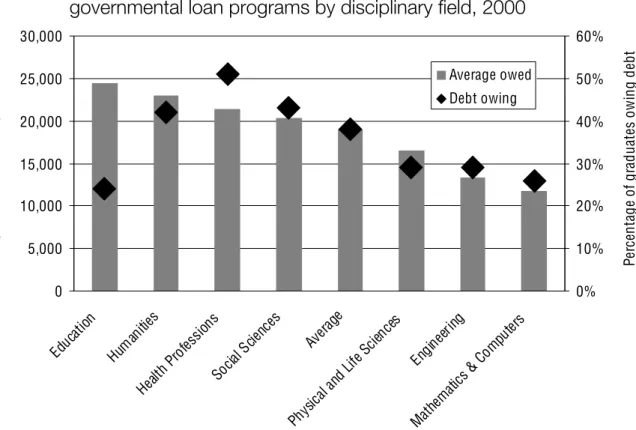
Specifically, 46.5% of students in the social sciences and 44% of students in the humanities graduated without educational debt. 20,000, and the share was even lower in the social sciences, 16.7% of students, indicating that funding for graduate studies in the SSH is relatively healthy. This is especially important to consider because, as mentioned in section 2.3, difficulties in obtaining funding for their studies are positively correlated with attrition among PhD students in the SSH.
Merit-based Funding
Even more substantive are the University Graduate Fellowships (UGF): approximately $1.15 million in UGF funding was awarded to PhD students in the SSH. In addition to these regular scholarships, which totaled $2.3 million in 2004-2005, UBC doctoral students in the SSH are eligible to compete for 142 types of scholarships, 68 types of fellowships, 67 types of fellowships, 30 types of prizes and 39 different prizes . . Clearly, SSHRC is emerging as the largest external funding source for SSH doctoral students at UBC.

Teaching and Research Assistantships and Stipends
Student Grant and Loan Programs
Canada Access Grant for Housing Students with Permanent Disabilities: These grants cover up to. Canada Study Grant for part-time students with dependents: These grants provide assistance up to. 1,920 per loan year, intended to assist eligible students studying part-time who continue to demonstrate financial need after receiving the maximum Canada Study Grant for part-time students with high needs and the maximum Canada Study Loan for part-time students.
Financial Support Available for Specialized Equipment and Resources
Changing needs regarding the equipment and resources used by doctoral students in the SSH. Is there a changing pattern of doctoral research in the SSH that involves greater interaction with supervisors and with other students. What is the pattern of international mobility of doctoral students in the SSH and what is the level of demand by foreign students to study in Canada.