Edited by Jean Michaud and Tim Forsyth
Moving Mountains
Ethnicity and Livelihoods in Highland
China, Vietnam, and Laos
Contents
Illustrations / vii Foreword / ix
Terry McGee
Acknowledgments / xvii
1 Rethinking the Relationships between Livelihoods and Ethnicity in Highland China, Vietnam, and Laos / 1
Tim Forsyth and Jean Michaud
2 Economic Marginalization and Social Identity among the Drung People of Northwest Yunnan / 28
Stéphane Gros
3 Integration of a Lineage Society on the Laos-Vietnam Border / 50 Steeve Daviau
4 Oral Histories of Livelihoods and Migration under Socialism and Post-Socialism among the Khmu of Northern Laos / 76
Olivier Évrard
5 Of Rice and Spice: Hmong Livelihoods and Diversification in the Northern Vietnam Uplands / 100
Claire Tugault-Lafleur and Sarah Turner
6 Hani Agency and Ways of Seeing Environmental Change on the China-Vietnam Border / 123
John McKinnon
Sample Material © 2011 UBC Press
vi Contents
7 Land Reform and Changing Identities in Two Tai-Speaking Districts in Northern Vietnam / 146
Marie Mellac
8 Commoditized Ethnicity for Tourism Development in Yunnan / 173 Margaret Byrne Swain
9 Rubber Transformations: Post-Socialist Livelihoods and Identities for Akha and Tai Lue Farmers in Xishuangbanna, China / 193
Janet C. Sturgeon
10 Conclusion: Lesson for the Future / 215 Jean Michaud
Contributors / 228 Index / 231
Illustrations
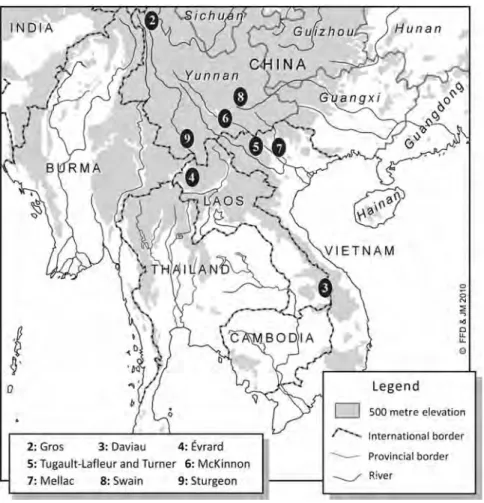
1.1 The Southeast Asian Massif and the eight case study chapters / 4
2.1 Nujiang Lisu Nationality Autonomous Prefecture and Gongshan Dulong and Nu Nationalities Autonomous County / 29
2.2 Distribution of the Dulong population in Gongshan County / 30 2.3 Main political spheres in northwestern Yunnan (c. 1900) / 32 3.1 Tarieng area in the Annam Range / 51
3.2 Original Tarieng village setting / 53 3.3 Resettled Tarieng village / 57
3.4 Village development cluster, Xieng Louang, Dakcheung district / 59 3.5 Free-roaming buffaloes typical of Tarieng husbandry / 63
3.6 Customary buffalo sacrifice ritual among the Tarieng / 63 3.7 Educational board by German Agro Action / 64
4.1 Mon-Khmer populations in northwest Laos / 78 4.2 Khmu subgroups’ areas (tmoys) / 82
4.3 Resettlement of highland villages in Nalae district / 86 4.4 Mokkoud and Konkoud villages / 88
4.5 “Strengthen friendship between all the ethnic groups to unify the [Lao]
society” / 89
4.6 “The army needs the people like the fish needs water” / 93 5.1 Sa Pa district in Lào Cai province, northern Vietnam / 103 5.2 Sa Pa District and Hoàng Liên National Park / 105
5.3 Typical Hmong household labour calendar in Sa Pa district / 107
5.4 A Hmong household’s fuel wood collection in San Sҧ Hӗ commune / 109 5.5 A Hmong healer in her medicinal plant garden / 111
5.6 Livelihood portfolio for Hoa’s household, Lào Chҧi commune / 114 5.7 Livelihood portfolio for Tao’s household, Bҧn Khoang commune / 114
Sample Material © 2011 UBC Press
viii Illustrations
6.1 Study area / 127
6.2 Land use in Shapu sector of Badong sub-catchment, 1990 / 137 6.3 Land use in Shapu sector of Badong sub-catchment, 1999 / 138 7.1 Fieldwork location in Northern Vietnam / 149
7.2 Overlapping influences of land-based institutions’ models / 150 7.3 Land management and administration, situation at the national and
local level / 151
7.4 An upper view of Ban Luot village, Than Uyên district / 160 7.5 Phong Huan commune, Cho Don district / 162
7.6 Behind the differences: two apparently opposite cases generated by similar processes / 164
9.1 Yunnan province, China / 194
9.2 Xishuangbanna, Yunnan province and Muang Sing, in Laos / 195 9.3 Rubber plantations in Xishuangbanna / 203
9.4 Modern young Akha women in Xishuangbanna / 210
Foreword
Terry McGee
It is much easier to move mountains than to change minds.
– Mien saying
It is a little surprising to find myself as an avowed urbanist writing a foreword for a book that focuses on the ethnic minorities in the eastern part of the Southeast Asian Massif, and in particular, on the highland borderlands of socialist China, Vietnam, and Laos – an area that is not characterized by high levels of urbanization. Fifty years of research on urbanization in South- east Asia and China rarely took me beyond the metropoles of the region.
The closest I got to the Massif was in the 1980s when I conceived the idea of what I believed to be a cunningly devised project to carry out research on the “colonial origins” of the “hill stations” of Southeast Asia, where his- tory and liveability would combine to enable “comfortable fieldwork” in the pleasant temperatures of the highlands. Unfortunately, the project had to be aborted. Someone more clever than I had already mined the field and published it in a rather obscure press that my far from thorough research had failed to unearth.
However, in the process of doing preliminary work for that project, I spent a month in Dalat, the summer residence of the Emperor Bao Dai and the former French colonial administration. With the help of Vietnamese colleagues, a visit to an “ethnic minority village” was organized. At first, this appeared to be unlikely. Many permits had to be obtained from officials at different levels of the administration. But eventually we set forth in heavy rain; the macadam road ceased three kilometres outside Dalat and became a dirt road, which seemed to have temporarily become a major watercourse. Eventually, we stopped at a village that consisted of what appeared to be rather comfortable government-like housing. Not at all my image of a so-called ethnic minority village. It was in fact the commune headquarters, where, after meeting the chairman of the People’s Committee who, along with everyone else, appeared to be Kinh, we were entertained to a lengthy and quite alcoholic lunch. This seemed to break the ice, and
Sample Material © 2011 UBC Press
x Terry McGee
around about 4 p.m. we set off for the ethnic minority village, where we met our first ethnic minority representative. He spoke English with a marked American accent (somewhere in the South), and it turned out he had spent the last twenty-five years in the United States after arriving there as a refugee with his family. His family had originally come from this village, and he had returned to try to develop the village as a tourist site, working with tourist operators in Dalat. Members of the village staged a program featur- ing cheerful presentations of the local culture, dances, and goods – for example, woven baskets, food, and rice wine – which involved ample op- portunity for the participation of the tourist that I had become instead of the researcher I had been. Far from the grassroots entrepreneurs of Yunnan of whom Margaret Byrne Swain writes in Chapter 8, the organizer was engaged in manipulating the authentic, in what seemed to me a reflection of American marketing practices. Having filled in the comments form with fulsome praise, we left at about 9 p.m. for the rather arduous journey back to Dalat.
I have engaged in this lengthy anecdote as a perhaps irreverent way to find an intersection between the world of cities that has been my research focus and this study of the ethnic minorities of the Southeast Asian Massif.
A world remote and isolated from the large lowland cities, or so I believed.
But as the Dalat experience reveals, this idea of remoteness and isolation and separation from urban areas needs to be carefully evaluated.
This observation leads me to the central issue I would like to explore in this brief foreword, which is how the processes of change among upland ethnic minorities resonate with the changes occurring in the urban areas of Southeast Asia. On the face of it, this is a very provocative proposition, for it challenges the conventional wisdoms that rural and urban areas are sharply differentiated, that urbanites are somehow more entrepreneurial and cosmo- politan than people who live outside urban areas, and that urban dwellers are less resistant to change. This, like much of the conventional wisdoms that influence research and policies in developing countries, is mostly derived from the experience of developed countries, as Forsyth and Michaud em- phasize in Chapter 1 with their statement that “clearly, we should be careful in transferring concepts developed in settings such as modern industrial societies or post-industrial cities to locations such as the Southeast Asian Massif.”
Expanding the Knowledge of Southeast Asia
The three specific questions, paraphrased from Chapter 1, that this book seeks to answer in the study of these upland ethnic minorities are, I suggest, also echoed in the current rethinking about the urbanization process in Southeast Asia:
xi Foreword
1 How do local populations on the margins of centralized states make a living and maintain their identity in terms of external forces – the state and, the market – and their own agency?
2 Why does the understanding of highland livelihoods need a more nu- anced frame of transnationalism rather than simply proceeding by country analysis?
3 How can a more complex stance about assumptions of the region as a predictable social space be adopted?
These questions reflect a wider set of underlying themes that relate to the way knowledge is being generated about the processes of social and economic change in developing countries. But my interest in the book is the way it contributes to expanding our understandings of what I have called else where the many “knowledge(s)” of Southeast Asia (McGee 2007). In this piece, I identify three types of knowledge as they are being used to interpret South- east Asia. The first is “above ground knowledge,” which is what I would call globally applied theories that rely on hegemonic paradigms. The second is what I call “grounded knowledge,” which is a form of knowledge embedded in the practices of people and culture that inform these practices. Third, the idea of “underground knowledge,” which is influenced by James C. Scott’s formulations of everyday forms of resistance and the hidden transcripts of local people (Scott 1985, 1990).
In focusing on these issues, I of course realize that I am leaving aside im- portant issues such as culture, kin systems, and identity that are an important part of the intellectual underpinning of the book. The editors and the other authors are certainly aware of the debates about the meaning of these terms that have been generated in the literature. I will leave it for reviewers to engage the issue of how important culture and identity are to an understand- ing of the way ethnic minorities survive in the Southeast Asian Massif.
Utilizing the framework of many knowledge(s), I would suggest three ways in which the book intersects with the formation of knowledge about South- east Asian urban areas and contributes to our understanding of Southeast Asia as a whole. These are emphasizing the need to (1) (re)conceptualize hegemonic paradigms that are applied at a global level to interpret social, economic, and political change at national and local levels (above ground);
(2) stress the importance of long-term grounded research into the practices and knowledge of local people that empower the role of local knowledge (grounded knowledge); and (3) recognize that there is also a form of under- ground knowledge and action that informs these practices, that is not understood or in many cases even known by policy makers, and that rarely informs global theories. In the next section, I explore these ideas in greater detail in a suggestive way rather than a prescriptive one.
Sample Material © 2011 UBC Press
xii Terry McGee
(Re)conceptualizing Global Hegemonic Paradigms (Above Ground Knowledge)
Three hegemonic paradigms have influenced thinking about processes of change in Southeast Asia.
The Domination of the Idea of Urban and Rural Difference
First is the spatially embedded idea that rural and urban spaces are sharply divided and that within these spaces, rural and urban life are sharply differ- ent. This is a powerful hegemonic belief that effects assumptions about re- search and policy. Thus, urban areas (particularly the metropoles) are thought of as dynamic centres of political, economic, and social change. Rural areas are portrayed as increasingly marginalized – places where socio-economic change is slow and people are poor and resistant to change.
Much of the research reported in this book refutes this idea of the rural as static and marginalized. This is particularly important given that ethnic minorities are widely portrayed in popular perceptions as being at the ex- treme end of some rural-urban continuum. What we find is the stories of people of the Massif who are actively engaged in livelihood strategies that are, again in the words of Forsyth and Michaud, “experiments in finding solutions to basic needs, while at the same time asserting identity in accord- ance with their economic potential and the moral dimensions of local cul- tures.” This is occurring within the context of the modernization projects implemented by what many label the post-socialist state but which I prefer to call a form of hybrid socialism in the sense that the political control of the state still remains from the previous socialist period.
The Role of Globalization
A second hegemonic paradigm that influences thinking about social and economic change is the idea of the dominant role of international forces on the economy of Southeast Asia, which is often summed up with the term
“globalization” in an attempt to capture the major components of economic and technical change that have characterized the world over the last fifty years. It is argued that globalization embodies three main elements. First, it is a process whereby the global economy is becoming increasingly integrated through linked production centres, commodity chains, and information networks that are reshaping the global market economy. Second, these de- velopments are based on technological developments in transportation and communications that accelerate the flows of commodities, people, capital, and information in time and space. Third, this is accompanied by an ideo- logical rationale based on a triumphant neo-liberalism that sees globalization universally increasing economic wealth within the market system.
This is not a discourse that the authors of this book engage to any great
xiii Foreword
in the Massif is the realization that improved communications and transport are freeing up space to move, interact, and trade, allowing the people of the Massif to become more mobile. For example, in Vietnam, the use of motor- bikes has been pivotal in breaking down the barriers of isolation and an inadequate transportation structure. These have facilitated the extension of social networks of ethnic groups even beyond national boundaries.
Within the urban context of Southeast Asia, globalization has become a more influential paradigm. As many writers have shown, the globalization trends accelerate urbanization (particularly the growth of the multi-functional port cities), as well as internal changes in urban space that have encouraged the universal outward spread of urban activity into surrounding areas. This has led to the breaking down of the boundaries between rural and urban and has precipitated the need to imagine new ways of thinking about rural and urban relationships in space in a similar way to the extensions of ethnic networks through national boundaries in the Massif.
Modernization and “Developmentalism”
Now the third hegemonic paradigm. All the trends listed in the previous section have been driven by a state-led push for modernization throughout Southeast Asia (Myanmar offers a peculiar kind of exception to this state- ment) in which, even in the hybrid socialist states, there is an increasing determination to seek techno-economic policies that are basic to this form of developmentalism. In this model of urbanization, technological change is seen as the catalytic element for modernism and economic growth. Recent research into the urbanization process has begun to question this model, particularly as it relates to the challenges posed by climate change, increases in energy prices, and the American-led recessions (McGee 2008).
Reinventing Research Paradigms, Vernacularizing Modernity (Grounded Knowledge)
A second theme relates to the need to reinvent research paradigms so that processes of change are seen from the perspectives of ethnically and cultur- ally diverse groups of people actively negotiating these processes at the grassroots level. This approach is central to Moving Mountains. For instance, in the Conclusion, Michaud makes a sophisticated argument as to why the prevailing paradigms of modernism (summarized in the discussion of the first theme) set up a hegemonic view on the part of lowland majorities that portrays the locally embedded traditions stemming from ethnicity and culture as backward. These traditions have to be “normalized” through education, technological change, and, in some cases such as Laos, through dislocation and establishing new settlements. Developmentalists, often working for international agencies, tend to see ethnic minorities as people whose condition is one of poverty that is measured in terms of material and
Sample Material © 2011 UBC Press
xiv Terry McGee
supposedly objective facts, such as agricultural yields, transport costs, and so on. The contributors to this book start off from a very different position.
They see the upland ethnic groups as actively engaging these processes with awareness and subtlety. To quote Michaud from his Conclusion, “Authors in this book have relied predominantly on qualitative factors: beliefs and spirituality, customary wisdom (indigenous knowledge), social organizations, oral history, fears, desires, and more. Across the board, their studies have benefited from long and recurring fieldwork periods, intense participant observation, life stories, loosely structured and repeated interviews, and perhaps most importantly, a marked empathy for their subjects, for their fate, and for their right to participate fully in deciding their own future.”
This same process is observable in urban areas. As urbanization has in- creased in Southeast Asia, the poor – squatters, street hawkers, becak drivers – have been portrayed as “people who get in the way.” In the view of the policy makers, they illegally occupy land, they cause congestion in the streets, and they block development. However, grounded research that relies on both quantitative and qualitative data has constantly emphasized the con- tribution that the poor make to cities in which they reside and their efforts that show how vigorous and adept they are at making livelihoods and at what I have previously called “making out” in the urban setting (McGee 1976). Grounded research in the urban areas of Southeast Asia constantly reminds us that, like the upland ethnic minorities, the urban poor deserve the right to participate more fully within the urban areas.
Reassessing the Relationship of People and the State (Underground Knowledge)
The final theme I wish to approach relates to the relationship between the state, the market, and people. In my rather simple view of it, this relationship is governed by the power and access to resources of different economically and socially positioned groups, which in my admittedly Marxist-influenced youth we used to call classes. The exploration of this relationship has been a constant theme of Southeast Asian research – for example, the work of Yeoh (1996) and Kusno (2000). One important thread of this research is the resistance of people who are marginalized in terms of access to the power of the state and participation in the market. Throughout most of rapidly urbanizing Southeast Asia (again with the exception of Myanmar), this re- lationship often involves liaison between the state and the major participants in the market, to which the growing middle classes are given complete ac- cess, while sizable proportions of the low-income communities and poor are given only marginal access. The study of resistance in the urban context of Southeast Asia is, in the highly factionalized urban society, complex and indicates that overt resistance (for example, student demonstrations at the
xv Foreword
end of the Suharto era) has led to changes in political power. But resistance in the economic arena has been much less successful. In the political econ- omy of hybrid socialism in which the upland ethnic communities live, where the centralized one-party states exert considerable power, this nexus between state, the market, and people is far more nuanced. Although Laos, China, and Vietnam are opening up spaces for the market economy as part of a modernist vision, there is only a limited discussion of open resistance pre- sented in this book. However, there is ample evidence of covert resistance.
These actions represent a degree of defiance that remains most of the time under the radar, and, to again quote Michaud from his Conclusion to this book, “it is the particular contours of customary social relations, local culture, and agency that decide the balance between the two.” In a way, this is not surprising given the general geographical and linguistic fragmentation of the upland ethnic minorities, the lack of real civil society, and their history of violent repression.
Critically Evaluating Homogenizing Paradigms
Finally, I would like to return to the anecdote I told earlier. All my assump- tions about the ethnic minority village close to Dalat had been conceived out of an understanding of the world of upland ethnic minorities in South- east Asia that had been formulated from the “colonial geographies” of Pierre Gourou and K.J. Pelzer, along with an uncritical acceptance of the minorities ideology that was a part of Asian socialism. These were, of course, part of a genre of homogenizing understandings that my work on urbanization in Southeast Asia had increasingly come to question (McGee 2002). The great strength of this book is that, in addition to being a major contribution to the study of upland ethnic communities in hybrid socialist societies, it cre- ates space to reconceptualize our understandings of the processes of social, political, and economic change among the people of the urban worlds of Southeast Asia and other parts of the world. But this also involves us in critically evaluating the homogenizing paradigms that currently often guide our assumptions about the processes of social, political, and economic change; the ways we acquire this knowledge; and how we listen to the voices of the people in local settings. This is a task about which the majority of the authors in this volume seem to be quite hopeful and is already well advanced. But as the Mien saying that introduces this foreword suggests, this is no easy task.
References
Kusno, A. 2000. Beyond the Postcolonial: Architecture, Urban Space and Political Cultures in Indonesia. London: Routledge.
McGee, T.G. 1976. Hawkers and hookers: Making out in the Third World city – Some Southeast Asian examples. Manpower and Unemployment Research, April: 3-16.
Sample Material © 2011 UBC Press
xvi Terry McGee
–. 2002. Reconstructing The Southeast Asian City in an era of volatile globalization. In Critical Reflections on Cities in Southeast Asia, ed. Tim Bunnell, Lisa B.W. Drummond, and K.C. Ho, 31-53. Singapore: Times Academic Press.
–. 2007. Many knowledge(s) of Southeast Asia: Rethinking Southeast Asia in real time. Asian Pacific Viewpoint 48(2): 270-80.
–. 2008. Managing the rural-urban transition in East Asia in the 21st century. Sustainability Science 3(1): 155-67.
Scott, J.C. 1985. Weapons of the Weak: Everyday Forms of Peasant Resistance. New Haven, CT:
Yale University Press.
–. 1990. Domination and the Arts of Resistance: Hidden Transcripts. New Haven, CT: Yale University Press.
Yeoh, B. 1996. Contesting Space: Power Relations and the Urban Built Environment in Colonial Singapore. Kuala Lumpur: Oxford University Press.
Acknowledgments
This book is the result of four years of work and talks. Discussions were often held via the Internet – at times, some authors could meet in person – and most congregated for a four-day workshop in Québec City, Canada, in Oc- tober 2007. Financial support for that workshop was provided by the Social Sciences and Humanities Research Council of Canada (Aid to Research Workshops and Conferences).
On that occasion and in conjunction with the bi-annual conference of the Canadian Council for Southeast Asian Studies, also held in Québec City, four panels were set up. In addition to the book’s contributors, the following people contributed to these panels: Isabelle Henrion-Dourcy and Marise Lachapelle (Laval), Yves Goudineau and Christophe Caudron (EFEO, Paris), and Ménaïque Légaré-Dionne (Montréal). The editors thank them warmly for their valuable contributions.
Terry McGee, of the University of British Columbia, immediately agreed to write a Foreword to the collection, for which we are most grateful. Our author and colleague Sarah Turner generously contributed much of her time to significantly enhancing the whole manuscript. Laura Schoenberger also helped with careful editing.
The editors would also like to express their gratitude to Emily Andrew and Megan Brand from UBC Press for their excellent collaboration, as well as UBC Press’s anonymous readers for making enlightening and stimulating suggestions.
Sample Material © 2011 UBC Press
Moving Mountains
1
Rethinking the Relationships
between Livelihoods and Ethnicity in Highland China, Vietnam, and Laos
Tim Forsyth and Jean Michaud
In the far south of China and the neighbouring lands of Southeast Asia there is a mountainous zone that stretches some thousand kilometres from the South China Sea to the Himalayas. This land is not snow-capped nor entirely rocky but instead features a mixture of forest, rain-fed agriculture, and rice terraces that sometimes extend to the very top of steep slopes in deep valleys that criss-cross the region. More than 200 million people distributed over eight countries live in this zone, of which about half belong to ethnic min- orities living chiefly in scattered hamlets, villages, and market towns in a staggering array of cultural diversity.1 This vast region, which we call the Southeast Asian Massif (Michaud 2000b), is now increasingly opening up to investment, regional planning, and development interventions, often as countries change from socialism to more liberal markets and political sys- tems. Yet, despite its size and importance, there has been little in-depth research about how people make a living or about the interconnections of cultural diversity, political and economic change, and livelihoods in these highlands.
This book presents a number of rich analyses of livelihoods and cultural diversity in selected parts of this region. More specifically, the authors of the chapters here investigate the relationships between livelihoods and ethnicity in the high borderlands of socialist China, Vietnam, and Laos, which together represent more than two-thirds of the Massif’s surface and an even greater proportion of its population. The aim of the book is to present locally grounded analyses of how ethnic minorities there fashion livelihoods and to question how ethnicity affects, and is influenced by, economic and political changes in relation to these livelihoods. We believe this discussion provides much-needed local information about this complex region. It also demon- strates the role of cultural and ethnic networks as an under-acknowledged influence in the livelihood strategies of so-called “poor people.” This ap- proach is crucial for better informing discussions on poverty alleviation and livelihoods in general; perhaps even more so for the countries of China,
Sample Material © 2011 UBC Press
2 Tim Forsyth and Jean Michaud
Vietnam, and Laos, which have now opened up to marketization and political reform after years of centrally planned economies under state socialism.
Together, the authors in this book make three key arguments. First, we suggest that the ways local populations on the margins of centralized states in the Southeast Asian Massif make a living and maintain their identities are shaped both by external forces – such as the state and the market – and by their own agency. Indeed, marginal highland groups demonstrate par- ticular, locally rooted, and culturally informed agency that, in our opinion, is often overlooked in generalized approaches to livelihoods within develop- ment practice.
Second, we believe that understanding highland livelihoods in the South- east Asian Massif as a whole requires a more nuanced appreciation of trans- nationalism than considering highland people simply in terms of “national minorities.” Many upland groups engage in cross-border trade, or have cur- rent or historical social networks across state borders. Some existing analyses of upland marginal groups in Asia fail to notice this transnationalism. Civil- izing the Margins: Southeast Asian Government Policies for the Development of Minorities, edited by Christopher Duncan (2004), is an important work that summarizes problems and challenges for minority peoples in almost all the countries officially located in Southeast Asia. While having many merits, it overlooks not only cross-border issues within Southeast Asia but also the situation in the adjacent uplands of China, Bangladesh, and India. The over- all picture thus produced is country-focused, fitting chiefly the needs of modern political analyses determined by state boundaries – national policies addressing national minorities. Moving on from such an approach, we dem- onstrate in this book that there is a compelling logic in choosing to study highland groups in the Massif transnationally and, in particular here, those of southwest China along with those adjacent in Vietnam and Laos, where borderlands opened only recently to outside scholarly inquiry, with little research of this kind having yet been published (see Lim Joo Jock 1984;
Evans, Hutton, and Kuah 2000).
Third, we choose to adopt a more complex stance toward assumptions made about this region being a single and, in some ways, coherent social space. Willem van Schendel (2002, 647) proposed to call the wider moun- tainous region from the coast of Vietnam to Tibet – and even to Afghanistan, as he suggested later – “Zomia,” and claimed it was unexamined because it
“lacked strong centers of state formation, was politically ambiguous, and did not command sufficient scholarly clout.” Along those same lines, political scientist James C. Scott (2009), in his thought provoking book The Art of Not Being Governed: An Anarchist History of Upland Southeast Asia, picks up the baton and labels Zomia – which he confines, however, to the eastern section of van Schendel’s original Zomia, thus equating Zomia with the same region
3 Rethinking the Relationships between Livelihoods and Ethnicity
on which this book focuses – as “the last great enclosure.”2 For Scott, this is where a wide variety of populations have historically taken refuge from the surrounding “civilizations” in order to pursue an age-old or, in some cases, a renewed interest in the remarkable project of living in a stateless society (or at least in a space where the state does not control people significantly).3 Although we look at such considerations, made from a distance sympathetic- ally, we argue for a more refined reflection from the ground up and a more dynamic understanding of the relationships between (marginal) local sub- jects, (global) market forces, and (national) states.
In other words, the authors of this book use locally grounded studies to reveal the unexpected ways in which people on the margins do not just get onboard and accept (socialist) modernity, but, rather, use their agency to maintain direction over their lives and livelihoods despite current and far- reaching changes to economic conditions and political authority.
The Southeast Asian Massif
We will expand more on the claims outlined previously and their rationales shortly, but first, it is helpful to more precisely locate the subjects of this book. The Southeast Asian Massif, as we define it, brings together the high- lands of all the countries sharing a large chunk of the southeastern portion of the Asian land mass. These lie roughly east of the lower Brahmaputra River, in India and Bangladesh, and south of the Yangtze River in China, all the way to the Isthmus of Kra in Thailand at its southernmost extension (see Figure 1.1; Michaud 2006). As of 2008, as we mentioned, about 100 million of the Massif’s inhabitants belong to ethnicities that are distinct from the lowland majorities who form the cultural core in each of these eight countries, that is the Han (China), Kinh (Vietnam), Burman (Burma/
Myanmar), Bengali (Bangladesh and northeastern India), Thai (Thailand), Lao (Laos), and Khmer (Cambodia) majorities. Over the course of centuries, these dominant lowland ethnic groups have – more or less firmly – ruled the highlands and their populations, albeit often with important disagree- ments. As such, one of the themes we address in this book is how these relationships have affected ethnicity and livelihood strategies.
We have selected three socialist states for analysis: the People’s Republic of China, the Socialist Republic of Vietnam, and the Lao People’s Democratic Republic. These are countries where, because of their participation in the world’s Communist “brotherhood” (Evans and Rowley 1984), a fused ideol- ogy has guided state dealings with “minority nationalities” (Michaud 2009, 30). Academic research on these populations by non-Communist academics was virtually impossible for several decades, roughly from 1945 to 1990. It is therefore useful and timely that the authors included in this book have been able to perform lengthy field-based investigations in these socialist
Sample Material © 2011 UBC Press
4 Tim Forsyth and Jean Michaud
Figure 1.1 The Southeast Asian Massif and the eight case study chapters
settings and that they have developed intimate knowledge of the lived ex- periences of ethnic minorities in these highlands, and of what making a livelihood on the margins of a Communist state involves.
Some may argue that nowadays, what are often called the post-socialist regimes of China, Vietnam, and Laos have little in common beyond the worn-out veneer of previously being highly centralized revolutionary regimes, which have gradually departed from Marxist orthodoxy and have now opened up to the liberal market economy – China in 1978, Vietnam and Laos in 1986.4 Certainly, all three countries are liberalizing their economic activities. But at the same time, these three regimes share a unique ideology that directs the relationships of the state with minority groups dwelling within their national borders. In China, Nicholas Tapp (2001) has shown
5 Rethinking the Relationships between Livelihoods and Ethnicity
“nation,” and the policies they eventually entailed, served in the 1930s as a template for strategies of alliance building between the Communist Party of China and minority groups whose support was essential to ensure victory over Republican forces. In Vietnam, the strategy that linked the Viet Minh’s political project with highland minorities closely followed the Chinese model, in this and many other aspects of the revolutionary struggle (McAlister 1967;
Michaud 2000b). Furthermore, Yves Goudineau (2000) showed that the USSR-China-Vietnam ideological stance on minorities triggered a similar response in Laos.
Indeed, the parallels in approaches to ethnic minorities in China, Vietnam, and Laos raise several important questions for ethnicity, livelihoods, and state-society relationships. Many authors have acknowledged that the vari- ous national Communist revolutions in these locales could not have been successful without strategic wartime alliances with minority groups on the margins. For example, it is well known now that in China, the Yi of Yunnan sheltered and protected the fleeing Communist troops during the Long March of the 1930s (Mueggler 2001; Harrell 2002). In Vietnam, the Tày of Bac Thái province hosted and fed Viet Minh leaders in hiding from French colonial troops for years, while the Thái in northwestern Vietnam were instrumental in the decisive victory at Dien Bien Phu in 1954 (Michaud 2000a, 352-53).5 In Laos, with the majority of its national territory located in mountainous areas, the Communist triumph was possible only with the support of scores of highland allies (Goudineau 2000; Pholsena 2007). In all three countries, revolutionary leaders had to provide assurances of pol- itical autonomy to highland peoples, and included this in early drafts of national constitutions. This way, many ethnic minorities decided to ally with the Communist forces in hope of some political reward (McAlister 1967; MacKerras 2003).
Yet, once Communist victories were achieved, the new socialist states cun- ningly backtracked in unison. They argued that wartime pledges could not be carried out effectively without endangering the socialist project and the very existence of the new socialist nations. Early commitments to grant political autonomy were toned down, diluted, or sometimes plainly forgot- ten. In clear contradiction to all the promises made, these socialist states instead took the stance that highland margins and their populations could not be given real self-government. On the contrary, minorities had to readily accept being ever more firmly attached to the central state and to the socialist project of establishing a unified citizenship seeking uniform and predefined goals. Ironically, an important tool to achieve this forced marriage involved a decoy strategy of setting up showcase, largely powerless “autonomous ter- ritories” where sizable numbers of minority occupants were dwelling – one of Stalin’s original precepts. In China’s southwestern upland border zone, this practice became policy for the first time shortly after the Communist
Sample Material © 2011 UBC Press
6 Tim Forsyth and Jean Michaud
victory of 1949, while in the Democratic Republic of Vietnam (North Viet- nam), these came into existence in 1955, right after independence.
The modern practice of organizational segregation of mountainous areas in the Southeast Asian Massif can be traced back to British Burma, which set up administrative enclaves in the nineteenth century for numerically important ethnic groups, such as the Shan, Chin, and Kachin. Not long after, the French in Indochina took the same route with the Military Terri- tories policy implemented in 1891 (Condominas 1978; Michaud 2000a, 344). As elsewhere throughout the colonial world, these constituted rather crude attempts at dividing local societies to rule them more efficiently, in this case, by encouraging an upland-lowland fracture rooted in ancient cultural distinctions. For the colonial powers, to ally with upland minority leaders served the purpose of thwarting nationalist sentiments and weak- ening resistance among the lowland majorities. It is not surprising that, in time, victorious socialist regimes in the region pragmatically accepted this heritage and used it to their own ends, blending it with original Soviet ideology.
Today, highlanders in the socialist portion of the Southeast Asian Massif are still facing governments that in large part lack dependable information about their history, cultural distinctiveness, and aspirations for the present and the future. More importantly, it seems these governments, taken by their fast-paced neo-liberal national growth agendas, often lack even the interest to learn more about ethnic minorities. Instead, they vigorously implement nationwide policies of cultural integration and economic standardization.
Education, for instance, in principle a tool for emancipation, is geared in- stead toward Sinization, Lao-ization, and Vietnamization (Goudineau 2000;
Potter 2007).6
For the most part, the region’s state programs are attuned to growth and progress. The dominant rhetoric, after decades of applied social evolutionism inherited from strict Marxist ideology, has now moved increasingly toward the language of economic growth and development. Development agencies from the affluent world are joining governments to apply the technology of the international development industry to ethnic minority health, educa- tion, and agricultural practices; in the process, traditional practices end up being labelled as obsolete or even harmful, especially to the environment.
Although the general indicators of health and education undeniably show an upgrading among highland populations, these initiatives also play directly into the national governments’ strategies of integrating minorities into the central national economy and identity. In the process, cultural distinction is paid only subsidiary attention, with an array of other issues being judged incomparably more urgent.
China clearly has a strong central policy of controlling and integrating
7 Rethinking the Relationships between Livelihoods and Ethnicity
1997; Baranovitch 2001; MacKerras 2001, Michaud 2009).7 This region is politically sensitive because it touches several international borders. It is also rich in natural resources important to the national economy, it provides a substantial portion of the country’s diet through intensive agriculture, and it is a land of migration for many lowland citizens (Blum 2002; Wilkerson 2003). From the state’s viewpoint, migration of lowland Han people to the margins of China might be motivated by a desire to eventually outnumber locals and take final political, economic, and cultural control over these margins (Harrell 2001; MacKerras 2003). Indeed, China’s Go West campaign is an ambitious state-sponsored series of investments and land use plans that aim to bring development to provinces that would not usually attract the same level of industrialization as the seaboard. Started in 2000, the campaign aims to steer state investment, outside expertise, foreign loans, and private capital into western provinces of China, especially Yunnan, the province that occupies much of China’s portion of the Southeast Asian Massif. Some of these activities include turning existing towns and cities into regional centres of economic development, such as the provincial capital Kunming. Yet, there has also been resettlement of villages in order to change the distribution of population in affected areas, and the reforestation of previously agricultural land by plantation forestry. Some commentators fear that the non-Han populations living in southwest China will find their societies, languages, and cultures threatened by these activities and the in- migration of lowland Han (Plafker 2001). Picking up on this program, four chapters in this book consider various aspects of the Go West campaign (Gros, McKinnon, Swain, and Sturgeon). They illustrate that, in remote loca- tions of southwest China, resistance to such programs exists, while taking covert, restrained forms.
In Vietnam, the state has officially made its peace with its các dân t͡c thi͋u s͙, the minority nationalities, through their legal enshrinement in official polity since the late 1970s (McElwee 2004). But the Vietnamese government still considers dangerous political resistance to be simmering in the Central Highlands and elsewhere. The government has denounced political support for minorities coming from mainly US-based organizations, often made up of Vietnamese who fled the country in the 1970s and whom the government branded reactionary (Anonymous 2002; Salemink 2003). Christian mission- ary activism is a bone of contention, chiefly in the south, but increasingly in the northern highlands too. As a countermeasure, education is seen as a tool for the state to preserve carefully selected and benign features of local highland cultures (Nong Quoc Chan 1978) while showing the public eye the face of a benevolent state preserving minority cultures (McElwee 2004).
In Laos, the government has adopted a vigorous relocation program in order to move some minority ethnicities (sonphao) from upland areas to the lowlands and to force scores of highland villagers into larger groupings (see
Sample Material © 2011 UBC Press
8 Tim Forsyth and Jean Michaud
Daviau, Évrard, this volume). This approach allows highlanders to be placed directly under the Lao state’s gaze – a form of national panopticon as it were.
Also, a deeply rooted mistrust between the socialist state and old royalist factions among certain highland groups has ensured that armed struggles endured long after the revolution was officially over in 1975. The Xaysom- boun Special Region in northern Laos, an area sealed off from outside observ- ers, was enforced from 1994 to 2006 to isolate pockets of minority resistance to the Laotian forces. Clearly, however, with nearly half its population be- longing to one or another of many non-Lao ethnicities, Laos cannot afford to wage an all-out confrontation on its minorities, and a degree of negotia- tion has to prevail (Goudineau 2003; Ovesen 2004; Soukamneuth 2006).
The Implications of Ethnicity
In this culturally complex, mountainous transnational setting, authors in this book reflect on the relationships between ethnicity and livelihood practices on the frontiers of the state (see Brown 1994; Donnan and Wilson 1994; Lamont and Molnar 2002). But what do we mean by “ethnicity”? And why is this important in state-society relations and livelihood strategies?
Within the expansive field of identity studies, ethnicity generally refers to kinship, group solidarity, common culture, and shared strategy (see Barth 1969, 1999; Glazer and Moynihan 1975; Cohen 1978; Gordon 1978; Yinger 1985; Nash 1989; Thompson 1989; Banks 1996; Hutchinson and Smith 1996;
Eriksen 2002; Cornell and Hartmann 2007). With the possible exception of increasingly industrialized urban settings where anonymity can sometimes prevail over most other components of individual and group identity (Fong and Shibuya 2005), blood ties and regionalism have always played, and still do play, a crucial role in defining individuals as part of groups, and groups as distinct from each other (Rata and Openshaw 2006).
But it would be a mistake to presume that ethnicity thus implies an es- sential, fixed, or unchanging form of identity rooted only in biology and location (Melucci, Keane, and Mier 1989).8 For many years during the European colonial era and then during Communist regimes in the twentieth century, defining an ethnic group was above all an act of classification and control. Administrators saw indigenous cultures as fixed entities – “tribes”
(Sahlins 1968) – with permanent characteristics in the likes of skin colour and facial features, and circumstantial evidence such as location and dress, as determining exactly who was or was not Karen, Masai, or Maori (see Sollors 1996).
The social sciences have since come a long way. Ethnicity today is believed to refer to personal and collective decisions, circumstantial strategies, and various other influences that sustain a discrete and negotiable form of col- lective identity (Jenkins 1997). Indeed, this was a tenet of the influential
9 Rethinking the Relationships between Livelihoods and Ethnicity
that the ethnic group called the Kachin was actually far more differentiated than initially thought, and communal identities were more contingent on short-term strategies and needs than outsiders predicted. As later summar- ized by Eriksen (2005, 353), ethnicity came to be seen as comprising aspects of both symbolic meaning and instrumental utility. These forces may be defined as desires to fit in (such as via belonging or compliance) and strategies to opt out (via distinction, resistance, or defiance), which together compose an astoundingly complex and highly localized set of factors forming the agency of a particular group (Sollors 1989). Indeed, agency is a vital notion in this book; it is the instrument by which local responses to external pres- sures for change are conceived and put in practice (Holland et al. 2001). It is the highly localized element defying the routine elaboration and applica- tion of overarching models of development and integration of local societies into nations, the market, and the global world.
The ethnic factor is everywhere. Around the world, internal hostility to- ward ethnically distinct groups within national borders surfaces with a stubborn regularity in Burma, the Sudan, Iraq, India, China, Indonesia, and Brazil to name just a few zones where ethnic tensions flare (see Eller 1999).
The so-called developed world is not immune either, as the recent incidence of ethnic war and ethnic cleansing experienced in Eastern Europe demon- strate (Cigar 1995). Furthermore, policies of singling out and excluding specific ethnic identities are still rampant in the United States, Canada, Mexico, Australia, Germany, Switzerland, and France (Dean and Levi 2003).
Ethnic factors can be invoked to support both affirmative action and the harshest political projects (Ceuppens and Geschiere 2005). But the ethnic factor, in all its fluidity, is also a powerful tool for understanding human behaviour in context, including, for our purpose here, how certain peoples in given locations negotiate their livelihoods (Lamont and Molnar 2002).
In fact, it is so powerful that we contend that neglecting ethnicity and its local cultural determinants will ensure the long-term failure of effective good governance and development programs. Many contemporary approaches to livelihoods and development, we contend, do not pay sufficient attention to this challenge.
Recent debates on ethnicity have been lively. Essentialists (see Fuchs 2005), primordialists (Geertz 1963; Eller and Coughman 1993), and sociobiologists (van den Berghe 1987) have long insisted on blood ties and locality as the key elements of ethnicity over other possible dimensions. This position is fragile: Is one’s brother really automatically one’s best ally or trading partner?
Are different ethnic groups necessarily prohibited by custom to marry across ethnic boundaries? Clearly, interracial, inter-ethnic, or cross-class cooper- ation occurs and is not routinely doomed, even if social customs exist to ascribe limits to it. At the other end of the spectrum, instrumentalists insist that, nowadays, ethnicity is not rooted in essence. They argue that ethnicity
Sample Material © 2011 UBC Press
10 Tim Forsyth and Jean Michaud
is in fact nothing but a short-term, instrumental construction that is used by specific actors to achieve specific ends. This drastically opposite position is equally fragile: Can a Hindu really move across castes freely and without hindrance (Reddy 2005)? Will the Sicilian mafia, the Japanese Yakuza, and the Chinese Triads smoothly admit members from any racial background?
Indeed, could the American voters elect a black president without ever rais- ing the issue of race? And finally, in parallel, Marxist analyses have argued against ethnicity being related to any of the above. Friedman’s classic work (1979) challenged Leach’s emphasis on local explanations for ethnic identity and instead claimed that ethnicity and indeed culture are themselves pro- duced through market forces and modes of production (see also O’Connor 1995; the new introduction to Friedman in 1998; Robinne and Sadan 2007).
Efforts at bridging the gap between such extremes have led to a middle ground based on propositions such as those supported by transactionalist and ethnosymbolist arguments (Poutignat and Streiff-Fenart 1995; Hutchinson and Smith 1996). The majority of proponents of such conciliatory positions see ethnicity as partly biological (visible in marriage preference, inheritance patterns, preferred trading association, clustering in times of adversity, and so on), and partly subjective and political (visible, for instance, in strategic grouping and modern urban lifestyles that allow diverse, competing identi- ties encouraged by volatile technologies, challenges, and living circum- stances) (Sanders 2002; Dean and Levi 2003; Fong and Shibuya 2005). The balance between these sets of characteristics can vary hugely across time and space but, overall, all are believed to play a role (Fuchs 2005; Ceuppens and Geschiere 2005; Cornell and Hartmann 2007).
Clearly, we should be careful in transferring concepts developed in settings such as modern industrial societies or post-industrial cities to locations such as the Southeast Asian Massif. For our purpose in this book then, ethnicity refers to blood ties, cultural variety, local agency, and the political agendas of highland peoples dealing with opportunities and constraints. Ethnicity helps people reproduce an identity they believe in. This is especially import- ant when a group has to maintain itself in the face of fast-changing circum- stances such as those related to globalization and, as in our case studies here, when attempting to create viable livelihoods while negotiating particular standardization constraints created by socialist regimes. In turn, this means paying attention to both the growing role of national and global trade flows in these regions, as well as local explanations of distinctiveness. This is an approach that is shared by all the authors in this book.
The Dilemmas of Livelihoods and Development
Let us also explain what we mean by “livelihoods,” and how these may con- nect with ethnicity in the Southeast Asian Massif. But, to begin, how can
11 Rethinking the Relationships between Livelihoods and Ethnicity
livelihood studies help us understand socio-economic change and “develop- ment” in this region?
At the most basic level, livelihoods are the means by which people make a living, such as through agriculture, trade, and waged employment. A com- mon image of highland livelihoods in the Southeast Asian Massif focuses on scattered villages following customary ways, with the occasional road or ac- cess to electricity, and with inhabitants engaged in a combination of subsist- ence agriculture (that is, farmers’ land used for food production), cash cropping, gathering of forest products, and subsidiary trade. This image in- cludes the cultivation of upland dry (non-irrigated) rice, frequently on steep slopes, and the growing of vegetables and maize, the latter mainly as feed for pigs or as an ingredient for alcohol making. Furthermore, a common form of agriculture in the past was “pioneer” shifting cultivation (Conklin 1963), in which migratory groups, such as Miao-Yao speakers, would use land and forests exhaustively before relocating villages every ten to twenty years.9 Yet, these classic images of livelihood practices in the Massif are question- able. Subsistence agriculture and shifting cultivation certainly exist in this region, but many highland peoples in northern Vietnam and southwest China, for instance, have been sedentarized (that is to say, settled on a semi- permanent or permanent basis) for centuries, especially those using irrigated rice terraces under local feudal chiefdoms. Added to this, other villages are becoming sedentarized either through choice or because they have been forced to resettle to lowland sites by state campaigns (see both Daviau and Évrard, this volume). Consequently, challenges to such allegedly classical images of highland livelihoods in the Massif have appeared, in part, because academics and development agents have come to realize that many research- ers had been influenced by their experiences with the so-called “hill tribe”
minorities in northern Thailand. For many years, researchers from the First World found themselves confined to Thailand because it was next to impos- sible to gain access to China, Vietnam, and Laos, and their findings bear that signature. With approximately one percent of the total highland ethnic minority population of the Massif, the Thailand heritage has been given an importance that today appears disproportionate. For several reasons relating to politics (the advent of socialism), demography, and history (including colonialism), research findings arising from this relatively constricted re- search hotbed are not often easily transferable to China, Vietnam, and Laos.
Contributing to bridging this gap, scholarship based in these three countries is at last flourishing, helping to correct this discrepancy, and conveying a more attuned picture of the highland realities there.
Upland agriculture has often been cited as a reason to encourage resettle- ment or sedentarization. Highland practices such as shifting cultivation have been blamed for various environmental problems, including lowland flooding
Sample Material © 2011 UBC Press
12 Tim Forsyth and Jean Michaud
and upland erosion. Undoubtedly, much classic shifting cultivation occurred on land that was previously forested, and farmers burnt forest and other vegetation in order to plant crops and add nutrients to the soil. But ecological geographers and anthropologists have argued that shifting cultivation, in locales with low population density, and without interference from the state or rival communities, is sustainable for upland societies (Conklin 1963;
Boulbet 1975). More recently, hydrological researchers have shown that the links between upland agriculture and these environmental problems are likely to be exaggerated because fluctuations in soil, rain, and water flows are com- plex and not always linked to agriculture, and because many upland farmers adjust practices to many of the risks they face (De Koninck 1999; Bonell and Bruijnzeel 2004; Bruijnzeel 2004; Forsyth and Walker 2008). These findings have been claimed for traditional forms of shifting cultivation, as well as for cultivation under higher population densities or with newer commercialized crops. This work does not suggest that upland agriculture has no environ- mental implications but questions the certainty with which environmental degradation has been cited by states and other actors to justify resettlement or reforestation.
It is now also widely acknowledged that subsistence agriculture has been supplemented for years through trading or bartering products, or by paid labour. Labour has been an income source from the post-feudal era (that is, roughly from the mid-nineteenth century) until the collectivization of the economies in China, Vietnam, and Laos in the mid-twentieth century. Dur- ing that period, trade in agricultural products such as opium and home- brewed alcohol was complemented by trading livestock, timber, and a mind-boggling variety of non-timber forest products, including live and dead animals, or parts of animals. Waged agricultural labour also grew mark- edly after the end of the collectivized era (from the 1950s to the 1980s). In addition, non-agricultural incomes in larger settlements in the Massif grew considerably following numerous state-led industrial projects as part of overarching modernization plans. Indeed, Rigg (2005) notes that one should not only focus on assessing sources of agricultural income from the land around villages, but also acknowledge the growing importance of paid em- ployment and remittances from off-farm labour.
Moreover, it is important to assess to what degree long-term customary land tenure systems have continued to operate in these uplands, or have been reformed or challenged by new systems imposed by successive national regimes over the last century. As China, Vietnam, and Laos undergo economic and political liberalization, opportunities for highland peoples are changing, local decision making has taken on new urgencies, and new property rights and forms of agriculture are merging with ancient ones. Moreover, as land use rights (but not land ownership) are now transferable and marketable,
13 Rethinking the Relationships between Livelihoods and Ethnicity
These insights into how highland people gain livelihoods are vital for understanding social and economic change in the Massif today. Yet, “liveli- hoods” mean more than the activities people use to make a living. Under- standing livelihoods also requires looking at the less obvious social resources, organizations, local politics, and ethnic and social networks and decision making that underpin economic activities and can effectively reduce or increase social vulnerability to economic and political change.
The language of the development theorist Amartya Sen is particularly useful in understanding the wider basis of livelihoods (Sen 1984, 1987). Sen suggests that livelihoods are a means of achieving capabilities, or the range of a person’s life options, and are not only a means of achieving an economic income. Similarly, livelihoods reflect the availability of assets, or those valued items that also enhance an individual’s ability to achieve life goals and lifestyles. Such assets might include a combination of physical, natural, and social properties such as infrastructure, land, and social networks along with human talents and skills, and financial resources that provide access to certain livelihoods. Accordingly, a livelihoods approach focuses not only on activities but also on access to these and on how changing social contexts might change the underlying means by which people can seek suitable livelihoods on a long-term and rewarding basis (Ribot and Peluso 2003).
Ethnicity, or the social and cultural networks that maintain local identity, is clearly an important variable for understanding sources of capabilities and assets, as well as access to them.
Recent discussions, regarding long-term and rewarding livelihoods, within anthropology, human geography, and development studies have used the concept of sustainable livelihoods to refer to how one might make a living that can continue despite upsets or threats to income. Chambers and Conway (1992, 1) define a sustainable livelihood as one that “can cope with and recover from stress and shocks, maintain and enhance its capabilities and assets and provide sustainable livelihood opportunities for the next genera- tion.” Sensibly, this framework focuses on addressing the vulnerability and poverty of affected peoples as they themselves see these (Chambers and Conway 1992; Scoones 1998; Ribot and Peluso, 2003), and requires “an examination of critical elements such as a livelihood’s impact on resources and its relationship to poverty reduction, security, equity, well-being, and capability” (Turner 2007, 403).
To identify livelihood strategies, many sustainable livelihoods approaches recognize five kinds of capital, or forms of assets available to an individual or to a household, village, or region. These capitals are human capital (edu- cational and practical skills, health); natural capital (resources such as land and forests); physical capital (infrastructure such as roads); financial capital (savings, credit); and social capital (networks and relationships of trust) (Bebbington 1999). These assets, in turn, are deemed to allow vulnerable
Sample Material © 2011 UBC Press
14 Tim Forsyth and Jean Michaud
people to increase livelihood options through three broad strategies: first, agricultural intensification (such as increasing the number of crops per year, including the use of fertilizers, mechanization, or access to more productive land); second, incomes diversification (including access to non- agriculture income in addition to agriculture); and third, creative uses of migration as a means of securing incomes (for example, involving one household member working for cash elsewhere, or an individual travelling to a city to engage in non-agricultural activities on a cyclical, seasonal basis).
These capitals have been used by development agencies such as the United Nations Development Programme and the United Kingdom’s Department for International Development as the basis of livelihood analyses and aid programs.
Critics, however, propose that seeing diverse communities through the lens of these capitals is to adopt a cookie-cutter style of analysis, a mechanical model that assumes these factors will create success, regardless of context, and overlooks the assumptions employed when using them. According to Hinshelwood (2003, 254, 243) these capitals are “merely a confused diagram and a wordy manual.” Others have suggested that using words such as
“capitals” in uncritical, easily transferred ways may reduce the ability for local people to assert their own values in framing development policy (Arce 2003, 204). Indeed, some social analysts have suggested that using the word
“capitals” to describe social networks and culture reflects a market-driven outlook; unsurprisingly, the capitals approach was developed largely in countries with liberal economies.
Accordingly, critics have argued that any focus on the five capitals should be matched by an awareness of what these capitals mean in different cultural contexts. Similarly, there is a need to understand how specific cultural and/
or political factors govern access to different assets (Ribot and Peluso 2003;
Forsyth 2007; Scoones 2009). Assets are not accessible to all citizens equally, including in socialist regimes. Consequently, some observers have argued that we need to incorporate more rigorous forms of bottom-up, rights- based analyses into livelihood studies. Such approaches would consider how ethnic minorities or poor people assert their needs and make decisions, rather than, in the case of development programs, achieving top-down
“sham participation” by the poor in pre-set development goals (Baumann 2000, 34; Carney 2003).
To that end, in this book, we question how far ethnicity, encompassing cultural identity and linkages, should be considered an agent of access, or indeed as an asset itself when wishing to better understand ethnic minority livelihoods in the socialist portion of the Southeast Asian Massif. If one takes on board the five capitals approach, discussed above, then it is the concept of social capital that is assumed, most commonly, to include social associa-
15 Rethinking the Relationships between Livelihoods and Ethnicity
that actors such as the World Bank have used the concept of social capital in ways that overlook various deeper and indeed, more negative forms of power and control (Portes and Landolt 2000; Woolcock and Narayan 2000;
Harriss 2002; Radcliffe 2004). Other critics have suggested that this approach avoids deeper understandings of social connectivity – one example being Bourdieu’s earlier formulation (1972) of social capital – along with that other form of capital bypassed by more recent livelihood analysts, namely, cultural capital. Under Pierre Bourdieu’s formulation (1972), cultural capital focuses on shared meanings within societies and cultures, which – knowingly or unknowingly – may be used both positively to include more people in deci- sion making or negatively to reinforce existing political power.
In sum, cultural factors, or the presence of shared values and understand- ings, are a crucial source of support and creativity within livelihood strategies.
Yet, many critics, including the authors, feel that current approaches to the analysis of livelihoods do not take culture and ethnicity sufficiently into account (Ellis 2000; de Haan and Zoomers 2005). As noted earlier, the aim of this book is therefore to question how and to what extent ethnicity im- pacts the fashioning of local livelihoods and how it interacts with other oft-forgotten variables such as political relations and social change.
Rethinking the Relationships between Livelihoods and Ethnicity What, then, needs to be done to better understand the relationships between ethnicity and livelihoods, and how can we illustrate this in the highlands of the Southeast Asian Massif?
As we stated at the start of this chapter, this book is based on three key arguments. First, local people’s ability to forge livelihoods is a product of both external changes, such as political and economic changes, as well as of their own agency, always influenced by ethnic identity and culture.
Second, ethnicity is best understood on a transnational basis relating to the existence of cultural and trading links across borders rather than within the restrictive and artificial (at least culturally speaking) context of single coun- tries. And third, we need to view the Massif area in more complex and dynamic terms that go beyond categorizing ethnic minorities as just state- controlled or stateless, or considering all local people as sharing the same political, cultural, and economic characteristics.
We propose a few central routes to advancing these new understandings of the Massif. First, we suggest that studying and understanding ethnicity and culture assists in helping highland peoples achieve effective livelihood strategies. By stating this, we propose that there is a need to indicate how, and in which ways, culture can be assessed and better understood. This has been a recurrent concern for social anthropology in particular, which has advocated research methods adapted to local circumstances and involving long-term observation (Bernard 2005), rather than rapid rural appraisal or