Professionalism, Diversity, and Knowledge Production in the Social Economy: Keynote Address at the Association for Nonprofits and Social Economy Conference 2019. I first met Jack Quarter in the context of the Social Economy Research Partnerships group. We need to allow the social economy to be agile, to avoid being locked into rigid structures.
Modélisation des capacités organisationnelles en évaluation dans le secteur communautaire et implications pour le
David Buetti, Isabelle Bourgeois, & Sébastien Savard Université d’Ottawa
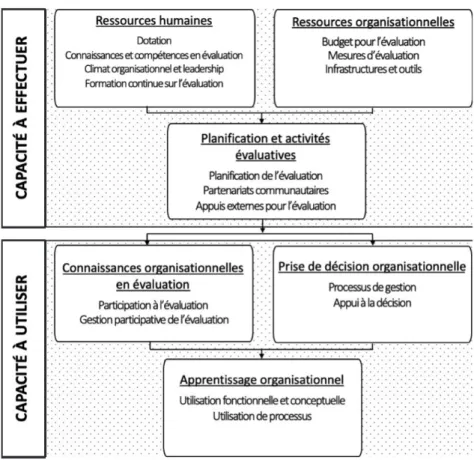
Ressources organisationnelles Budget
Ainsi, les bureaux de pays en situation d’incertitude sont plus susceptibles d’allouer des ressources financières à la mise en œuvre d’activités et de services qu’à l’évaluation des résultats (Alaimo, 2008 ; Carman & Fredericks, 2010 ; Kegeles et al., 2005). Les lignes directrices sur les pratiques d’évaluation peuvent également soutenir la conduite d’évaluations dans les organisations confessionnelles (Adams et al., 2015). Un cadre de référence d’évaluation conçu conjointement et mutuellement accepté par les parties prenantes est également un élément favorisant la RBC en CB (Adams et al., 2015 ; Schalock et al., 2014).
Planification et activités évaluatives Planification
La présence de politiques organisationnelles peut atténuer les effets négatifs d'un roulement élevé sur la durabilité de l'évaluation (Alaimo, 2008). À l’inverse, lorsque l’évaluation n’est pas endossée par une politique ou lorsqu’elle n’est pas liée à un processus de gouvernance (par exemple la planification stratégique annuelle), les évaluations résultent uniquement de la volonté des membres de les réaliser (Alaimo, 2008 ; Carnochan et al. al. , 2014). Les guides de pratiques d’évaluation peuvent également contribuer à la mise en œuvre des évaluations dans les IC (Adams et al., 2015).
Connaissances organisationnelles en évaluation Implication des parties prenantes
Les partenariats entre universités et organisations communautaires offrent une alternative peu coûteuse aux consultants (Garcia-Iriarte et al., 2011). Les partenariats entre les universités et les acteurs de l’évaluation sont mieux axés sur une collaboration interactive et participative (Janzen et al., 2017). Les SL situées à l'extérieur des centres urbains ont généralement moins accès à un soutien externe pour l'évaluation, ce qui constitue un élément problématique pour le RCÉ (Simmons et al., 2015).
Prise de décision organisationnelle Processus de gestion
Apprentissage organisationnel Utilisation conceptuelle, instrumentale et processuelle
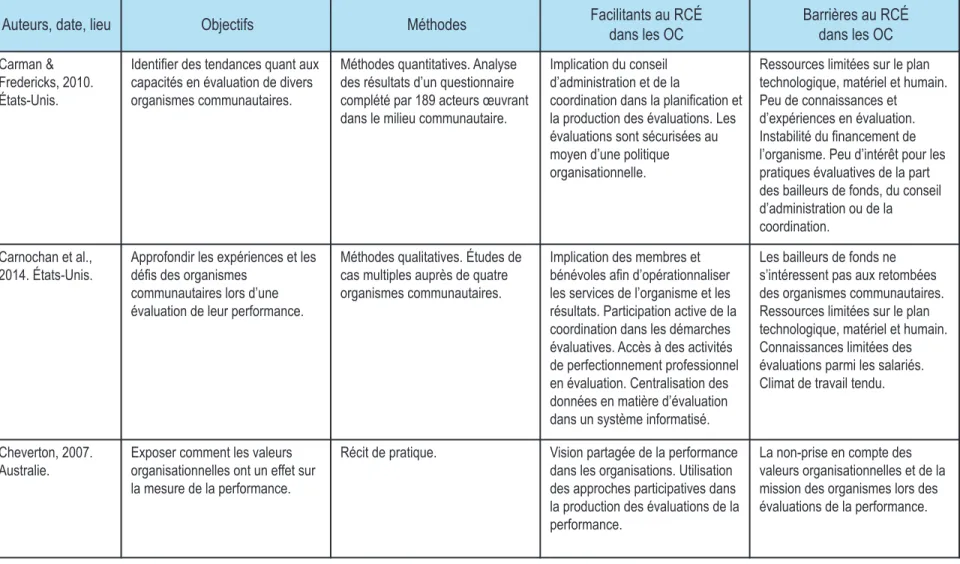
De plus, l'analyse actuelle suggère que les études surestiment le rôle des caractéristiques organisationnelles sur les capacités d'évaluation des SL (Cheverton, 2007 ; Houlbrook, 2011). Quelles composantes et sous-composantes du cadre conceptuel apparaissent essentielles à l'analyse des capacités d'évaluation des LM du Québec. Évaluer les effets d'un programme intitulé Attentes de changement (E2C) sur la capacité d'évaluation d'un échantillon d'organismes communautaires.
Évaluer la démarche mise en œuvre par un groupe universitaire spécialisé en développement communautaire en fonction des capacités d'évaluation d'un échantillon d'organismes communautaires en santé. Présenter les leçons apprises par un groupe d’universitaires qui ont travaillé avec des organismes communautaires pour renforcer leurs capacités d’évaluation. Comparez les différences et les similitudes entre les options d'évaluation de différentes organisations canadiennes.
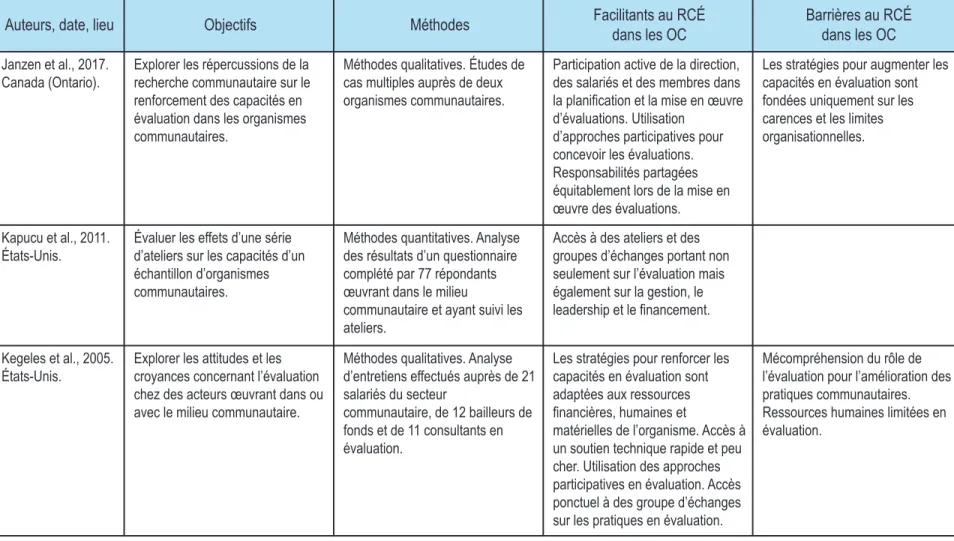
Explorez les implications de la recherche communautaire sur le renforcement de la capacité d'évaluation des organisations communautaires. Les stratégies visant à accroître la capacité d’évaluation reposent uniquement sur les lacunes et les limites organisationnelles. Les stratégies de renforcement des capacités d'évaluation sont adaptées aux besoins financiers, humains et en ressources.
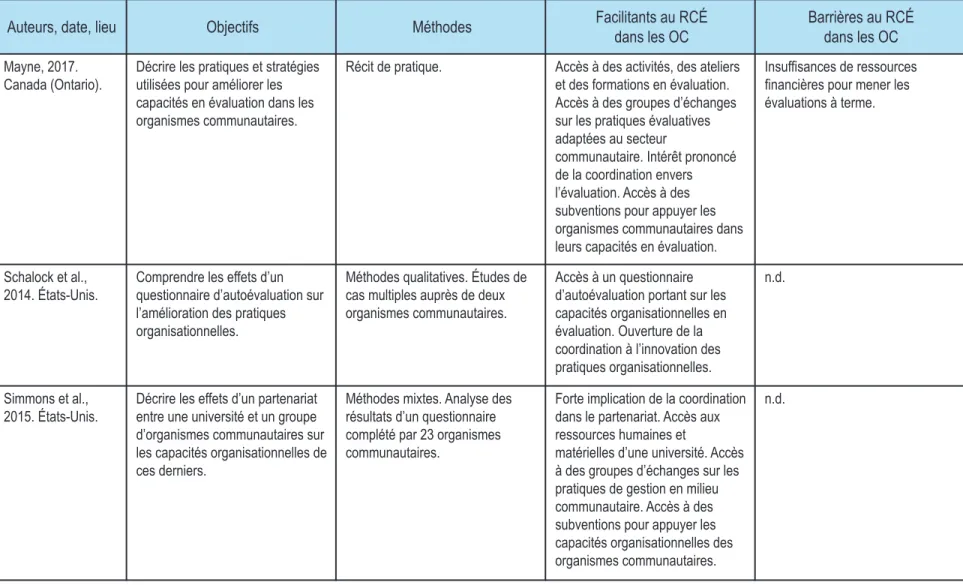
Décrire les pratiques et les stratégies utilisées pour améliorer la capacité d'évaluation des organismes communautaires.

Chasing Funding to “Eat Our Own Tail”: The Invisible Emotional Work of Making Social Change
Jayne Malenfant & Naomi Nichols McGill University
Kaitlin Schwan York University
In many ways, nonprofits are experiencing the unique effects of the neoliberal restructuring of social services, including a growing movement toward “social entrepreneurship” (Maier, Meyer, & Steinbereithner, 2016; Peris-Ortiz, Teulon, Bonet-Fernandez, 2017). This research produced data that reveal the importance of the relational and emotional work within the two networks as vital drivers of social and political change. Supportive and emotional tasks were often considered secondary to what people described as their official mandates, or less essential to carrying out the official mission of the organization (e.g., the work of writing late-night emails to stakeholders, ensuring, that spontaneous deadlines were met, enabling well-being among colleagues).
The scope of the organizations work may change depending on the funding or partnership being pursued and the understanding of particular political priorities or. This work was part of the job, but also often outside the time, hours and tasks that officially fell within their roles in their organizations. This blurring of the boundaries between work and home is increasingly typical of those working in nonprofit organizations (Baines, Charlesworth, & Cunningham, 2012; Hasenfeld. & Garrow, 2012).
Within the organizations examined here, the "scientific" activities associated with research are framed as an integral part of the mission-driven work of the organizations in question, and other forms of work associated with maintenance, community-building and provisioning roles are more likely to be erased within dominant workplace narratives and structures. To stay afloat financially, nonprofits often have to reluctantly “mimic the practices and culture of their institutional counterparts” (Côté & Simard, 2012, p. 109), leading to these negative or ambivalent feelings about “compromising” the work's mandate. In Montréal, too, there was widespread recognition of the value of reflecting on and changing how work was understood in the organization.
It is the appreciation of the work within organizations that contributes to shifts in social policies, practices and people's experience and pushes back against the erasure of connections between people's day-to-day work - the work that involves all the moving parts of an organi to stand - ation - which must be recognized as a key part in the process of contributing to social change.
Funding Nonprofit Radio Technology Initiatives in Canada
The following pages provide a detailed description of the sector and funding, as well as an overview of existing research in the field. The sample was built on the total income listed in the income categories listed in the statements of operations section of the financial statements provided for the study. The sample was built on both the stations that received funds for technology projects from the Radiometres program and the revenue categories provided in the statements of operations section of the financial statements for the study.
The sample is built on the revenue categories listed in the operating summary section of the financial statements made available for the study. The sample is built on both the stations that received funding for technology projects from the Radiometres program and the revenue categories listed in the income statement section of the financial statements for the survey. The sample is built on both the stations that have received funding for technology projects from the Radiometres program and the revenue categories listed in the operating summary section of the annual financial statements for the survey.
The sample is based on the revenue categories reported in the Statements of Operations section of the financial statements provided for the study. No such variations were found in the compilation of the top five expenditure categories reported by these participating stations. The sample is based on both the stations that received funding for technology projects from the Radiometres program and the revenue categories reported in the operating statements of the financial statements provided for the study.
The sample consists of both stations that received funds for technology projects from the Radiometers program and the revenue categories listed in the operating statements section of the financial statements that were available for the study. The sample is based on both the stations that received funds for technology projects from the Radiometers program and the revenue categories reported in the operating statements section of the financial statements prepared for the study. Nonprofit radio is one of the most important sectors in radio because it “gives voice to the voiceless.

My Life and My Work, in Brief 1
Jack Quarter
In the 1920s, my aunt, uncle and cousin returned to Moscow to be part of the revolution. I was 11 years old and trying to make sense of the conflicting signals from the world around me and my family. I did my PhD at the Ontario Institute for Studies in Education (OISE) at the U of T, with a thesis on the student movement of the sixties, which was published as a book in 1972, the year my daughter, Zoey , was born .
One of the most striking observations for me when we arrived at the kibbutz was the concern of the younger generation. While the founders believed they had created heaven on Earth, their children were seeking change and were encouraged to do so by their elders; the elders encouraged them to travel and see the rest of the world, believing that they would return because the kibbutz was such a superior society. One of the greatest joys in my job is sharing with past and present students.
A common denominator in my work is faith in a better way, possibly a form of religious faith, but one that gives meaning to my life's work. We share many of the same ideals, but she has helped me remain balanced and carefully consider evidence before formulating opinions. Nevertheless, I have had a lot of luck in my life – both personally and professionally – and I hope I have contributed to that in some small way.
Despite the many problems in this world, I remain hopeful that people will find a better way.
The Sustainable Development Goals
A Tipping Point for Impact Measurement?
Laurie Mook Arizona State University
One of the complexities of measuring impact is navigating the vast number of methods, indicators and tools available to do so. For example, organizations that calculate social return on investment (SROI) report that measuring social impact is a highly subjective process. On the positive side, implementing an impact measurement process such as SROI results in greater dialogue and engagement with stakeholders.
Building on the Nonprofit Integrated Social Accounting (NISA) model (Mook, 2014) and the popularity of the United Nations Sustainable Development Goals 2030 Agenda (United Nations, n.d., Annex 1), a new integrated social accounting model (ISA) has been developed that It is proposed to expand the focus to align with the social impact. While the NISA model motivates and monitors organizational performance toward achieving an organization's mission, ISA focuses on both inward-looking and outward-looking organizational and societal goals, using the lens of the Sustainable Development Goals (SDGs). This ISA model consists of four interrelated dimensions: 1) resources/capital, 2) value creation/destruction, 3) internal systems and processes, and 4) organizational learning, growth, and innovation. This is the perspective taken by the Common Approach to Impact Measurement (2019) social enterprise initiative led by accounting professor Kate Ruff and housed at Carleton University (Common Approach, 2019).
The CIF sets out ambitions and suggested indicators for each of the SDGs in the Canadian context. This article proposes the next wave of integrated social accounting, linking performance management and impact measurement through the common lens of the world. URL: https://sprott.carleton.ca/2019/unlocking-social-change-through-a-common -approach-to-impact-measurement/ [November 10, 2019].
Stanford Social Innovation Review.URL: https://ssir.org/articles/entry/next_frontier_in_social_impact_measurement [10 november 2019].

APPENDIX A: SUSTAINABLE DEVELOPMENT GOALS
APPENDIX A: (continued)