THE FUTURE OF MAINTENANCE IN THE ROYAL CANADIAN NAVY Lieutenant-Commander Jeffrey Anderson
JCSP 46
Solo Flight
Disclaimer
Opinions expressed remain those of the author and do not represent Department of National Defence or Canadian Forces policy. This paper may not be used without written permission.
© Her Majesty the Queen in Right of Canada, as represented by the Minister of National Defence, 2020.
PCEMI 46
Solo Flight
Avertissement
Les opinons exprimées n’engagent que leurs auteurs et ne reflètent aucunement des politiques du Ministère de la Défense nationale ou des Forces canadiennes. Ce papier ne peut être reproduit sans autorisation écrite.
© Sa Majesté la Reine du Chef du Canada, représentée par le ministre de la Défense nationale, 2020.
JCSP 46 – PCEMI 46 2019-2020 SOLO FLIGHT
THE FUTURE OF MAINTENANCE IN THE ROYAL CANADIAN NAVY
Lieutenant-Commander Jeffrey Anderson
“This paper was written by a candidate attending the Canadian Forces College in fulfilment of one of the requirements of the Course of Studies. The paper is a
scholastic document, and thus contains facts and opinions which the author alone considered appropriate and correct for the subject. It does not necessarily reflect the policy or the opinion of any agency, including the Government of Canada and the Canadian Department of National Defence. This paper may not be released, quoted or copied, except with the express permission of the Canadian Department of National Defence.”
Word Count: 5,082
“La présente étude a été rédigée par un stagiaire du Collège des Forces canadiennes pour satisfaire à l'une des exigences du cours. L'étude est un document qui se rapporte au cours et contient donc des faits et des opinions que seul l'auteur considère appropriés et convenables au sujet. Elle ne reflète pas nécessairement la politique ou l'opinion d'un organisme quelconque, y compris le gouvernement du Canada et le ministère de la Défense nationale du Canada. Il est défendu de diffuser, de citer ou de reproduire cette étude sans la
permission expresse du ministère de la Défense nationale.”
Nombre de mots : 5.082
THE FUTURE OF MAINTENANCE IN THE ROYAL CANADIAN NAVY
If it ain’t broke, don’t fix it.
– Burt Lance
INTRODUCTION
Maintenance is conducted to care for equipment, extend its useful life, and to ensure it is operating at peak ability. Sometimes maintenance is done after a piece of equipment has broken and needs repair or replacement. In other cases, maintenance is done before the failure as a means of preventing it. Generally, these preventative
measures are utilized on expensive or critical equipment where the cost of a failure, either in equipment cost or in output, exceeds the ongoing prevention costs or where the risks of unpredicted failures are too high.
As technology improves and the ability to monitor unique situations increases, specific advice will be given as a result and the old paradigm of a generic maintenance plan will becomes less efficient by comparison. The internet of things (IoT), for example, is giving rise to including all sorts of sensors on equipment and establishing ready access to those numerous sensors.1 Today, “Industry 4.0 – the proclaimed forth industrial revolution – is unfolding at the moment. It is characterized by interconnectedness and vast amounts of available information.”2 The availability of that vast amount of data
1 The Internet of Things is a network of physical objects – vehicles, machines, home appliances, and more – that use sensors and Application Programming Interfaces (APIs) to connect and exchange data over the Internet. Other key IoT technologies are Big Data management tools, predictive analytics, AI and machine learning, the cloud, and radio-frequency identification (RFID). SAP Canada, “Trends: Internet of Things,” last accessed 5 May 2020, https://www.sap.com/canada/trends/internet-of-things.html.
2 Deloitte: Analytics Institute, “Predictive Maintenance: Taking pro-active measures based on advanced data analytics to predict and avoid machine failure” Position Papers 7 (2017), 6.
about equipment and how it operates, combined with the processing power to conduct analytics on that data – often in real time – opens doors to opportunities previously held as only a theoretical ideal.
Given the effort expended on maintenance of all types in person-hours, materiel, funds, and time, efficiencies should be continuously sought. This is not only to reduce operating costs – a savings for a company or government and thus taxpayers – but also to maximize equipment availability and make the most of technician efforts. Furthermore, by evaluating and optimizing maintenance routines, improvements in sustainability by reducing consumption and reusing components where appropriate may be found.
This paper will investigate different types of maintenance, the use and
applicability of them in the Royal Canadian Navy (RCN), potential improvements on the current paradigm, and then focus on the difficulties in implementing such improvements.
BACKGROUND: TYPES OF MAINTENANCE
To understand this paper will not require an advanced engineering degree.
However, appreciation of what different types of maintenance exist will assist the reader in assessing the information in the remainder of this paper. Maintenance is an important activity for any company because it takes time and money to complete, often requires significant planning, and must be done properly to maximize profits. This is especially true for the Navy as profits translates directly as readiness. As VAdm (retired) Lloyd, the 35th Commander of the RCN, would say: “whereas in industry profits are measured in dollars and cents, in the RCN we measure our profits in terms of technical, materiel,
https://www2.deloitte.com/content/dam/Deloitte/de/Documents/deloitte-analytics/Deloitte_Predictive- Maintenance_PositionPaper.pdf.
personnel and combat readiness.”3 He was speaking to the use of business intelligence and analytics, and these are a cornerstone in optimizing maintenance.
Maintenance is a considerable cost of doing business, and proper management of that maintenance can offer significant potential for maximizing productivity and
minimizing those costs.4 Additionally, it must also be considered that most equipment is part of a system and failure or degradation of one part may have second or third order effects. Therefore, the management and proper alignment of types of maintenance is required to reduce risks and maximize readiness. Activities within the spectrum of
maintenance fall into two broad categories: Preventive Maintenance (PM) and Corrective Maintenance (CM). All other forms of maintenance – such as conditions-based,
predetermined, or predictive – are either component parts of one or both those categories, or are scheduling approaches for them.
As the name implies, PM is maintenance which is conducted before a failure occurs, to prevent it. “The underlying aim of preventive maintenance includes improving reliability, operational availability and lifecycle costs of systems by reducing the risk of potentially expensive and inopportune failure.”5 PM may be as simple as an inspection or replacing a filter, to a planned significant effort for preventing a future failure at an unknown time. When a failure occurs, either planned due to PM not being conducted as cost or time prohibitive or unexpectedly, then corrective maintenance (CM) is required.
3 VAdm (ret’d) Lloyd (keynote speech, aSUG BI+Analytics Conference, Orlando, Florida, May 2017).
4 C. Sheut and L. J. Krajewski, "A Decision Model for Corrective Maintenance Management,"
International Journal of Production Research 32, no. 6 (1994), 1365.
5 Robert Arno, Neal Dowling, and Robert J. Schuerger, "Equipment Failure Characteristics and RCM for Optimizing Maintenance Cost," IEEE Transactions on Industry Applications 52, no. 2 (2016), 1257.
CM occurs when something has already failed, but it does not mean that it is completely unplanned. A failure could have been expected, and plans or parts in backup prepared. Other times it is completely unexpected and this prompts investigation to determine the cause of the fault and rectify it. It could be a component part or the entire piece of equipment which has failed. It could also be something upstream in the system which needs correction. CM may involve repair, replacement, or if the item is obsolete then perhaps an upgrade. Often it is the same technicians who perform both PM and CM tasks, but some CM is so large that other staff or contracts are required.6
Risk tolerance, unique circumstances, and severity of potential outcomes are also important to consider. To date, the “maintenance decision problems have been analyzed from Reliability, Availability, Maintainability and Serviceability (RAMS) perspectives and many maintenance models have been developed for optimal decision-making” in different industries.7 While useful, those models may not take into account the value of technician skillsets and training in performing maintenance, the lack of easy access to parts which companies ashore do not necessarily contend with, or have such significant impacts from the results of failure as a Navy does. Having clear goals regarding
maintenance must include more than the binary break/fix considerations for military applications. Identifying those items while investigating maintenance routines will be an aim throughout this paper.
6 For the purposes here, the author decided not to delve into the specifics of 1st, 2nd and 3rd line maintenance or details around ISSC contracts and such as it did not add significantly to the discussion.
7 Sathishkumar Nachimuthu, Ming J. Zuo, and Yi Ding, "A Decision-Making Model for Corrective Maintenance of Offshore Wind Turbines Considering Uncertainties," Energies 12, no. 8 (2019), 1408.
CONSIDERATIONS
Before going further into understanding and comparing the options, it is useful to recall what is trying to be achieved. Firstly, broadly speaking, the “purpose of
maintenance management is to reduce the adverse effects of breakdown and to maximize… availability at minimum cost.”8 Secondly, in the Royal Canadian Navy (RCN) Strategic Plan 2017-2022 it states that:
The RCN must be bold and far-reaching in our approach to innovation with a view to not just focusing on new technologies to fit into ships and submarines, but to seek new ways of conducting core functions like training and maintenance, as well as better and more efficient ways to run our enterprise. The technology engine behind the information age presents new and very powerful opportunities to be leaders in sound and effective corporate management…9
VAdm Lloyd further stressed this when he said that “innovation is a strategic imperative.
It’s how we create our future.”10 Improving maintenance is one way to demand and harness innovation.
Finding ways to optimize maintenance efforts to maximize availability will enable the greatest balance of operations and maintenance. The Naval Materiel Management System (NaMMS) Manual requires this noting that “[o]rganizations involved in PM management shall implement continuous improvement processes to progress towards the goal of completing all PM routines within the Formations.”11 Clearly, investigating and embracing new techniques are not simply desirable, but required.12 This direction was
8 Sheut, “A Decision Model for Corrective Maintenance Management,” 1365.
9 Department of National Defence, Royal Canadian Navy: Strategic Plan 2017-2022 (Ottawa: DND Canada, 2017), 9.
10 VAdm Ron Lloyd (Keynote speech at the NATO Communications and Information Agency 17, Ottawa, 25 April 2017), available on YouTube at https://youtu.be/19G2uopq00I?t=83.
11 Department of National Defence, C-03-005-012/AM-001, Naval Materiel Management System Manual, (Ottawa: DND Canada, 2013), 10-1-3.
12 In military writing, “should” equates to may or can while “shall” equates to must.
later reinforced in Leadmark 2050 where the requirement to develop improved
monitoring and maintenance management going forward was included. Specifically, it states:
Closely related to crew optimization is the need to optimize warship and submarine maintenance practices to improve the percentage of time within the operational cycle that a warship or submarine may be operationally employed. Shipboard maintenance management systems are expected to become increasingly information-enabled to improve the efficiency of existing maintenance practices and enhance workforce scheduling and management. Moreover, developments in areas such as equipment health monitoring and non-destructive testing may apportion naval maintenance work more effectively at the unit, dockyard and industry levels.13
The execution of maintenance on existing equipment is not the only aspect which needs to be considered. Rather, maintenance management is something which should be considered throughout the life of a project or equipment. “The risk of severe accidents is reduced first through competent engineering design, then through diligent conduct of maintenance, and finally by pragmatic risk-based decisions when dealing with departures from the design intent of the materiel.”14 This includes easing the task of repair by:
designing equipment to facilitate maintenance and technician access; planning redundancy and location of equipment; using modular designs to enable quick
replacement and repair; and training for operators and staff.15 Today, consideration must also be given to including appropriate monitoring systems, from cameras and vibration sensors to automated recording and technician interfaces with alerts. These will give
13 Department of National Defence, Leadmark 2050: Canada in a New Maritime World (RCN) (Ottawa: Directorate of Maritime Strategy, 2016), 50.
14 Lt(N) Scott Koshman, Cdr David Peer, Cdr Russell Green, “Naval Materiel Assurance — Prelude to Action for the Royal Canadian Navy,” Maritime Engineering Journal 70 (Fall 2012), 7.
15 Sheut, “A Decision Model for Corrective Maintenance Management,” 1366.
technicians and the supporting computer systems the information they need to make the best recommendations, decisions, and action.
CURRENT METHODS
Preventive maintenance today is generally based on time or use and is not
inclusive of many other factors. For example, consider the average car on the road today and oil changes. Years ago, mechanics swore by changing oil at 3,000 miles or after three months. In more recent times, due to improvements in engine design and oil quality, requirements are much higher, such as Toyota shifting to a 10,000-mile interval with synthetic oil.16 In these examples we see a use limit and/or a time limit, whichever occurs first. However, it does not specifically take into account what type of driving habits the driver has, what kind of maintenance the vehicle has received, what type of load was on the engine (i.e. engine hours from driving in town vs highway or heavy towing), type of oil filter used, or atmospheric conditions and temperature where the vehicle was operated.
To further improve monitoring and recommendation to change the oil, many cars today are utilizing the vast array of sensors in the vehicle to feature an oil life monitor.17 This incorporates many of the variables – which previously were unavailable or averaged – to give a more accurate – and less generic – indication of when to change the engine oil.
The same is true in industrial and commercial settings, where coupling new and existing sensors to monitoring systems is possible.18
16 Philip Reed, “Stop Changing Your Oil!” last accessed 1 April 2020, https://www.edmunds.com/car- maintenance/stop-changing-your-oil.html.
17 Noria Corporation: Machinery Lubrication, Jim Fitch, “Determining Proper Oil and Filter Change Intervals: Can Onboard Automotive Sensors Help?” last accessed 5 May 2020,
https://www.machinerylubrication.com/Read/562/oil-change-filter-sensors.
18 Noria Corporation: Reliable Plant, Jeff O’Brian, “Improve Maintenance with the Internet of Things,”
last accessed 5 May 2020, https://www.reliableplant.com/Read/29962/internet-of-things.
A parallel example is the use of a RADAR system and its maintenance. Let us propose that a rotating antenna needs to be greased every thousand hours of operation or two months, whichever comes sooner. These time-based PM activities are created “based on warranty history from the manufacture’s own information and is designed to reduce the probability of failure or corrective maintenance (CM) actions, especially during the warranty period.”19 As alluded to above, this does not mean it perfectly fits every given circumstance. The PM favours avoiding a most-likely-adverse-condition to prevent catastrophic failures. That means that it is greased too often in ideal conditions and perhaps not enough in the absolute worst conditions, but that generally it is sufficient or excessive and thus safest. But at what cost? Compared to catastrophic failure a grease routine is certainly cheaper as grease is relatively inexpensive. However, if each routine takes three person-hours plus materiel and it is done unnecessarily often, then the maintenance costs are excessive and the use of extra materiel wasteful. Also, as technician time is incredibly limited, organizations need to prioritize maintenance to maximize efficiencies. Predictive and conditions-based maintenance can improve conventional preventive maintenance scheduling and help achieve that goal. Inspections and recordkeeping are important components of documenting equipment and providing data to achieve that aim. Perhaps the grease routine was ideal, in which case the updated maintenance monitoring and planning would validate it. Perhaps there are efficiencies to be found.
The RCN has a robust and comprehensive approach to maintenance which aims to maximize readiness though optimization and efficient allocation of resources. Warships
19 Arno, “Equipment Failure Characteristics and RCM for Optimizing Maintenance Cost,”1257.
are among the most complex systems of systems in the world and also carry an inherently high risk given their missions.20 In the Navy, the priorities at sea are float, move, fight.
Maintenance enables all these priorities in normal routines as well as prepares the crew to deal with unexpected situations in emergencies. This approach is backed up in the
NaMMS manual. But while:
NaMMS is written very well, the benefits cannot be fully realized because the demands exceed capacity. Holistically, maintenance in the RCN is stuck in the ‘tyranny of the urgent’ where pressure from deploying ships, CM, and implementing engineering changes (ECs) negatively impacts the conduct of PM across the Halifax Class.21
Properly structuring, prioritizing, and resourcing maintenance is necessary to the long- term survivability of the Navy and will be key to future success. However, scheduling it is not enough; PM must actually be completed to be beneficial.
PREDICTIVE AND CONDITIONS-BASED MAINTENANCE
Most simply put, conditions-based is conducting maintenance when the condition of the equipment necessitates it and predictive maintenance is using extensive data, statistics, and analytics to predict when that condition will be met. Let us take an example of a factory or shop with a number of critical and non-critical motors which run the equipment. If the maintenance team knows “what the normal life expectancy of the bearings are for the critical motors, they can schedule maintenance and change out the bearings or motor before they fail. For the less critical motors, they just let the motor run until it fails.”22 So first they have decided when preventative maintenance is necessary
20 Jacques P. Olivier and Santiago Balestrini-Robinson, “Capability-Based System-of-Systems Approach in Support of Complex Naval Ship Design,” CEUR Workshop Proceedings 1234 (2014): 64.
21 Cdr Tom Sheehan (Nav Eng), email conversation with the author, 1 April 2020.
22 Arno, “Equipment Failure Characteristics and RCM for Optimizing Maintenance Cost,” 1260.
from a time-cost-risk analysis, and when waiting until CM is required to take action is acceptable. But how do they determine when to conduct that PM?
Today, they would likely use the methods above where time-based
recommendations are based on historical failure averages. The “well known ‘bell curve,’
shown in Fig. 1 is a probability density function of failure in which a few items fail very quickly and a few items last a very long time, but the majority of items fail around a specific average or mean time period.” This average life expectancy is known as the Mean Time Before Failure (MTBF).23 In Figure 1 it is the MTBF of an incandescent lightbulb.
Figure 1 – Rate of Failures versus Time - Normal Distribution
Source: Arno et al., “Equipment Failure Characteristics… for Optimizing Maintenance Cost”, 1258.
While utilizing the MTBF is a predictor upon which most preventive schemes are based today, it is not what people think of – or probably mean – when they say predictive maintenance.
Put more specifically, conditions-based maintenance (CBM) “consists of the analysis of the monitored parameters to evaluate if certain indicators present signs of
23 Arno, 1258.
decreasing performance or incipient fault.”24 This information could be from many different types of sensors or from an inspection by a technician. For example, utilizing electrical signature analysis (ESA) in electrical generation systems “faults can be detected at an early stage and the frequency components’ magnitudes are generally related to the fault severity.”25 Sensor data including pressure monitoring, vibration analysis, external conditions, and load on the equipment would all help provide the live picture and compare it to a model. Take an engine where the cylinder temperature increases. If you did not know that the ocean temperature was warmer than when the equipment was tested, or that the load or speed had just increased, you could not accurately measure the current temperature data against the correct component of the model. A more complete dataset is required. But while this increases accuracy of the model, it also increases the complexity of it and the processing power required to run it.
Newer equipment comes with many of these sensors included, and some even with self-contained monitoring. But correlating that data and having access to the
necessary models to understand the data holistically may not be readily available. This is because that data and model has value to companies to provide a service such as
Caterpillar’s recent release of the “New Remote Troubleshoot [which] analyzes real-time asset data, so the dealer can run diagnostics testing on the connected product and pinpoint potential issues… The machine or engine continues to do its job throughout the
24 Camila Paes Salomon, Claudio Ferreira, Wilson Cesar Sant'Ana, Germano Lambert-Torres, Luiz Eduardo Borges da Silva, Erik Leandro Bonaldi, Levy Ely de Lacerda de Oliveira, and Bruno Silva Torres,
"A Study of Fault Diagnosis Based on Electrical Signature Analysis for Synchronous Generators Predictive Maintenance in Bulk Electric Systems," Energies 12, no. 8 (2019): 1506, 1-2.
25 Ibid, 2.
process…”26 Deloitte goes further stating that “in the environment of Industry 4.0, maintenance should do much more than merely preventing downtimes of individual assets. Predicting failures via advanced analytics can increase equipment uptime by up to 20%.”27 Thus, the data and the model can be monetized and could be ongoing revenue streams for the OEM or third party data brokers.
One example of using real-time information to diagnose equipment and predict failure is the use of thermal imaging for monitoring parts and equipment. The technology has been around for decades but has – as with many technologies – improved in recent years and become more commonly used and useful. It is noteworthy that “[m]ost failures in equipment are signalled by a significant rise in operating temperature long before failure occurs.”28 Being able to track and act upon those changes could prevent
catastrophic failure or indicate maintenance is required. Temperature sensors are placed throughout engines to measure these items. However, not every component or piece of equipment has a heat sensor. Specifically “[i]n the marine industry, thermal imaging can be used to detect delamination in hulls, bad core material under layers of fiberglass, leaking tanks, overheating wiring, water not flowing properly through heat exchangers or engine blocks, faulty pumps, etc.”29
26 Caterpillar Inc., “New Cat® Remote Services Reduce Equipment Diagnostics and Update Time to Improve Jobsite Efficiency,” Last accessed 3 April 2020, https://www.cat.com/en_US/news/machine-press- releases/new-cat-remote-services-reduce-equipment-diagnostics-and-update-time-to-improve-jobsite- efficiency.html.
27 Deloitte, “Predictive Maintenance…” 3.
28 Justyna Molenda and Adam Charchalis, "Preliminary Research of Possibility of using Thermovision for Diagnosis and Predictive Maintenance of Marine Engines," Journal of KONBiN 49, no. 3 (2019): 51.
29 Ibid.
Figure 2 – The Exemplary Thermogram of 3AL25/30 Engine: a) IR View, b) Visible Picture Source: Molenda and Charchalis, "Preliminary Research of Possibility of using Thermovision." 50.
As a testament to this:
In 2004, Lloyd’s Register, the world’s most important ship classification and certification body, made the following prediction: ‘In the near future, mechanical machinery on board vessels will also benefit from thermal imaging, especially as a pre-docking strategy to identify and target equipment and systems which need attention as well as to eliminate unnecessary work’.30
Today, the capacity and opportunities are likely even greater. Tools like this deliver live data and can be used to make a prediction about failure and efficiency. It is an important tool in the predictive maintenance toolbelt.
An example of an emerging software to provide predictive capability is IBM’s Predictive Maintenance Insights which is a part of the IBM Maximo Asset Performance Management (APM) suite. IBM claims it can be used to predict the likelihood of future failures and determine factors as it “uses Watson™ to look for patterns in asset data, usage and the environment, and correlates with any known issues to help predict
30 Ibid, 56.
failures.”31 The expected results include to “reduce unplanned downtime and risks;
reduce maintenance costs; improve asset utilization; extend asset life; and increase production output.”32 The results are similar to the desired outcome of PM in the
traditional sense, but the intent appears as further improved and focused for each machine and its specific use.
Another example is SAP’s Predictive Maintenance Software which advertises to enable a “move from reactive to predictive maintenance and service – with the Internet of Things (IoT).”33 Similar to IBM’s software, SAP claims that by combining sensor data with business information from the Enterprise Resource Planning (ERP) tools, Enterprise Asset Management (EAM) data, and other sources, using this software will: improve service profitability, reduce maintenance costs, and increase asset availability.34
Clearly the technology is available to provide maintenance advice based on monitoring and predictions. These predictions, if correct and if utilized as envisioned, could have a positive impact on how the RCN does maintenance and therefore result in greater readiness. In some instances, if “continuous monitoring can be used to indicate incipient failure, regularly scheduled PM becomes unnecessary.”35 Use of this type of technology could set conditions for more advanced optimization of scheduling and understanding current engineering states and greater understanding of risks by not
31 IBM, “Identify and Manage Asset Reliability Risks,” last accessed 1 April 2020,
https://www.ibm.com/products/ibm-maximo-asset-performance-management/predictive-maintenance- insights.
32 Ibid.
33 SAP, “SAP Predictive Maintenance and Service,” last accessed 1 April 2020, https://www.sap.com/canada/products/predictive-maintenance.html.
34 Ibid.
35 Arno, “Equipment Failure Characteristics and RCM for Optimizing Maintenance Cost,” 1257.
completing maintenance. To accomplish this, the systems rely on a suite of sensors and technical expertise, as well as extensive models and clean datasets to provide that advice.
In 2009, an important action was commenced which today gives greater data about how the machinery in the RCN operate. L-3 Communications (MAPPS Division) was awarded a $73 million contract to “supply its Integrated Platform Management System (IPMS) upgrade for the Canadian Navy’s 12 Halifax Class frigates… to
modernize the frigate’s ship control system and improve the operational effectiveness of the vessels.”36 Not only does it allow the ship to be operated more easily, it includes equipment health monitoring. This data can be mined for insight into problems, but so far has only been used for investigating problems after an incident has occurred to help identify normal parameters or cause of failure on a case-by-case basis.
Then, in 2019, the RCN directed that the Maritime Operational Research Team (MORT) – comprised of five scientists from Defence Research and Development Canada (DRDC) – investigate using IPMS data for analytics and analysis. Specifically, they were to investigate if there is any predictive power in the IPMS data “in providing early
indications of corrective maintenance events.”37 Their objectives included identifying
“relationships between IPMS data and corrective maintenance records, in hopes of using sensor data to accurately predict corrective maintenance.”38 To be considered successful,
36 David Pugliese, “L-3 to Supply Platform Management System to Halifax-Class Frigates,” Ottawa Citizen, 19 January 2009.
37 Defence Research and Development Canada (DRDC) and National Research Council Canada (NRC), DRDC-RDDC-2019-L124, On the use of the Integrated Platform Management System (IPMS) data to develop predictive models: Summary of initial results and finding for supervised learning, (Ottawa:
DND Canada, May 2019), 1.
38 Defence Research and Development Canada (DRDC) and National Research Council Canada (NRC), DRDC-RDDC-2019-C279, Corrective Maintenance Prediction using Supervised Models and Unsupervised Anomaly Detection of Halifax-Class Frigate Sensor Data: Final Report: Phases I and II, (Ottawa: NRC, September 2019,) 5.
the model would have to predict future maintenance requirements on an actionable timescale as well as minimize the false positive predictions where maintenance would be indicated when it was not required.39
The data MORT was provided included over 1.5 billion data points per year from over eight thousand sensors, as well as supporting data regarding maintenance.40 The team applied many different approaches to utilizing the data and investigating it to find insight. Through down-selecting to a few systems which had the most reliable and
identifiable data, the team was able to create a model and train it. When the trained model was tested on a frigate whose data had not been included in training the system, “a top performance of 0.75 accuracy was achieved, when considering those cases that proved significant.”41
While the results of the supervised learning were able to show there is predictive power within the data, the models did not perform well enough to be deployed.42 The limited amount of data in the CM records – and it not always being purposefully tied to an exact failure or time – made the system learning more difficult. Another issue
discovered was the sensors on the ship were designed primarily to operate it (e.g. speed, temperature), and more sensors for vibration, flow, and acceleration would be required to further refine the model and improve predictions.43
39 DRDC and NRC, DRDC-RDDC-2019-L124, On the use of the Integrated Platform…, 2.
40 Ibid, 1.
41 DRDC and NRC, DRDC-RDDC-2019-C279, Corrective Maintenance Prediction…, 18.
42 DRDC and NRC, DRDC-RDDC-2019-L124, On the use of the Integrated Platform…, 7.
43 Ibid.
COMPARISON
Understanding the current state of how maintenance is scheduled and conducted in the RCN, as well as what is available in industry and in the computer science and analytics community, allows for introspection regarding what may be required to improve.
There are four basic steps to optimize maintenance at any facility:
understanding the current approach to maintenance and the resulting impact on mission and cost; developing a statistical approach to both PM and CM based on data; optimization of the maintenance process with established tools; cost comparison of existing maintenance program to an optimized program.44
These steps sound simple enough at first glance, and perhaps they are at a macro level.
Yet, when actually conducting them it will quickly become obvious that this is a very complex problem. There are multiple points of view to consider and often there will be valid reasons for two or more courses of action. Understanding costs compared to value and readiness is challenging, even in an ideal setting with all the information. In reality, decision makers are unlikely to have all the necessary information.
When considering improving maintenance, those participating in the analysis and the decision-makers will have many options available. These would include: maintaining the status quo; maximizing optimization within existing limitations of equipment;
investing in equipment, training, and/or technology today; investing in technology and sensors, but only for future platforms; completely outsourcing the problem; or any combination of those options. While considering those options, the question is further
44 Arno, “Equipment Failure Characteristics and RCM for Optimizing Maintenance Cost,” 1257.
complicated by weighing the benefits with the costs against the risks (both in terms of risk of not improving and the risks in transition).
The following graphs show CM and PM effort in the Halifax class by hours applied and number of maintenance work orders closed.
Figure 3 – Halifax Class CM and PM: Hours and Closed Orders by Year
Source: RCN Digital Solutions Team, DRMIS Data Sources and Simple Graph, 27 March 2020.
It is a simple demonstration of extracting information from data entered into the system.
If set up correctly, this graph could be automatically reproduced without any additional effort other than clicking “refresh” or scheduling it as a recurring report.45 This is because rather than requiring extra staff work, it relies on data which has and is already entered into the system by people in the normal course of them documenting their work. The question is “what is it telling us?”. Perhaps many things. It appears CM did not sharply
45 SAP, SAP BusinessObjects Web Intelligence User's Guide 4.2, (n.p., 2018), 821.
decrease with increased PM efforts in 2013-2014 (despite that fact being opposite to the intuitive belief that more PM should reduce CM). Did that happen because the FMFs were over-tasked with maintenance already so the backlog was outside the scope of this graph’s ability to show? Or is it showing that as the ships are aging and CM is increasing, it is at a similar rate which PM is improving? Or perhaps the PM backlog is so extensive that even the marked increase in conducting PM has not yet had the effect it should have?
Are there relationships between the numbers, and if so what do those relationships mean (if anything)? The number of questions and ideas which these two graphs can generate are amazing. Sadly, those interesting questions cannot be answered here (yet). But the graphs do show that better conclusions – or at least better questions – are possible when the data is exposed and used in a meaningful way, and this is only a hint of the potential.
Building on that example and what has been discussed about technology and optimization, the potential benefits of harnessing data and analytics for predictive maintenance are obvious. Unfortunately, the impressive benefits are only achievable when the means of collecting good data, cataloguing it, and running the model in real- time is possible. The Navy, and likely a lot of industry, does not yet have this capability.
The Navy already has a very well-defined approach to maintenance and – like
professionals in other areas – has naturally found efficiencies. By leveraging technology, we can work smarter, not harder.46
46 “The term “work smarter… not harder” originated in the 1930’s. Allen F. Morgenstern, an industrial engineer, the creator of the work simplification program, coined the term. The program’s intent was to increase the ability of people to produce more with less effort.” ToughNickel, “How to Work Harder, Smarter, Better: Quotes from Famous People on Work,” Last accessed 3 May 2020,
https://toughnickel.com/business/How-to-Work-Harder-Smarter-Better-Quotes-from-Famous-People.
CONCERNS
As with any innovative idea or change, there are concerns and considerations which need to be understood and addressed if adoption is to be successful. Generally, these seem to break down into four broad categories: scientifically sound; legal requirements; risk tolerance; and the human factors.
When a failure has occurred or important PM cannot be completed and a ship needs to sail, then a risk assessment is done. In many cases this is determined by the Commanding Officer (CO), but in more complex or important cases it is reviewed by staff ashore. To ensure that this is handled properly, Naval Order (NAVORD) 3000-0 Materiel Baseline Standard (MBS) – Surface Ships Policy states that “Ships shall not be considered to have met the MBS to proceed to sea unless these PM routines are up-to- date or a Risk Assessment (RA) is submitted to the Formation Technical Authority (FTA) for review and endorsement as appropriate…”47 This is to ensure that a sufficiently qualified and experienced authority reviews important assessments. Cdr Tom Sheehan, previously the FTA in the Canadian Fleet Atlantic and now in the Project Management Office (PMO) at Canadian Surface Combatant (CSC) notes that:
Risk management is key, but it is impossible to fully understand the complete and actual state of maintenance and repair of all shipboard systems in our current construct. There are latent defects which will go unknown until the PM routine is actually completed or a failure occurs.
Those defects may cause second and third order effects which also will go unknown until put in place as mitigation efforts to the original failure.48 Better understanding of the state of a ship is something which is achieved through completing PM and properly documenting it.
47 Royal Canadian Navy, NAVORD 3000-0, Materiel Baseline Standard (MBS) – Surface Ships Policy, (Ottawa: DND Canada, 12 December 2016), 2.
48 Cdr Tom Sheehan (Nav Eng), email conversation with the author, 1 April 2020.
Access to useful and quality data to make statistical conclusions and analytical conclusions will be necessary to both optimize the current paradigm and progress to any future version. One of the key areas referenced for such data is the Defence Resource Management Information System (DRMIS), which was launched in 2010 as an ERP software to integrate finance, procurement, materiel management, human resources management, as well as planning and other functions.49 As an example of data quality issues, over the last five years the HALIFAX class appears to have a sharp increase in defects but this “is most likely due to the implementation of increased Materiel State Validation (MSV) checks and ship’s staff efforts in logging more defects into DRMIS, vice an exponential decrease in the materiel state of the platforms.”50 Data completeness and accuracy will need to be a consideration going forward, but should not stop attempts to use it. Rather, it should be used as is, and any gaps or concerns noted for improvement.
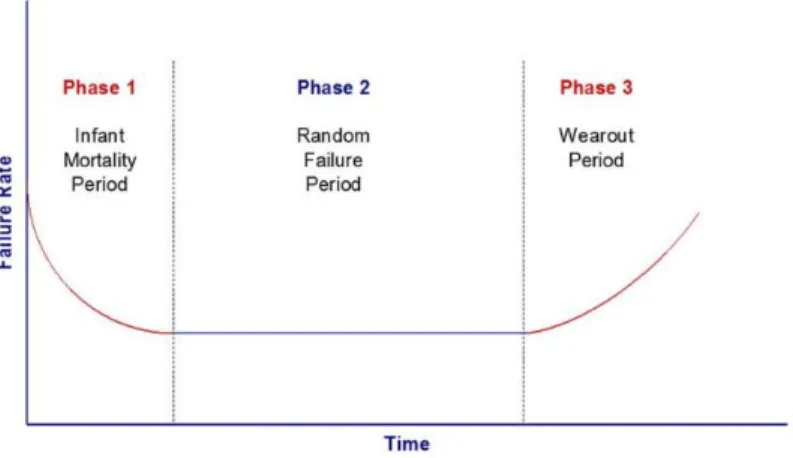
To improve data accuracy and completeness, it should be a priority to ensure that it is easy for technicians to enter data and that it is assessed for being useful.51 That improved data would make projections and estimates more accurate, confirm appropriate PM is scheduled and highlight when it was not completed in time, and therefore improve readiness. Without knowing how bad the data is today, the sudden rise being seen could be due to the age of the equipment entering the wearout period, as seen in the bath tub curve at Figure 4 which shows failure rate against time, and it would be hard to confirm or deny.
49 Department of National Defence, C-03-005-012/AM-001, Naval Materiel Management System Manual, (Ottawa: DND Canada, 2013), 3-1-2.
50 Department of National Defence, RCN Quarterly Report FY 2019/2020 Q3, (Ottawa: DND Canada, 2020), 44.
51 Future of Field Service, “What Good Digital UX Means to Your Technicians,” last modified 5 April 2019, https://www.futureoffieldservice.com/2019/04/05/what-good-digital-ux-means-to-your-technicians/.
Figure 4 – Bath Tub Curve Showing Three Failure Distributions
Source: Arno et al., “Equipment Failure Characteristics… for Optimizing Maintenance Cost”, 1258.
Another concern is where the extra person power could come from for this
additional work. The question of maintenance is a complex one because, in addition to all the other issues, the effort at the coastal Fleet Maintenance Facilities (FMF) are a capped resource.52 That is, they only have so many hours to dedicate to maintenance of any type and prioritizing additional PM generally results in being less available for CM. Since it is a capped resource, it is less about how much effort is being expended and is about how smartly that effort is expended.53 Properly prioritizing PM and optimizing scheduling will provide the greatest effectiveness, but even the task of investigating and improving takes effort. The human capital management component of maintenance is an important aspect and potential limiting factor.
The human factor from the point of view of the staff scheduling or performing maintenance is also important to consider. “At first the traditional maintenance
organization will view this as a threat to their livelihood. The reality is the process will
52 Cdr Jon Lee (Nav Eng), email conversation with the author, 30 March 2020.
53 Ibid.
enhance their effectiveness and provide justification for good maintenance practices.”54 There will, for the foreseeable future, likely be more PM than can be accomplished. So the threat of job security is not an issue from this cause. However, as with all change, managing expectations of both staff and supervisors will be critical to shepherding successful advancement.
The final concern is cost. Not only is there cost in developing a new program, but cost in maintaining the old one. Government spending and allocation of funds to materiel can change, and this is problematic for planning. As maintenance is a large component of operating the Fleet, it is considered at all levels. But a significant portion of that
maintenance is PM which is done often without an immediate return. PM is, by its very definition, preventing something rather than repairing something that is broken. That does not mean that it is cost effective to avoid or ignore PM, just that the results are long- term. Imagine steel rusting all over because a quick paint job was not finished, or a mis- aligned motor causing pump failure because vibrations were ignored. Yet short-term gains are real, and long-term risk seems to be something for the future.
CONCLUSION
This paper investigated different types of maintenance, the use and applicability of them, potential improvements on the current paradigm, and then focused on the difficulties in implementing such improvements. The greater efficiencies that conditions- based maintenance and predictive maintenance can provide is self evident. And in a world where AI and the use of big data offers to provide seemingly limitless opportunity, it is critical that the RCN consider using them today and in the future. However, the path
54 Arno, “Equipment Failure Characteristics and RCM for Optimizing Maintenance Cost,” 1263.
to gathering the necessary information and achieving the parameters for establishing the modernisation of maintenance routines has many difficulties.
The benefits of applying predictive models are impressive when fully implemented, but at this point do not appear to overcome the investment required to achieve them – particularly for the Halifax Class. However, that only indicates that a wholesale change is not advantageous at present; efficiencies and optimizations should still be sought with the help of software today. There is great value in learning the techniques, developing the tools, and implementing the practices which will enable the future fleet to capitalize on technology improvements. As things are continuously changing, the skillsets and mindsets must reflect this as one of continuous improvement and developing capabilities. Tradespeople will continue to be valued, along with their experience, but will be aided in deciding what needs attention by computers which are constantly monitor equipment.
The efforts and expense to achieve the desired outcomes of improved
maintenance for the Fleet is necessary and ongoing. Changes will not happen over night nor by accident; specific and concerted effort developing such abilities today will pay dividends well into the future. While doing so, however, it is important to note that short- term gains favouring mission are real while the resulting long-term risk of incomplete maintenance feels intangible. The RCN must guard against this mentality and make wise decisions for maintaining the Fleet today for tomorrow.
BIBLIOGRAPHY
Arno, Robert, Neal Dowling, and Robert J. Schuerger. "Equipment Failure
Characteristics and RCM for Optimizing Maintenance Cost." IEEE Transactions on Industry Applications 52, no. 2 (2016): 1257-1264.
https://doi.org/10.1109/TIA.2015.2483700.
Canada. Defence Research and Development Canada (DRDC) and National Research Council Canada (NRC). DRDC-RDDC-2019-L124, On the use of the Integrated Platform Management System (IPMS) data to develop predictive models:
Summary of initial results and finding for supervised learning. Ottawa: DND Canada, May 2019.
Canada. Defence Research and Development Canada (DRDC) and National Research Council Canada (NRC). DRDC-RDDC-2019-C279, Corrective Maintenance Prediction using Supervised Models and Unsupervised Anomaly Detection of Halifax-Class Frigate Sensor Data: Final Report: Phases I and II. Ottawa: NRC, September 2019.
Canada. Department of National Defence. 1258-224 (ADM(RS)), Evaluation of the Maritime Equipment Program. Ottawa: DND Associate Deputy Minister (Review Services), 2016.
Canada. Department of National Defence. Leadmark 2050: Canada in a New Maritime World (RCN). Ottawa: Directorate of Maritime Strategy, 2016.
Canada. Department of National Defence. Royal Canadian Navy: Strategic Plan 2017- 2022. Ottawa: DND Canada, 2017.
Canada. Department of National Defence. RCN Quarterly Report FY 2019/2020 Q2.
Ottawa: Directorate of Naval Strategic Management, 2020.
Canada. Department of National Defence. RCN Quarterly Report FY 2019/2020 Q3.
Ottawa: Directorate of Naval Strategic Management, 2020.
Canada. Department of National Defence. C-03-005-012/AM-001, Naval Materiel Management System Manual. Ottawa: DND Canada, 2013.
Canada. Department of National Defence. C-23-005-000/AG-001, Naval Materiel Regulation for Surface Ships. Ottawa: DND Canada, 2013.
Canada. Office of the Auditor General of Canada. “Chapter 5—Maintaining and Repairing Military Equipment—National Defence.” In 2011 Fall Report of the Auditor General of Canada. Ottawa: OAG Canada, 2011. Available at
https://www.oag-bvg.gc.ca/internet/English/parl_oag_201111_05_e_35937.html.
Canada. Royal Canadian Navy. NAVORD 3000-0, Materiel Baseline Standard (MBS) – Surface Ships Policy. Ottawa: DND Canada, 12 December 2016.
Caterpillar Inc. “New Cat® Remote Services Reduce Equipment Diagnostics and Update Time to Improve Jobsite Efficiency.” Last accessed 3 April 2020.
https://www.cat.com/en_US/news/machine-press-releases/new-cat-remote- services-reduce-equipment-diagnostics-and-update-time-to-improve-jobsite- efficiency.html.
Deloitte: Analytics Institute, “Predictive Maintenance: Taking Pro-active Measures Based on Advanced Data Analytics to Predict and Avoid Machine Failure”
Position Papers 7 (2017), 6.
https://www2.deloitte.com/content/dam/Deloitte/de/Documents/deloitte- analytics/Deloitte_Predictive-Maintenance_PositionPaper.pdf.
Ding, Yi, Anatoly Lisnianski, Ilia Frenkel, and Lev Khvatskin. "Optimal Corrective Maintenance Contract Planning for Aging multi‐state System." Applied Stochastic Models in Business and Industry 25, no. 5 (2009): 612-631.
Future of Field Service. “What Good Digital UX Means to Your Technicians.” Last modified 5 April 2019. https://www.futureoffieldservice.com/2019/04/05/what- good-digital-ux-means-to-your-technicians/.
IBM. “Identify and Manage Asset Reliability Risks.” Last accessed 1 April 2020.
https://www.ibm.com/products/ibm-maximo-asset-performance- management/predictive-maintenance-insights.
Koshman, Lt(N) Scott , Cdr David Peer, and Cdr Russell Green. “Naval Materiel Assurance — Prelude to Action for the Royal Canadian Navy.” Maritime Engineering Journal 70 (Fall 2012): 6-9.
http://www.cntha.ca/static/documents/mej/mej-70.pdf.
Lloyd, VAdm (ret’d). Keynote speech, NATO Communications and Information Agency 17, Ottawa, Canada, 25 April 2017. Available on YouTube at
https://youtu.be/19G2uopq00I.
Lloyd, VAdm (ret’d). Keynote speech, aSUG BI+Analytics Conference, Orlando, Florida, May 2017.
Molenda, Justyna and Adam Charchalis. "Preliminary Research of Possibility of using Thermovision for Diagnosis and Predictive Maintenance of Marine Engines."
Journal of KONBiN 49, no. 3 (2019): 49-64.
https://search.proquest.com/docview/2311753225?accountid=9867.
Nachimuthu, Sathishkumar, Ming J. Zuo, and Yi Ding. "A Decision-Making Model for Corrective Maintenance of Offshore Wind Turbines Considering Uncertainties."
Energies 12, no. 8 (2019): 1408-1421.
Noria Corporation: Machinery Lubrication, Jim Fitch. “Determining Proper Oil and Filter Change Intervals: Can Onboard Automotive Sensors Help?” Last accessed 5 May 2020. https://www.machinerylubrication.com/Read/562/oil-change-filter-sensors.
Noria Corporation: Reliable Plant, Jeff O’Brian. “Improve Maintenance with the Internet of Things.” Last accessed 5 May 2020.
https://www.reliableplant.com/Read/29962/internet-of-things.
Olivier, Jacques P. and Santiago Balestrini-Robinson. “Capability-Based System-of- Systems Approach in Support of Complex Naval Ship Design.” CEUR Workshop Proceedings 1234 (2014): 59-70. http://ceur-ws.org/Vol-1234/paper-06.pdf.
Pugliese, David. “L-3 to Supply Platform Management System to Halifax-Class Frigates.” Ottawa Citizen, 19 January 2009. Last accessed 3 May 2020.
https://ottawacitizen.com/news/national/defence-watch/l-3-to-supply-platform- management-system-to-halifax-class-frigates/
Reed, Philip. “Stop Changing Your Oil!” Last accessed 1 April 2020.
https://www.edmunds.com/car-maintenance/stop-changing-your-oil.html.
SAP. SAP BusinessObjects Web Intelligence User's Guide 4.2, 15 November 2018.
https://help.sap.com/doc/4f6c0512515d48e884444d0671980060/4.2.4/en- US/webi42sp4_user_guide_en.pdf.
SAP. “SAP Predictive Maintenance and Service.” Last accessed 1 April 2020.
https://www.sap.com/canada/products/predictive-maintenance.html.
SAP Canada. “Trends: Internet of Things.” Last accessed 5 May 2020.
https://www.sap.com/canada/trends/internet-of-things.html.
Salomon, Camila Paes, Claudio Ferreira, Wilson Cesar Sant'Ana, Germano Lambert- Torres, Luiz Eduardo Borges da Silva, Erik Leandro Bonaldi, Levy Ely de Lacerda de Oliveira, and Bruno Silva Torres. "A Study of Fault Diagnosis Based on Electrical Signature Analysis for Synchronous Generators Predictive
Maintenance in Bulk Electric Systems." Energies 12, no. 8 (2019): 1506.
Https://DOI.org/10.3390/en12081506.
Sheut, C. and L. J. Krajewski. "A Decision Model for Corrective Maintenance
Management." International Journal of Production Research 32, no. 6 (1994):
1365-1382.
Stenström, Christer, Per Norrbin, Aditya Parida, Uday Kumar, Luleå tekniska universitet, underhåll och akustik Drift, and Institutionen för samhällsbyggnad och
naturresurser. "Preventive and Corrective Maintenance - Cost Comparison and Cost-Benefit Analysis." Structure and Infrastructure Engineering 12, no. 5 (2016): 603-617.