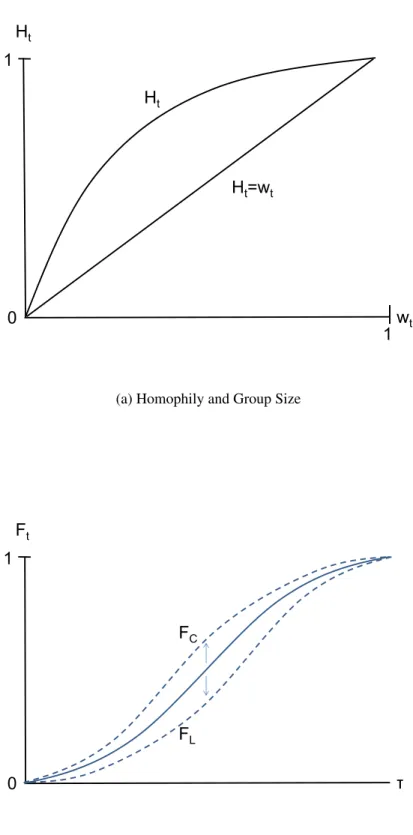
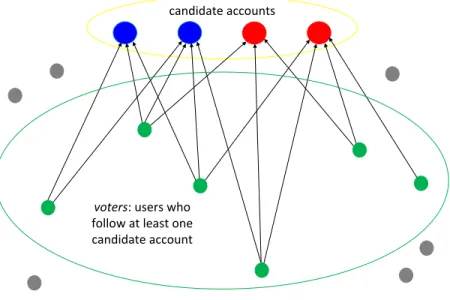
In the absence of one-way interactions (ps >pd), there are no differences between the majority and minority groups in information exposure. Further, in the absence of differences in group size (wC=0.5), there will be no group-level difference in information exposure. Proposition 3: With one-sided interactions (ps>pd) and the production of like-minded information (es>ed), groups are disproportionately exposed to like-minded information.
The Political Network
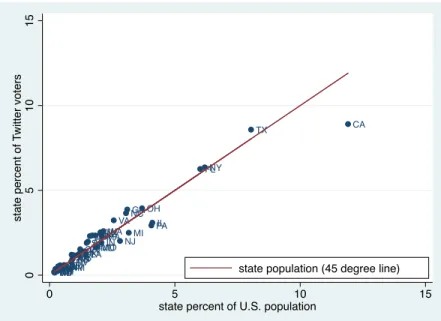
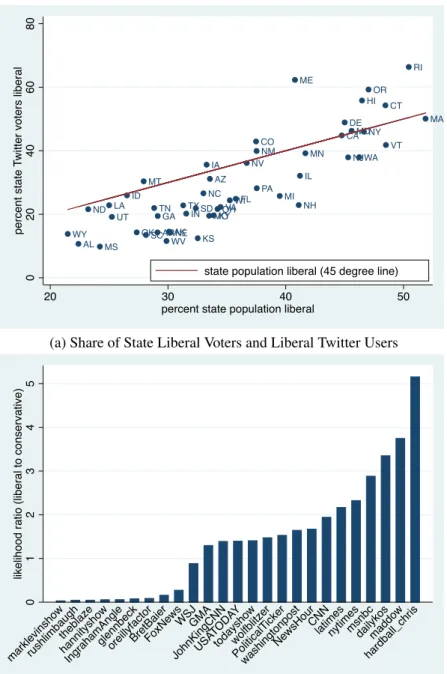
To give a sense of the geographic distribution of these online voters, we examine user-provided locations, which are provided by approximately one-quarter of voters.9 Figure 3 presents the percentage of voters on Twitter from a given state supplied by user vs. state percentage of US population. Surprisingly, all states line up near the 45-degree line except California, which has a lower percentage of voters relative to its share of the US population.10 This finding suggests that our group of Twitter voters closely mirrors the distribution geographic distribution of current voters in the United States.
Voter Ideology
As shown, media outlets and programs traditionally considered right-leaning, such as Rush Limbaugh, The Hannity Show, and Fox News, have very low odds ratios. On the other hand, media outlets and programs traditionally considered left-leaning, such as the New York Times and the Rachel Maddow Show, have an odds ratio greater than one.
Political Communications
Based on this Twitter data, we first use the network structure to develop measures of the degree of homophily. Then, with the help of network structure and communications within the network, we develop measures of voters' exposure to information.
Measures of Homophily in Social Networks
Measuring Exposure to Information
The greater the exposure index relative to baseline exposure, the greater the bias in exposure to the same type of information due to homophily. Finally, to measure the relationship between group size and total exposure to information, we will use the measure of tweets per inhabitant, ets+etd, for group t. Using the data described in Section 3 and the measures developed in Section 4, we then present our empirical results on network structure.
We begin by describing our results on homophily at the national level before turning to the results in state political networks.
National Political Network
State Political Networks
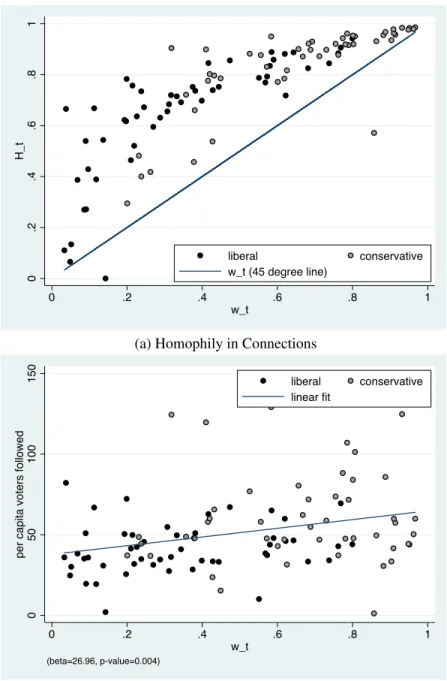
As shown, almost all observations lie above the 45 degree line, which means that homophily in the kinship is satisfied. Also consistent with the model's predictions, homophily generally increases with group size. We also verified that in each country, homophily is greater for the majority group; thus relative homophily is also satisfied.
Again using state-level variation, Figure 6b relates followers per capita for each group to the group's share of the population, with the linear fit presented to demonstrate the general trend. As shown, an increase from 0 to 1 in the proportion of the population increases the number of followers per capita from about 40 to 60, an increase of 50 percent. Our data is thus also consistent with the prediction that larger groups have more followers per inhabitant.
In particular, all groups are prone to inbreeding, with larger groups showing higher levels of homophily and having more network connections per capita. Once we have documented evidence of a network structure consistent with the theoretical model and the existing literature on homophily, we then examine how information flows through this political network.
Production and Transmission of Information
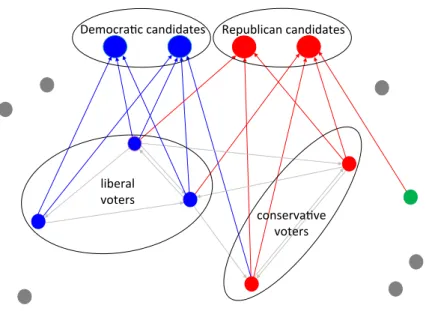
That is, as a result of network homophily, do members of larger groups receive more information, are voters disproportionately exposed to like-minded content, and, conditional on exposure, does political content arrive more quickly to like-minded users. While this may reflect a preference to produce like-minded information, it may also reflect the exposure mechanism through which voters retweeted after being exposed through another voter. That is, because of homophily, it may be that liberal voters are disproportionately exposed to tweets from Democratic candidates via other liberal voters and also for conservative voters and Republican candidates.
In this case, voters could not have been previously exposed to the tweet through another voter. As shown, a strong correlation between voter ideology and candidate party remains in the broadcast of prime retweets, with 86 percent of Democratic candidate retweets broadcast by liberal voters and almost 98 percent of tweet retweets from Republican candidates cast by conservative voters. . Next, we examine mention production and, as shown in the last two columns of Table 2 , 66 percent of Democratic candidate mentions were produced by liberal voters.
So, using data on candidate mentions, we see that voters produce a disproportionate amount of like-minded information. In particular, because candidates control the sentiment of tweets but voters control the sentiment of mentions, it is possible that some mentions of Democrats by conservative voters may have negative sentiment and therefore could be considered conservative content, and the same is true for mentions of Republicans by liberal voters. .
Communications in the National Political Network
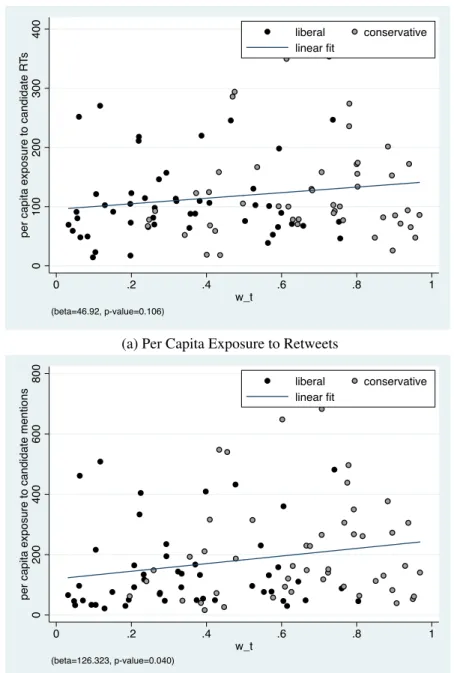
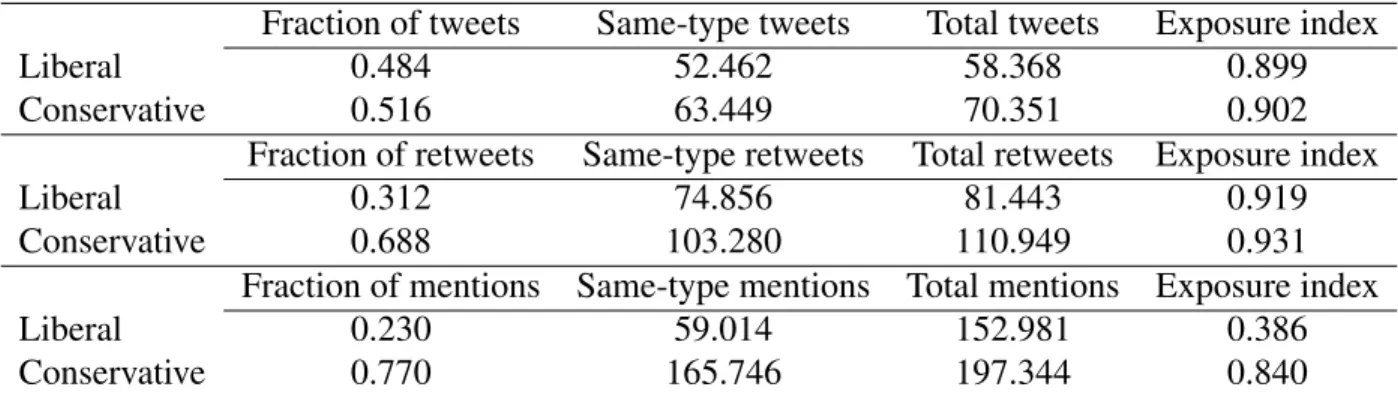
Next, we look at exposure to like-minded information based on retweets, which account for multiple exposures to the same candidate tweet. As shown in Table 3, exposure to like-minded information is even higher (92 percent for liberal voters and 93 percent for conservative voters) when measured by exposure to retweets. If voters were randomly exposed to retweets, liberal voters would have an index of exposure to like-minded information of 31 percent, and conservative voters would have an index of 69 percent.
As shown, among exposures to mentions of liberal voters, 39 percent are mentions of Democratic candidates, and among exposures to mentions of conservative voters, 84 percent are mentions of Republican candidates. This is true when measured by exposure to candidate tweets, exposure to candidate tweets via retweets, and exposure to voter mentions of candidates. Accordingly, when measuring exposure to candidate tweets, we ignore exposure to the initial tweet generated by the candidate, as this would bias our results toward finding disproportionate exposure to like-minded information.
That is, we measure exposure to candidate tweets only through retweets from other voters in the network. So there is no circularity in the way we measure voter ideology and voters' exposure to political information.
Communications in State Political Networks
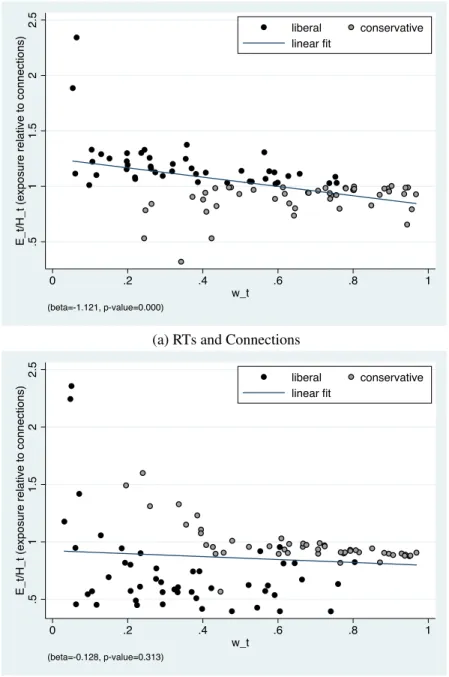
Finally, in Figure 9, we examine the relationship between group size and the relationship between exposure and homophily (E/H). Focusing on retweets, we first note that the ratio E/H strictly decreases in group size. In other words, a marginal increase in group size has a diminishing effect on voter exposure to like-minded information relative to the same type of connections.
The trend for mentions shows a similar downward slope, but is less pronounced compared to the trend for retweets. In general, the rate of homophily and exposure to like-minded information are highly correlated as implied by the narrow range of values E/H takes around one, and this is especially true for retweets. To summarize, our results suggest that group size affects both the degree and type of communication within social networks characterized by homophily.
Most are more homophilous and are exposed to more information in general and like-minded people in particular.
Speed Analysis
As shown, a mismatch between voter ideology and candidate party is associated with a decrease in the probability of exposure, conditional on not having been previously exposed, in a given time period. Note that a decrease in the probability of exposure is associated with an increase in expected time to exposure, and thus the results are consistent with those using linear regression. In summary and consistent with the predictions of the theoretical model, this section provides evidence that in social networks characterized by homophily and the production of like-minded information, users are exposed to like-minded information more quickly than they are exposed to information of opposing ideologies.
Content Analysis
As shown in panel a), we find that exposure to political tweets is more similar in nature when compared to exposure to non-political tweets. As documented above, the production of political retweets is somewhat more similar in nature than the production of non-political retweets. With this in mind, we investigate whether political tweets reach like-minded users faster than non-political tweets.
As shown, in all three specifications we find that non-political tweets reach like-minded users faster, but that the difference in time to exposure is larger for political tweets. Regarding mentions, we next examine whether exposure to positive mentions tends to be more like-minded compared to exposure to negative mentions of candidates. As shown in panel b) of Table 5, we find significant differences in the production of like-minded information depending on whether the publicity was positive or negative.
Turning to exposure, as shown in panel b) of Table 6, we also find significant differences in exposure between positive and negative sentiment mentions, with high exposure to positive like-minded information. To summarize, the content analysis documents that the production and exposure to political information is more similar in nature when compared to non-political information, although some of the differences are small in magnitude. This paper begins by developing a model that predicts that larger groups are exposed to more information and all groups are disproportionately exposed to like-minded information.
Also consistent with homophily, we find that voters from all groups are disproportionately exposed to like-minded information. Finally, we present evidence suggesting that, conditional on exposure, information reaches like-minded users more quickly. As shown in Table 2 and consistent with the view that these moderates have weaker preferences for linking to like-minded users, we find that segregation is lower for moderates compared to the entire sample.