To my best friend Mai: Your help and continued support kept me going even when I didn't know if I could continue. To my supportive cousin Nashwa, you are always there when I need you, thank you for being a great friend.
Introduction
Although statistics are available on Canadian women's experience of IPV (Statistics Canada, 2015), data are limited on Muslim women's experience of IPV. Nevertheless, the data did not provide specific information about Canadian Muslim women's experience of IPV.
Literature Review
The understanding of the women's reasons for leaving and/or staying in the relationship is increasing in the literature. Other studies have highlighted the importance of the women's emotional needs and investment in the relationship (Wuest & Merritt-Gray, 1999).
Research Methodology
- High Levels of Conflict Inherent in the Family: Conflict inside the family is
- Violence Integrated into the Personality and Behavioral Script: Early experience with physical punishment as a form of discipline lay the groundwork for the normative
- Cultural Norms Legitimating Violence between Family Members: Preceding cultural norms legitimizes violence between family members. The marriage license can
- Sexist Organization of Society and its Family System: The sexist organizations of the society and the system are one of the most fundamental factors in the high level of
- An Individual Woman Putting up with Beating: This could be due to economic dependence on husband, denial of public assistance, doubts about own ability, near
I followed the recommendations of the World Health Organization to ensure the safety of the participants. The extent to which detail is included will be based on the richness of the data and the research purpose (Neuman, 2011).
Findings
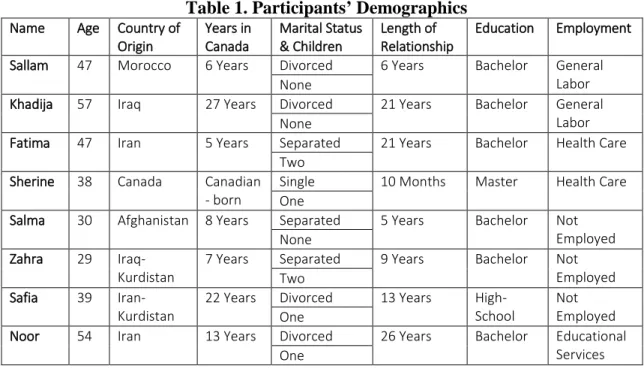
Four participants were divorced at the time of the interview, three were separated, and one was single. However, at the time of the interview, five participants were employed and three were unemployed.
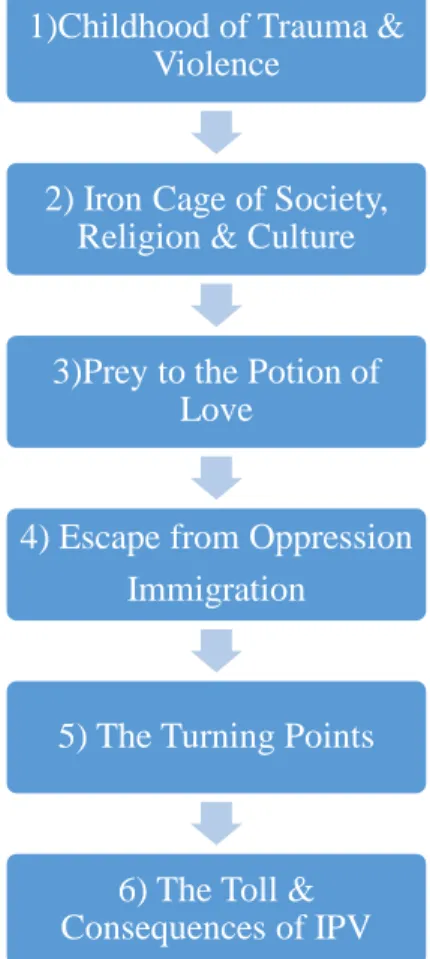
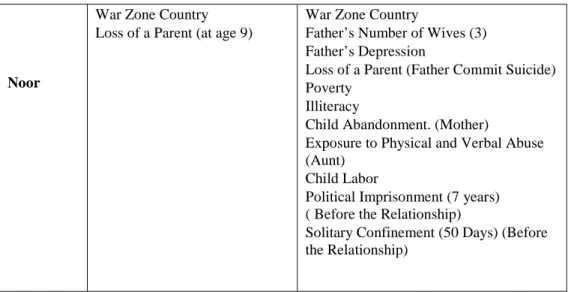
Childhood of Trauma and Violence Women’s Childhood Experiences of Abuse Women’s Childhood Experiences of Abuse
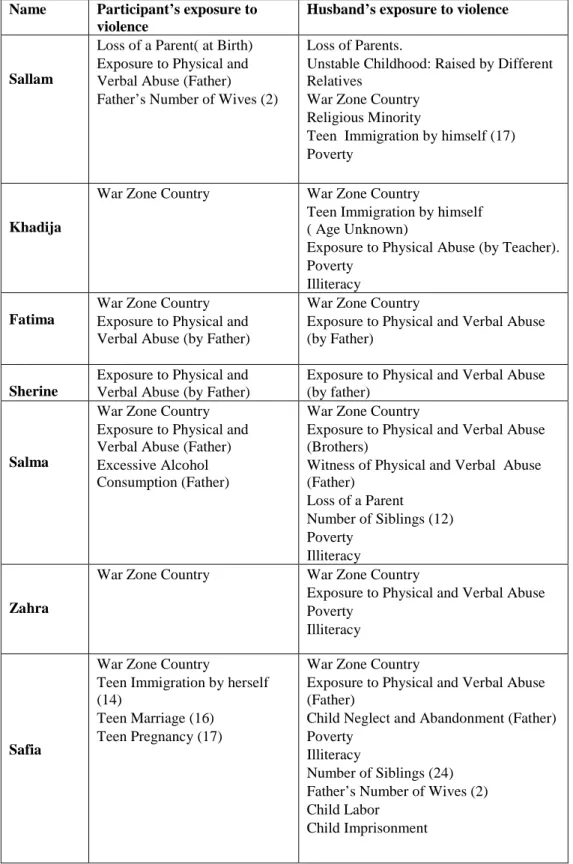
In the above quote, Sallam described her childhood as marked by abuse, and how her father treated her stepmother with excessive use of physical violence. My husband was almost 12 years older than me when we got married, so I guess I wasn't attracted to boys my age. During the interviews, all the participants had some details of their husbands or partners who had been exposed to and witnessed abuse as children, with variations in the severity and the amount of details they shared with their wives.
When the second wife came to the family, she wouldn't let him see his older children, you know what I mean, so they were like, he abandoned them. He had no father, they were poor, his father and their stepmother took everything from them, the land, the money. For example, Sallam was one of the participants who experienced family pressure and married to please her family, as mentioned in the following quote.
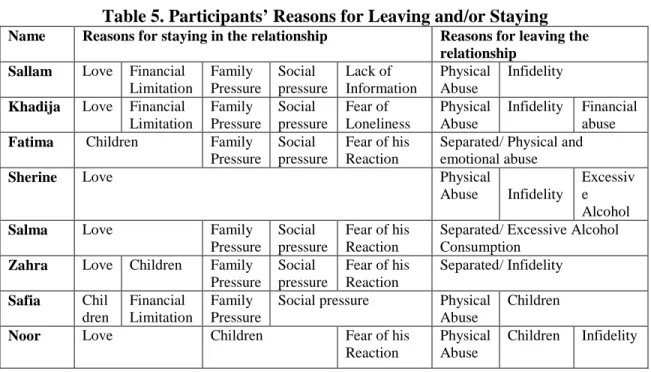
My family pressured me to get married: 'You're getting older, you should try, why not, why not get married and go to the US', I mean Canada.” Similarly, Salma expressed her reasons for not leaving an abusive relationship as, "I stayed in the relationship because of the role of society and my family's reputation." My family doesn't like divorce, everyone said, 'Be patient, be patient', and when I got married, my family was very happy for me, so how could I get divorced in the first month?”. On the other hand, five out of eight participants reported that especially in the country of origin, the husband's family maintained the patriarchal extended family system.
Iron Cage of Society, Religion and Culture
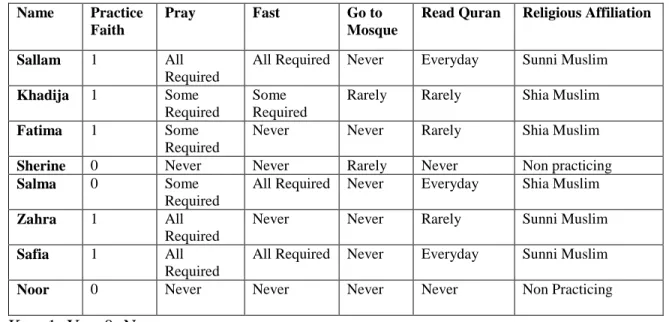
Second, religious coercion was experienced by two participants in their country of origin, but none of the participants reported it in Canada. This was based on their responses in the demographic information form, however none of the participants indicated any regular attendance during the interviews. The next section will examine participants' cultural values to understand how they may contribute to increasing the risk of IPV.
With the exception of the Canadian-born participant, Canadian immigrant women had experienced high levels of social stigmatization in their country of origin and in Canada, due to negative social perceptions of women in general, and of divorced women in particular. However, only the Canadian-born participant demonstrated an equal division of housework, while Canadian immigrants stated that their spouses made all the decisions regarding various aspects of their lives. Salma and Zahra both highlighted the consequences of maintaining a patriarchal system in the household, in which gender inequality is strongly implemented among cultural values and reinforced by members of society.
Strict gender roles were internalized and maintained even after immigration; even when 100% of female participants worked and contributed financially to the household, Canadian immigrant women were also responsible for household chores, adding more stress and reasons for. The only exception was a Canadian-born participant who indicated an equal division of housework, further supporting the implications of cultural values in imposing strict gender roles. Finally, another theme examined the effect of religious, cultural, and social values that contributed to women's exposure to IPV.
Prey to the Potion of Love
The emotional feelings quickly deteriorated after marriage when their male partners began to distance themselves, and the participants began to experience another phase of the relationship that would be introduced in the next section. This increase in emotional detachment quickly developed and created a mixture of love and violence that coexisted in the relationship, which was confusing for the. Their attachment needs acted as a powerful motivator to overlook the warning signs of IPV and stay in the relationship.
The participants' level of commitment and hope for change were important factors in the decision to maintain or end the relationship. In the next section, I will provide some details about the regrets participants experienced after leaving the relationship. The women expressed an overwhelming sense of regret about their emotional, physical, and financial investments in the relationship.
The love and violence in the relationship confused them, making them maintain hope for reconciliation and change. Women in this study reported fear of loneliness as a reason for tolerating the abuse and for staying in the relationship. In addition, all of the Canadian immigrant participants had experienced economic instability after immigration, which had a major effect in escalating the abuse and in hindering the help-seeking process, as can be seen in the next section.

The Turning Points
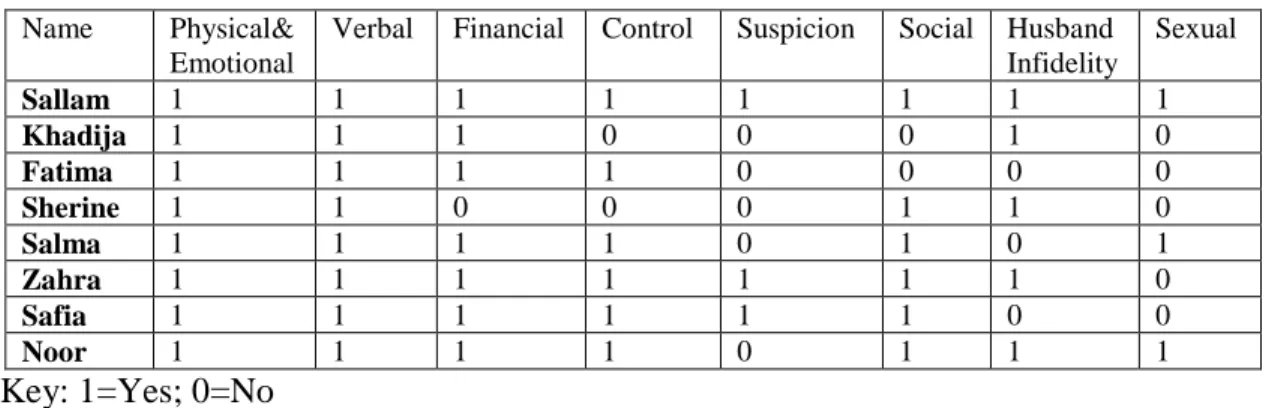
In the next theme, a representation will be made to see the effect of all the previously mentioned factors on the relationship, to which forms of abuse the women were exposed and what contributed to the decision to end the relationship. Even with the instances of physical abuse, all of the participants endured an excessive amount of violence and abuse in the relationship to reach the tipping point permanently. Different reasons were provided for staying in the abusive relationship, including familial and social pressures which most influenced the women's decision.
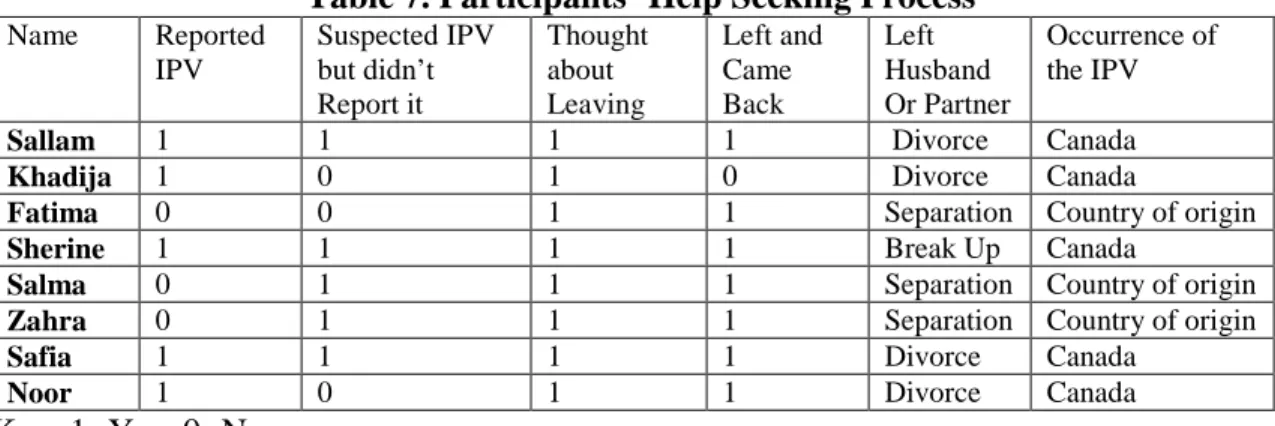
A connection must be made between the turning points and the types of abuse the participants were subjected to, as can be seen in the next section. They are separated but not divorced, which shows the differences in women's reactions to different forms of abuse. Additionally, four participants reported fear of their partner's reaction as a reason for staying in the relationship.
Furthermore, the participants expressed their views about the definition of abuse which is directly related to what they perceived as abuse, as can be seen in the next section. Although most of the reasons do not apply in the Canadian context, they were still reluctant to report. The welfare of a child was one of the most determining factors for women when it came to leaving or staying in a relationship.
The Toll of IPV
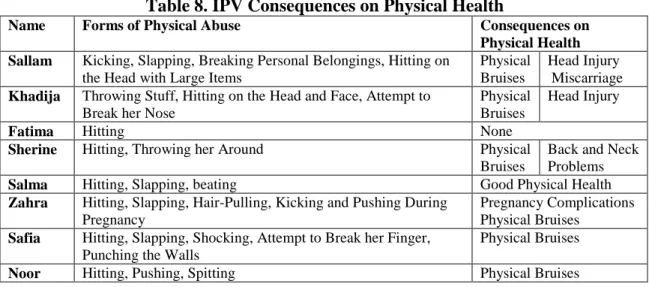
Although not all incidents of physical abuse resulted in an injury that sent a woman to the hospital, participants reported acts such as slapping, kicking, hair pulling, spitting, throwing objects, choking, and attempting to break a nose or finger. The implication of different reports in the general health survey may be related to the level of tolerance for abuse and the fact that all participants had ended the relationship either permanently or temporarily, which could have influenced their responses. In addition, five of the participants reported frequent verbal abuse in the form of insults and belittling, and six reported frequent yelling and cursing.
Further, during the interviews, all participants verbalized some form of mental health consequences of the abuse they had experienced. Mean=19 reported across participants indicates moderately severe depression in this sample of women. Inability to stop worrying, trouble relaxing, being so anxious, easily upset, and worrying too much almost every day were reported by three of the participants.
All of the participants experienced at least one or two symptoms of depression, anxiety and PTSD, with differences in the severity and variability of the symptoms. Furthermore, the participants also reported improvement in their mental and physical health after leaving the relationship. Although all participants had endured various forms of physical abuse, five reported good physical health at the time of the abuse.
Discussion
My research findings are consistent with existing literature, as Canadian immigrant women were under pressure to stay in relationships and tolerate abuse. Findings from my study suggest that patriarchal cultural values can be enforced through religious teachings, especially in the country of origin. This is consistent with my findings regarding participants' limited references to religious instruction and participation in the context of IPV.
The Canadian immigrant women in this study listed their children as reasons for leaving and staying in the relationship. I predict that age and number of children may play an important role in women's help-seeking process. Pre-migration stressors were also associated with acculturation difficulties in the post-migration context (Li, 2016).
My findings suggest that Canadian immigrant women were affected by negative pre-migration experiences with service providers, which slowed their help-seeking process in the post-migration context. Further research is recommended to understand the impact of intimate partner violence on women's productivity in the workplace. This study is unique as a mixed-methods exploration of Canadian Muslim women's experiences with intimate partner violence in the pre- and post-migration context, and contributes to the limited body of literature on intimate partner violence among the Muslim population.
Future studies are recommended to expand the differences in the experience of abuse in the pre- and post-migration context with a larger sample. My research has contributed to the limited literature on intimate partner violence among Canadian Muslim women in the post-migration context.