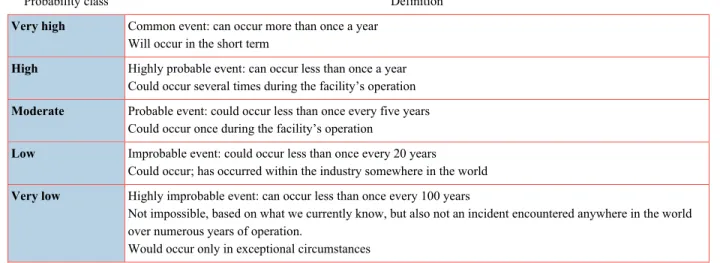
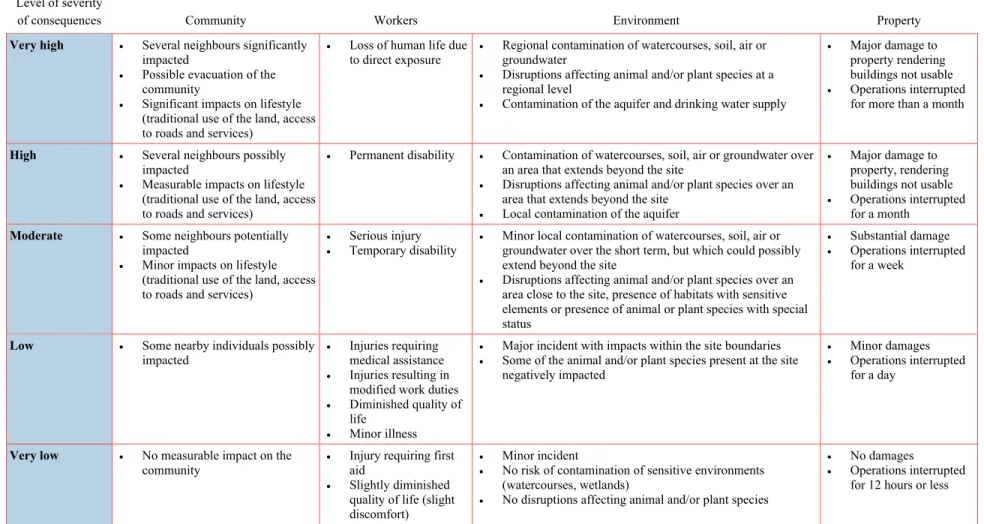
Consequence severity levels are determined based on the descriptions in Table 9-2. Of the small mammal species captured in the study area, only one—the rock vole—is on the list of species likely to be designated as threatened or vulnerable in Québec.
HISTORY OF ACCIDENTS
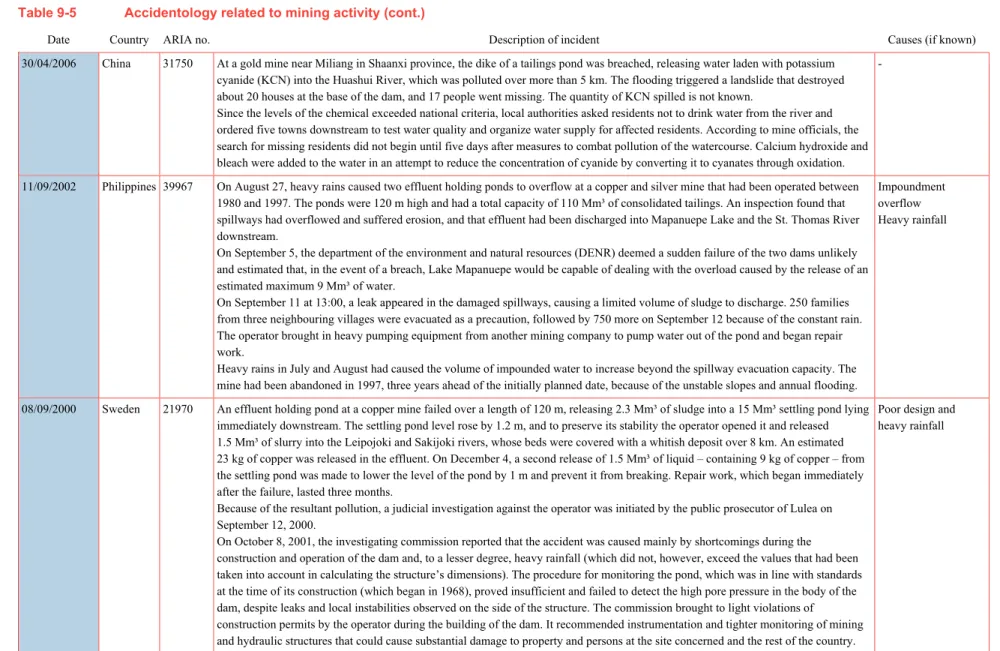
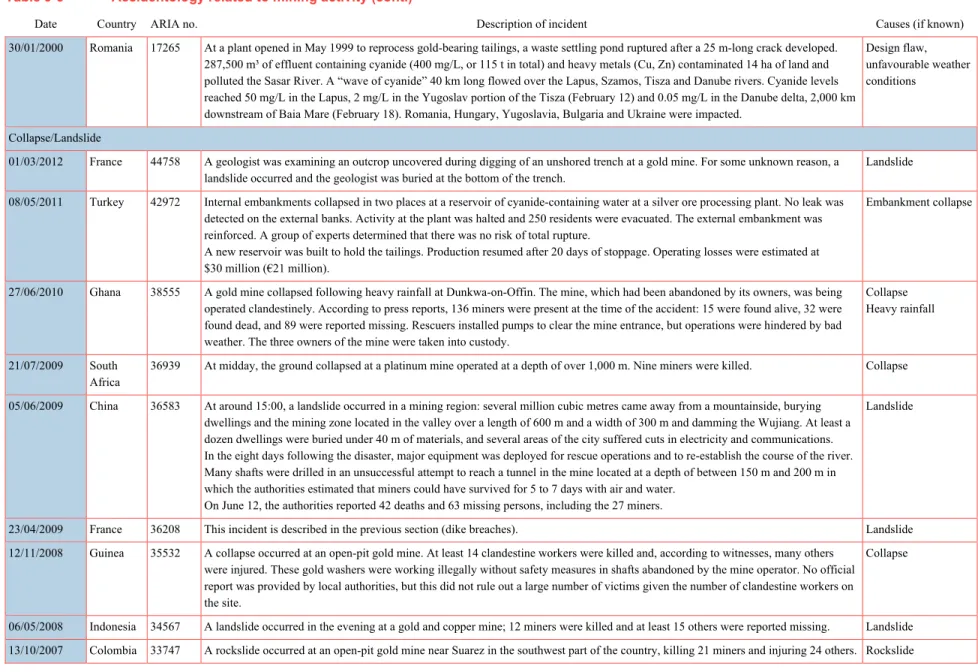
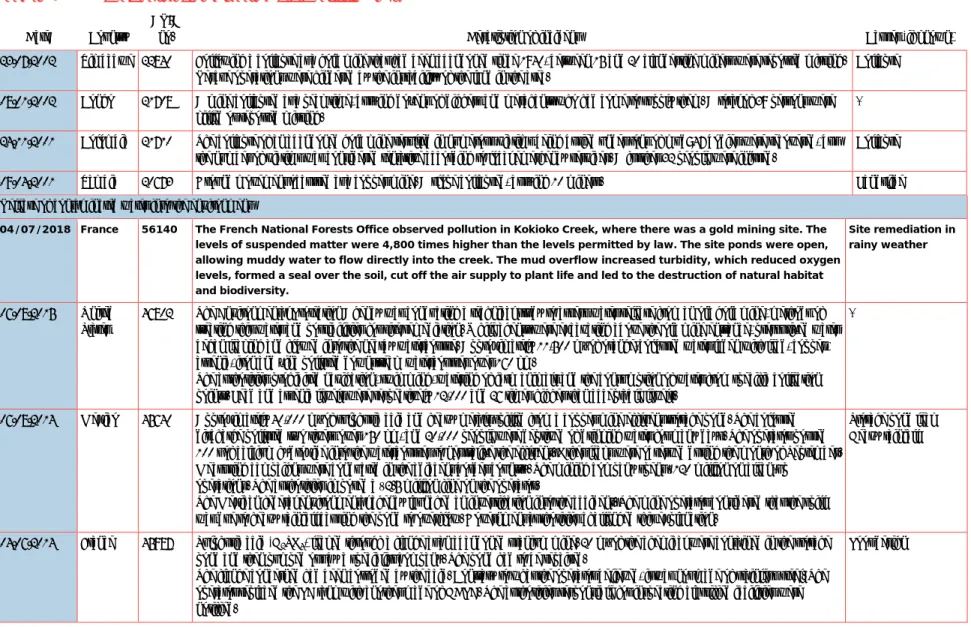
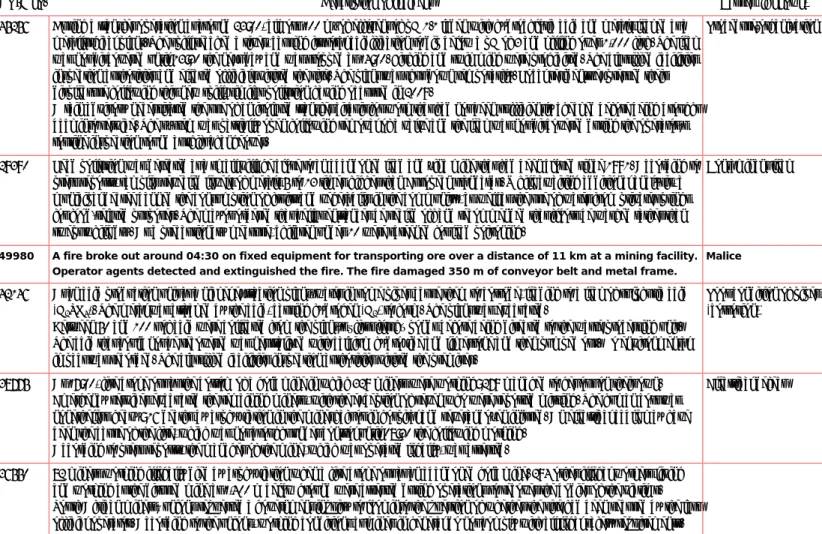
MINING ACCIDENTOLOGY
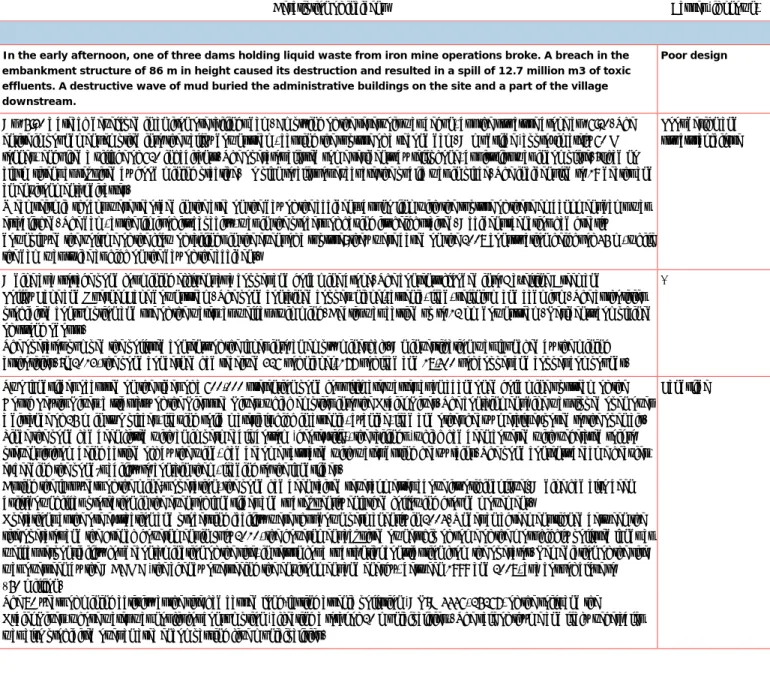
A destructive wave of mud buried the administrative buildings at the site and part of the village downstream. For some unknown reason, a landslide occurred and the geologist was buried at the bottom of the trench. 20 m³ of the chemical was contained in the storage pond and then pumped out by a specialist company.
According to press reports, the manager of the legally operated mine has been arrested. The area has been marked off, but not all personnel likely to be in the area have been warned of the danger.
ACCIDENTS AT THE AUSTRALIAN MT CATTLIN SITE
IDENTIFICATION OF HAZARDS
EXTERNAL HAZARDS OF NATURAL ORIGIN
- EARTHQUAKES
- FLOODING
- TERRAIN INSTABILITY
- EXCEPTIONAL WEATHER CONDITIONS
- FOREST FIRES
Extraordinary weather conditions in the form of heavy rainfall, hail or high winds can occur during the summer. Fighting forest fires in this area is only carried out by agreement or in support of emergency preparedness. The project area is considered a region in which forest fires are most active and in which some of the largest fires have been recorded.
In 2005, forest fires reached within a kilometer of the project site from the northeast and the south. In 2009, many forest fires were observed west and southwest of the project site, with one reaching within about a kilometer to the southwest.
ANTHROPOGENIC EXTERNAL HAZARDS
- AIR TRANSPORT
- POWER TRANSMISSION LINES
- REMOTE LANDFILL
Given the small elevation difference in the study area, there are no problems regarding the stability of surface deposits. In fact, wind, precipitation, snow and ice can cause overloads and directly endanger the integrity of buildings or equipment. Building and equipment designs shall be in accordance with current codes and regulations to withstand the overloads created by extreme weather conditions.
In addition, many studies suggest that increased concentrations of greenhouse gases in the atmosphere should increase the conditions that promote forest fires, thereby increasing both the number and severity of fires (Girardin and Terrier, 2015). With the exception of these areas, the probability of an aircraft crashing in a given location is considered to be very low.
HAZARDS RELATED TO THE ACTIVITIES ON SITE
In addition to these areas covering the immediate periphery of the airport, the risk of an accident is also higher in the corridors used for air traffic.
ACCIDENTS AND MALFUNCTIONS
OPEN-PIT MINING
- PIT FLOODING
- FALLING ROCKS AND LANDSLIDES ALONG PIT WALLS
As for the well, surface water or groundwater may enter the well due to rock damage caused by explosions or damage to the rock structure showing excessive cracks, which may lead to water flow into the well or major flooding. The excess water that enters the well will then have to be pumped out, causing work on the well to be interrupted. There may be flooding of the well due to water intrusion as these types of incidents have occurred in similar locations.
By including components and their severity, the risk of flooding the well due to water ingress is moderated. Including the probability and severity components moderates the risk of rockfall or landslides along the pit walls.
ORE PROCESSING
- FIRE
- EXPOSURE TO IONIZING RADIATION
- DUST EMISSIONS
Including the probability and severity components brings the risk level for a fire to medium. Core gauges will be used to measure pulp density in the ore treatment (concentration) plant. The inclusion of probability and severity components brings the level of risk of exposure to ionizing radiation to moderate.
The ore processing plant will be equipped with dust extractors where necessary to control airborne dust emissions. By including the components of probability and severity, the risk of dust exposure is moderated.
WATER TREATMENT PLANT
However, a breakdown or incorrect handling can lead to the accidental release of dust into the air. A non-compliant discharge to the final effluent could potentially occur as this has already occurred in similar locations. Spillage of environmentally harmful substances can affect animal and/or plant species over an area that extends beyond the site.
Fish can ingest highly toxic substances and pass them on to predators that eat them. By including the components of probability and severity, the risk level of non-compliant discharge in the final effluent is moderated.
STORAGE AND USE OF PETROLEUM PRODUCTS
- SPILL OF PETROLEUM PRODUCTS
- FIRE AND/OR EXPLOSION OF PETROLEUM PRODUCTS
- SPILL OF OILS AND GREASES
This section covers the potential risks associated with the transport, storage and use of petroleum products. The following prevention and mitigation measures will be implemented to reduce the risk of petroleum product spills. The inclusion of the probability and severity components brings the risk of a petroleum product spill to moderate.
An explosion of petroleum products can cause flammable materials to ignite due to the thermal effect or projection of burning debris. By including the components of probability and severity, the risk of fire and/or explosion of a petroleum product is mitigated.
PROPANE STORAGE AND USE
- PROPANE TANK FIRES
- PROPANE VAPOUR CLOUD FORMATION
The inclusion of the probability and severity components reduces the risk of oil or grease spills. The inclusion of the probability and severity components brings the risk level of a propane tank fire/explosion to moderate. Propane vapor clouds can occur due to a propane leak in a pipe or valve due to equipment failure.
A flammable propane vapor cloud can lead to a fire and/or explosion causing loss of life and significant damage to the surrounding infrastructure, resulting in major business interruption and economic loss. The inclusion of the probability and severity components brings the risk level for propane vapor cloud formation to moderate.
STORAGE AND USE OF NON-PETROLEUM PRODUCTS
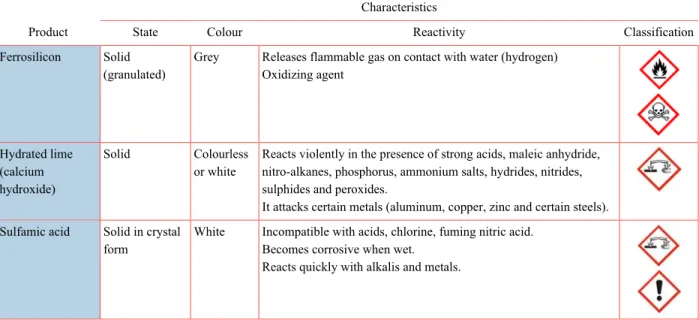
The following preventive and mitigation measures will be put in place to reduce the risk of chemical spills. Storage areas will be established and storage conditions will take into account incompatibilities between products. All used and non-reusable chemicals will be stored for up to one year in accordance with the Regulation respecting hazardous materials.
Hazardous products will be placed in compliant, leak-proof containers to minimize the risk of a spill if knocked over by the carrier. Spill response kits, tailored to the type and amount of dust, will be placed at strategic locations on site (storage and refill areas).
EXPLOSIVES HANDLING AND STORAGE
- EXPLOSION OF EXPLOSIVE MATERIAL
- THEFT OF EXPLOSIVE MATERIAL Stolen explosives could be used for criminal purposes
The level of environmental impact is therefore considered low due to the quantities involved, the fact that the products will be used and stored in buildings and the mitigation measures in place. The following prevention and mitigation measures will be taken to reduce the risk of above-ground explosions. Specific checks will be carried out to check the dimensions, depth and orientation of the borehole, as well as the loads.
So the blasting schedule will be based on weather conditions to reduce the risk of faulty blasting and to protect workers. Signs prohibiting smoking will be posted in the explosive assembly facility and within the blast zone.
USE OF ELECTRIC TRANSFORMERS
- DIELECTRIC OIL SPILL
- TRANSFORMER FIRE/EXPLOSION
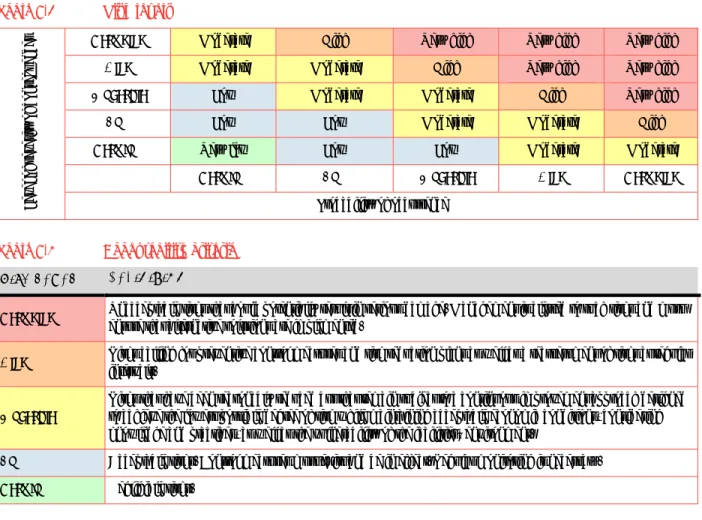
The inclusion of the probability and severity components brings the risk level for explosive material theft to moderate. To get the risk level, the severity level must be combined with the probability of occurrence. Combined with a high or very high severity of consequences, a very low probability of occurrence leads to a moderate level of risk.
As the estimate of the risk level therefore remains unchanged, the resulting assessment remains unchanged. The inclusion of the probability and severity components brings the risk level of a transformer fire and/or explosion to moderate.
ACCUMULATION AREAS
- STOCKPILE COLLAPSE
- FAILURE OF A RETAINING DIKE A retaining dike could fail as a result of
Since there will be levees around the stockpile containment areas, the collapse of the stockpile would have little or no impact on the infrastructure (buildings, power lines, roads, etc.) with the exception of the road between the stockpile areas. By including the probability and severity components, the level of risk of stock collapse increases to moderate. After the completion of the detailed engineering of the project, an analysis of the risk of embankment collapse and the possible consequences will be carried out.
It should be noted that the runoff collection pond located east of the eastern tailings and tailings impoundment will most often be empty or nearly empty because this pond will be a transfer point where a pump will divert water to the main water pond. The inclusion of the probability and severity components moderates the level of risk of a restraining levee failure.
ROAD TRANSPORT
- ACCIDENT INVOLVING HAZARDOUS MATERIALS
- ACCIDENT INVOLVING A TRUCK CARRYING ORE CONCENTRATE
The proportion of product that flows versus the amount that infiltrates depends on the permeability of the soil and the characteristics of the spilled product. The costs of wetland restoration are high and depend mainly on the amount of spillage, response time and the effectiveness of response strategies. In general, fish populations can be affected by a spill at different times of the year if their habitat or prey is affected in terms of reproduction, hatching, feeding, migration and wintering.
The inclusion of the probability and severity components moderates the level of risk of a hazardous material spill on the road network. The inclusion of the probability and severity components brings down the level of risk of a spodumene collapse on the road network.
RISKS ASSOCIATED WITH EXTERNAL HAZARDS
- FOREST FIRES
- EXTREME WEATHER
In case of fire, the expected impacts are the mortality of the vegetation, the disturbance of the evolution of the forest and the loss over time of habitats or plant species favorable for the presence of some species of wild animals. In the event of fire, the effects on land and avifauna are potential mortality during juvenile rearing, a reduction in the availability of feeding and sheltering areas when habitats are disturbed, and destruction of eggs during the nesting season. In the event of fire, the possible effects on herpetofauna are mortality, destruction of eggs during the incubation period, and reduced availability of foraging and sheltering areas when habitats are disturbed.
The inclusion of the probability and severity components brings the level of risk of a forest fire threatening the facilities to a high level. The inclusion of the probability and severity components brings the risk level of extreme weather to moderate.
RISK SUMMARY
The consequences of such weather can vary, but can go as far as major infrastructure damage and damage to Hydro-Québec's 450 kV line or to the internal line, depriving the site of power for a long time and seriously disrupting operations.
PRELIMINARY EMERGENCY RESPONSE PLAN
CORPORATE POLICY