Together, these two elements allowed the identification of VCs associated with the project and ultimately the selection of those that will be subject to the assessment of cumulative effects. As a result, predictions become increasingly uncertain the longer the cumulative effects projection period becomes. According to Hegmann et al. 1999), determining the significance of effects in a cumulative effects assessment is essentially the same as in an impact assessment.
As part of this specific project, three venture capital funds have been selected for cumulative impact analysis; the Chiroptera (bats) at risk, bird species at risk and the traditional use of the territory by the Cree. 2 Detailed information on the low potential for caribou presence is presented in section 6.3. On the one hand, the study area defined for the assessment of the cumulative effects on the use of the territory includes the territory of the Eastmain community, as well as the staircase lines assigned to the latter.
VALUED COMPONENTS
BATS (CHIROPTERA)
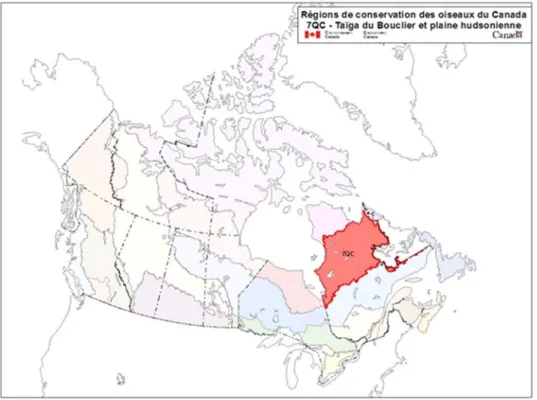
Par ailleurs, la zone d'étude désignée pour évaluer les effets cumulatifs sur les chauves-souris et les espèces d'oiseaux menacées correspond au territoire inclus dans un rayon de 110 km autour du site minier proposé. Zone d'étude des impacts cumulatifs des chauves-souris et des oiseaux en voie de disparition Zone d'étude des impacts cumulatifs des chauves-souris et des oiseaux en voie de disparition.
The selected indicator is the number of surveyed counts for the targeted species in the study area for cumulative effect.
BIRD SPECIES AT RISK
Given that most bats (Chiroptera) visiting the study area will travel hundreds of kilometers during the spring and fall migration periods, it is difficult to determine the exact area for cumulative effects. Given the movement patterns of bats and the various projects underway or planned near the project site that may have or could affect bats, the spatial boundary considered for the assessment of cumulative effects covers an area of approximately 110 km around the project (map 8-1). However, in order to have the minimum data to determine the baseline and past conditions of bat populations, data from the Réseau québécois d'inventaires acoustiques de chauves-souris (Réseau) were considered, although they were collected in Lac Bourbeau, about 300 kilometers southeast of the study area .
The temporal limit corresponds to the 2003 survey, the first carried out by the Réseau in the Nord-du-Québec region; the future temporal limit corresponds to 10 years, as the probability of occurrence of another project (or another source of impact) in the study area beyond this limit is too speculative. However, given the scarcity of data for this VC in the region, and as the methods used vary from one study to another, caution is required when considering this indicator.
TRADITIONAL USE OF THE TERRITORY BY INDIGENOUS PEOPLES
It is linked to energy development, which involves various diversions of watercourses and the establishment of Hydro-Québec dams, and to mining development. The year 1980 was therefore chosen as past temporal scope and the future scope was set at 2028. Beyond this limit, it is very difficult to make projections based on existing documentation (master plans, development strategies, etc.).
Furthermore, the analysis of cumulative impacts on this VC covers the total area visited by the Eastmain Cree.
PROJECTS, ACTIVITIES OR EVENTS LINKED TO VECS AND VSCS
- INFRASTRUCTURE AND SERVICES
- HYDROELECTRIC INFRASTRUCTURE AND CHANGE IN RIVER SYSTEM Based on the impact assessment study of the Eastmain-1-A and Sarcelle stations and the Rupert diversion
- ROAD TRANSPORTATION AND POWER TRANSMISSION INFRASTRUCTURE Prior to 1974, the road network was concentrated in the southern part of James Bay. With the building of the La
- DEVELOPMENT OF NATURAL RESOURCES
- FORESTRY ACTIVITIES
- MINING ACTIVITIES
- USE OF THE TERRITORY BY NON-INDIGENOUS PEOPLE
- WILDLIFE OR PROTECTED TERRITORIES
- WILDLIFE RESERVES, SANCTUARIES AND BIODIVERSITY RESERVES No wildlife reserve is located within the study areas of cumulative effects
- OTHER PROTECTION
- DISTURBANCES, NATURAL AND OTHER
- FOREST FIRES
- WHITE-NOSE SYNDROME
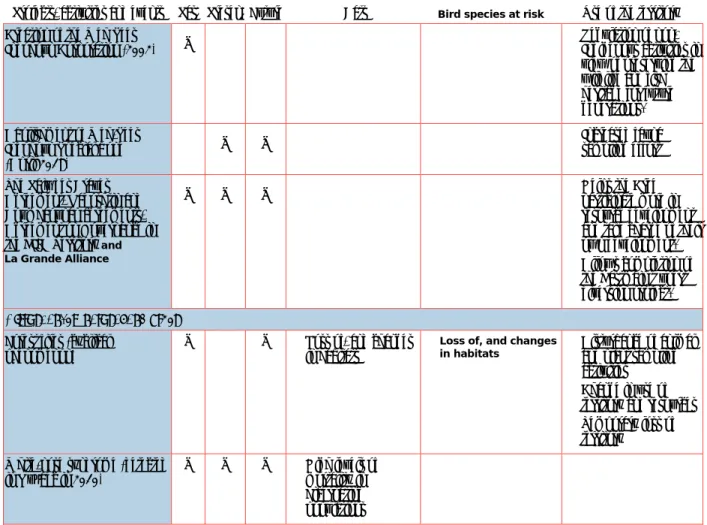
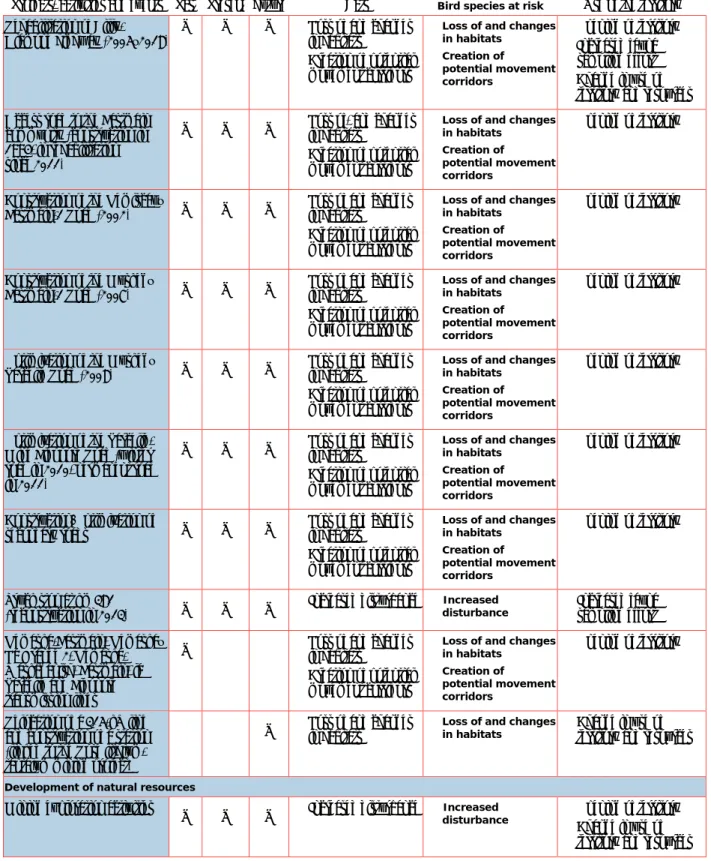
Projects, activities and events Past Present Future Bats Bird species at risk Use of the territory Infrastructure and services. Projects, activities and events Past Present Future Bats Bird species at risk Use of the territory Rehabilitation of Billy-. Projects, activities and events Past Present Future Bats Bird species at risk Use of the territory Eleonore Mine.
Projects, activities and events Past Present Future Bats Bird species in danger Use of the territory Origin of the Weh-Sees. The study areas of the cumulative impacts of the project are fully contained within those of the Eastmain-1-A-Sarcelle–. With the construction of the La Prior in 1974, the road network was concentrated in the southern part of James Bay.
The transport infrastructure in the study areas of the project's cumulative effects was particularly marked by the reconstruction of the Billy-Diamond highway (620 km long). The 315-kV transmission line that crosses the Rose mining project area will be relocated to allow the project to be completed. The Whabouchi Mining Project (Nemaska Lithium) is located more than 100 km southeast of the project.
This stepline is located northeast of the project, on the north shore of the Eastmain River. Including this rental agreement, there are 16 rental agreements for holiday plots within the boundaries of the study area of the cumulative effects on the use of the territory. It also constitutes a recognition by the Cree of the application of certain Canadian laws in these sectors.
As mentioned in the EIA of the Eastmain-1-A-Rupert project (Hydro-Québec Production, 2004), forest fires sometimes affect Cree fault lines and terrestrial ecosystems.
ANALYSIS OF CUMULATIVE EFFECTS ON VCS
BATS
- PROJECTS, ACTIONS OR EVENTS
- BASELINE CONDITION
- HISTORICAL TRENDS
- CUMULATIVE EFFECTS
- MITIGATION MEASURES AND FOLLOW-UP
Few data are available to provide a relevant baseline condition for bats in the region. According to the latest figures published by the Réseau in its CHIROPS newsletter (Jutras and Vasseur, 2011), bats of the genus Myotis accounted for 5 of the 7 records collected in the Nord-du-Québec region in. Information on bats in the Nordic region -du- The Québec region is very scarce and fragmentary, making it difficult to define historical trends regarding populations of the various species of bats.
Like forest fires, deforestation activities also contribute to the fragmentation of forest habitats and lead to the creation of linear elements used by certain species of bats (EC, 2015). Given the absence of wind energy projects in the region, the potential negative effects of human development projects essentially involve habitat loss. These environments are therefore not the most favorable for the bat species identified in the study area, which is essentially arboreal.
Furthermore, if no deforestation occurs during the breeding season, the fact that there are sufficient replacement habitats of comparable quality in the region means that the effect of this habitat loss will not prove significant on bat populations. However, their impacts are limited in area given the spatial boundaries considered when assessing cumulative impacts. Moreover, for the assessment of cumulative effects, the presence of a part of the territory belonging to three planned biodiversity reserves in the study area represents a positive impact for bats and birds through the increase of the number of protected areas, including their habitats of interest.
There is very little data available regarding the location of hibernation sites in the Nord-du-Québec region. As a guide, in hibernation sites in the United States, the decline recorded in the species present in Québec stands at 91% for the small brown myotis (Myotis . lucifugus), 98% for the northern myotis (Myotis septentrionalis), 41% for the big brown bat (Eptesicus fuscus), 75%.
BIRD SPECIES AT RISK
- PROJECTS, ACTIONS OR EVENTS
- BASELINE CONDITIONS
- HISTORICAL TRENDS
- CUMULATIVE EFFECTS
- MITIGATION MEASURES AND FOLLOW-UP
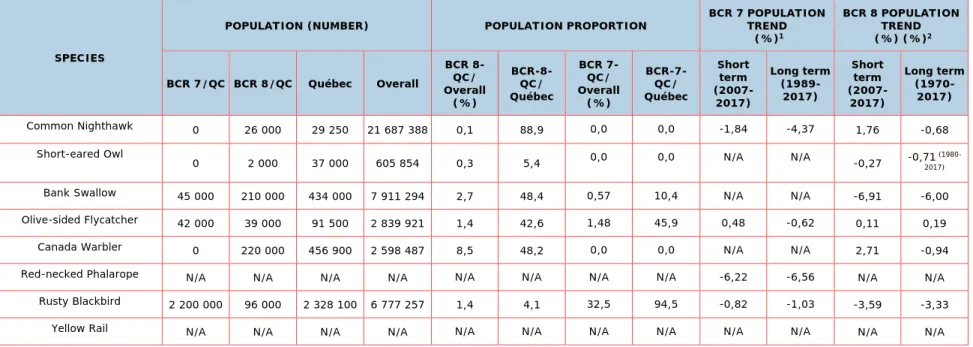
Also note that no data were available for the Short-eared Owl, the Sand Martin and the Canada Warbler. In addition, no data were available for the Yellow Spur and very little for the Phalarope. No data were available for the Short-eared Owl, the Sand Martin and the Canada Warbler.
The potential habitat for this species occurs within the project footprint (363.64 ha: 47.34 ha temporary loss and 316.30 ha permanent loss), but also outside this area, i.e. within the area considered for the assessment of cumulative effects. Therefore, the cumulative effect of the project on the species will be low, as replacement habitat is available in the vicinity of the project and the project will create new habitat. Potential habitat for this species occurs within the project footprint (443.83 ha: 29.42 ha temporary loss and 414.41 ha permanent loss).
Thus, the cumulative effect of the project on this species will be small due to the low impact of the project itself on this species. Because the project will affect a small area of potential habitat and the species was not detected by the inventories, the cumulative effect of the project on this species is low due to the small direct effect of the project on this species. Since the species was not notified, the cumulative impact of the project is based on the loss of available habitat for the species, which corresponds to 375.32 ha (22.91 ha of temporary habitat and 352.41 ha of permanent habitat).
Therefore, the cumulative effect of the project on this species will be low, due to the low direct effect of the project on this species. Since the Canada Warbler has not been reported in the study area even though potential habitat is present, the cumulative effect of the project on the species is low.
LAND USE FOR TRADITIONAL PURPOSES
- PROJECTS, ACTIONS OR EVENTS
- BASELINE CONDITION
- HISTORICAL TRENDS
- CUMULATIVE EFFECTS
- MITIGATION MEASURES AND FOLLOW-UP
Note, however, that given the species' known range, it would be surprising if the Red-necked Warbler nested in the study area (QBBA, 2020). Note, however, that given the species' known distribution, it would be surprising if the Yellow Rail nested in the study area (QBBA, 2020). For example, the diversion of the Eastmain River reduced its flow by 90% (Hydro-Québec, 2001).
The presence of worker camps also disrupted the tranquility of the Eastmain Crees and sometimes increased the pressure on the resource. This division of the land is the result of the creation of beaver reserves in the 1930s and 1940s (Hydro-Québec Production, 2004). Also in the 1980s, the construction of the La Grande hydroelectric complex led to several changes.
The development of the La Grande complex also brought about changes in the Crees' fish consumption habits. In fact, most of the camps replaced as part of the Eastmain-1-A mitigation measures were built along roads. Billy-Diamond Highway runs directly east of the project and has been under repair since 2015.
In addition, elk began to return to the area after the construction of the Eastmain-Rupert-Sarcelle complex. The cumulative effect of the project on Cree use of land for traditional purposes is therefore insignificant.
RESULTS OF THE CUMULATIVE EFFECTS ASSESSMENT