The anchor point and foundation for the success of the organization in realizing its vision is the management of its most important resource, its staff. 2. The main drivers cited by the report relate to the attrition issues of the CAF. To help ensure the RCAF's success in employing Gen Z, this study will analyze the RCAF's readiness to employ Gen Z.
It will demonstrate that Gen Z values are mostly compatible with RCAF values, and with the implementation of the study's recommendations, the RCAF can optimize Gen Z recruitment and retention strategies. This study will also include recommendations to help ensure the successful employment of the next generation.
Values and Traits
The trait that correlated more weakly, but still meaningfully, was extraversion with values of excitement and variety (stimulation) and “enhancement of self-interest through dominance, success, and having fun (power, achievement, and hedonism).”57 As expected, it the only trait that did not correlate well with any values in either study was emotional stability. A significant difference between the two research studies is in the value relationship between the trait conscientiousness. The Oxford Dictionary describes a generation as "all people born and living at about the same time, considered collectively" and that it is "the average period, generally considered to be about thirty years, during which children grow up, become adults, and have children of their own.”65 Combining the two parts of Oxford's definition, it is assumed that a generation is a collective group of individuals born within a defined period of time.
They suggest that generations are also defined through shared societal experiences, including: "the life-defining events that occur during a generation's growing period (adolescence)."82 Using an example helps provide some context. Gen Zer Jonah Stillman writes: "Gone are the days of teenage dreams of becoming president or making millions of dollars as a business magnate. In the next Chapter 4 – RCAF Values, the values of the RCAF will be presented and interpreted in the same way.
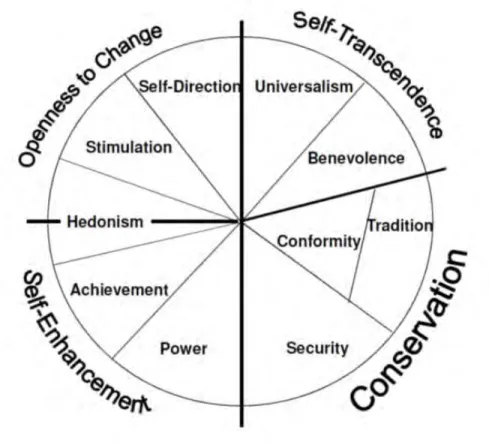
These values are representative of the RCAF's fundamental elements and strategic guidance as outlined in its capstone document, Air Force Vectors. Many of the RCAF's core values relate to the organisation's recognition of its history and heritage. This chapter will analyze the aligned and incongruent motivation types within the opposing dimensions of the Schwartz model.
It is extremely important for professional pilots and other members of the RCAF to seize opportunities to do so. An example is the creation of “The Flight Deck” at Communitech in 2017, a quarterly, industry-led, innovative training seminar with the goal of “identifying and developing solutions to challenges that exist at every level of the world. This information interpreted Gen Z's motivation types in comparison to the values espoused by RCAF and produced numerous areas of alignment and incongruence within the four dimensions of the Schwartz values model.
It is recommended that the RCAF commission an in-depth study of the P-O fit between the RCAF and Gen Z in order to better understand what motivations are not aligned with the organization. This will enable the RCAF to better prepare for next generation sustainment. Therefore, between his espoused and core values, there are no significant areas of inconsistency in the values of the RCAF and General Z.
An Overview of Schwartz's Theory of Basic Values." Online Readings in Psychology and Culture, Unit 2, Subunit 1 (2012).

Defining Gen Z
Gen Z Values
These values derive from characteristic adaptations and motivational goals influenced by Gen Z's physical environment, social networks and the important design role of their parents. This chapter will present and interpret the most dominant motivational goals of Generation Z in the form of motivational types from Schwartz's value model. In doing so, Gen Z motivations become basic human values that reveal the generation's competing and aligned priorities.
Ultimately, Generation Z's motivations related to self-management lie in their desire to be independent in thought and action, flexible and creative. The economic lessons that Generation X learned as young adults have translated into self-management values that have influenced Generation Z's perception of money, employment and financial success. However, Generation Z's need for social media and to be constantly connected to their digital world is just a byproduct of what Stillman describes as the "fear of missing out."
Therefore, Gen Z's preference to be constantly connected to social media is directly related to Schwartz's value of hedonism. Those influencers have combined to shape Gen Z's ideas on hiring priorities and value for money. Their desire for high incomes, the need to earn wages through competitive wages, avoiding debt, and already saving for retirement all relate to Gen Z's goals of acquiring wealth.
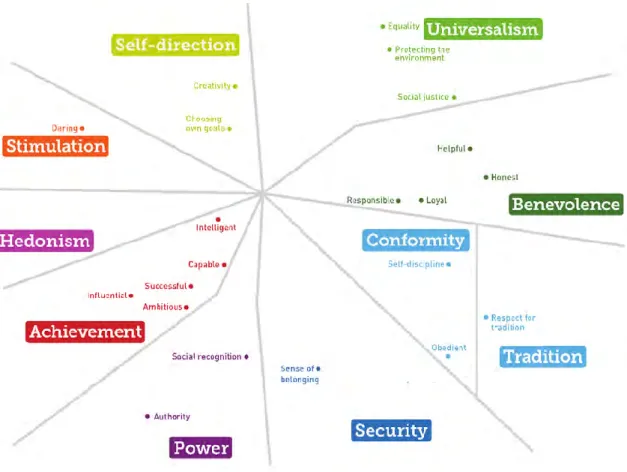
Societal and environmental factors also have a great impact on the development of characteristics and learned behavior of children.148 Some of Gen Z's most liberal values have been influenced by societal norms that prevail in the world today. A key aspect of these motivations is Gen Z's communication skills and how this affects their ability to understand and employ empathy. As mentioned in Chapter 1, the motivational types and characteristics of empathy and Gen Z's concern for others are related to the basic human value of benevolence (honest, helpful).
Questions from n-gen's survey asked respondents what their preferences were outside of achieving financial stability. Here, the motivations align with Gen Z's attitudes to the dimension of self-transcendence through universalism's importance of social justice and equality, and benevolence's importance of empathy through helpfulness and honesty.

RCAF Values
RCAF Core Values are the organization's accepted and common ways of thinking, and are observed through RCAF members' tacit decisions and actions. CAF values were last communicated in 2012 with the release of the DND and CF Code of Values and Ethics and are the "standard of expected behavior for all personnel in the Department of National Defense (DND) and the Canadian Forces (CF)." 186 In this directive CAF values are identified as: integrity, loyalty, courage, honour, stewardship and excellence. The explicit definition of CAF values can be found in Annex D – Values and expected behavior of DND employees and CF members.187 Each value brings its own specific expected behavior for CAF members, and since each value is a prerequisite for employment in the RCAF, they must all be considered in the Schwartz value model for RCAF employee congruence.
The motivation types associated with loyalty relate to Schwartz's values of universalism (social justice, equality), benevolence (responsibility, loyalty), and conformity (obedience, self-discipline). The directive identifies harmful and inappropriate sexual behavior as incompatible with the values of the profession of arms.200 As such, the values in the directive and those set out in The Summary of Duty with Honour: The Profession of Arms are to be included as RCAF values. Although the RCAF must adhere to the values instructed by the CAF, there are also specific RCAF values found in the service.
The RCAF value of professionalism is asserted as its key expected behavior for the organization. RCAF core values are the observed behavior of the organization that is displayed in its culture and the customs and traditions it practices. These core values are captured in the institution's written orders and doctrine, its programs and management direction.
217 Joanna Calder, “Holiday Traditions in the Royal Canadian Air Force,” Royal Canadian Air Force, last accessed April 24, 2019, http://www.rcaf-arc.forces.gc.ca/en/article-template- . Together they provide a framework for members to adhere to and reference when making decisions in achieving organizational goals. The model's relationships between motivations reveal aligned and competing priorities within the RCAF value system.
Analysis and Conclusion
Outside of the RCAF Commander's Navaids doily, there was no common handbook or directive outlining the organization's specific value system. Freedom and independence relate to Gen Z's value of self-management, where sense of belonging relates to the RCAF value of teamwork through safety. Both the RCAF and Gen Z share many values in self-transcendence and self-enhancing dimensions that help offset motivation.
The RCAF will need to address both of these competing motivations with its values in order to better appeal to Gen Z. In contrast, Gen Z does not have any motivations that are directly aligned or opposed to the RCAF. It is recommended that the RCAF re-evaluate its espoused values with a view to becoming more explicit about their content and direction.
Furthermore, it is recommended that the RCAF make the values it cherishes easily accessible and known to all stakeholders. The RCAF holds many core values that are desirable to Gen Z, but may not be known to the generation. The RCAF responded by implementing several programs over the past three years to promote creativity and innovation.
These initiatives demonstrate that the RCAF welcomes creativity and innovation and taps directly into the motivations of Generation Z. The RCAF must better embrace the values that inspired these programs, both within the organization and externally to the public. It is recommended that the RCAF pursue changes to the employment model that address Gen Z's motivations of self-improvement through lateral specialization and reward incentives as an alternative to promotion.
The Schwartz model shows that there are several congruent values between Gen Z and the RCAF. When considering RCAF core values, there is even more alignment between the Gen Z motivations and RCAF.