The parameters of the kernel function control the structure of data in feature space and must be simultaneously optimized while also estimating the number of clusters in a dataset. The proposed method denoted by kernel k-Minimum Mean Central Error (kernel k-MACE) estimates the number of clusters in a dataset while simultaneously clustering the dataset in feature space by finding the optimum value of the Gaussian kernel parameter σk.
![Table 2: Table of symbols used for the formulation of k-MACE part 2 [29]](https://thumb-us.123doks.com/thumbv2/9docorg/12434113.0/12.918.172.798.162.564/table-2-table-symbols-used-formulation-mace-29.webp)
Introduction
Kernel functions have been widely used for clustering data and the kernel k-means algorithm is an implementation of k-means in a high dimensional space [8]. Algorithms have been proposed to make kernel k-means faster with little loss in clustering quality [9][10].
INTRODUCTION
These validation indices work together with a clustering algorithm which requires the number of clusters as input [24]. In Chapter 3, the k-Minimization of Mean Central Error kernel (k-MACE kernel) is proposed for estimating the number of clusters and the Gaussian kernel parameter for a data set.
Background
Kernel Methods
- Kernel Basics
The dataset distance matrix contains the distance between data samples in the dataset using a distance measure such as Euclidean distance. The biggest advantage of using a kernel function is that it calculates the distance between data samples in F without requiring any knowledge of the transformation function φ (also known as the feature map).
BACKGROUND
- Calculation of Kernel Feature Map
- Visualizing the Kernel Feature Map
- Kernel k-means
- k-MACE Algorithm
- Index Validation Methods for Cluster Evaluation
- Gap Index
- Calinski-Harabasz Index
- Davies-Bouldin Index
- Silhouette Index
The sizes of data samples in the feature space (using the method mentioned above) are equal to the number of data samples in the dataset. Input: dataset xN = [x1, x2, .., xN], number of clusters and parameters of the kernel function used. Statistical calculations are performed on the cluster result, as shown in Appendix 1, to determine the cluster compactness and ultimately estimate the number of clusters.
The within-cluster sum of the squares around the cluster mean for all clusters is given by equation (2.9) where |Cs| indicates the number of data samples in cluster s. The Gap index is then given by equation (2.10), where En denotes the expected value of a sample of size n from the reference data distribution. For a given cluster result, δj denotes the average distance of data samples in the cluster j to its center cj, given by equation (2.14).
Unsupervised clustering methods that use kernel functions to cluster data in feature space require two input parameters, the number of clusters in the data set and the optimal value of the kernel function parameter. Kernel-based unsupervised clustering methods, which estimate the number of clusters in a data set [18] and [19] use the best possible value of the kernel parameter by using the trial and error method. The proposed method estimates the correct number of clusters while also estimating the value of the Gaussian kernel parameter σk that corresponds to the best clustering result for most datasets.
KERNEL K-MACE CLUSTERING
Study and Analysis of Gaussian Kernel Func- tions
- Gaussian Kernel Function
- Examining Gaussian Kernel and σ k
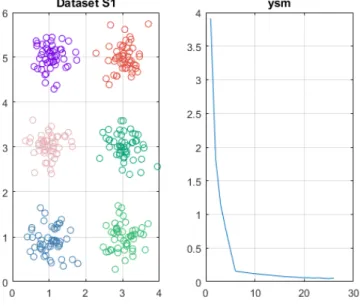
An explicit definition of the Gaussian kernel feature map φGauss using Taylor series expansion is given in equation (3.1), where σk is the Gaussian kernel parameter. The dataset to be clustered must be converted into feature space in such a way that the clusters can be easily separated. The dataset consists of 6 clusters that can be easily separated using a clustering algorithm. However, to demonstrate the effect of σk on the kernel feature map, we used SVD and PCA to map the first three principal components of the kernel feature map for different values of σk. .
From Figures 3.3 and 3.4 we can see that σk values less than 1 will not generate a good separation of clusters in feature space. Very large values of σk such as 109 will still result in a good cluster separation in feature space while maintaining the profile of the clusters as shown in Figure 3.5a. Increasingσk further will lead to the loss of the separation atσk= 1016 as shown in Figure 3.5b.
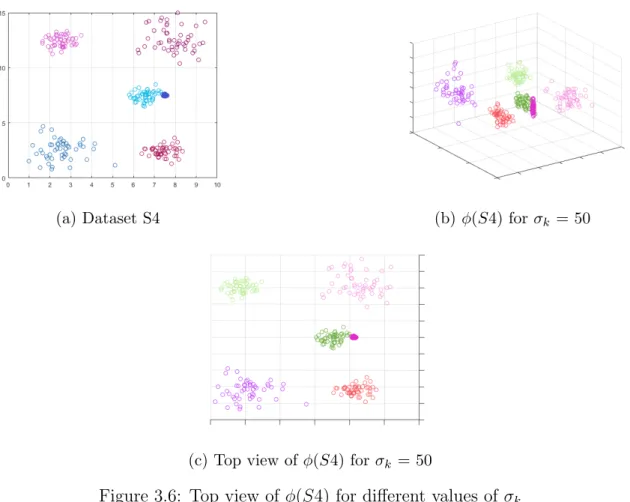
The range of σk that leads to the visible separation of clusters is different for different data sets. The feature space representation of the dataset using Gaussian kernel and values ofσk = 50 is shown in Figure 3.6b. The dataset S4 should be successfully clustered using kernel methods since kernel functions obtain a better representation of data in feature space.
![Figure 3.2: Gaussian kernel feature space representation of the surface in Figure 3.1 for different values of σ k [31]](https://thumb-us.123doks.com/thumbv2/9docorg/12434113.0/31.918.197.759.168.347/figure-gaussian-kernel-feature-representation-surface-figure-different.webp)
Kernel k-MACE Algorithm
- Preliminaries and Notations
- Initial Data Assignment and Clustering for Kernel k-MACE
Kernel k-means requires each sample in the data set to be assigned to a cluster to begin with. An algorithm has been proposed to improve the accuracy of clustering results produced by the k-means algorithm in [32]. The same analogy has been used to extend the algorithm to work with kernel k-means given in Algorithm 3.
As far as we know, the algorithm proposed in [32] has not been used to work with kernel methods.
KERNEL K-MACE CLUSTERING Algorithm 3 Initial cluster assignment
- ACE and Data Error in Kernel k-MACE
- Estimating Z s m and m ˆ
- Choosing the Gaussian Kernel Parameter σ k
- Time Complexity of Kernel k-MACE
- Proposed Cluster Initialization Vs Random Clus- ter Initialization for Kernel k-meanster Initialization for Kernel k-means
- Synthetic Datasets
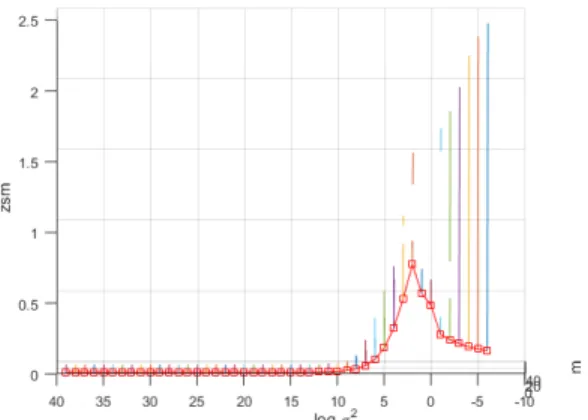
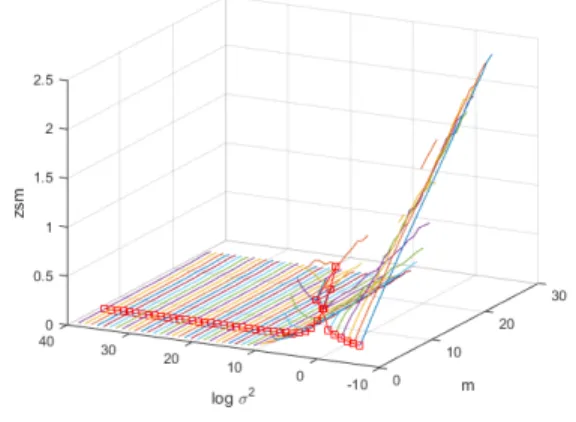
The minimum limit for ACE will correspond to the estimated number of clusters ˆm in a data set. We propose a method to obtain the optimal value of σk that corresponds to the correct clustering result. To obtain the bestσk, we obtain the gradient of the red curve shown in Figure 3.9a, and for each σk, the absolute value of the previous and the next gradient in equation (3.8) is added after the peak.
The value of σk corresponding to the maximum value of this sum is selected and the corresponding ˆm and grouping result is selected as the correct result. This corresponds to the 10th red square from the right which occurs at logσ2k = 3 and is visible in Figure 3.9b which corresponds to ˆm = 6 which is visible in Figure 3.9c. a) Plot showing Zsm for different values of σk. The values of σk with very small overall Zsm result in the transformed data samples being very close to each other (while maintaining the same relative distance), causing the data error Ysm to be small, resulting in a small estimate of Zsm compared to values of σk closer to the peak.
We are trying to find the σk that results in the largest change in the minimum value of Zsm after the peak, and we know that for very small values of σk the estimated number of clusters ˆm is less than CNC as shown in Figure 3.9a. For the value of σk at which ˆm increases to the value of CNC, a rapid decrease of the minimum Zsm occurs that corresponds to the estimated value of σk and the correct clustering result. This is also confirmed by the external validity indices which show that the best clustering results are generated for values of σk immediately after the peak.

SIMULATIONS AND RESULTS
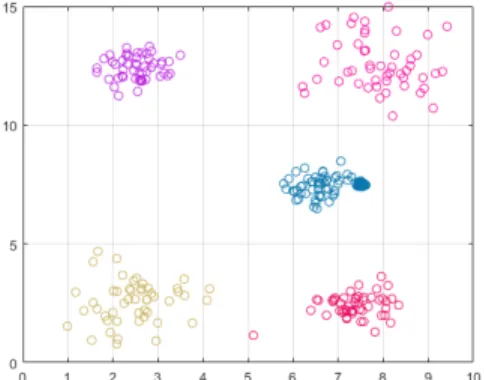
The k-MACE kernel with a polynomial kernel can identify the correct number of clusters for datasets S1, S2 and S4 - S6. The final clustering results for datasets S4, S5 and S6 are shown in Figure 4.3 for both k-MACE kernel and k-MACE. Using the algorithm with other kernel functions such as Polynomial will be explicitly stated. a) Final clustering result for the S4 dataset using the k-MACE kernel.
In Section 3.1, we showed that kernel k-MACE is able to transform Gaussian distributions in kernel space so that they retain the Gaussian profile as in the case of dataset S4. Kernel k-MACE is equally effective at clustering high dimensional Gaussian distributions with varying degrees of overlap. Kernel k-MACE also estimates the CNC for S5 data set which has a greater degree of group overlap compared to S4.
Both kernel k-MACE and k-MACE failed to identify the correct number of clusters in this dataset. Kernel k-MACE with Polynomial kernel can identify the CNC for most datasets, but does not generate the best clustering results. Kernel k-MACE with polynomial kernel is able to successfully cluster the high-dimensional datasets in Table 4.2, just like kernel k-MACE and k-MACE.
SIMULA TIONS AND RESUL TS
SIMULA TIONS AND RESUL TS
- Real Datasets
- Normality Tests for Kernel k-MACE Evaluation
Real datasets used to evaluate the performance of kernel k-MACE are listed in Table 4.3. The kernel k-MACE algorithm gives poor clustering results for the Thyroid dataset in terms of ARI and NVI. Kernel k-MACE with polynomial kernel produces worse results compared to kernel k-MACE for most real datasets.
However, kernel k-MACE with polynomial kernel is able to estimate the CNC for the vertebral data set. Kernel k-MACE probabilistically estimates the number of clusters for a given data set, while also obtaining the value of the Gaussian kernel parameterσk corresponding to the best clustering result. Kernel k-MACE can be divided into three sections: Initialization and clustering of data, cluster evaluation, and estimation of the optimal value of σk.
The k-MACE kernel with polynomial kernel on the other hand is able to identify 50% overlapping clusters. The k-MACE kernel produces consistent clustering results due to the use of the proposed k-means kernel clustering initialization. Normality tests are used to evaluate the clustering results from the k-MACE kernel to show that the clusters are normally distributed and independent of the original data distribution.

CONCLUSION AND FUTURE WORK
K-MACE (1.5) and (1.6) respectively
K-MACE
Data-driven market segmentation in tourism – approaches, changes over two decades and development potential”, 15th International Research Conference of the Council for Australian University Tourism and Hospitality Education, pp. Image Classification”, IEEE International Geoscience and Remote Sensing Symposium, 2002. A Set of New Chebyshev Kernel Functions for Support Vector Machine Pattern Classification”, Pattern Recognition, vol 44, pp.
A Fast Approximate Kernel k-means Clustering Method for Large Data Sets”, IEEE Recent Advances in Intelligent Computational Systems, pp. The Global Kernel k-Means Algorithm for Clustering in Feature Space”, IEEE Transactions on Neural Networks, vol 20, pp. Estimating the Number of Clusters in a Data Set via the Gap Statistic”,Journal of the Royal Statistical Society, vol.
Kernel Clustering for Knowledge Discovery in Clinical Microarray Data Analysis in Chapter 3: Kernel Methods in Bioengineering, Signal and Image Processing”, Idea Group Pub Dunn, J. Insights into the geometry of the Gaussian kernel and an application in geometric modeling”, Master's thesis. Improving the accuracy and efficiency of the k-means clustering algorithm”, Proceedings of the World Congress on Engineering.

![Figure 3.1: Surface in input space [31]](https://thumb-us.123doks.com/thumbv2/9docorg/12434113.0/30.918.381.559.773.965/figure-3-1-surface-in-input-space-31.webp)