The above statistical figures provide some facts about immigrant women's performance in the Canadian workforce. However, the statistical results do not explain the reasons why immigrant women do not participate equally in the labor market. The purpose of this paper is to contribute to the understanding of the nature and causes of the labor market inequalities experienced by immigrant women.
This will be done through focusing on the labor market experience of immigrant women living in the Flemingdon Park area of Toronto.
LITERATURE REVIEW: IMMIGRANT WOMEN AND THE LABOUR MARKET 1. Theoretical Framework
Neo-liberal Restructuring and Challenges in the Labour Market
In fact, the earning potential of recent immigrants who arrived in Canada in the 1990s is lower than that of those who arrived in the 1970s (Human Resources and Skills Development Canada, 2007; Li, 2003). Immigrants who arrived in the 1990s are having more difficulty earning the income of the Canadian-born population. In the previous sections, I discussed the barriers and challenges that have hindered immigrant women's participation in the labor market.
For example, research in the 1970s cites racism, sexism, and language barriers as major factors in the problems immigrant women face in the Canadian workforce (Amopoulos, 1979). I argue that neoliberal restructuring, which began in the 1980s and became well developed in the 1990s, is one of the main factors responsible for the poor economic integration of recent immigrants, especially female immigrants. Neoliberal ideology criticized the government for being too involved in the economy and society.
It also argued that the welfare state has slowed economic growth in the globalized economy. As already described, reports show that immigrant women have the lowest employment rate in the labor market; they are also ghettoized in poorly paid sales and production jobs (Man, 2002). Man (2004) raises concerns about how neoliberal restructuring has negative effects on the position of women in the labor market.
Structural changes in the labor market as well as the drastic reduction of social support programs hindered the integration of immigrants, especially immigrant women, into Canada and led to their marginalization. After the 19705, with the emergence of gender equality, women were encouraged to participate in the labor market and reduce their financial dependence on men (llcan et aI., 2007, p. 4).
METHODOLOGY
Data Collection Tool
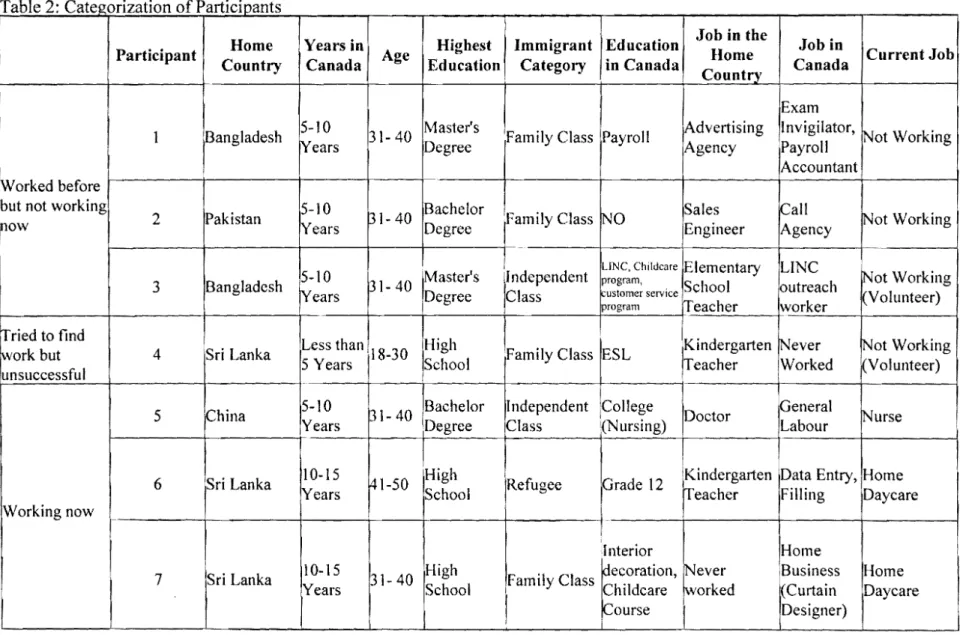
Seven immigrant women were recruited from the Flemingdon Park area to participate in individual face-to-face (or one-on-one) interviews. However, one of the interviews was conducted by telephone due to the participant's involvement in work13•. There are two main reasons for my decision to choose Flemingdon Park as my study location.
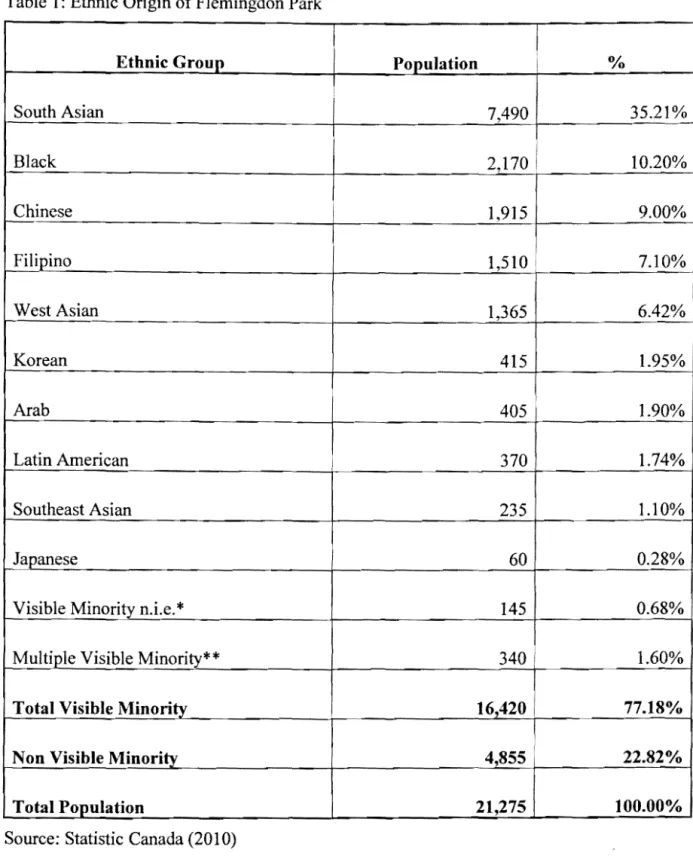
According to the 2006 census, approximately 67% of the population living in this area were immigrants (Statistics Canada, 2010). The 2006 census also shows that approximately 77% of the population in Flemingdon Park were visible minorities (Table 1) (Statistics Canada, 2010). The second reason for my choice of the Flemingdon Park area as the site for my research is that, as a resident of the Flemingdon Park, I have on many occasions directly and indirectly heard women in this area talk about the challenges and obstacles they face to look for work in Canada.
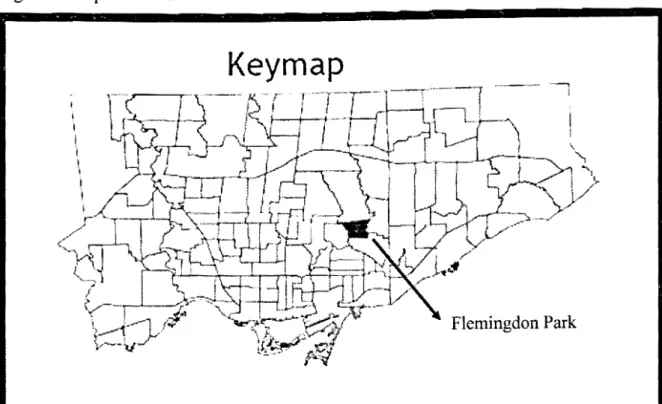
Flemingdon Park is located northeast of Toronto (Figure 1) within the boundaries of the Don River E Branch, Don River W Branch, Eglinton Avenue East and Old Lawrence Avenue (Figure 2). Of all those who were 15 years of age and older, had a college degree or higher; which was slightly higher than the percentage of the same population group in the Toronto Census Metropolis Area. This amount is significantly lower compared to the median income for the Toronto CMA despite a higher percentage of the population in the Flemingdon Park area having a university degree (Statistics Canada, 2010).
This is probably because the majority of the population in this area are immigrants (especially recent immigrants), and visible minorities. Source: Social Development, Finance and Administration Division: City of Toronto Figure 2: Map of Flemingdon Park.
Sample and Data Analysis
Initially, my plan was to recruit women from various community centers and organizations in the Flemingdon Park area, for example, the library, migrant service agencies in the area and the childcare center, in order to increase the validity and generalizability of the findings. mine. I approached several centers and community organizations in the area to explain my study and ask if I could get support (including permission to find potential participants from the center) from them. This emphasis helps the researcher to better focus on the research question and problem that he/she has raised or intends to explore, because only individuals who have experienced the central phenomenon will be selected to participate in the study.
For example, because my purpose in my study is to explore potential barriers to immigrant women's participation in the Canadian labor market, the participants in my study had to have some experience accessing the Canadian labor market. They also had to be residents of the Flemingdon Park area, as I listed it as my study location. In addition to the above requirements, participants had to be able to .. communicate in English as I could not provide interpretation/translation services.
Women who had never looked for a job in Canada or who could not communicate in English were excluded from the study. Their profiles did not fall into any of my three categories because they had no experience whatsoever looking for work in Canada. Understanding their own challenges, they did not plan to start working immediately upon arriving in Canada.
Instead, they engaged in volunteer activities to gain Canadian experience; in between, they also attended the LINC (Language Instruction for Newcomer to Canada) program. They also told me that after their English has reached a certain level, they plan to enroll in college before starting to look for a job in a new country.
FINDINGS AND DISCUSSION
Challenges within the \Vork Place
She also pointed out that staff in the company showed hostility towards new people in the company. Although Participant 2 did not explicitly associate her experience with any form of discrimination, I would argue that she was in fact discriminated against in the workplace because of her gender and race. Participant 5 worked in three different settings (nursing home, hospital, and retirement home) and described her workplaces in the nursing home and hospital as.
Especially at the nursing home, she said she had to manage 28 clients herself, not only had to take care of clients, but was also expected to "call the doctor's transfer order" and handle complaints from clients' families. . Although she said in the interview that she is satisfied with the salary she is receiving and that she is looking for a permanent position as a nurse, she gave a strong signal that she is not. I also felt that she had lost her passion in her career when I asked her to describe her dream job.
She told me that she hopes to find a full-time nursing position to replace her current three part-time jobs. However, the only jobs she could find in Canada were in sales or customer service related positions. Although she hoped that one day she could find a job in her field, she also understood that she had to accept the jobs she could get at the moment and work in the positions.
Therefore, even though she said that she was generally satisfied with service jobs, and that she also looked forward to rejoining the labor market (customer service) three days after the interview, she did not consider these jobs as part of her career not. In fact, she treats these jobs as tools to earn money so that she can be financially independent and can further study or upgrade herself, so that in the future she can find a job that matches her qualification.
CONCLUSION AND RECOMMENDATIONS
The results also reveal that despite all the obstacles faced by the immigrant women in the study, they do not give up on achieving their dream jobs in the future. As this study has revealed, "children" is the number one concern that immigrant women (who have children) face while trying to get a job. Therefore, creating more affordable and safe childcare environments will certainly increase the economic well-being of immigrant women.
Immigrant women are considered more in need of these programs because of their relative social isolation. 17 Immigrant women are often in a dilemma between the need for language training and naturalization due to the lack of childcare in the ESL program (Gormley & Gill, 2007). In order to explore the barriers and challenges immigrant women face in the Canadian labor market, this study has been limited by time constraints as it could only focus on immigrant women in the Flemingdon neighborhood of Toronto.
In conclusion, it can be argued that although economic integration of immigrant women in the new country is challenging, immigrant women are able to develop several strategies to overcome these barriers. Political Economy of Gender, Race and Class: Looking at South Asian Immigrant Women in Canada. Shaping immigrant women's retraining and reeducation experiences: The credential and certificate regime in Canada.
34;Work much harder and always have to prove yourself': Immigrant Women's Labor Force Experiences in the Canadian Maritimes. The purpose of the interview is to understand obstacles that immigrant women face while accessing the labor market.