That the MVRD Board receives the January 26, 2021 report entitled “Metro Vancouver’s 2020 Zero Waste Conference” for information purposes. That the MVRD board receives the report dated February 17, 2021, entitled “External Agency Appointment Process”, for information purposes.
REPORTS NOT INCLUDED IN CONSENT AGENDA
OTHER BUSINESS
- MVRD Board Committee Information Items and Delegation Summaries It was MOVED and SECONDED
MVRD Board Committee Information Items and Delegation Summaries It is MOVED and SECONDED It is MOVED and SECONDED. That the MVRD Board receive the MVRD Board Committee Information Items and Delegation Summaries, dated February 26, 2021, for information.
RESOLUTION TO CLOSE MEETING It was MOVED and SECONDED
ADJOURNMENT/CONCLUSION It was MOVED and SECONDED
That the MVRD Board authorize staff to proceed with engagement on the draft clean air plan, based on the report dated February 10, 2021, entitled "Draft Clean Air Plan". To request the authorization of the MVRD Board to continue with the engagement in the draft Clean Air Plan.
Section E 1.1
The draft Clean Air Plan focuses on actions that Metro Vancouver has the authority to implement. The Clean Air Plan is Metro Vancouver's fourth regional air quality and greenhouse gas management plan.
GREENHOUSE GASES
Regional Emission Sources: Emissions in the Metro Vancouver region come primarily from the burning of fossil fuels such as gasoline, diesel, natural gas and coal, as well as the burning of renewable fuels such as wood. Metro Vancouver is responsible for managing and regulating air pollution in the region under authority delegated by the BC government in the Environmental Management Act.
FINE PARTICULATE MATTER
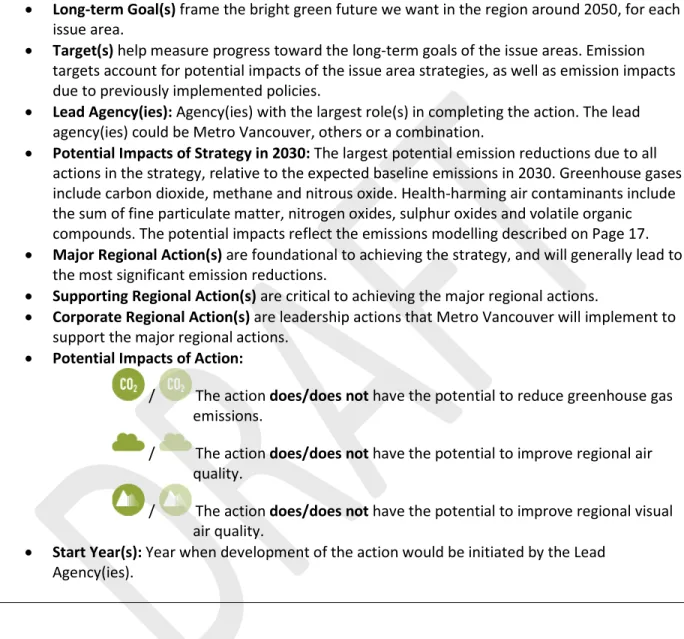
The main sources of regional emissions are transport, buildings and industry, as shown in the graphic below, with smaller contributions from agriculture, waste management and other sources. Metro Vancouver, along with its member jurisdictions, has been taking action on air quality and climate change for decades.
NITROGEN OXIDES
But governments, businesses and residents must do more to reduce our contributions to climate change, improve our local air quality and protect human health and the environment. The Plan was developed with input from across the region, and will be implemented until 2030.
VOLATILE ORGANIC COMPOUNDS
Accelerate Sales Targets for New Electric Vehicles
Advocate for the BC government to accelerate sales targets in the Zero Emission Vehicles Act to achieve 100% zero-emission vehicle sales by 2030 (rather than the current 2040 target).
Develop Regional Emission Requirements for Passenger Vehicles. Develop regulatory emission
Make Electric Vehicles More Affordable. Advocate to BC Government, Government of Canada and other regional
Regional Electric Vehicle Charging Strategy. Develop a long-term regional strategy for electric vehicle charging
Make New Passenger Vehicles Cleaner. Advocate to the Government of Canada to adopt more stringent fuel
Electric Vehicle Outreach Programs. Enhance existing and deliver new public outreach programs about the
Electrification Targets for Ride-Hailing Services
Eliminate Tampering with Vehicle Emission Controls
Reduce Vehicle Idling Emissions. Advocate to member jurisdictions to adopt Metro Vancouver’s model
Transition the Corporate Fleet to Zero Emissions
More Stable Funding for Regional Transit
More Stable Infrastructure Funding for Regional Active Transportation Networks. Advocate to BC
Regional Parking Strategy to Reduce Driving
Support Residents and Businesses in Active Transportation. Advocate to the BC Government and
Communicate the Benefits of Walking, Cycling and Public Transit. Support outreach campaigns led by
Implement Trip Reduction Programs. Advocate to BC Government to require large employers and
Support Low Emissions Commuting by Staff
Regulate Existing Medium and Heavy Trucks
Require Zero Emission Sales Targets for New Medium and Heavy Trucks. Advocate to BC Government
More Stringent Low Carbon Fuel Standards
Make Low and Zero Emission Heavy Trucks More Affordable. Advocate to BC Government, Government of
Regulate Fuel Economy and Emissions for Medium and Heavy Trucks. Advocate to the Government of Canada
Zero Carbon Refueling Strategy for Medium and Heavy Trucks. Develop a long-term regional zero carbon
Funding for Zero Carbon Refueling Infrastructure for Medium and Heavy Trucks. Advocate to the BC
Large Fleets to Adopt “ZEV-First” Procurement
Efficient Goods Movement to Reduce Emissions
Support Innovation in Zero Emission Technology for Medium and Heavy Trucks. Advocate to industry,
Use Business Licences to Support Emission Reductions. Work with member jurisdictions to explore
Accelerate Emission Reductions from Marine Vessels. Advocate to the Government of Canada and BC
Accelerate Emission Reductions from Rail
Support Emissions Reduction Actions at Vancouver Fraser Port Authority. Advocate to the Vancouver Fraser
Support Innovation in Low and Zero Emissions Marine and Rail Technologies. Advocate to BC
Carbon Neutral Aviation Sector. Advocate to Government of Canada to develop and implement a long-
Develop Local Sources of Sustainable Aviation Fuel
Technologies for Zero Emission Aircraft. Advocate to Government of Canada and BC Government to support
Stringent Fuel Sulphur Requirements. Advocate to Government of Canada to adopt more stringent sulphur
Support Low Carbon Corporate Business Travel
The almost 500,000 buildings in the region generate about 25% of the region's greenhouse gas emissions, mainly from natural gas heating. Multi-family buildings (e.g. townhouses, apartments) require less energy per inhabitant to heat and cool, so the Regional Growth Strategy's policy is more compact.
Greenhouse Gas Performance Requirements for Existing Large Buildings. Develop regulatory
Emissions requirements for existing homes and large buildings will also help meet the 2030 building targets for reducing greenhouse gases and nitrogen oxides. Equipment efficiency standards and the climate impacts of refrigerants also need to be addressed, along with a clear mandate for BC Hydro to support electrification of buildings.
Greenhouse Gas Performance Requirements for Existing Houses and Townhomes. Develop regulatory
New Buildings are Highly Efficient and Electric
Require Greenhouse Gas Reductions during Renovations. Advocate to the BC Government to
Energy Labels for Homes and Buildings. Work with the BC Government to require every building and home
High Performance Heating and Cooling Equipment Standards. Advocate to the Government of Canada and
Locate Exhausts to Minimize Local Air Quality Impacts. Work with member jurisdictions, the BC
Significantly Reduce Refrigerant Leaks in Building Equipment. Advocate to the BC Government to improve
Value Zero Emission and Resilient Buildings in Lending Practices. Work with the BC Government and
Building Electrification Mandate for BC Hydro
Expand Incentives for Low Carbon Upgrades
New Financing Tools for Low Carbon Upgrades
Online Decision Support Tools for Low Carbon Upgrades in Buildings. Work with the BC Government,
Energy Advisor Services for Homes and Large Buildings. Work with the BC Government to enhance
Make Electricity Upgrades Faster and Cheaper
Training and Education in Zero Emission Buildings
Share Lessons from Transitioning Metro Vancouver Corporate Buildings to Zero Emissions. Develop and
Test New Zero Emission Building Technologies
Enhance Wood Burning Education. Enhance existing awareness and educational programs about how to
All Wood Stoves are Certified. Advocate to BC Government and Government of Canada to require that
Emission Requirements for District Energy Systems
Low Carbon District Energy Policies. Work with member jurisdictions with district energy systems to
Incorporate Embodied Emissions into the BC Building Code. Advocate to BC Government that future
Use Building Materials with Low Embodied Emissions. Advocate to BC Government and member
Set Embodied Emission Targets for New Public Buildings. Advocate to public sector organizations in the
Strengthen Metro Vancouver’s Corporate Sustainable Design Requirements. Update Metro
Industrial facilities generate 15% of regional fine particulate matter and non-road equipment generates over 40% of regional diesel particulate matter. More background on climate change, industry and business is included in the Industry Roadmap for Climate 2050.
More Stringent Greenhouse Gas Requirements for Large Industrial Emitters. Advocate to the BC Government
Over 1,000 industrial facilities and associated commercial operations operate under Metro Vancouver's permits and regulations, which have historically focused on emissions of health-damaging air pollutants. Integrating greenhouse gas requirements into Metro Vancouver's permits and regulations, along with cleaner fuels and stricter emission requirements, will help meet 2030 emissions targets for industrial facilities.
Integrate Greenhouse Gases into Emission Regulations and Permits. Develop and implement
These operations manufacture cement, concrete and forest products, refine petroleum, distribute gasoline, paint vehicles and more. Reduce annual greenhouse gases by up to 520,000 tonnes Reduce annual health-damaging air pollutants by up to 2,100 tonnes.
Industrial Emission Reduction Incentives. Advocate to the BC Government and Government of Canada to
Implement Renewable Gas Content Requirements
Provincial and Federal Industrial Emission Standards. Advocate to the Government of Canada and
Carbon Tariffs. Advocate to the Government of Canada and the BC Government to establish carbon tariffs
Improve Volatile Organic Compound Content Limits
Reduce Air Quality Impacts from Odorous Air Contaminants. Continue to develop and implement a
Phase out High Global Warming Refrigerants
Improved Emission Controls at Petroleum Storage and Loading Facilities. Advocate to the Government of
Vancouver emissions regulations for non-road diesel engines with more stringent requirements that could cover additional air pollutants, equipment types, fuels and engine sizes. Any updates must be coordinated with the Vancouver Fraser Port Authority to align requirements as closely as possible.
Emission Standards for New Non-Road
Reduce annual greenhouse gases by up to 220,000 tons. Reduce annual air pollution that is harmful to health by up to 200 tons.
Funding for Cleaner Non-Road Equipment
Work with member jurisdictions, energy utilities, the Vancouver Fraser Port Authority and other regional partners to identify the region. This would take into account fueling and loading needs for different types of non-road equipment and should be consistent with similar actions for passenger vehicles and medium and heavy trucks (Actions 1.1.3 and 1.3.6).
Encourage Cleaner Non-Road Equipment for Construction. Advocate to member jurisdictions to
Awareness Program on Zero Emission Non-Road Equipment. Work with member jurisdictions and other
Regional Low Carbon Procurement. Work with member jurisdictions and other regional partners to
Air Quality Best Management Practices for Businesses and Organizations. Develop and promote a
Integrate Climate Considerations into Standard Business Practices. Advocate to the Government of
Low Carbon Corporate Procurement. Adopt low carbon procurement guidance as a Metro Vancouver
Corporate Opportunities to Reduce Emissions of Health-harming Air Contaminants. Explore and develop
Carbon Capture in Metro Vancouver Region
Develop Carbon Capture Standards. Advocate to the BC Government to develop technical
Alternatives to the incineration of vegetative agricultural waste and improved beneficial management practices will help achieve 2030 targets for greenhouse gases and fine particles. Work with the BC Government, BC Agricultural Council, BC Greenhouse BC Government, BC Agricultural Council, BC Greenhouse Growers Association and member jurisdictions to explore opportunities to reduce emissions from greenhouses.
Reduce Open-Air Burning. Work with the agricultural producers to reduce barriers to adopting
Reduce annual greenhouse gases by up to 150,000 tonnes Reduce annual air pollution that harms health by up to 50 tonnes.
Outreach Program on Reducing Agricultural Emissions. Develop and implement an awareness and
Enhance Funding for Environmental Farm Plans
Incentives for Farmers to Transition to Lower Emission Equipment. Advocate to the BC Government and
Pilot Study with Zero Emission Agricultural Equipment. Work with the BC Government and the
Regulatory Requirements for Cannabis Industry
Streamline Emission Requirements for Anaerobic Digestion Facilities. Develop an emission regulation for
Expand Anaerobic Digestion of Agricultural Waste
Encourage Local Agriculture. Advocate to member jurisdictions and other regional partners to continue
Exposure refers to the air pollutants that residents breathe in where they live, study, play and work. Managing exposure to health-damaging air pollutants reduces their impact on residents and communities in the Metro Vancouver region.
Integrate Health Impact Assessments into Major Projects. Work with member jurisdictions, health
Protect Against Wildfire Smoke Impacts. Work with health authorities, member jurisdictions and other regional
Strengthen Relationships with First Nations on Air Quality Issues. Work to strengthen relationships with local
Health and Air Quality Awareness. Work with health authorities and other health partners to develop
Enhance Social Support Programs to Consider Air Quality Impacts. Advocate to the BC Government and
Metro Vancouver aims for continuous improvement in air quality and greenhouse gas management through a fair, efficient and effective management program. Metro Vancouver implements world-leading and innovative air quality and greenhouse gas management services and solutions.
Air Quality and Greenhouse Gas
Emissions measurement and ambient air quality monitoring provide the foundation for Metro Vancouver's air quality and greenhouse gas management program. This issue area describes how Metro Vancouver currently functions as an authority on air quality and greenhouse gases, and identifies future directions.
Ozone Management. Implement targeted actions under existing Regional Ground Level
Odour Management. Implement existing regional odour management framework
Visual Air Quality Management. Implement existing visual air quality management program
Emissions Inventories and Related Data Sets. Track and forecast regional emissions of air
Air Quality Monitoring. Measure levels of
Review the monitoring network every 5-10 years to respond to regional changes, emerging issues and help protect human health and the environment. Develop and implement a user-friendly open data portal so that the public and researchers can more easily access and use data collected by Metro Vancouver.
Ambient Air Quality Objectives. Develop and update ambient air quality objectives,
Air Quality Advisories. Develop and issue air quality advisories and bulletins to inform the
Bylaw and Regulation Development
Regulatory Authorizations and Compliance. Authorize emissions through
Public Communication. Communicate with the public, stakeholders and other
Environmental Assessments. Provide
Specialized Studies. Conduct specialized studies on emerging areas of concern in local and
Greenhouse gases are air pollutants that trap heat and are the cause of climate change. Methane (CH4) is a short-lived greenhouse gas and is 25 times more effective than carbon dioxide at trapping heat in the atmosphere.
All other feedback will be considered. Specific sectors and organizations as represented in Clean Air. Organize four webinars to review the draft Clean Air Plan and answer any questions.
Section E 1.2
That the MVRD board authorizes the staff to proceed with the commitment to the draft climate plan for 2050 buildings, as presented in the report dated 10 February 2021 entitled "Draft climate plan for 2050 buildings". To seek the MVRD board's permission to continue engagement in the draft climate plan for 2050 buildings.
ATTACHMENT
Reduce Energy Demand
One of the first steps in pursuing zero emissions and resilient buildings is to look for opportunities to reduce how much energy the building needs for heating and cooling. Since electricity is more expensive than natural gas in BC, switching to electric heat pumps with zero emissions will make a better economic choice to keep the heat inside the building.
Use Zero Emissions Energy
Measures that improve the envelope (or shell) of a building to keep hot or cold air inside, such as weather sealing, improved insulation and windows, and heat recovery systems, will directly reduce energy demand.
Make It Smart
New buildings are constructed according to the requirements in the Building Code, which include the greenhouse gas emissions and energy consumption of the building until it undergoes a major renovation. They are also unaware of the climate, health and resilience benefits associated with high-efficiency electric heat pumps.
Signal the Transition to Zero Emission Buildings through Requirements and Standards
Work with the BC government to establish greenhouse gas performance requirements for new buildings, through the BC Energy Step Code or other legislation, that achieve zero emissions by 2030. Advocate with the BC government to introduce the BC Retrofit Code with increasingly stringent greenhouse gas performance requirements for buildings undergoing significant renovation.
Accelerate Demand for Zero Emission Buildings through Research, Education and Incentives
Work with the BC government to expand energy advisory services for homes and large building owners. Work with member states, the BC government, health authorities and other partners to develop awareness and educational programs that encourage home and building owners to choose zero-emission and resilient building solutions.
Shift to Zero Carbon District Energy Systems
Accelerate the Transition to Lower Embodied Emissions in Buildings
Advocate for the Government of BC for future updates to the BC Building and Retrofit Code to develop low-emission performance objectives for new construction and renovations, and to encourage the use of low-emission materials by considering the cost and availability of materials. Work with Member States, the BC government, industry and other regional partners to develop a regional working group focused on reducing embedded emissions in new construction and building renovations.
Support water conservation and non-potable water reuse to increase resilience to shifting precipitation patterns
Support the uptake of building design and retrofit solutions to reduce the impact of heatwaves and wildfires
Encourage the uptake of design and retrofit solutions that increase resilience to severe storms and flooding in buildings
Embodied emissions are greenhouse gas emissions associated with the construction of goods and products, including raw materials and the transportation of the good or product to the place where it is sold. Between September and November 2020, the Regional Planning Committee and the MVRD Board approved or received recommended policy guidance from 8 of the 11 Metro 2040 Policy Reviews.
Section E 2.1
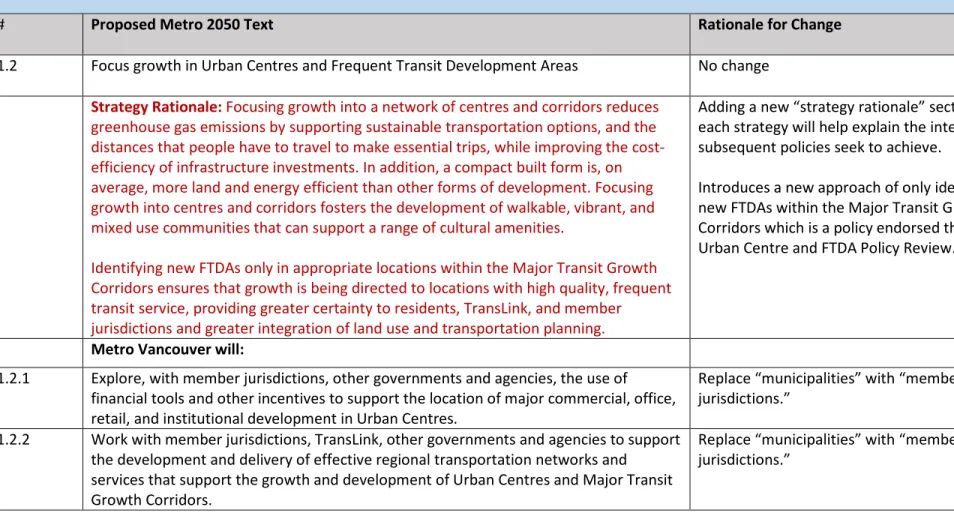
Metro Vancouver staff, working with the Metro 2050 Intergovernmental Advisory Committee, have developed content for Metro 2050's goals 1 and 2. A full draft of Metro 2050 will be presented to the Regional Planning Committee and MVRD Board in July with a recommendation that it is referred out for formal comment between August and December 2021.
Section D – Definitions
Regional Land Use Designations and Overlays (GOAL 1 / 2 CONTENT ONLY) (Metro 2040 p9/10)
They are intended to support local and regional economic activities, and to complement the planned function of urban centers and frequent transit development areas. Frequent Transit Development Areas are intended to be additional priority locations to accommodate concentrated growth in higher-density forms of development.
Goal: 1 Create a Compact Urban Area PREAMBLE (p13)
Goal: 1
Other research", "meets community societal needs and priorities", "air quality" and "disproportionately affected" added from IAC input. Added to address concerns of stakeholders and RPL .. to avoid inequities..." added from IAC inputs.
Goal: 1 Create a Compact Urban Area Strategy 1.4
Protect Rural areas from urban development
Content of the draft Goal 1 for Metro 2050, including IAC comments | 8th part of 8 | February 2021. a) identify rural areas and their boundaries on a map generally consistent with regional land use. labeled Rural' to be more precise.
PREAMBLE (p25)
The agricultural industry is dependent on the protection and availability of agricultural land for the production of food and other goods and services. This strategy also aims to protect agricultural land for local production and support the economic sustainability of the agricultural sector.
Goal: 2 Support a Sustainable Economy
Promote land development patterns that support a diverse regional economy and employment opportunities close to where people live
The content of the draft Goal 2 for Metro 2050 is awaiting feedback from the IAC | February 2021. a) encourage the use of excess airport land for industrial activities and, where appropriate, discourage non-airport commercial development and any expansion outside the industrial and employment areas identified on Map 6; Add a reference to the design of the built forms. b) support the development and expansion of large-scale office and retail uses in city centers and local uses in areas of frequent transit development through policies such as: zoning that reserves land for office use, density bonus provisions to encourage office development, variable cost charges development and/or other financial incentives; and.
Goal: 2
Strategy: Protect the supply, and enhance the efficient use, of industrial land Edit title in order to better profile the importance of industrial lands
Industrial Countries Strategy. vii) provide infrastructure and services in support of existing and growing industrial activities;. Add municipal action as per Regional Industrial Land Strategy .. x) do not allow strata ownership and/or small plot subdivisions on identified Trade Oriented Lands.
Protect the supply of agricultural land and strengthen agricultural viability The emphasis on food production was removed because it is beyond the ability
Advocacy action to address the inequity that exists when new and future farmers are unable to access agricultural land (formerly 2.3.9). New advocacy action that appeared during the engagement with the municipalities.. 2.3.11 Advocate in the province and in coordination with the Agricultural Land Commission, to establish the conditions and/or criteria to ensure the appropriate agro-industrial uses, if any, are allowed in the Reserve of Agricultural Land.
Section E 2.2
Social Equity and Regional Growth Study Regional Planning Committee Regular Meeting Date: 5 March 2021 Page 4 of 7. Social Equity and Regional Growth Study Regional Planning Committee Regular Meeting Date: 5 March 2021 Page 7 of 7.
Social Equity &
Regional Growth Study
And if we really talked about all the things that [inequality] created, I think it would melt people into the privileged. I don't think they should make a choice to go see a friend or family member who is on their deathbed.
Executive Summary
Use the "Social Justice Analysis Tool" (SEAT) developed during this project to evaluate the policies under consideration. The study of social justice and regional growth also includes some suggested areas for future work, both in
1.Introduction
Orientation
Terminology & Key Concepts
The experience of a lesbian Black woman will be different from that of other women who may not be Black, may not be lesbian, or may not be both. White Body supremacy: Trauma specialist and therapist Resmaa Menakem describes the concept of 'White body supremacy' as "the continuation of a false narrative that White people are better than people of other skin colors and ethnic backgrounds."
2.Study Overview
Project Context
Finally, the baseline report on inequality used only one form of quantitative analysis: the spatial distribution of equity indicators. While mapping these indicators can be useful for planning, which largely exists as a spatial exercise, spatial distribution also has some limitations.
Guiding Principles
Namely, some causes of inequalities will not appear on a map, as not every form of oppression can be represented with a spatial proxy. Spatial distribution also does not indicate disproportionate distribution of benefits and harms along other dimensions, which would be a useful exercise for future study.
3.Inequity Baseline Data Report
- Description
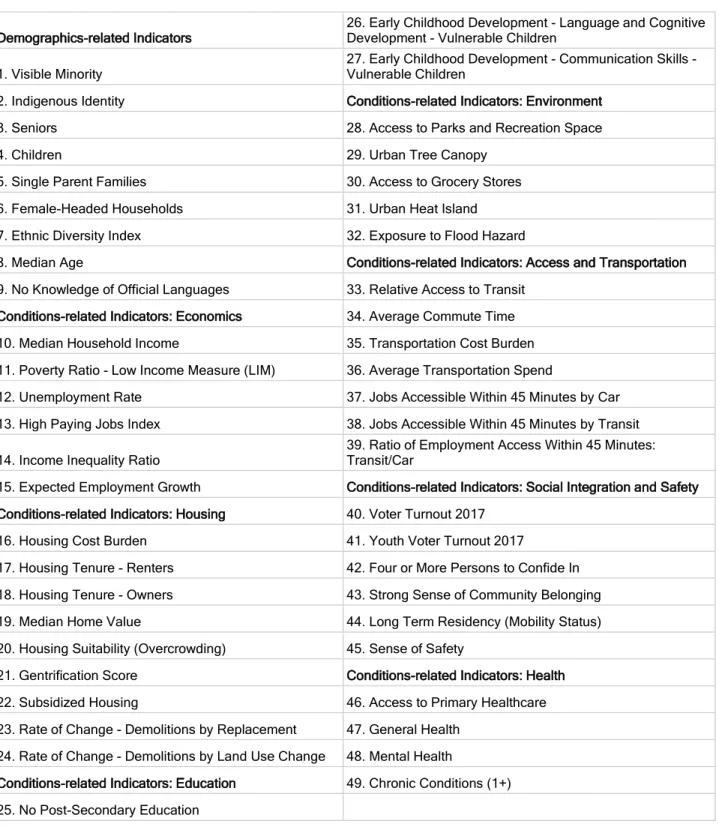
- Inequity Baseline Indicators
- Methods
- Indicator Maps
- Demographics-related Indicators
Percentage of population reporting Indigenous identity, collected from the 2016 Statistics Canada Census of Population. Percentage of population aged 0 to 14 years, calculated from the 2016 Statistics Canada Census of Population.