Children with dyslexia are diagnosed based on criteria that address language, stereotypic behavior, and social skills (Anagnostou et al., 2014). A variety of assessment tools are used to determine the extent of skill development in children with ASD. Social and emotional understanding of people is very difficult for children with MAS (Jureviciene & Sostakiene, 2014; Mathews, Erikfritz-Gay, Knight, Lancaster, & Kupzyk, 2013).
Children with ASD need to learn social language such as imitation, joint attention, and play skills (Wu & Chiang, 2014). There are various programs that work to develop social skills in children with disruptive disorders. Children with ASD have impaired imitation skills, which makes it difficult to understand and learn speech (Jalili et al., 2014).
Speech therapists are essential members of the team in the treatment plan for children with ASD (Auert et al., 2012). Besides speech therapy, occupational therapy is the most commonly used therapy to support sensory dysfunction in children with ASD (Ashburner, Rodger, Ziviani, & Jones, 2014). Many parents of children with ASD seek occupational therapy to address sensory dysfunction (Preis & McKenna, 2014).
RESEARCH METHODS Study Design
Prior to analysis, data were reduced to interview transcripts and information from the literature review. This process is part of the reflection and critical review required in ID analysis (Thorne et al., 2004). I maintained a level of skepticism so as not to reinforce the ideas that emerged from my initial inductive data analysis (Thorne et al., 2004).
Part of the process of demonstrating rigor was to make my view of the research transparent in the report (Thorne et al., 2004). I was careful not to assume that all information in the data was relevant or accurate (e.g., recurring ideas, participant quotes) (Thorne et al., 2004). The researcher is an essential component for the validity of the findings and must perform what is known as a “thoughtful clinical test” (Thorne et al., p. 17).
Peer review or debriefing provides the researcher with an external verification of the research process (Creswell, 2013).
RESULTS
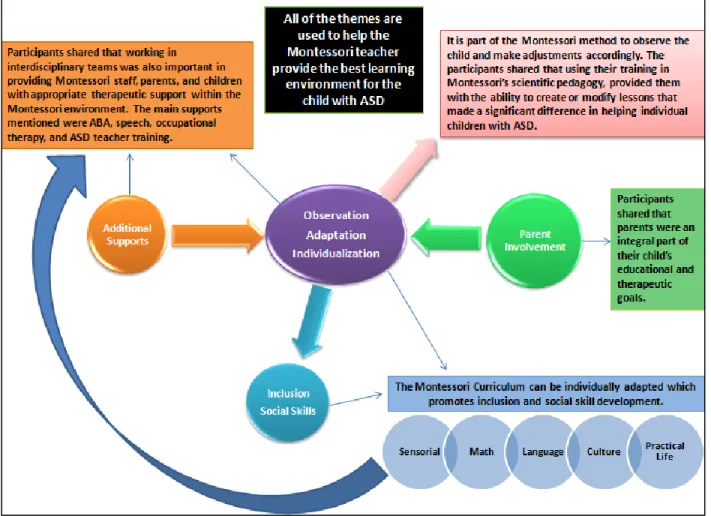
One of the participants shared how some Montessori teachers still work rigidly with the Montessori materials taught in training. Montessori expanded some of these activities and used them to teach children with learning differences as well as typically developing children as part of the Montessori method (Montessori. Participants also indicated that changing some materials in existing lessons can help a child with ASD participate better in the activity.
Padma noticed that some of the children she worked with did not want to touch the sandpaper of the sandpaper letters. The magnets were for some of the children with ASD who would get upset if the letters got mixed up. Teresa shared that including children with ASD to participate in activities that are part of the practical life curriculum, such as setting the table and cooking, gives the child a sense that they are a valuable and.
Participants indicated that many typically developing children were accepting children with ASD in the classroom. She found that they could provide an immersive experience by getting all the kids to use. When she had the final edit of the video, she provided one copy for the child's parents and one for the school.
Although she was able to have some of the siblings of the children with ASD in her exclusive school come and help, it was not as beneficial as having continuous peer modeling. All the participants in this study discussed the importance of continuing to develop their skills in this area. Participants shared that children can sometimes exhibit dangerous behavior, and that it is important to have a system in place that will support all the children.
One of the therapies that participants shared was provided for many of the children with ASD was ABA therapy. Padma discussed that many of the children with ASD would do a morning obstacle course that implemented tunnels to work on various body movements, as part of their therapeutic program. Bailey also warned that some of the parents of children with ASD will receive incorrect information (eg online) and discussed that there is a lack of appropriate resources for families.
This is partly why Beth dedicated one of the rooms in the school to serve as a therapy room and resource room.
DISCUSSION
This is the basis by which Montessori teachers can adapt lessons for children with ADHD. All participants confirmed that children with ADHD were viewed from a medical perspective, as Montessori views all children. Having professionals who are familiar with different treatment methods can increase the potential for a child with ASD.
Participants also reported that the support of trained ASD therapists helped them feel more comfortable being creative with adaptations for a child with ASD that departed from their traditional Montessori training. Participants agreed on the importance of having individuals from different disciplines available for consistent group discussions in order to successfully achieve the various goals for the child with ADHD. The intensive nature of ABA was discussed in the literature review as the modality that may best affect children with ADHD.
The information from the literature review showed how language and communication skills are affected in children with ASD. Participants also shared that providing space (eg, a room) within the school for the speech therapist to work with the child with ASD without distractions, as well as providing opportunities for the speech therapist to observe the child's take. The information in the literature review indicated that occupational therapy is the most used therapy after speech for children with ASD.
Participants shared that many of their students with ASD worked either with occupational therapists at school or at home. In addition, participants reported that techniques used in occupational therapy to assist with self-regulation were helpful for children with ASD in the Montessori school setting. From the interviews with the participants, they were able to convey that an inclusive environment helped children with ASD to learn peer modeling, as well as to be a contributing member of the school community.
This helps the child with ASD develop confidence and teaches children who normally develop empathy and understanding for individuals with learning differences. Participants reported that parental support was invaluable and broadened their understanding of children with attribution disorders.
CONCLUSION
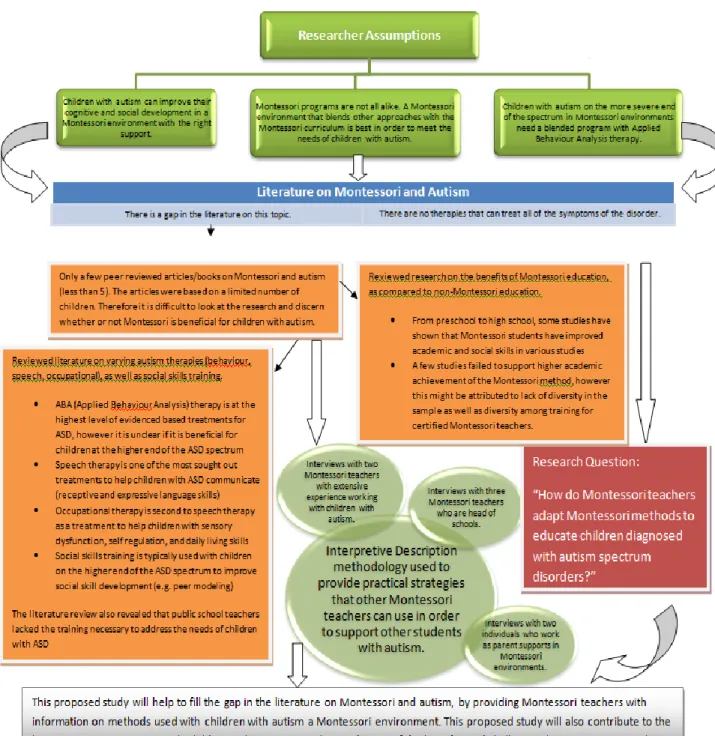
Purpose of the Study: There is a lack of research in the field of Montessori and autism. The purpose of this study is to provide practical knowledge that other Montessori teachers can use
It is expected that this research will reveal the supports and challenges involved when teaching a student with autism in this environment. You will be asked to participate in an audio-recorded interview lasting from 1 to 1.5 hours. You will be asked a series of questions about your experience working with children with autism in a Montessori environment.
You can notify the researcher at any time that you wish to discontinue the interview and your participation in the study. If you choose to opt out before the data analysis stage, all the information you have provided will be destroyed. There are no risks associated with participating in this research other than those experienced in everyday life.
Discomforts and Risks: There are no risks in participating in this research beyond those experienced in everyday life
Benefits: The benefits to participating in this research project are that your contribution will help other Montessori teachers learn how the Montessori method can be adapted to the
There are no risks involved in participating in this research beyond those experienced in everyday life. . computers. In the event of a publication or presentation resulting from the research, no personally identifiable information will be shared. Future opportunities to have the results of the study published in a book, peer-reviewed journals, and presented at national conferences will help provide resources for Montessori teachers who need practical knowledge and insight into how Montessori teachers work with children with autism.
Payment for participation: There is no payment for participation
The Departmental Ethics Review Committee of the Faculty of Health Disciplines, acting under the authority of the Athabasca University Research Ethics Board to provide an expedited review process for minimal-risk student research projects, has approved your project, “Montessori and Autism: An Interpretive.” Your application has been approved on ethical grounds and this memorandum constitutes a certificate of ethical approval. As you progress with the study, all requests for changes or modifications, extensions of ethics approval, and reports of serious adverse events through the Research Portal must be reported to the Athabasca University Research Ethics Board.
To continue your proposed research after March 21, 2017, you must request an extension by completing and submitting an Ethics Extension Request form. Failure to request an annual renewal before the expiration date of the current ethics approval certification may result in the termination of ethics approval and formal closure of the REB ethics file. Application for ethics approval and internal and external funding managers in the Office of Research Services are notified that ethics approval has expired and the REB file has been closed.
When your research is completed, you must submit a Project Completion (Final) Report to conclude REB approval monitoring efforts. Failure to submit the required final report may mean that a future application for ethics approval will not be reviewed by the Research Ethics Board until the outstanding reporting is submitted. You can log into the Research Portal at any time to monitor the workflow status of your application.
If you experience any problems working in the Research Portal, please contact the system administrator at [email protected]. If you have any questions about the REB review and approval process, please contact the AUREB office at [email protected].