That the MVRD board approves the statement of financial information for the year ended December. That the MVRD Board receives, for informational purposes, the report dated April 14, 2020, entitled “Greater Vancouver Regional Fund Annual Report as of December 31, 2019”.
Metro 2040 Implementation Policy Review: Scope of Work
It was MOVED and SECONDED
CARRIED 2.1 Audited 2019 Financial Statements
CARRIED G. REPORTS NOT INCLUDED IN CONSENT AGENDA
That the MVRD Board give first, second and third reading to Metro Vancouver Regional District Air Quality Management Amendment Bylaw No. That the MVRD Board approves and finally adopts Metro Vancouver Regional District Air Quality Management Amendment Bylaw No.
CARRIED H. MOTIONS FOR WHICH NOTICE HAS BEEN GIVEN
OTHER BUSINESS
- MVRD Board Committee Information Items and Delegation Summaries It was MOVED and SECONDED
Minutes of the regular meeting of the Metro Vancouver Regional District (MVRD) Board of Directors held on Friday, May 29, 2020 Page 7 of 8 of the Metro Vancouver Regional District Air Quality Management Amendment By-law No. regarding consequential amendments deemed resulting from the adoption of the Metro Vancouver Regional District Residential Indoor Wood Burning Emission Regulation Bylaw No.
CARRIED J. BUSINESS ARISING FROM DELEGATIONS
RESOLUTION TO CLOSE MEETING It was MOVED and SECONDED
90 (2) Part of the meeting must be closed to the public if the matter under consideration relates to one or more of the following: b) consideration of received and confidential information relating to negotiations between the regional district and the provincial government or the federal government or both or between the provincial government or the federal government or both and a third party."
CARRIED L. RISE AND REPORT (Items Released from Closed Meeting)
ADJOURNMENT/CONCLUSION It was MOVED and SECONDED
CARRIED (Time: 9:34 a.m.)
Minutes of the special joint meeting between the MVRD, GVWD, GVS&DD and the MVHC Board held on Friday, June 5, 2020 Page 1 of 4 METRO VANCOUVER BOARD BUDGET WORKSHOP. Minutes of the special joint meeting of the Metro Vancouver Regional District (MVRD), Greater Vancouver Water District (GVWD), Greater Vancouver Sewerage and Drainage District (GVS&DD) and Metro Vancouver Housing Corporation (MVHC) Board held at 9:04 am
MEMBERS PRESENT
MEMBERS ABSENT
Section B 2
ADOPTION OF THE AGENDA
PRESENTATION AND DISCUSSION 1.1 Budget Workshop
2020 – 2024 Financial Plan
The President called a joint meeting of the MVRD, GVWD, GVS&DD and MVHC Boards of Directors on June 5, 2020. Minutes of the special joint meeting of the MVRD, GVWD, GVS&DD and MVHC Board of Directors on Friday, June 5, 2020 Page 3 of 4 Adjournment.
COVID-19 Implications and Opportunities
ADJOURNMENT OR CONCLUSION
CERTIFIED CORRECT
Section E 1.1
EXECUTIVE SUMMARY
PURPOSE
BACKGROUND
Constituency A Reserve Funds - Possible Uses of Discretionary Reserves Electoral Committee Regular Meeting Date: 10 June 2020 This report addresses the work plan item "Financial Plan for Constituency A Reserves - Report on Possible Uses".
ELECTORAL AREA A RESERVES
Operating Reserves
Statutory Reserves
Discretionary Reserves
POTENTIAL USES OF DISCRETIONARY RESERVES
One-time Projects
The annual regional district base grant (approximately $50,000) serves to offset the total amount of discretionary reserves used to fund one-time projects. Staff recommends continued use of the regional district's basic grant and discretionary reserves to fund future one-time projects for Electoral Area A.
Smoothing Increases to the Electoral Area A Levy
Maintaining Discretionary Reserves in the Event of UEL (or UBC) Governance Changes
Staff recommends that sufficient discretionary reserves be maintained to fund the constituency service function for at least three years, in the event that governance changes at UEL or UBC result in a significant loss to the constituency A tax base. This would allow time to transfer constituency services to a smaller tax base.
ALTERNATIVES
That the MVRD Board
As for SUP, although internal governance matters have been a recent topic of the University Neighborhood Association (UNA) committee, staff are not aware of any discussions that could result in one or both of UBC or UNA changing their relationship with MVRD. Given that the UBC represents a similar percentage of the tax base as the UEL for the Constituency Services budget, the above option is useful should management changes to the UBC be proposed in the future.
That the Electoral Area Committee receive for information the report dated May 22, 2020, titled
FINANCIAL IMPLICATIONS
CONCLUSION
ATTACHMENT BOARD POLICY
Policy No. FN-016
BOARD POLICY
- OPERATING RESERVES
- STATUTORY RESERVES
- DISCRETIONARY RESERVES
- APPROPRIATION OF ANNUAL SURPLUS
At its June 11, 2020 meeting, the Industrial Lands Strategy Task Force discussed the attached report entitled “Metro Vancouver Regional Industrial Lands Strategy – Revised for Approval,” dated May 22, 2020. This principle was endorsed by the Industrial Lands Strategy Task Force and Metro Vancouver board.”;.
Section E 2.1
Metro Vancouver Regional Industrial Lands Strategy - Amended for Approval MVRD Regular Board Meeting Date: July 3, 2020 Page 2 of 2 Taking into account the 4 “big moves” and recommendations that follow, the strategy affirms that changing or using agricultural land is not the answer for the lack of industrial land in the region.
Attachments
Report dated May 22, 2020 titled “Metro Vancouver Regional Industrial Lands Strategy – Revised for Approval”
This principle has been endorsed by the Industrial Lands Strategy Task Force and Metro Vancouver Board.”; and . f. on page 42, under Recommendation 1, by striking the phrase "During the development of the Regional Industrial Land Strategy, the Industrial Land Strategy Task Force and Metro Vancouver Council adopted a resolution stating "... that solutions to the shortages of industrial land in the region does not include the possibility of encroachment of agricultural land.”. The Strategy must be considered within that context.”; and b) send the revised Strategy to the MVRD Board for its consideration.”.
Draft Regional Industrial Lands Strategy dated June 2020 (as revised by the Industrial Lands Strategy Task Force on June 11, 2020)
The task force subsequently modified the recommendation presented in the report as presented and underlined above.
RECOMMENDATION That the MVRD Board
Metro Vancouver Regional Strategy for Industrial Countries – Revised for Adoption Task Force on the Industrial Countries Strategy Meeting Date: June 11, 2020 Page 2 of 3. In response, the Strategy was revised to add further references to the impact that solutions to the shortage of industrial land does not include encroachment on agricultural land, and deletes the reference to exploring the potential of a provincial industrial land reserve.
ADDITIONAL STAKEHOLDER COMMENTS RECEIVED
NEXT STEPS
That the Regional Industrial Lands Task Force receive for information the report dated May 22, 2020, titled “Metro Vancouver Regional Industrial Lands Strategy – Revised for
Metro Vancouver Regional Industrial Lands Strategy – Revised for Approval Industrial Lands Strategy Task Force Meeting Date: June 11, 2020 Page 3 of 3. Metro Vancouver Regional Industrial Lands Strategy, June 2020 (Industrial Lands Strategy Task Force June 11, 2020 Meeting Agenda - Report 5.1, Annex 1).
REGIONAL PLANNING
Regional Industrial Lands Strategy
Metro Vancouver would like to thank the following for participating in the development of the Regional Industrial Lands Strategy. Metro Vancouver also acknowledges the individuals who participated in the stakeholder workshops and the subject matter expert panel, as well as the Greater Vancouver Urban Freight Council, the Greater Vancouver Gateway Council and the NAIOP Commercial Real Estate Development Association.
CONTENTS
Big Moves’
Priority Actions
Given Metro Vancouver's limited land base, there is considerable pressure for competing, legitimate land uses throughout the region. Metro Vancouver will update the Industrial Lands Inventory to better understand current land use and supply and conduct a regional employment survey.
SETTING THE STAGE
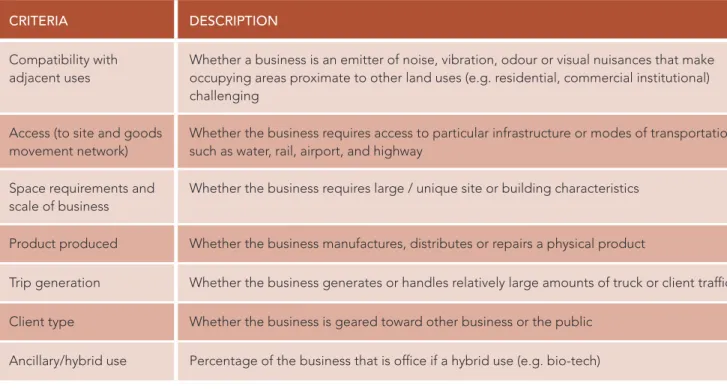
One of the first efforts of the Task Force was to confirm a vision for the Regional Industrial Land Strategy. If the purpose of the Regional Industrial Land Strategy is to ensure the adequate supply of
THE ROLE OF INDUSTRIAL LANDS BY SECTOR IN THE
METRO VANCOUVER ECONOMY
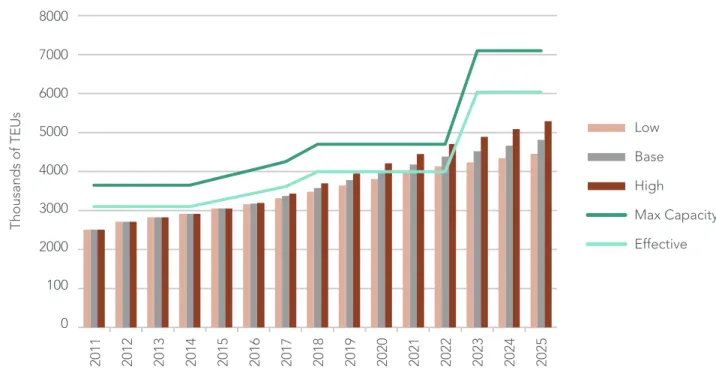
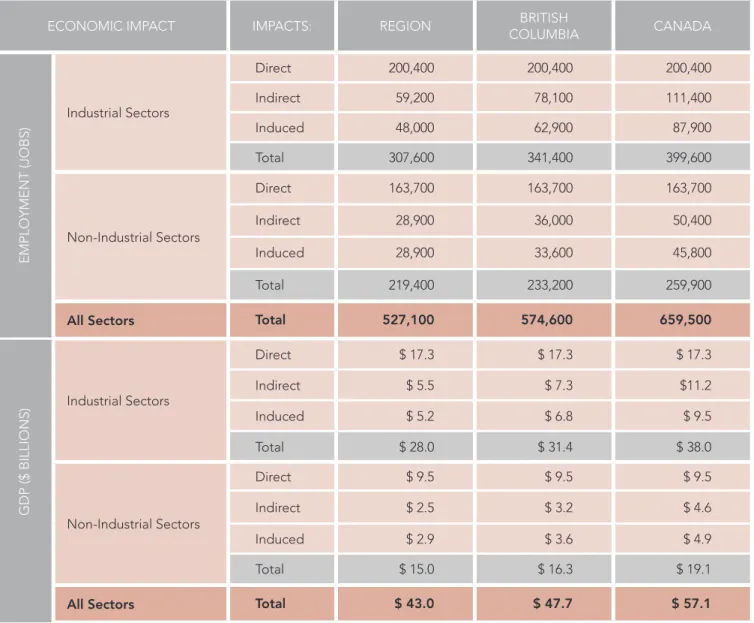
In 2016, business activities in industrial areas generated $27 billion in direct gross domestic product (GDP), equivalent to 30% of the region's total GDP. Metro Vancouver's industrial estates are estimated to generate $6.5 billion in tax revenue and fees for the federal government and $2.3 billion for the provincial government (Figure 1).
METRO VANCOUVER INDUSTRIAL LANDS - ISSUES AND TRENDS
- Constrained Land Supply
- Pressure on Industrial Lands
- Site and Adjacency Issues
- Complex Jurisdictional Environment Industrial lands and industrial activities play a crucial
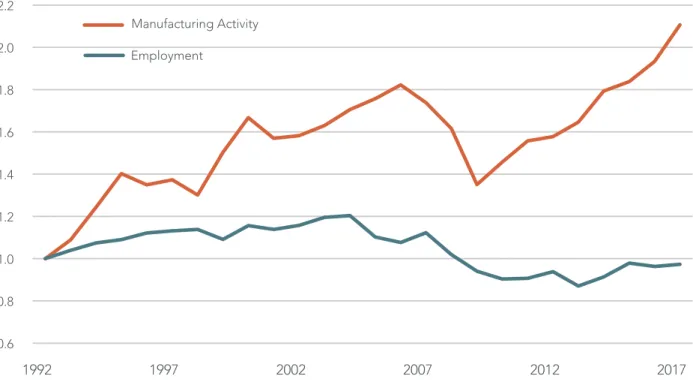
The challenges facing Metro Vancouver and its industrial land supply are somewhat unique, at least in the North American context. Like many other industrial markets around the world, the region's industrial countries have undergone a long-term transition in the nature and form of their use.
RECOMMENDATIONS
BIG MOVES’
PRIORITY ACTIONS
Maintaining and growing a flexible and reliable transportation network, including multiple modes of transit, is an integral part of planning for the effective management of industrial land in the region. For example, Metro Vancouver will seek to sign a memorandum of understanding with the Fraser Valley Regional District that will outline shared priorities regarding the effective and efficient management, protection and development of industrial lands within the Lower Mainland.
REGIONAL INDUSTRIAL LANDS STAKEHOLDERS
It administers a range of laws relating to traffic and the movement of goods, including the Motor Vehicles Act and the Commercial Transport Act. It administers many laws related to transportation, including new equipment vehicle requirements under the Canadian Motor Vehicle Safety Standards (CMVSS), engine emission standards and rail safety standards.
INDUSTRIAL MARKET CONDITIONS
METRO VANCOUVER INDUSTRIAL LAND VALUES AND LEASE RATES, 2014, 2017, 2019
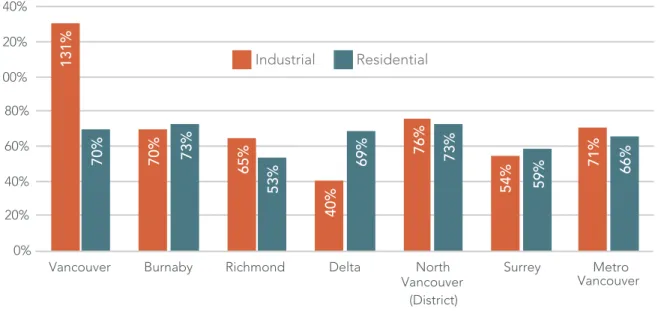
INDUSTRIAL LANDS INVENTORY AND ABSORPTION
That the MVRD Board receive for information the report dated May 20, 2020, entitled "Food Flows in Metro Vancouver: Study Results". To share the results of the Metro Vancouver Food Streams study (Attachment) with the Regional Planning Committee and MVRD Board.
FOOD FLOWS IN METRO VANCOUVER STUDY
A recently completed study, Food Flows in Metro Vancouver, commissioned by Metro Vancouver, describes the food products transported across regional district boundaries. Metro Vancouver is a food distribution hub for the province, with approximately 78% of the total provincial food supply crossing regional borders.
Section E 3.1
Export Food produced in Metro Vancouver and transported to other regions of BC for consumption. Import Food produced in the other provinces of Canada and transported to Metro Vancouver for consumption.
STUDY RESULTS
Feed Food produced in BC outside of Metro Vancouver and transported to Metro Vancouver for consumption. Export Food produced in Metro Vancouver or other locations in Canada and transported through Metro Vancouver for consumption in the US.
LESSONS LEARNED
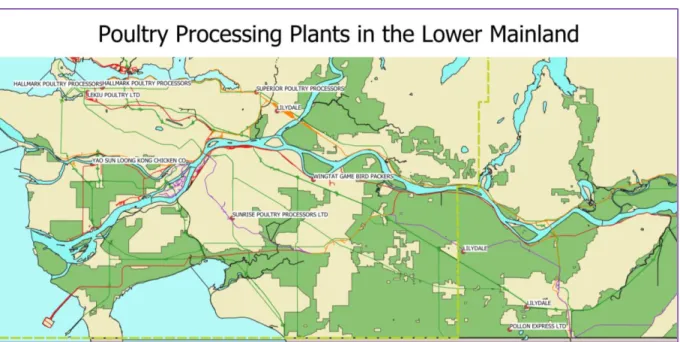
Eggs Eggs produced in the Lower Mainland account for 77% of total BC production; 54,000 tonnes come from Metro Vancouver (6%) and the Fraser Valley (94%). Seafood Metro Vancouver generates a surplus of seafood products as most seafood is processed in the Lower Mainland (81%).
Attachment
Food Flows in Metro Vancouver Final Report
April 30, 2020
Davies Transportation Consulting Inc
ATTACHMENT
Food Flows in Metro Vancouver
10 TRANSPORTATION OF PERISHABLE COMMODITIES BY MODE OF TRANSPORT
1 Executive Summary
C. Food Supply
Provincial food flow in Metro Vancouver includes 100% of the food supply in Metro Vancouver, plus a portion of the food flow associated with the food supply for the rest of B.C., which flows through Metro Vancouver due to the region's role as the distribution hub for the province.
Estimated BC Food Supply by Commodity 2018 Tonnes
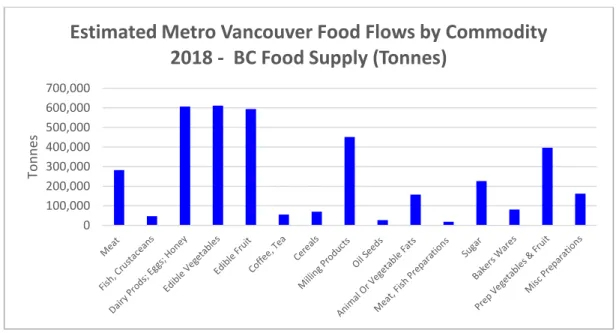
The resulting total Metro Vancouver food flow attributed to the provincial food supply (including both Metro Vancouver and the rest of B.C.) is depicted below.
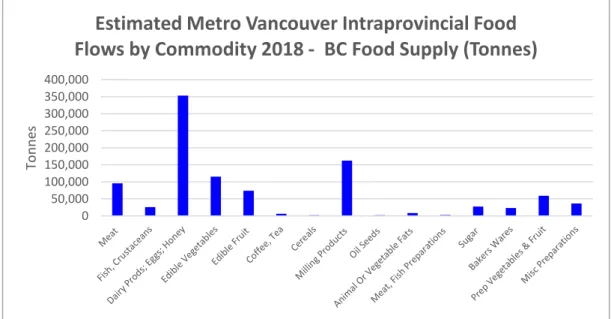
Estimated Metro Vancouver Intraprovincial Food Flows by Commodity 2018 - BC Food Supply (Tonnes)
The assessment of Metro Vancouver's level of food self-sufficiency required disaggregating intraprovincial flows (within Metro Vancouver) and intraprovincial imports (products imported into Metro Vancouver from other parts of the province). Estimates of intra-regional power flows are based on the share of provincial commodities produced in Metro Vancouver.
Metro Vancouver Food Flows Requiring Temperature - Controlled Transport
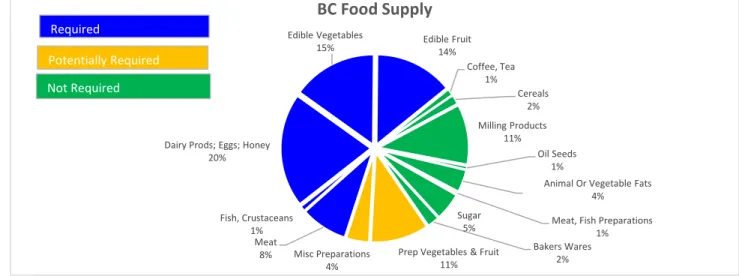
Perishable foods are defined as food products such as meat, poultry, fish, dairy products, unprocessed raw fruits and vegetables that require temperature-controlled transportation and storage. Almost 60% of the total requires temperature-controlled distribution, and an additional 15% may require temperature-controlled transport if necessary to protect against freezing.
BC Food Supply
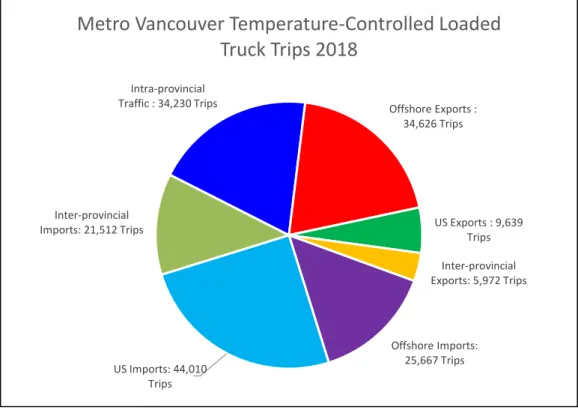
Temperature-controlled food truck trips in Metro Vancouver have been estimated based on the volume of products requiring temperature-controlled transportation for each origin-destination food stream. The estimated annual total is 153,466 temperature-controlled loaded trips (ie, trips with a truck pulling a loaded refrigerated trailer or intermodal container); this is approximately one-third of the total estimated intermodal rail and truck volume.
2 Introduction
Food Flow Origins and Destinations
Intraprovincial exports: food produced in Metro Vancouver and transported to other regions of B.C. Interprovincial exports: food produced in Metro Vancouver and transported to other provinces for consumption.
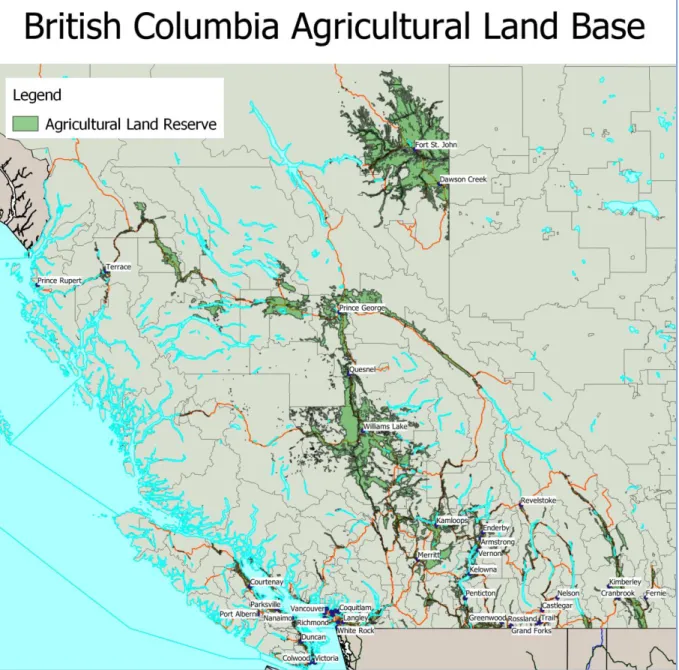
- Agricultural Land Base
- Location and Transportation Infrastructure
Foreign imports: food produced in overseas countries and transported to Metro Vancouver or through Metro Vancouver to other Canadian locations for consumption. Foreign exports: food produced in Metro Vancouver or other locations in Canada and transported through Metro Vancouver for consumption in overseas countries.
4 International Trade
Port of Vancouver Imports and Exports
HS2 Description 000 Tonnes
Share of
Imports 000 Tonnes
Share of Exports
Port of Vancouver Food Imports and Exports 2018 (Tonnes)
Port of Vancouver Food Exports 2018
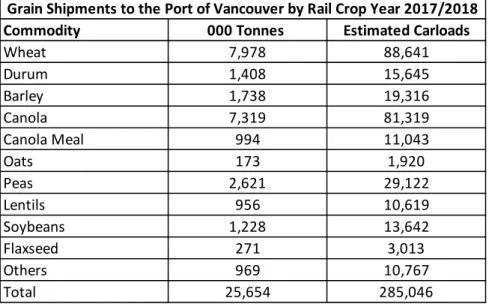
Export traffic consists primarily of grains, oilseeds and specialty crops3 produced in the Prairie provinces and shipped directly by rail to terminal elevators in the port. Origin of grains, oilseeds and specialty crops shipped to the Port of Vancouver crop year 2017/2018.
Port of Vancouver Food Imports 2018
YVR Air Cargo
Vancouver International Airport Air Cargo 2018
Cargo Type Value (CDN $
Millions) Tonnes Average Value CDN$/Tonne
Estimated Value of YVR Enplaned/Deplaned Air Cargo 2018
US Imports and Exports
The Pacific Highway is by far the busiest trade route in BC, accounting for 81% of food imports and 68% of food exports. Total tonnage of imports and exports at Metro Vancouver border points by commodity group was estimated based on product values for the Pacific Highway border crossing and average values per tonne calculated from Canadian Customs data obtained from the Canadian Database of International Trade in Goods.11 Details of food import and export estimates by category are presented below.
Pacific Highway Border Crossing Canadian Food Imports and Exports 2018 (000 Tonnes)
The value of food imports and exports at Metro Vancouver border crossings by commodity group in 2018 is shown below.

Pacific Highway Border Crossing Food Canadian Imports and Exports 2018 (CDN $ Millions)
5 Food Supply in BC and Metro Vancouver
Methodology
Statistics Canada Food Availability Statistics
The values of these commodity flows are estimated based on offshore and US customs values.
Estimated BC Food Supply by Commodity 2018 - Values CDN $ Millions
BC Food Supply by Source
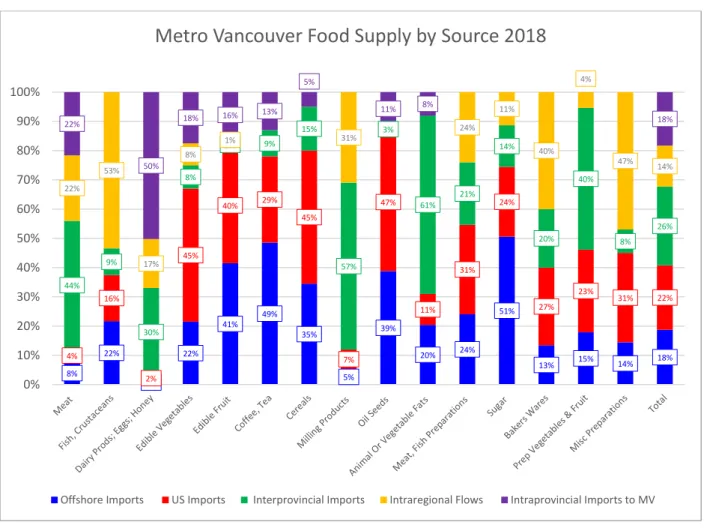
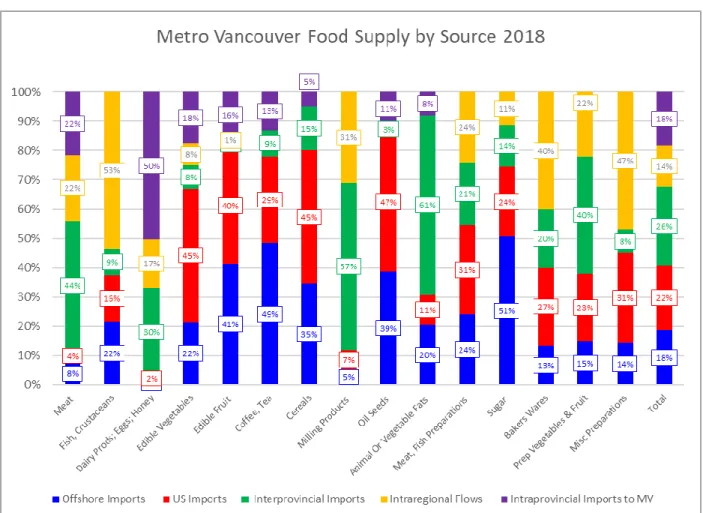
The resulting ROBC food supply shares by commodity group flowing through Metro Vancouver are shown in the figure below. Estimated Metro Vancouver Food Flows by Commodity 2018 - BC Food Supply (tonnes) 2018 - BC Food Supply (tonnes).

6 Intraprovincial and Intraregional Food Flows
Estimated Metro Vancouver Intraprovincial Food Flows by Commodity 2018 - BC Food Supply (Tonnes)
Overall, about 14% of Metro Vancouver's food supply comes from the region, and 18% from the rest of B.C. This highlights the importance of the Fraser Valley to the local food supply for Metro Vancouver and the Lower Mainland as a whole.
7 Food Supply by Commodity Group
- HS 03 Seafood
- HS 04 Dairy Products, Eggs and Honey .1 Dairy Products
- Eggs and Honey
- HS 07 Vegetables
- HS 08 Fruit
- HS 10 Cereals
- HS 11 Milling Products
- HS 16 Meat and Fish Preparations
- HS17 Sugar
- HS 19 Bakers Wares
- HS20 Vegetable Preparations
Based on the production shares of the 2016 Census of Agriculture, Metro Vancouver accounted for 8% and FVRD for 68% of total provincial production in 2018. Metro Vancouver production accounts for approximately 6% of Metro Vancouver demand; the balance is mainly obtained from FVRD.
8 Transportation by Mode
Marine Transportation
- Bulk Commodities
- Containerized Commodities
- Summary
Carload Rail Transportation
- Rail Infrastructure
The table below shows grain shipments to the Port of Vancouver by rail for the 2017/2018 crop year.29 All of these shipments are exported. The Lower Mainland rail network can be divided into three primary corridors that access the three main terminal clusters at the Port of Vancouver: (1) the Roberts Bank Rail Corridor, which accesses the Deltaport and Westshore terminals on Roberts Bank; (2) a southern coastal rail corridor with access to terminals on the southern shore of Burrard Bay; and (3) the North Shore Rail Corridor, which accesses terminals on the north shore of Burrard Bay.
Rail Intermodal and Trucking
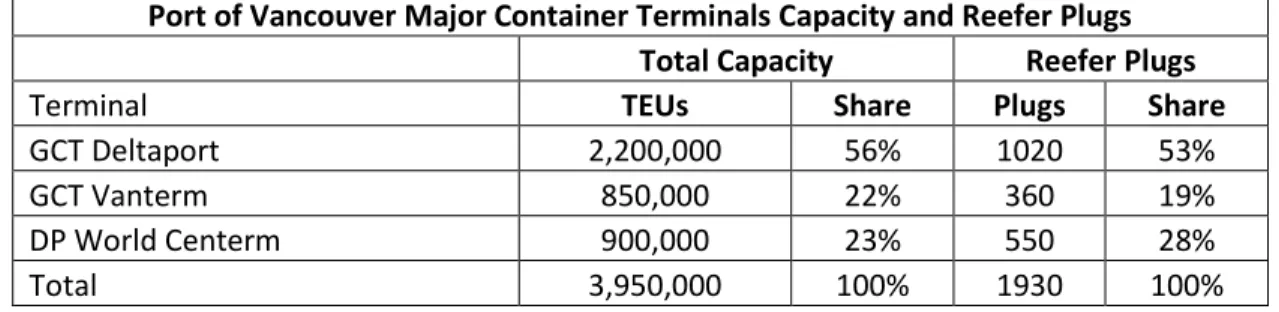
The primary routes for food shipments include the South Shore and North Shore Rail Corridors accessing the grain terminals on the Inner Harbor (North Shore and South Shore of Burrard Inlet), Burrard Inlet and Roberts Bank, and the South Shore Rail Corridors accessing Deltaport and respectively South Shore Container Terminals.
9 Safety Requirements for Transportation of Perishable Commodities
- HS 2 Meat and Poultry
- HS 3 Seafood
- HS 4 Dairy and Eggs
- HS 7 Edible Vegetables and HS8 Edible fruit
- HS 16 Meat and Seafood Preparations; HS 19 Prepared Vegetables and Fruit, and HS 21 Miscellaneous Preparations
- Summary
Optimum conditions for avocados range from a desired temperature of 4°C to 13°C depending on variety and season, with a desired relative humidity of 85 to 90 percent.39. Almost 60% of the total requires temperature-controlled transport, and another 16% may require temperature-controlled transport if necessary to protect against frost.
Metro Vancouver Food Flows Requiring Temperature- Controlled Transport - BC Food Supply
The most common type of temperature damage to canned foods is can rusting. To protect canned foods from freezing damage during transit through areas of severe cold, the means of transportation may need to be heated rather than refrigerated.
10 Transportation of Perishable Commodities by Mode of Transport
- Marine Transportation
- Rail Intermodal Traffic
- Truck Transportation
- Temperature – Controlled Truck Traffic in Metro Vancouver
The volumes of commodities requiring temperature-controlled transport for each origin-destination food flow. The distribution of temperature-controlled loaded truck trips by origin-destination flow in 2018 is summarized in the figure below.
11 Appendix A Background Information on Statistics Canada Estimates of Food Availability
Production and inventory data are released on a monthly basis and import and export information is obtained from IATD. This value is also expressed in terms of milk solids (i.e. the portion of the product containing butterfat and non-fat solids such as protein and calcium, etc.).
RECOMMENDATION
Section E 3.2
Subject: Update on TransLink's study of land value capture and opportunities for transit-oriented affordable housing. Update on TransLink's study of land value capture and opportunities for transit-oriented affordable housing Regional Planning Committee Regular meeting date: June 12, 2020 Page 2 of 5.
LAND VALUE CAPTURE MECHANISMS
Seek a share of Property Transfer Tax from the provincial government – there was broad municipal and stakeholder support for this approach
Introducing a Benefitting Area Tax (BAT), potentially including areas around rapid transit stations and/or Frequent Transit Development Areas or transit corridors – support from member
Revenue-sharing of density bonus funds/community amenity contributions (CACs) in transit- oriented developments – there was significant municipal opposition to this approach
RE-INVESTMENT OPPORTUNITIES
Update on TransLink's land value capture study and opportunities for transit-oriented affordable housing Regional Planning Committee Regular Meeting Date: June 12, 2020 Page 3 of 5.
Re-Investing in Transit-Oriented Affordable Housing
Update on the TransLink study on land value capture and opportunities for transit-oriented affordable housing. Regional Planning Commission Regular Meeting: June 12, 2020 Page 4 of 5. Metro Vancouver's participation in the study and its findings provide an opportunity for the MVRD council to send a letter to the TransLink board advocating that TransLink create a statement of objectives that considers an expanded role in supporting transit-oriented affordable housing.
IMPLICATIONS OF THE LAND VALUE CAPTURE STUDY FOR METRO VANCOUVER
- The Study notes that any new tax, levy or charge imposed by an agency on a property or property owner will impact other agencies to draw upon that same revenue source. For
- Increased involvement by TransLink in urban development projects would not necessarily impact Metro Vancouver’s ability to collect revenues, but could present an opportunity for
- The Study found general municipal and stakeholder support for TransLink, Metro Vancouver and its member jurisdictions to lobby the Province for a share of the Property Transfer Tax;
- The Study recommends that TransLink “monitor the positions of the Provincial Government, Metro Vancouver, and municipalities in the region regarding a broader approach to land value
- Finally, as documented in the previous section, the Study recommends that TransLink
Update on TransLink's land value capture study and opportunities for transit-oriented affordable housing Regional Planning Committee Regular Meeting Date: June 12, 2020 Page 5 of 5. The land value capture study recommends that TransLink clarify its role in affordable housing through a statement of goals and, if necessary , a business case.
February 2020
Prepared for
- Introduction
- Background
- Terms
- rezoning. Disposition of sites or air rights is a form of land value capture, as it takes advantage of
- TransLink’s Goals
- Study Participants
- Professional Disclaimer
- Foundations of Land Value Capture
- Rationale
- The Factors that Create Urban Land Value
- The factors that determine land value can be divided into three broad categories
- Geography and Context
- Local Zoning and Infrastructure
- Site Characteristics
- The Role of Land Owners
- Approaches Using Taxes, Charges, and Zoning
- Approaches Using Direct Participation in Strategic Land Acquisition and Development Acquisition and Development
- o If the land required for transit construction necessitates the acquisition of a part of a property, it can
- Participation in Urban Development Projects
- for agency equity or borrowing, but it comes with a new set of risks associated with the legal and financial
- Other Approaches Not Considered in this Report
Participation in development projects is the only approach considered in this report that is not technically a form of land value capture. Land value capture by a public entity does not have to be accompanied by any direct participation in the land market or in urban development projects.