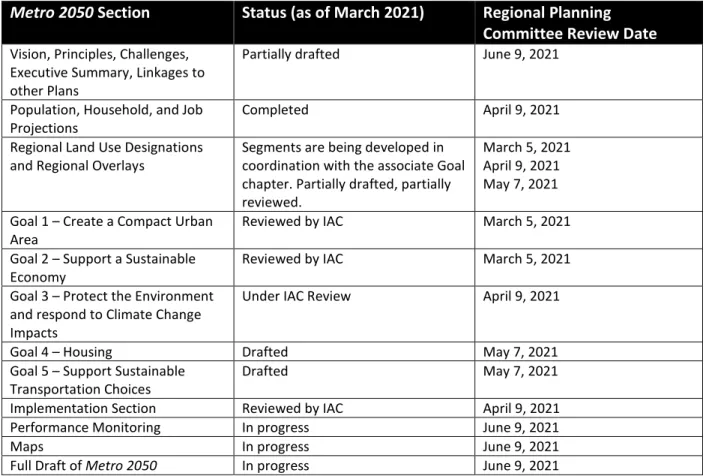
That the Regional Planning Committee receives for information the report of 26. March 2021 with the title "Metro 2050 Q1 2021 Status Update". In accordance with MVRD's Board-directed project timeline, a full draft of Metro 2050 will be presented to the Regional Planning Committee and Board in Q2 of 2021 with a recommendation to refer it for comment in Q3 and Q4.

METRO 2050 CONTENT DEVELOPMENT STATUS UPDATE
Staff also took the opportunity at the March IAC meeting to confirm already committed First Nations actions in Metro 2050. The full draft of Metro 2050 is expected in June 2021, with a formal comment period beginning in the third/fourth quarter.
FINAL AUDIT FINDINGS REPORT TO THE PERFORMANCE AND AUDIT COMMITTEE
AUDIT FINAL REPORT TO THE PERFORMANCE AND AUDIT COMMITTEE
METRO VANCOUVER REGIONAL DISTRICT METRO VANCOUVER REGIONAL DISTRICT
ATTACHMENT
We are pleased to present this report on the results of our audit of the consolidated financial statements of Metro Vancouver Regional District, Greater Vancouver Sewerage and Draining District (“GVSDD”), Greater Vancouver Water District (“GVWD”) and Metro Vancouver Housing Corporation (“ MVHC”) (collectively, the “Districts”) for the year ended December 31, 2020. We would like to express our sincere appreciation for the cooperation received during the audit from the management and staff of the Metro Vancouver Regional District who provided us have helped us carry out our work.
SUMMARY
We have disclosed all adjusted and unadjusted differences greater than 5% of materiality, as well as all material omissions of disclosures identified during our audit engagement. A summary of the written representations we have requested from management appears in the draft management representation letter included in Appendix C to the report.
AUDIT FINDINGS
We have reviewed the disclosures in the financial statements to ensure that the impact of COVID-19 is appropriately disclosed. Management has included a note to the financial statements that outlines the ongoing uncertainties resulting from COVID-19.
INTERNAL CONTROL MATTERS
SIGNIFICANT DEFICIENCIES IN INTERNAL CONTROL
OTHER REQUIRED COMMUNICATIONS
APPENDIX A: INDEPENDENCE LETTER
APPENDIX B: ADJUSTED AND UNADJUSTED DIFFERENCES
SUMMARY OF UNADJUSTED DIFFERENCES
SUMMARY OF ADJUSTED DIFFERENCES
SUMMARY OF DISCLOSURE OMISSIONS
APPENDIX C: REPRESENTATION LETTER
All transactions are recorded in the accounting records and are reflected in the financial statements. We have specifically considered the impacts of COVID-19 on the amounts and disclosures in the financial statements.
APPENDIX D: MANAGEMENT LETTER
ATTACHMENT 1 Metro Vancouver
ATTACHMENT 2
Metro Vancouver
ATTACHMENT 4 ‐ HOU
Capital Project Status Information December 31, 2020
ATTACHMENT 4 ‐ LWS Capital Project Status Information
December 31, 2020
ATTACHMENT 4 ‐ PARKS
In July 2020, the federal and provincial governments announced $2.5 million in joint funding for the Grouse Mountain Trail and Amenity Improvement project as part of the Government of Canada's Investing in Canada Infrastructure Plan. The service farm building at Crippen Regional Park was delayed due to unforeseen soil contamination and permitting challenges. Planning and design for the Pacific Spirit Service Yard was completed in 2020, and the project will be put out to bid for construction in 2021.
Design of the Capilano Regional Park Service Yard is substantially complete and the development permit process was initiated in 2020.
ATTACHMENT 4 ‐ SWS
Two feed chutes were installed during the fall 2020 shutdowns and one unit will be completed during the spring 2021 shutdown. The feed hoppers will be replaced in 2021 because they could not be completed during the same shutdown as the feed chutes.
ATTACHMENT 4 ‐ WS
Replacement of the E2 Shaft – The E2 Shaft, which has controlled groundwater in the eastern abutment of Cleveland Dam since the 1950s, is nearing the end of its life and must be replaced with a system of horizontal spills. 1 – Seismic upgrades and upgrades (non-seismic) – The main components of the seismic upgrade works are external shear walls, replacement of existing roof slabs and thickening of perimeter walls and foundations. Coquitlam Intake Tower Seismic Upgrade – The Coquitlam Intake Tower is located on the southeast corner of the Coquitlam Reservoir.
The next review of DCC rates is expected to be completed by the end of this year.
CONT’D)
Tender/Contract Award Information – December 2020 to February 2021 Performance and Audit Committee Regular Meeting Date: April 14, 2021 Page 2 of 6. Tender/Contract Award Information – December 2020 to February 2021 Meeting of Audit and Performance Committee Regular Meeting 1, Date: April 2021 Page 4 of 6. Tender/Contract Award Information – December 2020 to February 2021 Performance and Audit Committee Regular Meeting Date: April 14, 2021 Page 5 of 6.
Tender/Contract Award Information – December 2020 to February 2021 Performance and Audit Committee Regular Meeting Date: April 14, 2021 Page 6 of 6.
Appendix A
Registrants were invited by the Metro Vancouver and BC Bid websites and a private invitation on November 5, 2020. Registrants were invited by the Metro Vancouver and BC Bid websites and a private invitation on September 15, 2020. Registrants were invited by the websites of Metro Vancouver and BC Pray and private invitations. invitation on October 16, 2020.
Advocates were invited via the Metro Vancouver and BC Bid websites and a private invitation on September 8, 2020.
Appendix B
This amendment is for archaeological inspection services and assessment of deposits found during the monitoring of the phase 2 land improvement subgrade at Northwest Langley. The estimated hours of services may have been underestimated and will be exceeded necessitating an increase of approximately 2600 additional hours. The additional hours are due in part to the jurisdictional environmental agency's investigation of the Corporation-contractor's compliance with prevailing environmental regulations.
Appendix C
Design Build Consulting Services for the Lions Gate Secondary Wastewater Treatment Plant for the Greater Vancouver Sewerage and Drainage District. 01 is the result of additional funds needed to enable AECOM to continue to provide owner engineering consulting services for an additional 3 months while seeking revised overall project budget approval from Council. 02 is the result of the extension of the existing agreement on a sole source basis for a further two (2) years.
01 is the result of the successful completion of Phase B services and the successful negotiations for Phase C services.
Appendix D
Improving Metro Vancouver's Financial Standing Performance and Audit Committee Regular Meeting Date: April 14, 2021 Page 2 of 3 Improving Metro Vancouver's Financial Standing Performance and Audit Committee Regular Meeting Date: April 14, 2021 Page 3 of 3 Review of Metro Vancouver Electric Vehicle Programs and Recommendations Climate Action Committee Regular meeting date: April 16, 2021 Page 2 of 4.
Evaluation and Recommendations of Metro Vancouver Electric Vehicle Programs Periodic Meeting of the Climate Action Committee Date: April 16, 2021 Page 4 of 4.
December 2020
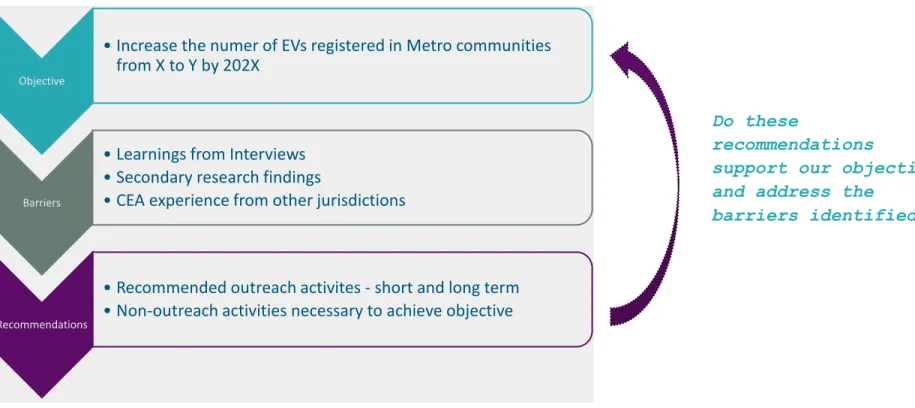
Review past and current programming
Identify and analyze program delivery gaps
Develop recommendations
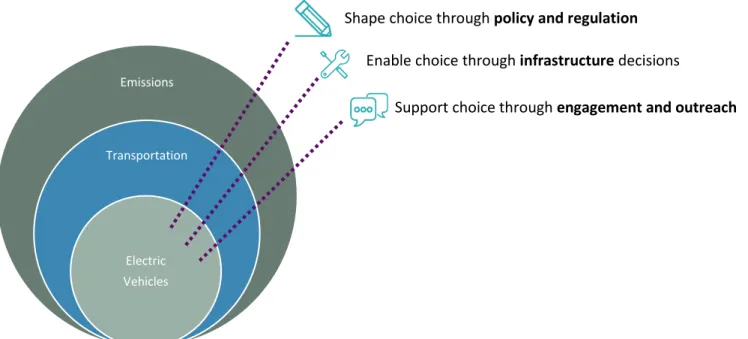
The Community Energy Association (CEA) conducted an evaluation of Metro Vancouver's electric vehicle programs using available data and documentation. Of the elements within Metro Vancouver's sphere of control, it is important to understand the areas where partners and organizations are currently working. The recommendations focus on just one of Metro Vancouver's levers to influence EV sales - Contact and Engagement.
A priority for short-term recommendations is to leverage existing assets such as Metro Vancouver's EV fleet, staff expertise and.
Program Guiding Document 2. Strategic Communications Plan
Opportunity: Take time and resources to establish an outcome-oriented foundation that will allow you to be nimble in the face of anticipated technology and policy changes on the horizon. Coupled with this is an opportunity, reflected in recommendations 1-3, to develop the guiding documents that will articulate a theory of change, identify and measurably explain priority market segments.
EV Loan Program 5. School Curriculum
EV Program Evaluation 19 on EV Condo: Continue to reach out to find out the number of condos Metro Vancouver has contacted. Unless the data submitted for this review – website visits and Facebook referrals – were considered as part of these metrics, data for these KPIs was not collected or shared. While the nature of Metro Vancouver staff's efforts to reach social media and engage its users is unclear, the extent of "reach" and "engagement" with social media viewers, the level of viewership.
Integrate data from ICBC and Stats Canada to understand the percentage of electric vehicle sales in each municipality as well as the make and model of the electric vehicle.
Strategic Communications Plan
Promote Metro Vancouver's internal efforts to transition to low-carbon transportation (eg, Metro Van has a strong fleet replacement strategy, leverage this and create awareness materials about EVs as they integrate.). While engaging these communities to identify barriers and needs, it is possible to include education on the basic principles of mobility equity and the burdens and benefits of transportation. In this way Metro Vancouver would ensure that all communities in the region have the opportunity to benefit from the e-mobility revolution (including understanding workforce trends and opportunities, entrepreneurial opportunities, technology trends).
A short-term option to ensure Metro Vancouver's EV fleet remains active would be to initiate a program that loans Emotive EVs to member municipalities as a way to test EVs and make their case of business.
School Curriculum (reference here)
Depending on the grade level, content may also have learning outcomes related to charging infrastructure, mass transit, microtransport, etc. In the near term, in order to maintain relationship with a variety of stakeholders – EV Ambassadors, Dealers, Workplaces, etc. This tool can be hosted on the emotive webpage or on Metro Vancouver's EV page, with hyperlinks from EV Condo and EV Workplace.
The cost-saving benefit is the most difficult to communicate through videos, etc., yet it is a great opportunity to engage more residents.
Fleet Transition Support 2. EV Condo
The following long-term recommendations leverage the gaps identified in Chapter 2 and align with the trajectory of complementary policy and infrastructure developments in supporting electric vehicle adoption. They have been developed knowing that in three years the market will look different than it does today: there will be a greater variety of vehicles available and local authorities will have tested and developed models for workplace, apartment and community charging .
Workplace Charging
Fleet Transition Support
EV Condo
In February 2020, the MVRD Board approved the award of $150,000 from the Regional District Sustainability Innovation Fund for a three-year, phased project entitled "Targeted Invasive Plant Grazing in Metro Vancouver". Feasibility of Targeted Invasive Plant Grazing in Metro Vancouver Climate Action Committee Regular Meeting Date: April 16, 2021 Page 2 of 4. Feasibility of Targeted Invasive Plant Grazing in Metro Vancouver Climate Action Committee Regular Meeting Date: April 16, 2021 Page 3 of 4.
Feasibility of Targeted Invasive Plant Grazing in Metro Vancouver Climate Action Committee Regular Meeting Date: April 16, 2021 Page 4 of 4.
SUMMARY REPORT
Feasibility of Targeted Invasive Plant Grazing
ACKNOWLEDGMENTS
DISCLAIMER AND COPYRIGHT
Contents
EXECUTIVE SUMMARY
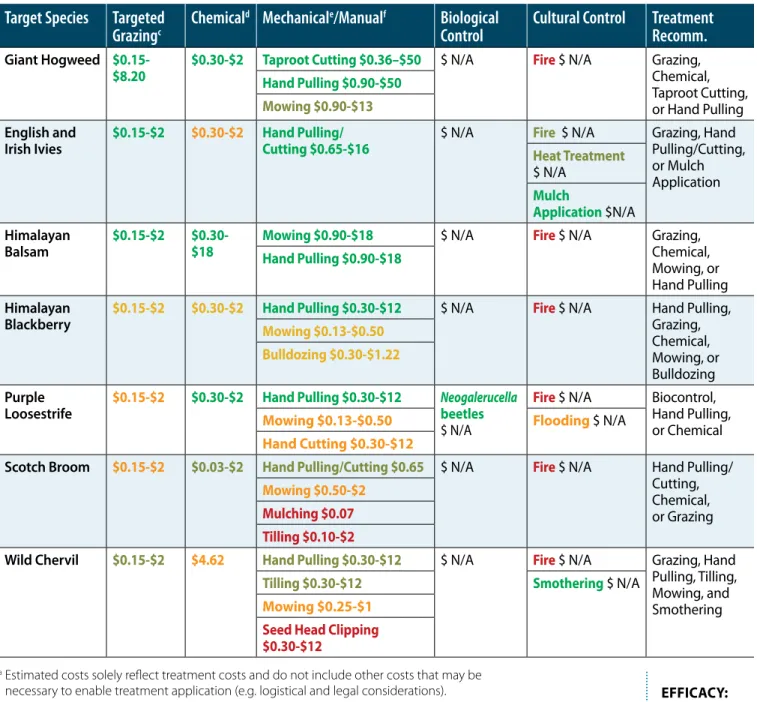
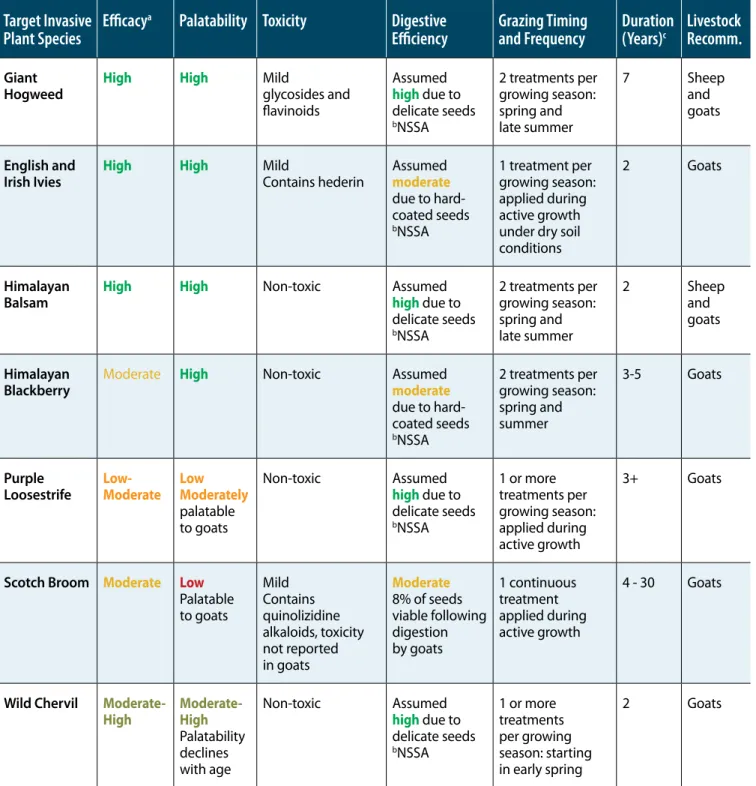
The efficacy of targeted grazing was determined for seven target species
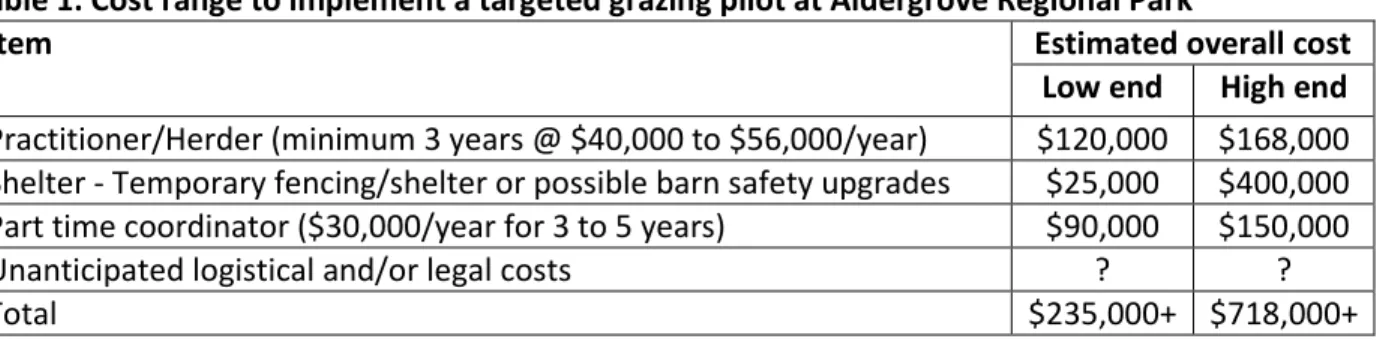
There is a shortage of targeted grazing practitioners in Western Canada and none in the Lower Mainland, but five practitioners expressed interest and willingness to work in the Metro Vancouver region. Potential carbon implications were reviewed as part of a case study of targeted grazing of Himalayan blackberries in Metro Vancouver's Aldergrove Regional Park, which found that emissions from targeted grazing would be lower than burning but higher than mowing or manual control. Specific cost estimates for targeted grazing in Aldergrove Regional Park range from per years based on a combination of practitioner interviews and recommended frequency and duration requirements from literature review.
Targeted grazing treatments in Metro Vancouver are only possible if logistical considerations can be met and funds and staff resources are dedicated to support the long-term partnerships necessary for effective control.
INTRODUCTION
COST AND EFFICACY COMPARISONS
All treatments require ongoing monitoring beyond this window and follow-up control efforts when necessary to address potential regrowth. Costs represent a single application and are estimated using the best available data from literature, practitioner interviews and Metro Vancouver.
Costs represent a single application and are estimated using best available data from literature, practitioner interviews, and Metro Vancouver
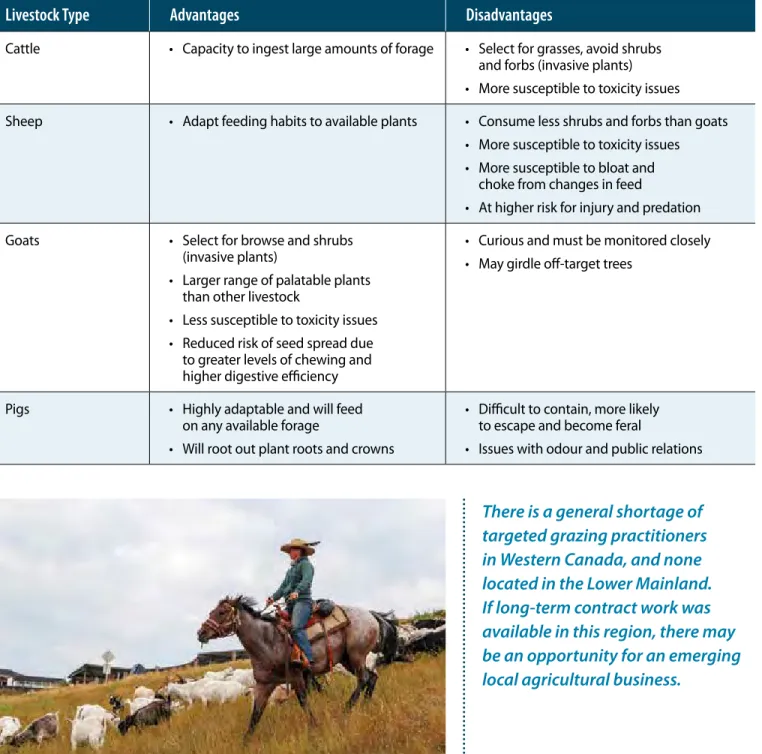
LIVESTOCK SUITABILITY
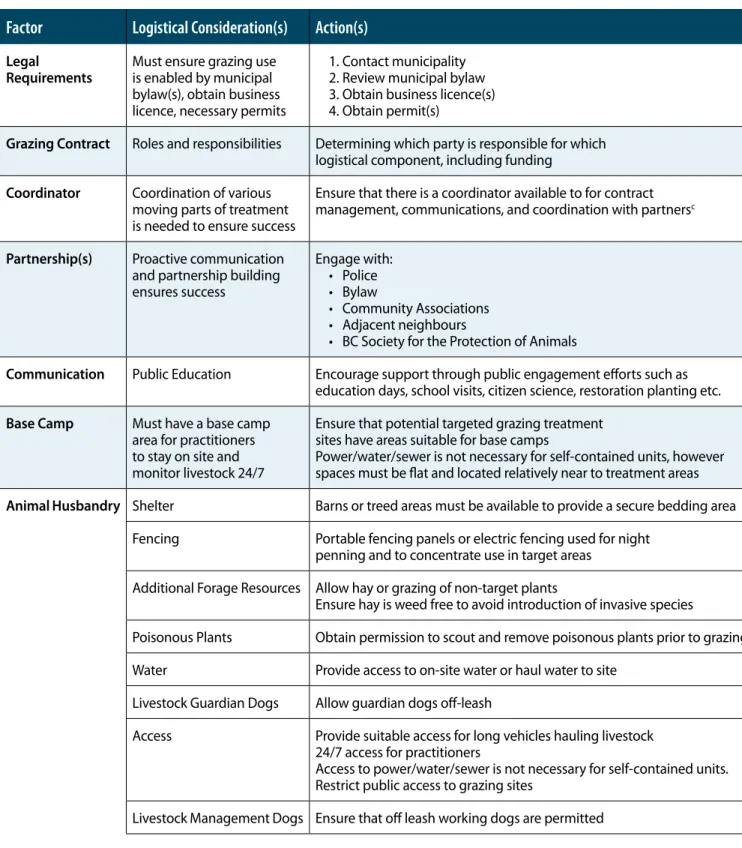
LEGAL REQUIREMENTS AND LOGISTICAL CONSIDERATIONS
Weed spread Reduce the risk of weed spread Livestock in pen 3-4 days before moving from site Manure. Herd Availability Limited Practitioners Contact Contractors who have expressed interest Transportation No Contractors v. Costs to address each logistic component in Table 4 may be additional to the estimated treatment costs listed in Table 2.
Identifying roles and responsibilities in the grazing contract, including which party is responsible for funding each logistical component, will be necessary to ensure success.
POTENTIAL CARBON IMPLICATIONS
Carbon dioxide emissions associated with targeted grazing in Aldergrove Regional Park would be lower than burning, but higher than emissions from mowing and manual control, which includes some emissions from disposal of invasive plant material in a landfill or industrial composting facility. Emissions from grazing would be significantly lower if a local herd were available, although this estimate assumes that manure would be handled on site and not transported to a landfill.
CONCLUSIONS
RECOMMENDATIONS FOR A POTENTIAL PILOT STUDY