
That the Board of Directors of the MVRD receives for its information the report dated March 18, 2019 entitled "Summary Report on Regional Long-Term Growth and Transportation Scenarios". That the Board of Directors of the MVRD receive for its information the report dated March 22, 2019 entitled “The Development and Engagement Process for the Metro Vancouver Clean Air Plan”.
George Massey Crossing – Project Principles and Goals
Minutes of the Regular Meeting of the Metro Vancouver Regional District (MVRD) Board of Directors held on Friday, April 26, 2019 Page 9 of 11 7.1 Delegations received at the Board in April 2019 Minutes of the Regular Meeting of the Metro Vancouver Regional District (MVRD) ) The Board of Directors is held on Friday, April 26, 2019. Page 10 of 11 Mr.
Metro 2040 Land Use Designation Amendment Request from the City of Delta – MK Delta Lands
MOTIONS FOR WHICH NOTICE HAS BEEN GIVEN No items presented
OTHER BUSINESS No items presented
BUSINESS ARISING FROM DELEGATIONS No items presented
RESOLUTION TO CLOSE MEETING It was MOVED and SECONDED
Minutes of the Regular Meeting of the Metro Vancouver Regional District (MVRD) Board of Directors held on Friday, April 26, 2019 Page 11 of 11 M
Current Project Status
Environmental & Agricultural Benefits and Land Transfer
MVRD Board On Table Item C1
Since the 155-acre property at 7969 Highway 91 Connector is excluded from the Agricultural Land Reserve, Lot B, which is 193 acres, is included in the Agricultural Land Reserve.
Industrial Land and the Economic Benefits of the Development
Conclusion
At its meeting on April 5, 2019, the Regional Planning Committee discussed a draft summary report on regional long-term growth and transportation scenarios. At the meeting on April 5, 2019, the Committee for Regional Planning received a report and a presentation of the draft summary report for the regional project of long-term growth and traffic scenarios.
Section E 1.1
Regional long-term growth management and transport scenarios – Final summary report Regional Planning Committee Regular meeting date: May 3, 2019 Page 2 of 3. Regional long-term growth management and transport scenarios – Final summary report Regional Planning Committee Regular meeting date: May 3, 2019 Page 3 of 3.
ATTACHMENT
Regional Long-Range Growth and Transportation Scenarios
SUMMARY REPORT
APRIL 19, 2019
Executive Summary
What Sort of Future Are We Planning For?
25 external forces considered
What is Scenario Planning?
Scenario planning in Metro Vancouver
Current economic, growth and development trends continue Automation-driven decline Job losses and automation-driven immigration result in the decline of a regional economy.
The Four Scenarios
Climate Change
More extreme rainfall events, especially in the wettest periods of the year, increasing the risk of localized flooding in roads, businesses and homes;. An increase in the number and duration of summer fires will affect air quality in the region, impacting community health and may reduce the desire to walk and cycle.
Understanding the Scenarios
Four Possible Futures Compared—2050 Scenarios
In the region by 2050, automation is common in repetitive, labor-intensive jobs such as farming, primary manufacturing, and in many retail and service industries. Overall, the region continues to focus growth in urban centers and corridors, in line with current regional and local plans.
Trend Forward
Improved productivity from automation and continued growth in consumer demand overseas results in increasing global trade through Metro Vancouver. Regional goods movement also continues to grow due to economic growth and population growth, regionally, and the steady growth of e-commerce and just-in-time deliveries.
Current economic, growth and development trends continue
People choose or are forced to look for housing outside the region and travel longer distances. The region remains an attractive place to live, but the costs of living and housing remain high.
Automation-Driven Decline
Automation-driven job losses and outmigration result in a regional economy in decline
There is less travel across the region, but some individuals have to travel much more. In the region by 2050, there is increased pressure to diversify the economy as the region has previously relied on international trade for many goods and services.
Self-Sufficiency
With less global trade, there is a greater incentive to transition to a more sustainable circular economy that uses fewer resources and produces less waste. There is a lower AV adoption rate due to a lack of global investment here and limited manufacturing capabilities to advance the technology in Canada.
Barriers to global trade spur a more self-sufficient regional economy
In the region by 2050, Metro Vancouver remains an attractive place to live relative to much of the world and is sought after for its livability. There is also more (non-work related) discretionary travel due to the increased wealth in the region.
Automation-Driven Boom
It is common to live in one region while working for a company in another part of the world. While both population and employment increase significantly as a result, most of the primary work people do goes to larger knowledge and creative firms based elsewhere in the world.
Automation drives a new economic boom led by new creative & knowledge sectors
Increasing wealth also means that some people choose to own AVs privately, and many more choose to outsource their mobility needs as a service, taking advantage of the many sharing options. Global workers operate in different time zones for companies based elsewhere, reducing traffic congestion in the region, but they also need more 24-hour services.
Next Steps
Indicator Today A: Trend Forward B: Automation-Driven Decline
Appendix A: Detailed Scenario Summary Table
Self-Sufficiency D: Automation-Driven Boom
While a significant proportion of new housing units are located in urban centres, with less commuting there is also a significant demand for more dispersed development. More people are working from home, cafes or co-working spaces, and there is a shift away from office towers and business parks among the professional class.
Appendix A: Detailed Scenario Summary Table (continued)
Housing affordability and income equality are not improving due to a widening wage gap between professional workers and lower-income workers. There has been lower adoption of AVs due to a lack of global investment and limited production of AVs in Canada.
Appendix B: Key Facts Supporting Scenario Development
Automation
Global Trade and Economy
Transportation
Housing
Endnotes
Retrieved from https://www.forbes.com/sites/kweilinellingrud the-upside-of-automation-new-jobs-increased-productivity-and-changing-roles-for-workers/#4192bae37df0. Retrieved from https://www.theglobeandmail.com/report-on-business/rob-commentary/the-gig-economy-is-here-and-we-arent-ready/article36678505/.
Retrieved from https://www.pwc.com/hu/hu/. kiadvanyok/assets/pdf/impact_of_automation_on_jobs.pdf. Retrieved from https://www.theglobeandmail.com/news/british-columbia/can-more-housing-supply-resolve-the-affordability-crisis-in-vancouver/article37601341/.
Section E 2.1
- INTERPRETATION 1 Definitions
- CONFIDENTIALITY 1 Public Announcement
- DISPUTE RESOLUTION 1 General
- GENERAL 1 Notices
Metro Vancouver continues to own and operate the western portion of Aldergrove Regional Park. This Operating Agreement will automatically terminate on the Closing Date of the MVRD Land Purchase Agreement.
Section E 3.1
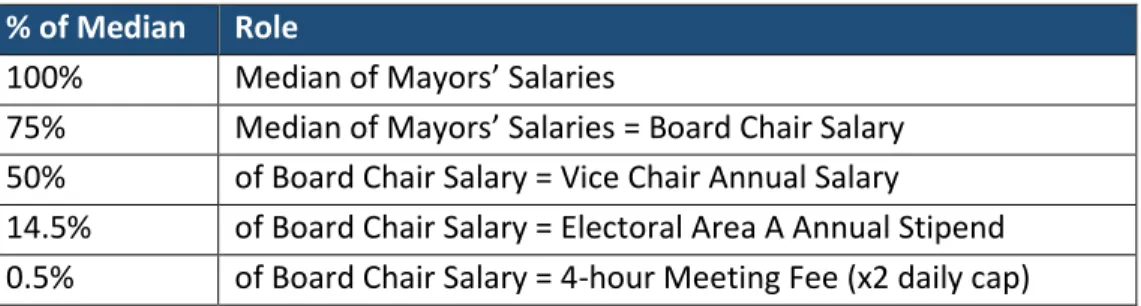
To submit the final report of the Board of Directors' independent compensation review panel to the Board for consideration. This report presents the final report of the Board Remuneration Independent Review Panel with its findings and recommendations for consideration. The Board of Directors has established an independent assessment panel to review the Board's remuneration policy as set out in the Remuneration Regulation.
B OARD R EMUNERATION R EVIEW
F INDINGS AND R ECOMMENDATIONS
- Base Salary Remuneration Model
- Meeting Per Diem Model and Formula
- Four (4)-Year Review Cycle
- Canada Revenue Agency Non-Taxable Changes
- Provincial Transition Allowance Model
- Remuneration Guidelines for Appointees to BC Ministry and Crown Agency Boards Excerpts from Treasury Board Directive 2/17 (Appendix 1)
- Regional Mayoral Compensation
Maintain the current formula for setting the Council Chair salary based on a percentage of the median of the Metro Vancouver regional mayors' salaries;. Adjust the base rate for the Electoral Area Director by increasing it to 30% of the Council Chair salary. The review panel considered the impact of the federal government's removal of the one-third non-taxable expenses allowance that formed part of the per diem allowance.
Section E 3.2
Regional Geospatial Reference System Transfer of excess guidance over operational reserve to Regional Geospatial Reference System Reserve. Regional Planning Transfer of excess over Operational Reserve Guideline to Regional Planning General Reserves Regional Prosperity Initiatives Transfer to Regional Prosperity Operational Reserve to meet operational reserve guideline. Sasamat Fire Protection Service Transfer of excess over operational reserve guidelines to Sasamat FPS capital reserve (822) 822.
Section E 3.3
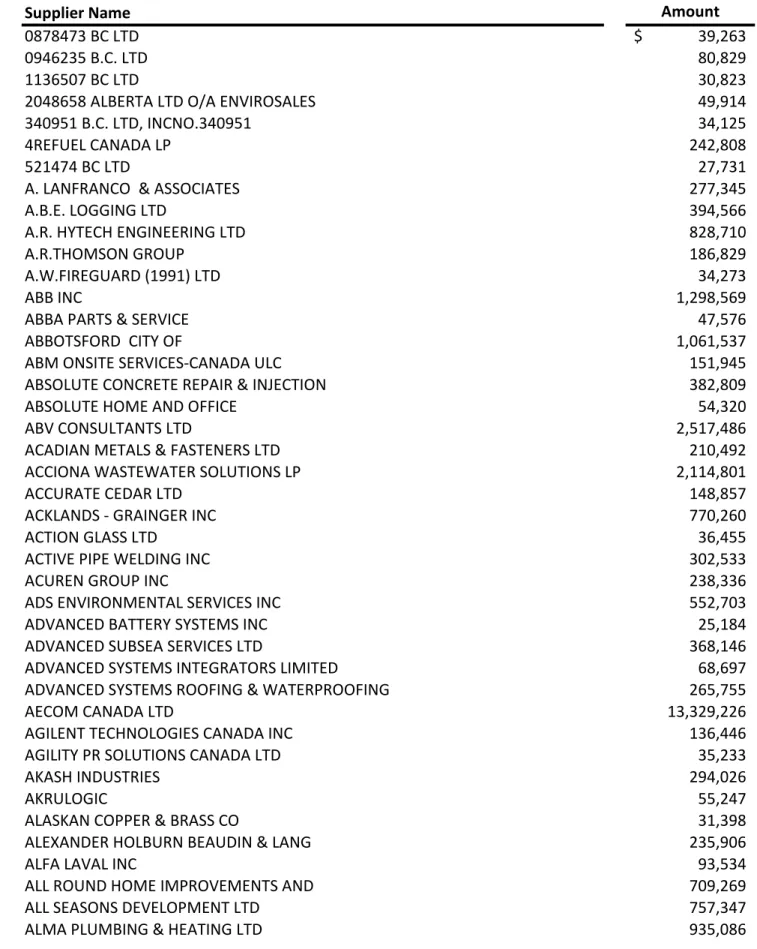
That the MVRD Board approve the Statement of Financial Information for the year ended 31 December 2018. To submit for approval the 2018 Statement of Financial Information (SOFI) as part of the reporting requirements of the Financial Information Act. This report is presented in accordance with the requirements of the Financial Information Act.
METRO VANCOUVER FINANCIAL INFORMATION ACT FILING
STATEMENT OF FINANCIAL INFORMATION FOR THE YEAR ENDED DECEMBER 31, 2018
The undersigned, as authorized by the Financial Information Regulation, Schedule 1, subsection 9(2), approves all statements and schedules included in this 2018 Statement of Financial Information prepared under the Financial Information Act. Johnston, Dan Board member (alternate) 387 - Johnstone, Patrick Committee member 3,870 - Jordan, Colleen Board member (alternate) Kanakos, Jeannie Committee member 1,935 - King, Heather Council of Councils 387 - Lahti,Meghan Board member (alternate) 387 - Lambur ,Peter Council of Councils 387. Salaries and benefits per note 18 in the annual accounts Salaries and benefits capitalized and included in tangible fixed assets.
At the May 15, 2019 meeting, the Finance and Intergovernmental Committee considered the request from the Village of Lions Bay, as presented in the agenda packet, for the MVRD Board's support for Lions Bay to be designated as an eligible rural community for provincial purposes. and federal rural grant programs, as presented in the agenda package. The Committee discussed the Board's 2018 support of funding eligibility for Bowen Island, included as an attachment to the agenda packet, and then approved the recommendation as presented above.
Section E 3.4
Correspondence presented at item 6.1 of the Finance and Intergovernmental Committee agenda on 15 May 2019 regarding the Village of Lions Bay's request to the MVRD in support of a Countryside Fund eligibility determination. To seek staff approval from the Metro Vancouver Regional District (MVRD) Board to continue an expanded consultation program on proposals to regulate air emissions from cannabis manufacturing and processing operations. On 29 March 2019, the MVRD Board of Directors received a report requesting direction for further consultation on the proposed approach to regulating air emissions from cannabis production.
Section E 4.1
Discussion paper on a potential emission regulation bylaw for cannabis production and processing
Bylaw development consultation paper on a potential emission regulation bylaw for cannabis production and processing
Presentations and feedback sessions at the Metro Vancouver Agricultural Advisory Committee and at municipal agricultural advisory meetings in the region (approx. 6).
DRAFT
Cannabis Production and Processing Operations
Metro Vancouver Regional District (MVRD, operating as Metro Vancouver) is responsible for managing and regulating air quality in the region under authority delegated by the provincial government in the BC Environmental Management Act. Metro Vancouver protects public health and the environment through a tiered approach to managing air pollutant discharges that implements the use of site-specific permits, sectoral emissions regulations and provisions in the Greater Vancouver Regional District (GVRD) Air. The following sections outline regulatory proposals to control air emissions from cannabis production and processing.
DRAFT DRAFT
Metro Vancouver as well as member municipalities have received complaints about odor emissions from cannabis production operations. EXAMPLE VOC EMISSIONS FOR SOME OF THE PLANTS GROWN COMMERCIALLY IN THE METRO VANCOUVER REGION. Metro Vancouver will carefully consider all feedback when considering potential proposals for managing emissions from cannabis production operations in the region.
Section E 4.2
2 Proposed changes to Metro Vancouver's air quality targets for nitrogen dioxide, ground-level ozone and carbon monoxide. Proposed Changes to Metro Vancouver's Ambient Air Quality Objectives on Nitrogen Dioxide, Ground-Level Ozone and Carbon Monoxide 3. 4 Proposed Changes to Metro Vancouver's Ambient Air Quality Objectives on Nitrogen Dioxide, Ground-Level Ozone and Carbon Monoxide.
DRAFTDRAFT
Proposed Changes to Metro Vancouver's Ambient Air Quality Goals for Nitrogen Dioxide, Ground Level Ozone, and Carbon Monoxide 15. COMMENTS ON PROPOSED CHANGES TO OUTDOOR AIR QUALITY OBJECTIVES Metro Vancouver is seeking input on the proposed. Thank you for taking the time to consider and provide your input on the proposed changes to Metro Vancouver's ambient air quality goals.