Minutes of the regular meeting of the Metro Vancouver Regional District (MVRD) board of directors, held at 9:03 a.m. Minutes of the regular meeting of the Metro Vancouver Regional District (MVRD) Board of Directors held on Friday, May 24, 2019 Page 7 of 10.
Number of Votes
CARRIED
Minutes of the Regular Meeting of the Metro Vancouver Regional District (MVRD) Board of Directors held on Friday, May 24, 2019 Page 8 of 10 5.1 Metro Vancouver External Agency Activities Status Report May 2019.
It was MOVED and SECONDED
CARRIED Alternate Director Ferguson absent at the vote
REPORTS NOT INCLUDED IN CONSENT AGENDA
- Amending Metro Vancouver 2040: Shaping our Future to Reflect Accepted Regional Context Statements
It was MOVED and SECONDED That the MVRD Board
Minutes of the regular meeting of the Metro Vancouver Regional District (MVRD) Board of Directors held on Friday, May 24, 2019. Page 9 of 10 1.2 Request by the City of Delta to change the use of the Metro 2040 land.
MK Delta Lands
CARRIED H. MOTIONS FOR WHICH NOTICE HAS BEEN GIVEN
OTHER BUSINESS
- MVRD Board Committee Information Items and Delegation Summaries It was MOVED and SECONDED
CARRIED J. BUSINESS ARISING FROM DELEGATIONS
RESOLUTION TO CLOSE MEETING No items presented
Minutes of the Regular Meeting of the Metro Vancouver Regional District (MVRD) Board of Directors held on Friday, May 24, 2019 Page 10 of 10 L.
ADJOURNMENT/CONCLUSION It was MOVED and SECONDED
CARRIED (Time: 9:59 a.m.)
To: Metro Vancouver GVRD Board, C/O Board and Information Services,
1-page;
Item E 1.1: Greater Vancouver Regional Fund Semi-Annual Report as of December 31, 2018
The MV GVRD board passes a Motion that a letter be sent to Translink and the Translink Mayors Council stating that, in future, when Translink submits applications for GVRF funding- the
Louis,
Meeting 1 of 8) MVRD On Table Delegation Section C1
Subject: Greater Vancouver Regional Fund Semi-Annual Report as of December 31, 2018 RECOMMENDATION
PURPOSE
BACKGROUND
2018 GVRF SEMI-ANNUAL REPORT AS OF DECEMBER 31, 2018
Progress on Active Projects
Section E 1.1
Semi-annual report for the Greater Vancouver Regional Fund as of December 31, 2018 Finance and Interstate Committee Regular Meeting Date: June 12, 2019 Page 2 of 3 One project (refurbishing 144 SkyTrain Mark I vehicles) currently shows the largest positive variance of $2.8 million due to lower labor costs than expected.
Risk Assessment
As a result, there is a positive difference of $4.4 million between the original amount of GVRF funding allocated to the project and the total projected funded expenditures. On the date of the staff report, the four buses had arrived and were put into use.
Alignment with Greater Vancouver Regional Fund Integrated Criteria
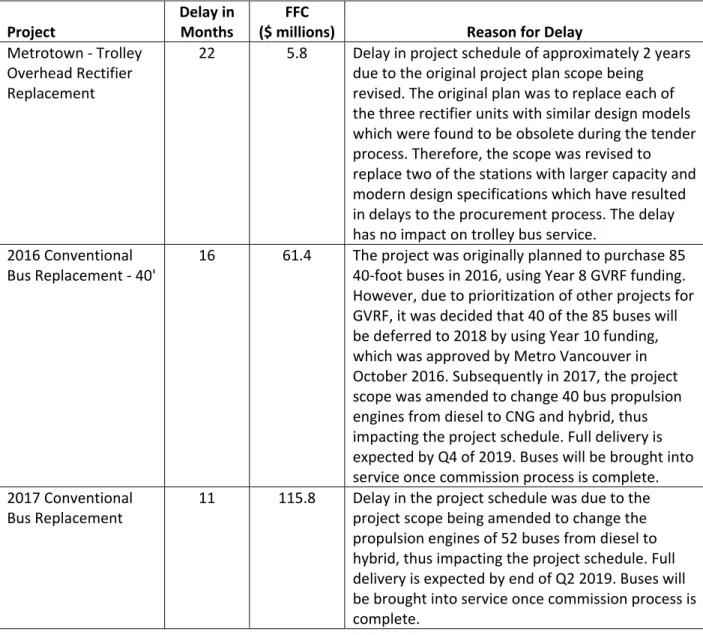
Any unused GVRF funds at the end of the project are returned to GVRF for future applications. The buses will be delivered between Q2-Q4 2019, and will be put into service once the commissioning process is complete.
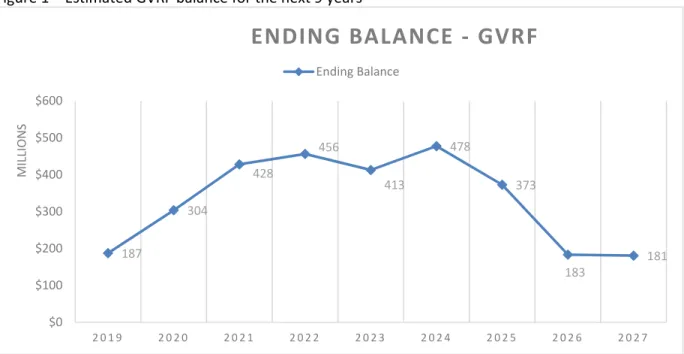
Greater Vancouver Regional Fund Balance
Greater Vancouver Regional Fund Half-Year Report as of December 31, 2018 Finance and Intergovernmental Committee Regular Meeting Date: June 12, 2019 Page 3 of 3.
ALTERNATIVES
FINANCIAL IMPLICATIONS
SUMMARY / CONCLUSION
- Report on Federal Gas Tax Funding received from the Greater Vancouver Regional Fund (GVRF), dated May 24, 2019
- Metro Vancouver’s Federal Gas Tax Fund Expenditures Policy
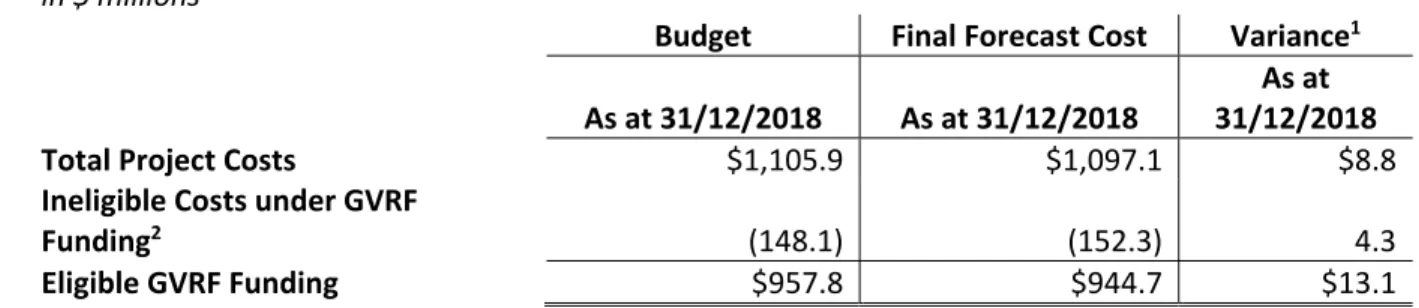
- Project budget to actual cost variances;
- Project expenditures to date;
- Current project schedule;
- Overall risk assessment;
- Project progress; and
- Alignment with Evaluation Criteria
TransLink expects to fully commit GVRF funding to support the 10-year vision through the implementation of the 2018 Investment Plan and subsequent investment plans. The development of subsequent investment plans will continue to support the 10-year vision and maximize the use of GVRF funds.
ENDING BALANCE ‐ GVRF
New bus depots to support bus fleet expansion and the Low Carbon Fleet Strategy¹; And.
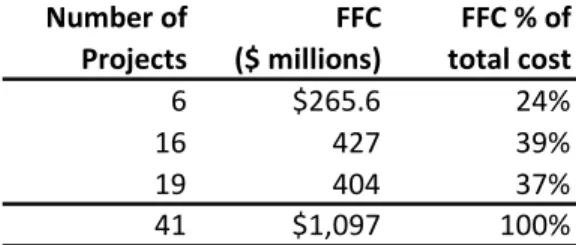
3 Active Projects
Note (2): Projects that are nearing completion, deployed or in use, but remain active to reflect outstanding costs and/or resolve delays that need to be addressed prior to project closure.
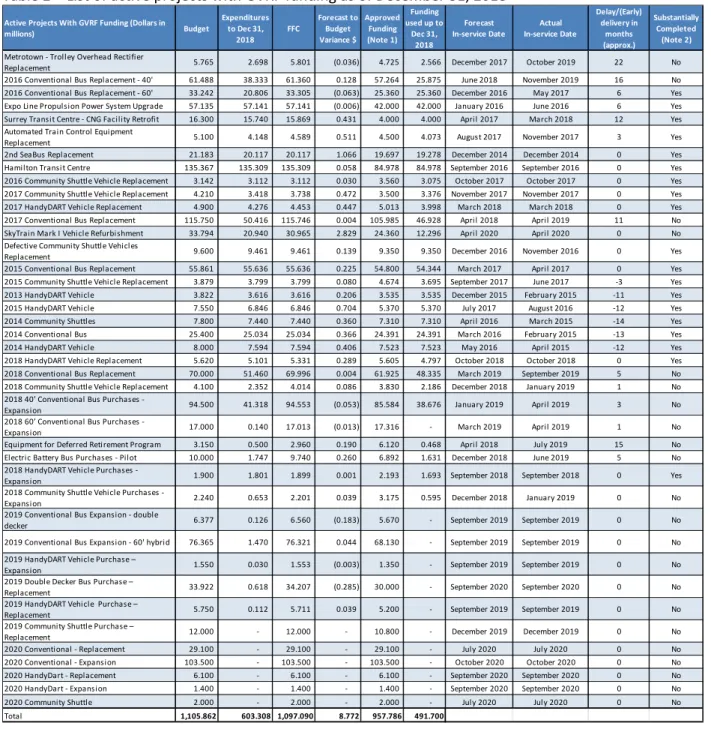
5 A. Project Budget to Actual Costs Variance
Project Expenditures to Date
6 C. Current Project Schedule
7 2018 Conventional
Overall Risk Assessment
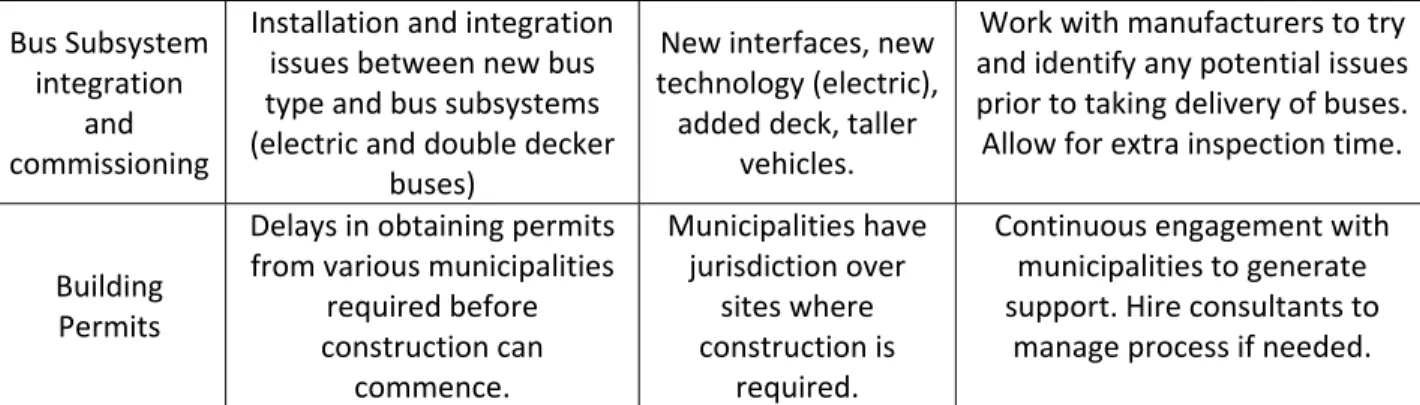
8 Bus Subsystem
Project Progress
Yes, SPA approved in September 2012. Replacement of defective community transport vehicles Largely complete; already in operation Yes, SPA approved in July 2014. Yes, SPA approved in July Conventional bus purchases - Expansion All buses are expected to be received in April 2019 incl.
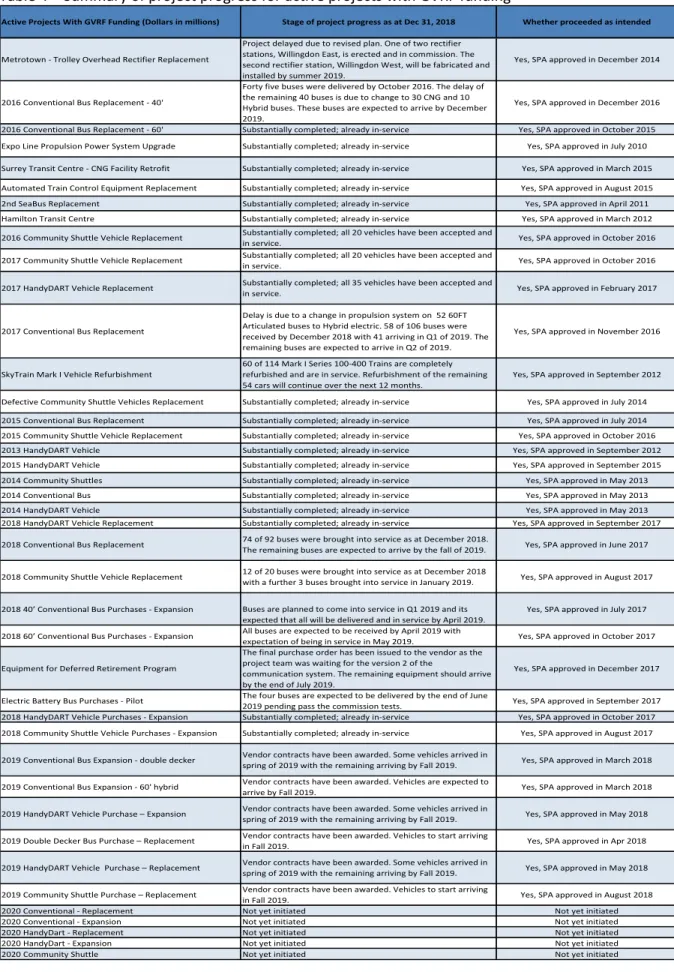
10 F. Alignment with Evaluation Criteria
Screening Criteria, which represents requirements that are mandatory for any project for which GVRF funding is requested; and
Integrated Criteria, which allows for a qualitative assessment of the proposed project based on high priority objectives that reflect the intent of the GVRF as well as of Metro Vancouver goals
BOARD POLICY
FEDERAL GASTAX FUND EXPENDITURES Effective Date: May 27, 2016
DEFINITIONS
Eligible Regional Transportation Projects” means the following eligible project categories described in Schedule B of the Administrative Agreement on the Federal Gas Tax Fund in British Columbia and
Federal Gas Tax Fund” means the predictable, long-term, stable funding provided by the federal government as part of the New Building Canada Plan for Canadian municipalities to help them build
Greater Vancouver Regional Fund” means the 95% of the Greater Vancouver Regional District and its member municipalities’ per-capita allocation that is pooled for eligible expenditures of regional
Information Requirements” means the information that must be provided by TransLink in order to allow for efficient and effective review of proposals by the GVRD Board, as described in the Federal
POLICY
Policy No. FN-012
BOARD POLICY
Application Process
Information Requirements
Proposals must also include a description of each project for which support is sought as defined in the Project Description section and must demonstrate compliance with evaluation criteria, both as defined in the application guidelines.
Evaluation Criteria
Review of Federal Gas Tax Fund - Greater Vancouver Regional Fund Application Guide
GVRF Funding
Ownership of Assets
Ownership of assets, including those acquired through GVRF financing, allows TransLink to borrow for its infrastructure needs on the open market. The GVRD Committee will, at its discretion, consider the ownership of a regional means of transportation on a case-by-case basis, taking into account the above factors.
Disposition of Assets
Public Sector Accounting Principles do not allow ownership of a tangible capital asset to be divided between different parties. Should the GVRD decide to become the owner of an asset purchased through GVRF funding, the GVRD will also have responsibility for the maintenance, replacement and disposal of those assets.
Scope Changes and Unspent Funds
At their February 2019 meetings, the MVRD Board and the Finance and Intergovernmental Committee received input on the voting provisions, including technology considerations. Staff was asked to report back to the Finance and Intergovernmental Committee with information on the feasibility of installing technology that would allow electronic voting at Board meetings.
RECORDED VOTE TECHNOLOGY
That the Board of Directors of the MVRD receives for its information the report dated May 27, 2019 entitled "Board Voting Technology". This report provides a description of proposed technology that would allow for electronic recording of votes at Metro Vancouver board meetings.
Functional Requirements
Section E 1.2
When a recorded vote is specifically requested, the corporate officer will send an e-ballot to each director's screen where each can vote either "for" or "against" the question to record their vote. As each director present votes, the result will be stored in the database and the corporate officer can then display the result of the vote on the screens in the boardroom.
PROCEDURAL CONSIDERATIONS
That the MVRD board approves the Asset Management for Corporate Facilities and Equipment Policy as presented in the report dated May 31, 2019, entitled “Asset Management for Corporate Facilities and Equipment Policy”. This report submits the Asset Management for Corporate Facilities and Equipment Policy to the Finance and Intergovernment Committee and the MVRD Board for consideration.
ASSET MANAGEMENT FOR REGIONAL SERVICES
To submit to MVRD Board for consideration and approval the Asset Management for Corporate Facilities and Equipment, which will establish asset management principles and a framework to balance asset performance, risk and cost to support the long-term provision of Regional Services not covered by a separate asset management policy . In 2018 and in 2019, asset management policies for the Metro Vancouver Housing Corporation (MVHC), Liquid Waste Services, Water Services and Solid Waste Services were adopted by the MVHC, Greater Vancouver Sewerage and Drainage District (GVS&DD) and Greater Vancouver Water Boards, as part of an overall asset management program and suite of asset management policies for all Metro Vancouver functions.
Section E 1.3
Asset Management for Corporate Facilities and Equipment Policy Finance and Intergovernmental Committee meeting date: June 12, 2019 Page 2 of 3. Asset management is an integrated approach that involves all levels of the organization and translates the organization's goals into asset-related decisions, plans and activities.
Proposed Asset Management Policy
That the MVRD Board approve the Asset Management for Corporate Facilities and Equipment Policy as presented in the report dated May 31, 2019, titled “Asset Management for Corporate
Asset-related decision-making is evidence-based and supports the delivery of clearly defined performance measures.
That the MVRD Board receive for information the report dated May 31, 2019, titled “Asset Management for Corporate Facilities and Equipment Policy” and provide alternate direction
Asset Management for Corporate Facilities and Equipment Policy Finance and Intergovernmental Committee meeting date: June 12, 2019 Page 3 of 3. Staff recommends Alternative 1 that the MVRD board approve the Asset Management for Corporate Facilities and Equipment Policy.
Attachment
The proposed Asset Management Policy for Corporate Facilities and Equipment will improve the ability to manage a wide range of asset data, prioritize maintenance activities and make informed decisions about long-term maintenance and replacements. capital. The purpose of the Asset Management Policy for Corporate Facilities and Equipment is to balance asset performance, risk and cost.
BOARD POLICY ATTACHMENT
ASSET MANAGEMENT FOR CORPORATE FACILITIES AND EQUIPMENT Effective Date: Click or tap to enter a date
ASSET MANAGEMENT PRINCIPLES
ASSET CLASSES
Head Office Building and supporting systems
Lake City Operations Centre and supporting systems 3) Corporate Fleet and Equipment
IT Equipment
Air Quality Monitoring Equipment
Air Quality Monitoring Station Buildings and supporting systems 7) Other corporate assets
ASSET DATA AND INFORMATION
Departments responsible for assets covered by this policy will use a condition classification system in accordance with the table below. Staff will develop equipment-specific descriptions based on the table below to enable the assignment of condition grades for relevant assets and asset subcomponents.
Condition Score Description
Condition information will be stored in an equipment registry based on system groupings or individual components to capture and maintain the condition data.
ASSET CRITICALITY AND CONSEQUENCE OF FAILURE
ASSET RISK AND LIFECYCLE MANAGEMENT STRATEGIES
ASSET MANAGEMENT PLANS
CONTINUOUS IMPROVEMENT
Subject: 2019 Rail~Volution Conference – Request for Sponsorship FINANCE AND INTERGOVERNMENT COMMITTEE RECOMMENDATION
Section E 1.4
ATTACHMENT
RAIL~VOLUTION
TransLink is the local host agency for this year's conference and serves as co-chair with the IBI Group on the local organizing committee. The local organizing committee is responsible for several key conference deliverables, including: scholarships for Metro Vancouver residents who require financial assistance to attend the conference; 25 mobile workshops; a welcome reception; and a "Regional Day", which is planned as a half-day forum focused on updates to Metro 2040, the regional growth strategy and TransLink's Regional Transport Strategy (Transport 2050).
ALIGNMENT WITH MVRD BOARD SPONSORSHIP POLICY
Metro Vancouver has flexibility in determining how the funds will be allocated if it wishes, or it can be left up to the conference organizing committee to decide and allocate.
Rail~Volution Conference 2019 – Request for Sponsorship Regular Meeting of the Financial and Intergovernmental Commission Date: June 12, 2019 Page 2 of 6. The logo on the conference webpage and conference app, including links to the website and social media;
REGIONAL DAY AND THE METRO 2040 UPDATE
Regional Planning staff are also helping to organize and lead two mobile workshops as part of the conference program with direct links to current policy research being carried out - ie. this effort is being supported only by in-kind services and there are no budget impacts associated with staff involvement in this part of the conference.
RAIL~VOLUTION BUDGET
Staff anticipate significant value to come from the breakout sessions being planned as part of the Regional Day event as meaningful input into the Metro 2040 update (as well as Transport 2050), raising the profile of the update and convening important conversations with the region's multi-disciplinary thought leaders about the major challenges that must be considered jointly by the two regional agencies. A detailed evaluation of the sponsorship proposal, including brand benefits, can be found in Appendix 3.
ZGF: $7,500 CAD
Rail~Volution Conference 2019 - Request for Sponsorship Funding and Regular Intergovernmental Committee Meeting Date: 12 June 2019 Page 4 of 6
VIA: $5,000 USD
That the MVRD Board approve $10,000 of sponsorship funding in support of the Regional Day component of the Rail~Volution Conference to be held in Metro Vancouver on September 11,
That the MVRD Board receive for information the report dated May 21, 2019, titled “2019 Rail~Volution Conference – Request for Sponsorship”
If the Board approves, Alternative will be allocated from the 2019 Regional Planning Budget to contribute to the sponsorship of the Rail~Volution conference. Staff anticipate significant value coming from the breakout sessions being planned as part of the event as a meaningful contribution to the Metro 2040 update and the new Regional Transport Strategy.
Detailed Evaluation of Rail~Volution Conference Sponsorship Proposal
2019 Rail~Volusion Conference – Request for Sponsorship Finance and Intergovernmental Committee Regular Meeting Date: 12 June 2019 Page 6 of 6.
On 811 September 2019, the annual RaihVolution Conference on Transportation and Community Development will be held in Metro Vancouver. Metro Vancouver staff worked with the local organizing committee to integrate Rail”Volution into the Metro 2050 process.
Sponsorship Levels
DIAMOND
SILVER
BRONZE
LIVABILITY SUPPORTER
On-screen logo recognition during the general session on the day of the event, announcing 'What's Next' for the reception. Sponsor acknowledgment on materials promoting the mobile app, such as program advertising, email promotions, and signage.
Sponsorship Benefit Levels
Take it to the Next Level
SPONSORSHIP
Policy No. FN-008
- Clearly advance Metro Vancouver’s corporate goals and objectives;
- Provide a clear, positive community benefit to the Metro Vancouver region overall
- It must offer specific benefits to Metro Vancouver or its members and must clearly outline the specific roles and responsibilities of each party in a formal agreement
- The event or program for which sponsorship is being sought must
- Metro Vancouver must receive benefits having a fair value that is consistent with the cost of the sponsorship to be provided
- Metro Vancouver must receive appropriate acknowledgement of its contribution to the event or program being sponsored
- Primarily promote a private or commercial interest;
- Promote or support political or religious organizations;
- Exclude or marginalize minority community groups;
- Pose potential environmental hazards; and
- Involve the taking of unnecessary risks, or that put the general public at risk
- The stated purpose of the event or program for which sponsorship is being sought;
- Metro Vancouver budgetary or financial considerations at the time of the sponsorship request; and
- The projected reach of the event or program and its visibility in communities that make up the Metro Vancouver region
Directly relates to one or more of Metro Vancouver's statutory functions (Metro Vancouver Regional District (MVRD), Greater Vancouver Sewerage & Drainage District (GVS&DD), Regional District (MVRD), Greater Vancouver Sewerage &Drainage District (GVS&DD), Greater Vancouver Water District (GVWD ) , Metro Vancouver Housing Corporation (MVHC);.Metro Vancouver shall receive appropriate recognition of its contribution to the event or program being sponsored.
Sponsorship Budgets
Funding Requests For $1,500 or Less
A list of the specific benefits that will accrue to Metro Vancouver if it proceeds with the sponsorship sought. The sponsorship program request may be approved or denied, or referred to the appropriate Metro Vancouver Standing Committee for further consideration.
Multi-Year Funding Requests Over $500
Detailed Evaluation of Rail~Volution Conference Sponsorship Proposal
It must offer specific benefits to Metro Vancouver or its members and must clearly outline the specific roles and responsibilities of each party in a formal agreement
Metro Vancouver must receive benefits having a fair value that is consistent with the cost of the sponsorship to be provided
Metro Vancouver must receive appropriate acknowledgement of its contribution to the event or program being sponsored
The event or program for which sponsorship is being sought must
Vision
3 Broad Roles
Mission
Values
RECOMMENDATION That the MVRD Board
NEED FOR AND DEVELOPMENT OF REGIONAL BEST MANAGEMENT PRACTICES
Section E 2.1
Topic: Best Management Practices for Invasive Species: English holly, English and Irish ivy, yellow archangel, Himalayan balsam, and parrot's feather. They requested that Metro Vancouver develop regionally appropriate best management practices for priority invasive species.
OVERVIEW OF LATEST FIVE BEST MANAGEMENT PRACTICES (ATTACHMENTS 1-5)
English Holly
As stated in best management practices, manual removal by pulling or digging is recommended, while girdling, mowing, or weeding should be used with caution, and should be done by professionals who are aware of all relevant laws, including municipal pesticide bylaws .
English and Irish Ivies
Yellow Archangel
Himalayan Balsam
Cutting/mowing shrubs and prescribed burning are generally ineffective, and livestock grazing is not recommended because the berries are poisonous. Controlling Himalayan balsam through livestock grazing is not recommended in urban environments, and biological control options are not yet available in British Columbia.
Parrot’s Feather
Pulling or mowing are generally the most effective methods for Himalayan balsam control, while mowing and brushing are best suited for large non-riparian infestations.
Prevention and Disposal
PROMOTION AND CURRENT UPTAKE
- That the MVRD Board
- That the Climate Action Committee receive for information the report dated May 21, 2019, titled
- Best Management Practices for English Holly in the Metro Vancouver Region
- Best Management Practices for English and Irish Ivies in the Metro Vancouver Region 3. Best Management Practices for Yellow Archangel in the Metro Vancouver Region
Best Management Practices for Invasive Species: English Holly, English and Irish Ivy, Yellow Archangel, Himalayan Balsam and Parrot's Feather", and provides alternative guidance for staff. Best Management Practices for English Holly, English and Irish Ivy, Yellow Archangel, Himalayan Balsam and Parrot's Feather are has been completed and is attached to this report.
BEST MANAGEMENT PRACTICES FOR
Created by: Metro Vancouver and the Invasive Species Council of Metro Vancouver In partnership with: The Invasive Species Council of British Columbia. The impact of invasive species on ecological, human and economic health is of concern in the Metro Vancouver region.
REGULATORY STATUS
It has been widely used in gardens and is still cultivated commercially for decorations, floral arrangements, and as a landscape plant in the Pacific Northwest (Klinkenberg, 2017). Please check metrovancouver.org regularly to get the latest version of these best management practices.
IMPACTS
REPRODUCTION AND SPREAD
This area of the park has been observed to have many more berry-producing trees than areas dominated by coniferous stands. Williams (2018) found that 26.2% of trees in alder-dominated stands had berries, while only 2% of plants in a conifer-dominated stand had visible berries (Worcester, 2018).
HABITAT AND DISTRIBUTION
SIMILAR SPECIES
Direct Landowner - If the landowner is unknown, the Metro Vancouver Invasive Species Council can provide support in identifying the appropriate authority. To avoid scratches or injury from prickly leaves, wear eye protection, long pants, long sleeves, sturdy footwear, and work gloves when working near English thistle (Pacific Spirit Park Society, 2018).
PREVENTION: IMPERATIVE
The Pacific Spirit Park Society has a dedicated group (formerly called the 'Holly Haulers', now the EcoTeam) that specifically addresses this plant throughout the year (Pierzchalski, 2018).
MANUAL/MECHANICAL: RECOMMENDED
It can also be used to control the lower branches of large English holly trees to prevent layering (Stanley Park Ecology Society, 2012). Pruning or mowing will not be successful on English holly as it will not target the roots and will grow back (MacKenzie, 2018).
CHEMICAL: CAUTION
Cutting surface or stump application and stem injection methods have recently been tested in the Metro Vancouver region on English holly trees with varying success rates (Hendel, 2018). The EZ-ject™ treatments are best for larger English holly plants that cannot be removed by hand (Voth, 2018).
CULTURAL: NOT RECOMMENDED
BIOLOGICAL: NOT AVAILABLE
CONTROL SUMMARY
ON SITE DISPOSAL
OFF SITE DISPOSAL
CLEANING AND DISINFECTION 4
Examples of common competing native species prescribed for sites in the Metro Vancouver region are summarized in the table below based on the moisture content of the site. Due to these limitations and the risk to animal health, browsing is not recommended as a management option for ivy in the Metro Vancouver region.
CLEANING AND DISINFECTION 5
Although yellow archangel is an invasive plant of concern in the Metro Vancouver region, it is not currently regulated anywhere in British Columbia. All levels of government, non-profit organizations and private property owners devote significant resources to managing Yellow Archangel in the Metro Vancouver region each year.
CHEMICAL: RECOMMENDED
APPLYING MANUAL/MECHANICAL CONTROL METHODS IN RIPAN AREAS The yellow archangel often grows in large contiguous patches right up to the edge of watercourses. Yellow Archangel is not on the list and therefore glyphosate and other herbicides should only be applied to Yellow Archangel up to 10 meters from the High Water Mark (HWM)4.
CULTURAL: NOT AVAILABLE
In the Metro Vancouver region, some facilities accept Himalayan balsam plants and/or infested soil. CREDIT: ROBERT VIDÉKI, DORONICUM KFT., BUGWOOD.ORG 8 Best Management Practices for Parrot Plumage in the Metro Vancouver Region.
MECHANICAL/MANUAL: RECOMMENDED
Special care should be taken when fighting parrot feathers to prevent movement of plant parts downstream. The city of Chilliwack experienced good success after excavating parrot feathers at No.
CULTURAL: CAUTION SHADING
Although this method can affect the survival of parrot feathers, it is considered a passive method because it is unpredictable and uncontrollable. It is unclear which type of flooding is most beneficial for parrot feather management.
CHEMICAL: NOT RECOMMENDED
Biological No biological control agents are currently available in British Columbia 20 Best Parrot Management Practices in the Metro Vancouver Region. In the Metro Vancouver region, several facilities are receiving parrot feather plants and/or infected sediment.
CLEANING AND DISINFECTION 2
Species must be prescribed based on the ecology of the site and determined by a qualified environmentalist. Below are examples of competing aquatic species that can be planted in parrot feather restoration sites.