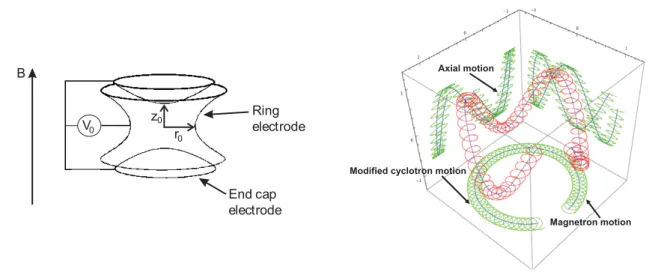
Dehmelt [9] invented and used the Penning trap system to successfully determine the electron theg-factor. The Penning trap configuration leads to the storage of charged particles in three dimensions, and the motion of the particles is well understood and can be described classically [12] and quantum mechanically [13,14]. Figure 1 shows on the right a calculated trajectory of an ion in a Penning trap and the deconvolution projection of the eigenmotions.
Special requirements for mass measurements of radioactive ions arise from the parameters of the ions themselves. One of the breakthroughs in systematic research was the introduction of so-called carbon cluster measurements. In addition to the actual time required for RF excitation of the TRF, ion preparation prior to excitation takes time.
The second term in equation (6), the so-called field shift, results from the change in electron energy due to the finite size of the nucleus. An estimate of the dependence of the field shift on the atomic number Z and the mass number A gives a rough approximation [6]. In Figure 6, the mass displacement (•) and field (N) contributions are shown as a function of atomic number.
This leads to a coupling of the electron shell's total angular momentum J and nuclear spin I to the atomic total angular momentum F=J+I.
Probing the nuclear interaction through ground-state properties
Continuous-wave RIMS has also been used to investigate the charge radii of lithium isotopes, as discussed below. In the following, we will focus on techniques and measurement results. This is largely due to the motion of the center of mass of the central core.
Simplified experimental setup for lithium spectroscopy (left) and a typical spectrum of 11Li (right) as a function of the transition frequency of two photons. Voigt profiles are fitted to the experimental data points and the residuals of the fit are shown below the spectrum. The power of the 610 nm laser beam is also enhanced in the same cavity as the 735 nm laser beam.
The measurement practically eliminated the uncertainty arising from the mass for the derivation of the charge radius [140]. Consequently, an accuracy of about 1 MHz in determining the isotope shift is sufficient to derive the nuclear charge radius with a relative accuracy of about 1%. Therefore, the new approach was greatly facilitated by the invention of the frequency comb [151], a device that allows the direct coupling of RF to optical frequencies and has been demonstrated to be able to determine transition frequencies with accuracy to the level of 10−17 [ 152].
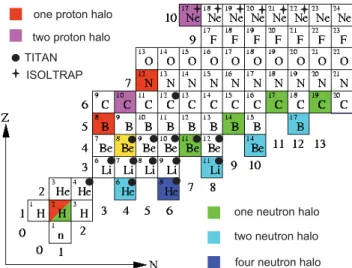
The center of mass motion in the one-neutron halo isotope 11Be is again the dominant contribution to the increase of the charge radius. The same technique will soon be applied for a measurement of the quadrupole moment of 11Li. The central region of the segmented Paul trap is shown on the left in figure 20 [167].
The β-asymmetry spectrum as a function of laser frequency, as shown in figure 21[175], exhibits only three resonances. It is surprising that all three elements exhibit a shallow charge radius minimum around N=14, so in the following we will mention some recent results using the cooling and stacking technique at ISOLDE and JYFL.
This is related to the unusual behavior of binding energies for individual isotopes of these elements. Many isotopic chains around mercury have been investigated using laser resonance ionization spectroscopy (RIS).
Nuclear astrophysics studies
Unfortunately, the approximation of 130Cd using the mass spectrometry techniques mentioned in this article is very complicated due to the low production rates and the large amount of isobaric contamination. So far, only Cd isotope masses up to A=128 could be directly addressed [269]. The latter show significant deviations of the experimental mass values from the predictions of the ETFSI-Q mass model [278], in which the quenching of the N=82 shell is explicitly introduced.
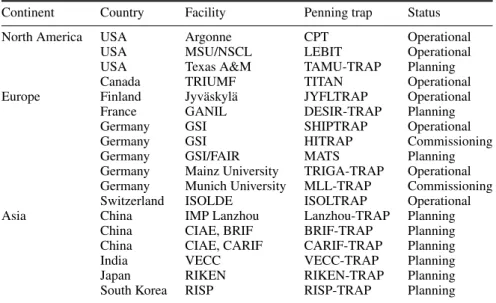
More data are expected to come from CPT, JYFLTRAP or TRIGATRAP in the coming years, the latter being the only facility installed in a research reactor (TRIGA-Mainz, Germany) [28].
Fundamental studies
The physical mechanism responsible for the non-zero neutrino mass is therefore unknown and there are numerous activities in the neutrino physics sector worldwide to answer these important questions. -trap mass spectrometry provides important information for many of these neutrino physics experiments, mainly via Q-value measurements of the involved nuclides in the decay processes. The most promising attempt to get the absolute mass value of the electron antineutrino νe is the investigation of the β-decay spectrum of tritium.
The excess energy Q is divided between the kinetic energy of the electron, the repulsion of the nucleus, and the total energy of the antineutrino. The shape of the energy spectrum for the decay electrons would be modified near the endpoint Q0 in the case of a finite electron antineutrino mass. (3 He), minus. Although electron delay spectrometers, such as KATRIN, can determine this quantity in addition to the neutrino mass from analysis of the electron spectral shape, independent measurements help to rule out possible systematic errors in the neutrino mass measurement.
Another interesting case for precision mass measurements related to neutrino mass studies is the Q value of the β-decay of 115In to the first excited level of 115Sn. In recent years, tremendous efforts have been made in experiments to clarify the ambiguity of whether the neutrino is a Dirac or Majorana particle. This would violate conservation of the total lepton number and show a clear sign for physics beyond the SM.
There are currently several experiments in operation or in preparation aimed at directly observing neutrinoless double beta decay (0νββ) [299] to elucidate the nature of neutrino-antineutrino duality. A survey of all known nuclide masses in the nuclear chart reveals that only 35 of them can undergo a 0νβ−β− decay due to energetic reasons. The experimental signature would be the observation of an increased event rate at the Q0 decay value in a multi-energy spectrum of two emitted electrons.
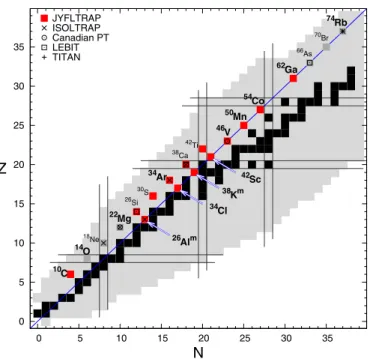
To date, as shown in Figure 28, the Q0 values of eight of the eleven most interesting double β-decay transitions have been determined by high-precision Penning-trap mass spectrometry with uncertainties of up to a few 100 eV. An experiment to observe the 0νECEC process is not yet planned, although it would allow the same physics conclusions as double β--neutrino-free annihilation experiments. But as already pointed out in 1983 by Bernabeu et al [312], the process can be resonantly enhanced by a favorable nuclear and atomic structure: an energetic degeneracy between the initial and final transition states, i.e.
Conclusion and outlook
Figure updated from [311].) Double beta decay (red) and double electron capture (blue) nuclei that have been addressed by high-precision Penning-trap mass spectrometry. The reason lies in the expected four to six orders of magnitude longer half-life and thus the amount of material needed to require such a virtually unobservable process. Determining such resonance conditions for specific transitions [301]—in order to find suitable candidates for 0νECEC searches—required high-precision Penning-trap mass measurements.
Since the first measurement with JYFLTRAP on 112Sn, a total of 15 Q-value measurements of double electron capture transitions, as shown in Fig. 28, have been made with uncertainties well below 1 keV. However, so far only one system, namely 152Gd–152Sm, meets the criteria for complete energy degeneracy, resulting in a half-life estimate of 1026 years when normalized to a neutrino effective mass of 1 eV [314]. For a detailed review of all transitions investigated so far by double electron capture by Penning trap mass spectrometry, we refer to the recent review by Eliseev et al [302].
Here, a multi-resonance phenomenon has been detected with four resonantly broadened transitions in nuclear excited states in the daughter nuclide [315]. Spectroscopy of Rare Franium Isotopes Proposal for ISOLDE and N-ToF Experiments Committee (INTC) (http://cdsweb.cern.ch/record/1080361).