
This project followed a program evaluation approach and addressed the resource component of the logic model framework. I am grateful for the knowledge gained, obstacles overcome, and new perspectives developed during this journey.
Introduction
Background/ Statement of Problem
Need for Program Evaluation
Creation of the eHealth Resource
Randomized Control Trial
Purpose
Objectives
Literature Review
- Healthcare Professionals
- Importance of Breastfeeding
- Online Resources
- The Logic Model
- The Gap in the Literature
- Conclusion
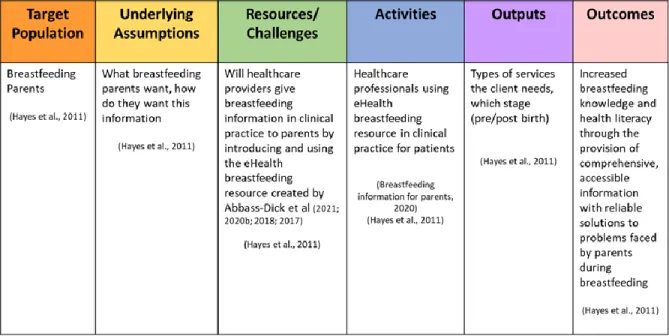
Additional literature was identified based on a logic model applied to the health environment and infant nutrition (Hayes et al. 2011). Will healthcare providers provide information about breastfeeding to parents in clinical practice through the implementation and use of the eHealth breastfeeding resource created by Abbass-Dick et al. Women want healthcare providers to suggest reliable e-health resources (Slomian et al., 2017b).
Methodology
Design
Sample
Recruitment
Study Procedures
Types of Measurements
Use and Storage of Data
Results
Participant Characteristic
Twelve of the participants were mothers; one was a co-parent and one was not a mother or co-parent. Half of the participants provided telephone and online services, while the other half provided in-person services. The majority of participants suggested that online, printed forms and verbal information during appointments are the information delivery platforms that should be recommended to parents.
Use of eHealth Resource
Design
However, some had suggestions about the illustrations, for example one participant said: "The latch illustration could be improved by showing more extension and cupping action of the tongue". Some participants thought the eHealth resource could be more interactive, the language could be simplified for better understanding, and the choice of color could be improved. In general, the participants considered the information, text, narration and illustration of the delivery method to be a good way to deliver breastfeeding information.
Healthcare professionals also suggested that links to other web materials, eBooks and quizzes could be improved. Most healthcare professionals suggested that videos containing information with narration, photographs and some animations were the best delivery methods used in healthcare. In response to the question: “Please indicate how helpful you find the methods of providing information,” healthcare providers most often selected 'easy to understand text' and 'links to other websites', suggesting that these were highly valued elements were from the eHealth source.
Some other components that ranked highly included videos of parents describing their experiences with good illustrations and videos of professionals explaining breastfeeding. Items that were least preferred as delivery methods used in the eHealth resources included narration, cartoon animation videos, games and quizzes.
Content
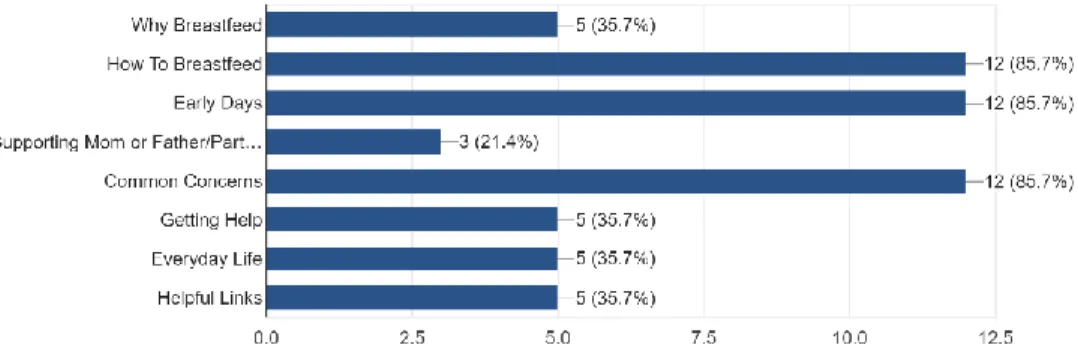
However, most healthcare professionals agreed that the content included in the eHealth resource would assist them in teaching patients. Health care providers generally felt that the following sections would be most helpful for perinatal families: Why to breastfeed, How to breastfeed, Early days, Support for moms/dads/partners, Common concerns, Finding help, Everyday life, and Helpful links. Healthcare professionals felt that the How to Breastfeed, Early Days and Frequently Asked Questions sections contained the most important information to share with parents.
Other topics rated as important included how to tell if your baby is getting enough, how to achieve a successful latch, how to overcome common problems and solutions, why breastfeeding is important and where to find help in your area. The three topics rated least for health professionals to include in patient education in their clinical practice were how to work as a co-parenting team, how co-parents can support the breastfeeding mother, and local resources for postpartum mood disorders/depression. Health professionals agreed that the eHealth resource provided accessible and credible information for perinatal families and felt that the eHealth resource was an important resource to present to parents in clinical practice to increase their health literacy about breastfeeding.
Some health professionals agreed that multiple ways of providing information will increase the patient's ability to understand the content, especially the narrative function of the text. Most health care providers seemed to feel that there was enough information in the eHealth resource to overcome the difficulties.
Usability
For example, a participant mentioned "The information is large and appears to be a high reading level". However, some participants commented on the language element, for example a participant mentioned, “Most of my clients are Spanish speaking, so I think maybe providing a great website, a translated version of it would reach more clients apart from English speakers. However, one participant mentioned, "It is difficult for such a universal document to provide local resources, but referring clients to their local public health unit can also be helpful."
One healthcare provider mentioned "No problems navigating the resource, just super busy and a lot to look at". Another mentioned “the resource can seem a little overwhelming, [with a lot of] information if it is not clearly explained by the HCP or if the client just had to open the resource on their own”. Most participants used Google Chrome as their web browser at (71.4%), while 21.4% used Microsoft Edge and 7.1% used their phones most of the time and ended up using Google Chrome on their laptop.
Most participants used Windows 7+ as their operating system, or Windows XP, while 14.3% did not know which operating system they were using.
Technical Difficulties
Usability Scale
Most participants did not think they needed the support of a technical person to be able to use the eHealth resource. Most healthcare professionals found the various functions in the eHealth resource to be well integrated, only a few disagreed. There was a mix of opinion about consistency in the design of the eHealth resource.
Almost half of the participants felt that the design of the eHealth resource was consistent, while the other half felt that it was inconsistent. Most health care providers envisioned that most people would learn to use the eHealth resource extensively. The majority of participants did not find the website awkward to use and most were comfortable using it.
Almost all participants did not need to learn many components before they could start using the system (website).
Credibility
Compared to other e-health resources, the majority of participants thought that this e-health resource provided more comprehensive breastfeeding information, had somewhat higher quality in relation to informed evidence, and appeared to be based on research. Most participants agreed that the eHealth resource targeted both mothers and their co-parents, and could be adapted to the needs of health care providers and families. Most health professionals thought it was more accessible to parents, had better information for patient education than other breastfeeding resources and the quality was also better.
There were mixed results in the charts of eHealth resources, as almost half agreed they were better, while the other disagreed. For example, one participant mentioned, “there are 2 main areas of content that I disagree with and would even say are harmful. The continued use of the term "drink" which [suggests] a bottle image to describe the sucking process by which infants receive milk at the human breast; and prohibition of alcohol and breastfeeding".
Despite this, most participants thought it would help them do a better job of educating breastfeeding parents and was more convenient, easier to use and cost-effective than what was currently available. Overall, healthcare providers thought this e-health resource was more beneficial to use and a better option to provide to perinatal families than other resources.
General Perceptions
Discussion
Strengths/Limitations/Future Implications of this Program Evaluation
Limitations of this program evaluation included low participation rates, with COVID-19 affecting the ability of healthcare professionals to take the time to respond to email and review the eHealth resource and complete the survey. In order to increase survey rates, it is suggested to pay attention to problems of access, motivation and knowledge of the target population when designing survey questions (Selm & Jankowski, 2006). It is also suggested to have open-ended questions in the survey as this may increase participation, which were included in our online survey (Selm & Jankowski, 2006).
Future research should be conducted when there is less stress on the target population, such as avoiding a pandemic at a time when this would potentially increase survey rates. Furthermore, a Delphi method could be used to gather information from different stakeholders to determine best practices regarding the use of eHealth to provide breastfeeding education and support ( NASA et al., 2021 ). As eHealth resources are increasingly used to provide breastfeeding information and support, it is important to determine the best way to implement them in practice.
This study illustrated the adoption of the eHealth breastfeeding resource by HCPs in their clinical practice.
Conclusion
If you agree to participate, you will be asked to review the eHealth resource and email us if you are interested in providing feedback. Any information collected prior to clicking "submit" at the end of the survey will be discarded should you choose not to participate and close your browser. Your participation is very important to us, as the results will be used to help us determine and achieve the usefulness of the online resource in clinical practice.
If you request a copy of the results, you will receive an email upon completion of the study notifying you of the study results. After you read the end of this form and agree to participate, you will receive the link to the online survey. The immediate benefit is knowing this resource, which can help you provide breastfeeding information to childbearing families.
The results of the study will be used to help researchers understand whether the eHealth resource meets the needs of healthcare providers. This resource will be widely disseminated in the future for healthcare providers to use with childbearing families to increase breastfeeding health literacy. The results of this study will be shared with the healthcare and research community through meetings, webinars, peer-reviewed journals and conference presentations.
Reminder emails will be sent after 7 and 14 days if we notice that the survey has not been completed.