There is now extensive literature on how community-led, cross-sector strategic partnerships can meaningfully contribute to sustainable energy development. Through an intensive case study of a community-led renewable energy project in southern Alberta, this study aims to address this gap in the literature and build theory for actionable policy guidance by government and future stakeholders on renewable energy partnerships in the region.
INTRODUCTION
PROBLEM FRAMING
Given the importance of collaboration and the growing need to redefine traditional or predominantly economic indicators of the achievements of said collaborations, the question I need to explore is how the "success" of sustainable energy projects can be framed in ways that look further. profit and to what extent partnerships and especially community involvement can be an effective way to achieve said success. Furthermore, when different stakeholders with different expertise, perspectives and priorities come together, I want to explore the extent to which such pooling of resources lends itself to a synergy that can address aspects of the problems at hand that no one could solve alone.
RESEARCH QUESTIONS
LITERATURE REVIEW
WHY PARTNER?
- SYNERGY
- DIVERSIFICATION LEADING TO RESILIENCE
- VALUE CREATION
- ENERGY PROVISION DRIVES GLOBAL DEVELOPMENT
- RESEARCH IMPLICATIONS
The role of the private sector in advancing the sustainability agenda cannot be overstated. It is also important to note that the private sector is in fact the largest polluter in many parts of the world.
THE ROLE OF COMMUNITY IN SUSTAINABLE ENERGY PARTNERSHIPS
- WHAT IS COMMUNITY ENERGY?
- FINDINGS FROM LITERATURE: COMMUNITY ENERGY OUTCOMES
- COMMUNITY-LED VS. MARKET-LED CSSPS: REDEFINING SUCCESS
- BUILDING TRUST: THE ROLE OF OWNERSHIP
- WHY COMMUNICATION MATTERS
Particularly in the US, the largely market-based use of the term "community energy" now refers loosely to projects initiated by businesses to earn income from the sale of electricity, where community members can buy into the projects as shareholders (John, 2014). Examples of unsustainable projects in the study, such as unsuccessful attempts to power irrigation pumps in Nigeria through renewable sources rather than kerosene, ultimately failed due to a lack of community ownership, trust and buy-in.
GAPS NECESSITATING RESEARCH QUESTION
- A MORE CRITICAL PERSPECTIVE ON PARTNERSHIP PERFORMANCE
- THE NEED FOR A BROADER VIEW OF CONDITIONS FOR SUCCESS
- FOCUSING ON NORTH AMERICA
The examples from the studies cited in the previous sections show that trust and communication, which together help generate the consensus that leads to project ownership and entrenchment within the community, then do not depend on the type of community—rural or urban—or the wealth of community, or even geographic location. This is in addition to the already narrow definition of success for partnerships that I highlighted in the previous section - the marginalization of key stakeholders, power dynamics, lack of trust are all factors discussed in this thesis that are not cited in the above study. Most research on community-led energy projects has a European or UK focus, and most of the barriers to success cited there are also in the area of institutional and financial shortcomings (Klein & Coffey, 2016).
Similar to Patterberg and Widerberg's (2016) view of partnership success, research on community-led energy in the UK only vaguely identifies local context or factors such as low community buy-in or ownership in cases where there has been no direct organized NIMBYism or to protest. As an example, Klein and Coffey (2016) highlight how in the US, behavioral interventions targeting the energy transition focus disproportionately on individual choices—a methodological individualism, as if everyone were acting in isolation. However, evidence suggests that energy behavior based on social or group decision-making is more likely to be closer to home, leading to conclusions about the need to develop a better understanding of the role of social interactions and power relations in the informed implementation of practices.
Intuitively, this also seems like something that would play a role in the context of southern Alberta.
METHODOLOGY
- DESCRIPTION OF THE CHOSEN RESEARCH METHOD
- RESEARCH CLASSIFICATION AND IMPLICATIONS: INTENSIVE CASE STUDY. 23
- DATA ANALYSIS AND DEVELOPMENT OF FINDINGS
- LIMITATIONS
Eckstein (2000) also argues that the most valuable application of the case study method is at the theory building stage of research. As this study aims to address some of those gaps by developing actionable policy findings and building theory, it includes many of the features for which a case study approach is considered appropriate. Given the suitability and versatility of the case study method, it is therefore my preferred approach for this research.
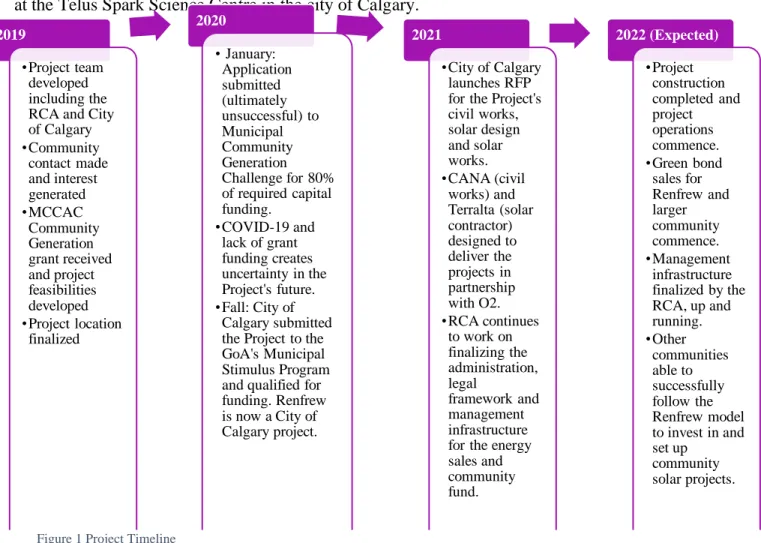
Alicia Cuoto, Solar Alberta board member and member of the Renew Community Association, was interviewed once. A description of the case is developed to build background information and a contextual framework within which the remainder of the findings are presented. This description is chronological, from the project's conception in the run-up to where it stands at the end of the participant interviews.
A timeline of key events in the life of the project is presented, as well as a stakeholder map.
FINDINGS
- PROJECT EVOLUTION
- RENFREW SOLAR INC
- TOWARDS PROJECT COMPLETION
- PROJECT THEMES
- CHANGE IN PARTNERSHIP LANDSCAPE
- WHAT IS COMMUNITY (TO YOU)?
The full onset of COVID-19 followed soon after and for the next few months the future of the project remained uncertain. It is also the City's prerogative to take a broader view of the project in the larger context of climate policy action in its marketing and communication efforts. One was the community member's investment-driven funding for the project, and another was the collaborative governance structure of the project.
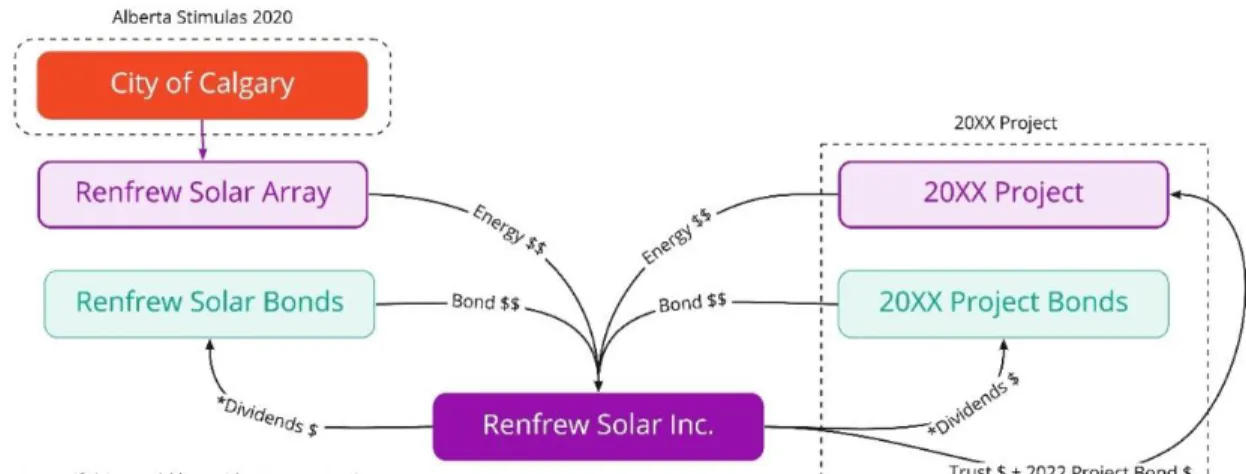
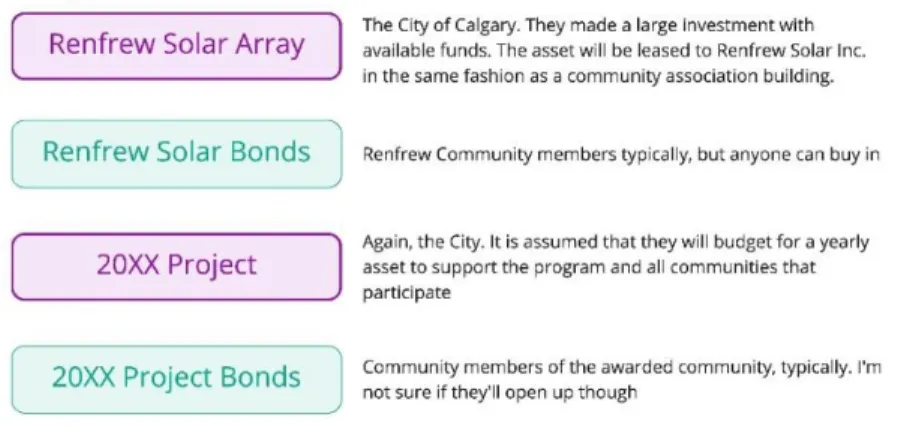
The evolution of the project in terms of which actors became central to the partnership depending on how the financing of (mainly) large projects changed. These include the MCCAC, which awarded the initial $194,200 fixed grant to the RCA due to the feasibility of the project. The larger renewable energy community can therefore also be seen as an interested party for the project.
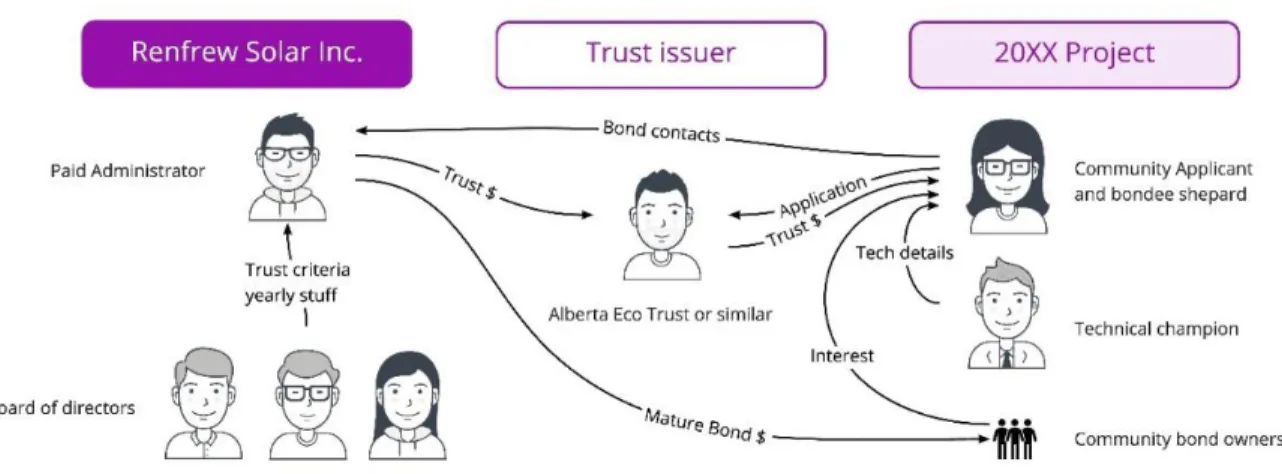
SMP and O2 are both involved in the project design, while the Alberta Eco-trust is the lead sponsor for the Renfrew Solar Inc. The interest of the larger renewable communities in the project remains as before, if not more. In conversation with members of the Renfrew community, it was emphasized that this shift in the project's public outlook was keenly felt.
CONCLUSIONS
IMPLICATIONS
- IMPLICATIONS FOR THEORY
- IMPLICATIONS FOR PRACTICE
Most of the main findings of community and community-led projects from the literature are then seen repeated in the case of the Renfrew project. This may be a natural consequence of the fact that a volunteer-led organization would only be able to spend time and effort on something or successfully achieve something if motivations aligned and relationships were conducive to productivity. Similarly, that a partnership as diverse and evolving as Renfrew works is evidence that partners got along well, or that problems were resolved – potentially due to the presence of a similar value system and outlook.
The Renfrew Project was set up from the start as a CSSP, a partnership focused on building a portfolio of supporting players for the community's vision, who can advise and help navigate the uncertain waters of navigating the first such initiative in the city. Despite my best efforts, I have not been able to speak with various members of the City of Calgary team as often and in as much detail as I would have liked. Likewise, in the absence of the pandemic and pandemic-related project delays, I would have prioritized engaging project partners on-site for the project, potentially gaining rich context for the case in addition to the responses I received in virtual interviews, but again due to the pandemic that did not prove possible, feasible or time-efficient to do.
There is a small, non-zero chance that between now and the end of the project, some unexpected event could occur that could change the course of the findings and the project in general.
FUTURE RESEARCH
All interviews were conducted virtually, another prominent effect of the pandemic on this study, which is less ideal for in-depth conversation, especially as an interview format, as body language and non-verbal cues are almost completely lost in the process. Regarding the research results, a clear limitation arises from the fact that the project is still ongoing and not yet completed. Due to the priorities in completing the study and taking into account the various delays already encountered in the completion of the project, which have been taken into account in this study, it was deemed prudent by the researcher and the supervisory committee to to limit. and currently collecting findings.
This will add both depth and breadth to the available data and analysis, allowing future students of the field a richer comparison and dissection. Additionally, with respect to the Renfrew project, an important area of future research may be to study the project once it is complete and generating power, or to compare its actual performance and impact on community solar in Calgary with its original goals (such as eg creation of enabling mechanisms for other community energy projects), a few years later. When it is that we are not in uncertainty and existential fear due to a global pandemic, researchers could also conduct interviews and on-site observation of projects, see stakeholder and partner relationships unfold in real time in in-person project meetings or on-site inspections, and add the additional dimension to their research into community energy partnerships, which is limited in my
What is the impact of working with a large company or business partner, as opposed to the government? How would bottom line considerations affect the project?
FINAL OBSERVATIONS
Onttrek van Clean Energy Wire: https://www.cleanenergywire.org/factsheets/whats-new-germanys-renewable-energy-act-2021. Onttrek van CANA: https://cana.ca/news-details/Renfrew-Solar-Carport-at-Telus-Spark- Science-Centre. Onttrek van Design Build Institute of America: https://www.dbiarockymountain.org/what_is_design_build.php Dickinson, H., & Sullivan, H. Towards a General Theory of Collaborative Performance:.
Hentet fra CISION PR: https://www.prnewswire.com/news-releases/hanwha- launches-campaign-to-help-clean-vietnams-mekong-river-300862266.html. Hentet fra Livewire Calgary: https://livewirecalgary.com shining-bright- renfrew-solar-garden-gets-2021-go-ahead/. Hentet 25. maj 2021 fra https://www.climate.gov/news- features/understanding-climate/climate-change-global-temperature.
Cross-sector partnerships for sustainability: how mission-driven convenors are driving change in national coffee platforms.
INTERVIEW BLUEPRINTS
How can attitudes and values within the community influence community partnerships in sustainable energy projects. What do you think has been the most challenging aspect of this project so far? Feel free to get back to me at any time within the month/4 weeks in case you want me to exclude some or all of the information contained herein, or if you want changes to your previously stated preferences of the use of your name or a pseudonym.
INTERVIEW GUIDE
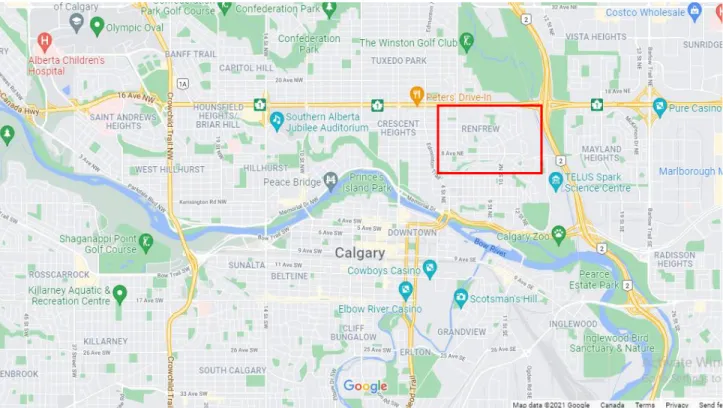
MAP OF RENFREW
SAMPLE PROJECTED FINANCIALS- RENFREW SOLAR INC