As part of the mill waste, there will also be some ore sorting waste, which is expected to range in size from approximately 5mm to 250mm diameter. Three (3) of the options assume a thickened tailings product that will be transported to the TSF by 1) Truck transport with a dump truck; 2) Truck transport with re-handle of loader; and 3) transport to the TSF by conveyor belt. The 4th option would involve a slurry fine tailings product pumped via pipeline to the TSF with the coarse tailings drawn to the TSF.
From the geotechnical point of view of EXP, the first 3 options using coarse fine tailings hauled or transported to the site are considered almost identical and each of the options is considered acceptable. We understand that DRA prefers the carrier option at this stage of the evaluation process. The EXP evaluation will primarily consider the advantages and disadvantages of TSF disposal of thickened fines versus tarnished fines.
The possibility of mixing thickened fine tailings with the coarse DMS tailings, and possibly also mixing these materials with waste mine rock, will also be discussed. Currently, the DRA projects (as of December 6, 2018) that the life of the open-pit mine will be approximately 12 years, given the proven lithium ore reserves.
Mill Tailings
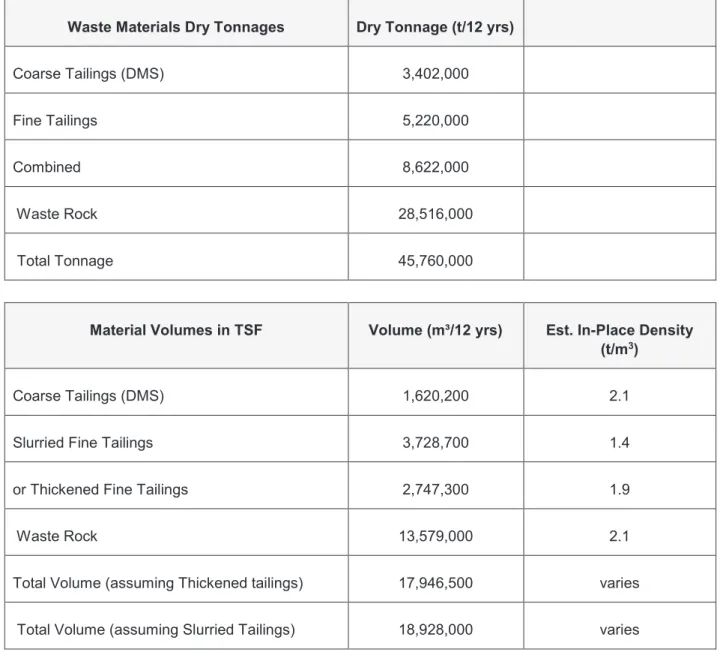
As part of EnviroCree's scope of work, EXP has been retained to provide geotechnical engineering design services for the proposed tailings disposal facility (TSF). Based on information provided by the DRA, the tailings generated will consist of coarse tailings "DMS", which is primarily a product of coarse sand and fine gravel size, and fine tailings, consisting of a product of fine sand, with approximately 45%. fines exceeding 75 micron sieve size (#200 mesh). 4 in Appendix B gives the annual dry tonnages for DMS coarse tails and fines tailings, which are equal for both the wet and dry waste options.
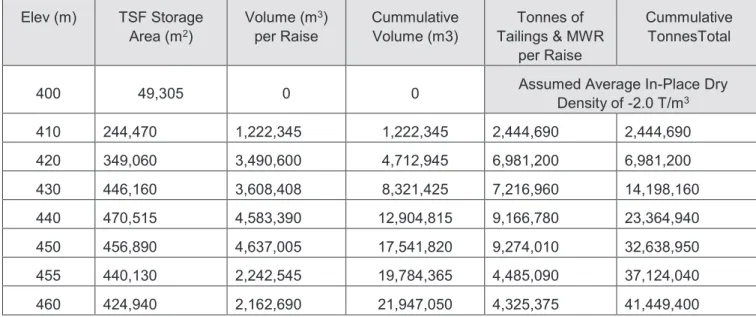
The corresponding volumes were then determined based on the estimated insitu or placed density of the various waste materials. The TSF was initially designed based on previous work by Golder Associates for site location and based on the preliminary estimates of tailings production provided above. Also considered for the size and storage capacity of the TSF were the tailings water flow through rates, monthly and extreme event precipitation, storage of snow precipitation during winter months, and recycling water considerations.
The TSF site is located on a gently sloping slope just west of the proposed mill site, which slopes from southeast to northwest. All TSF plans discussed below are based on this footprint, which covers approximately 97.1 ha.
Original TSF Design (TSF #1)
Neotec Lithium Ltd Project Name: Lake Moblan Mine Proposed Tailings Storage Facility (TSF) Final Report Assessing Tailings Disposal Trade-offs Project Number: GAT Date: December 7, 2018 At the time of the initial design of the TSF, it was not yet determined whether it would be for containment potentially contaminated water in the TSF required a low-permeability liner. For the preliminary design of the perimeter dams, it was assumed that the perimeter dams would have a geosynthetic clay (GCL) liner embedded in the top of the dam to retain water, with the option of compacted tailings being placed along the bottom of the TSF to act as a liner with relatively low permeability.
The main component of the dam will be constructed from Waste Mine rock with various sections of finer graded rock in the upstream direction. The original TSF design assumed that Waste Mine rock would be used to construct the perimeter dams and the internal continuous dyke. Some crushing of the rock material will be required to create finer, well-graded aggregate material to create suitable graded filter zones and filter drains.
If necessary, the entire footprint of the pond can be provided with a liner (such as a GCL or geomembrane). The design is flexible to be used to hold either thickened tailings or slurry as well as DMS tailings.
TSF to Store All Blended Waste Material (TSF #2)
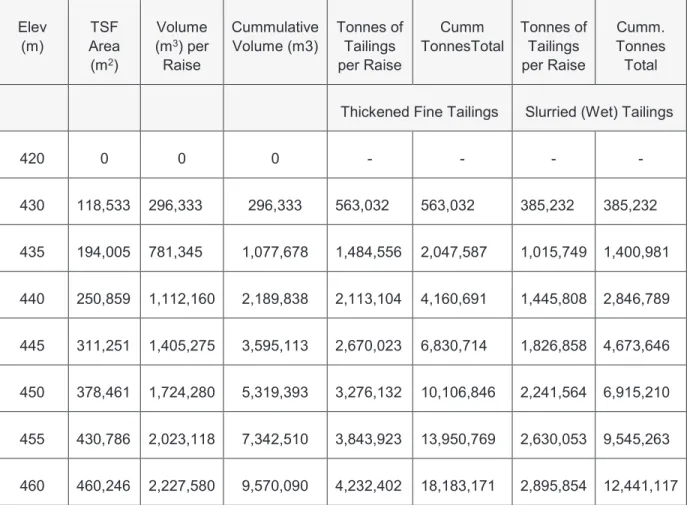
The raising of the inner embankment is likely to continue to approximately height 470 m, where the total storage capacity will be approximately tons or approximately m3 of combined waste material, which will be sufficient to contain the projected 12 year quantities of waste material.
Modified TSF Design to Isolate Area in Vicinity of Condemnation BH CD-8 (TSF #3)
A geotechnical investigation program was conducted based on the originally proposed location of the TSF (TSF-1). The preliminary results of the laboratory testing are shown on the grain size distribution plots in Appendix C. Mixing the mixed tailings with mine waste rock was also considered, but this option does not appear to provide any significant benefits.
Appropriate quantities were then determined based on the estimated density of the various waste materials in the in situ or installed TSF. Reclaim Pond is located on the lowest lying area in the northwest corner of the TSF. The design shown should enable compacted mixed tailings to be stored in the central part of the TSF in the rough.
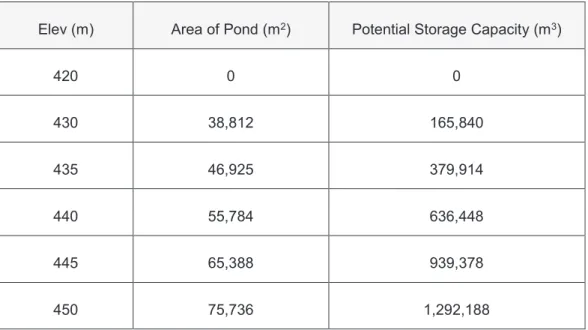
Since the top surface of the main mixed tailings section of the TSF will have a final slope of 1.0% to 5% dipping towards the northern perimeter, a volume adjustment will be required. A second pumping system will be provided to discharge excess treated water (assuming the water is of acceptable quality), to the natural drainage designated as Creek 7 downstream of the Reclamation Pond. The currently anticipated storage capacity of the Recovery Basin scene as shown in Dwg TSF-4 A-1 is given in Table 3-3 below.
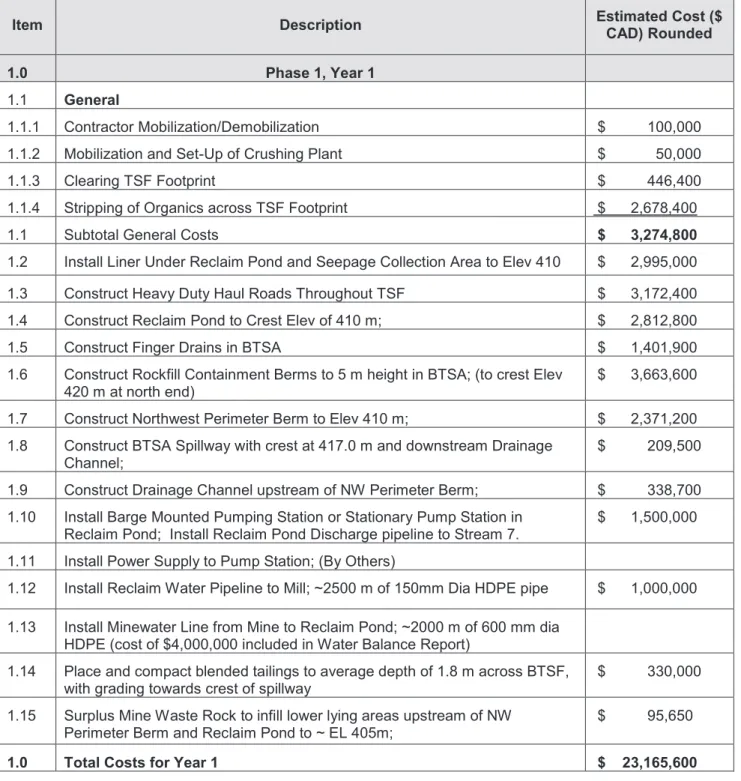
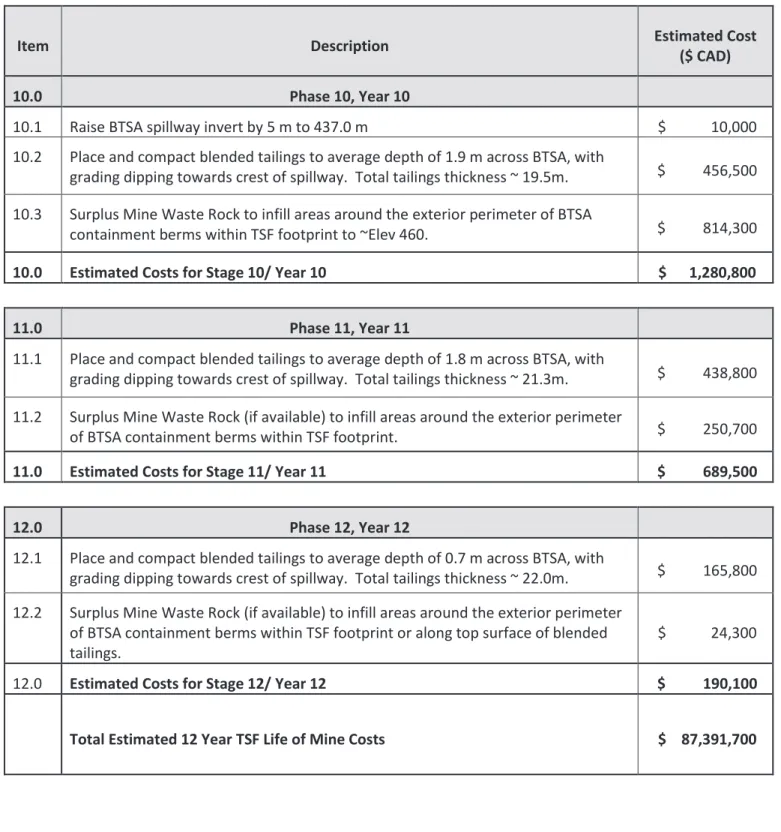
Drawings showing the proposed phased construction of the TSF over the twelve-year life of the mine can be found in Appendix A (TSF-4 ST-1 to ST-12 Drawings). Drawing ST-1 shows all initial construction work that was required in the first year to make the TSF operational. A bulldozer would be required to place and compact the tailings in 600mm lifts across the surface of the BTSA.
Coarse uncrushed mine waste rock may also be used along the downstream toe of the BTSA berms. A preliminary minimum FS of 2.06 was obtained for the Reclamation Dam dam for a failure through the dam on the downstream side of the structure. Analysis of the BTSA containment berm without the mine waste rock fill support behind it also indicated a FS of greater than 3.0.
This may also result in the formation of an ice thickness of 2.7 m on the upper surface of the Recovery Basin. The total volume of mixed waste during the 12-year life of the mine is estimated at about 5,000,000 m3. The TSF will be constructed in phases to enable efficient use of mine waste rock.
The northwestern perimeter of the TSF is designed with a lower bank at an elevation of 420 m (approximate elevation varying from 5 to 20 m above existing grade) containing the Reclamation Dam.