The development of the Regional Industrial Land Strategy was part of the Council's approved 2019 Regional Planning Budget. Taken together, the recommendations provide a road map to achieve the vision of the Regional Industrial Land Strategy.
INTRODUCTION
- OBJECTIVES
- METRO VANCOUVER’S INDUSTRIAL LANDS STRATEGY TASK FORCE
- REGIONAL INDUSTRIAL LANDS STRATEGY VISION
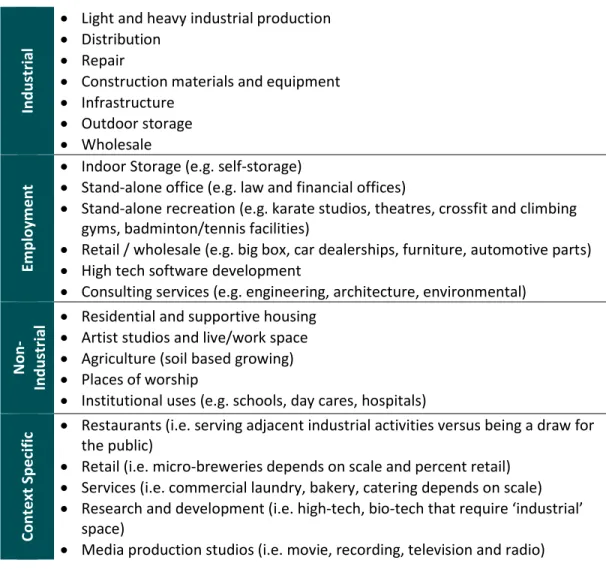
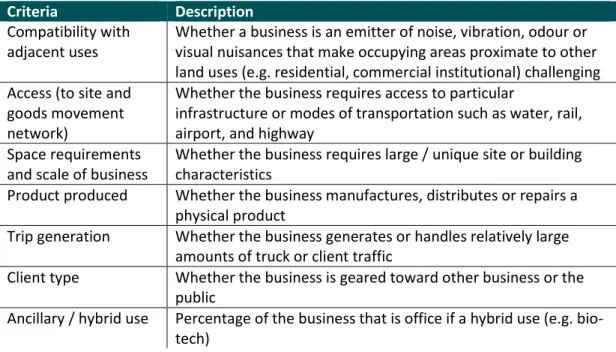
- DEFINITION OF ‘INDUSTRIAL’ AND WHAT IS APPROPRIATE WHERE . 10
The Task Force's mandate is to guide the development of a Regional Industrial Lands Strategy. One of the first efforts of the Task Force was to confirm a vision for the Regional Industrial Lands Strategy.
REGIONAL CONTEXT, ISSUES AND TRENDS
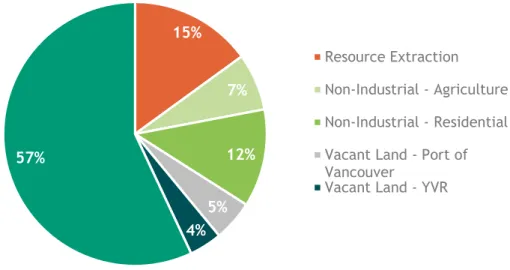
INDUSTRIAL LANDS IN METRO VANCOUVER
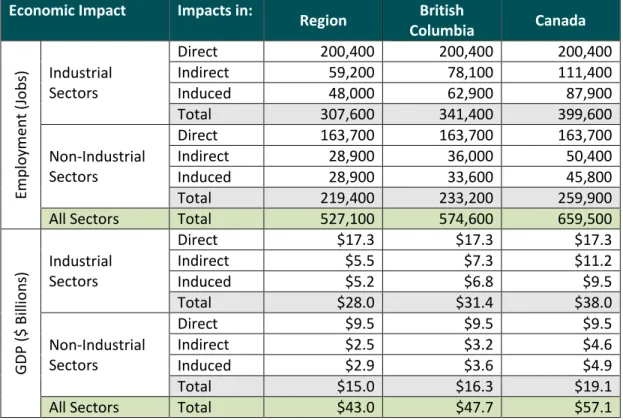
Of the 364,100 jobs at the region's industrial sites, they are related to industrial activities including manufacturing, distribution, repair, public infrastructure and trade facilitation applications (employment activities at sites associated with the Port of Vancouver and YVR Airport). Metro Vancouver's industrial lands generate an estimated $6.5 billion in tax revenues and fees for the federal government and $2.3 billion for the provincial government.
CHALLENGES FACING THE REGION’S INDUSTRIAL LANDS
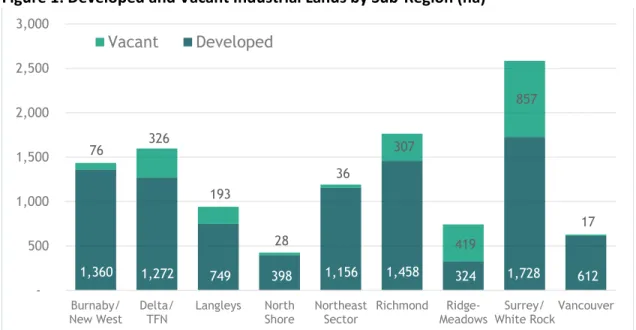
In the case of Metro Vancouver, demand and competition for these lands have steadily increased, while the supply of available industrial lands has decreased. The challenges facing Metro Vancouver and its industrial land supply are somewhat unique, at least in the North American context. While there is some potential for industrial development in the neighboring Fraser Valley Regional District to the east, there is also a limited supply of vacant industrial land available, largely limiting land supply within the Lower Mainland.
However, these and many other non-industrial uses can also compete for space in the industrial area. This can be a challenge given the limited number of large sites in the region that have the characteristics needed for trade enabling businesses. Just as growth in the context of a finite land base puts pressure on the region's industrial land base, it also puts pressure on the region's transport infrastructure network for moving goods and people.

THE FUTURE OF INDUSTRY AND CHANGING SPACE NEEDS
At the same time, the issues facing industrial estates involve multiple stakeholders and overlapping jurisdictions of government, which may have their own organizational mandates. The result is a broken regulatory landscape that can sometimes lead to redundancies or competing policy goals that stifle the efficient use of the region's remaining industrial land for various purposes. Trade enabling uses associated with the port and YVR represent only one part of the demand for industrial land.
Despite the changing nature of industrial activities in the region, industrial lands continue to play a fundamental role in facilitating activities that serve the city, such as vehicles. In addition to these functions serving the city, industrial lands are also playing an important role in accommodating the region's emerging innovation economy. Technological innovations are also dramatically changing the relationship between employment, productivity and the way industrial land is occupied and used.
INDUSTRIAL LAND DEMAND TO 2030 AND 2050
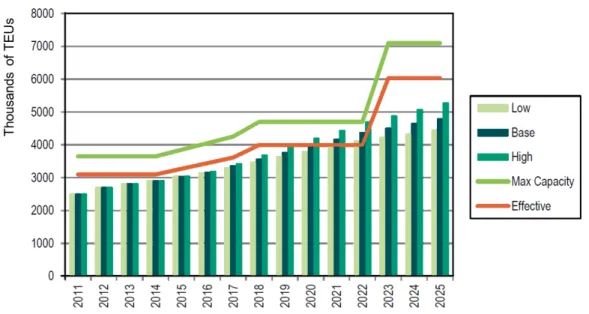
What would be the demand for land if there were no significant supply constraints in the region. The most recent forecast prepared for regional land demand used an absorption method with a range of 80 to 110 ha per year (200 to 275 hectares per year)27. As part of the work of the Regional Industrial Land Strategy, Hemson Consulting looked at the demand for industrial land from the perspective of employment growth.
Following current economic trends, there is a further shift in Metro Vancouver's employment base away from sectors occupying industrial land and towards service sector use. Assuming employment density at a somewhat optimistic average of 40 jobs per net ha, the resulting demand for industrial land to accommodate this growth would be 75 to 110 ha per year (185 to 260 hectares per year). This rate is quite similar to the conclusion from the White Paper on land demand.
IMPLICATIONS FOR THE REGIONAL ECONOMY
Similarly, a lack of logistics terminal space is seeing demand for inland distribution ports as far away as Calgary.29 These inland ports serve as staging areas for containers that are unloaded in Vancouver, transported by rail to the distribution hub to be unpacked and sorted, and then transported back to Vancouver for to be delivered to end users and points of sale. Should a company move to another port in the province, such as Prince Rupert, the impact could be neutral for British Columbia and Canada, but negative for the Metro Vancouver region. Should a company relocate to Alberta, the net impact may be neutral for Canada but negative for the Metro Vancouver region and British Columbia; and.
Should a company move south of the border (such as Washington, Oregon or California), the net impact would be negative for the Metro Vancouver region, British Columbia and Canada.30. The loss of local businesses can negatively impact the economy due to the loss of potential or existing jobs and tax revenue for governments. It's worth noting that adding new industrial uses in Metro Vancouver can result in its own set of costs and challenges, including increased competition for land and the potential to increase traffic, business-related emissions, and possible conflicts with other uses.
RECOMMENDATIONS
PROTECT REMAINING INDUSTRIAL LANDS
Metro 2040 aims to protect the region's stock of industrial land and promote its efficient use. As part of the Metro 2040 update, Metro Vancouver should strengthen regional policy by considering: .. a) increasing the electoral threshold required for a minor change to convert industrial and/or mixed employment to general urban;. It is important to recognize that trade-enabling industrial uses (such as logistics, warehouses, distribution centers, along with transportation terminals) are a key part of Metro Vancouver's role as an economic gateway between the Pacific and the rest of the country, and that these uses tend to have a very specific set needs that separate them from other industrial uses.
Because these sites also tend to offer attractive characteristics for other types of industrial uses, commercial enabling uses often compete with other industrial uses when attempting to purchase and develop this land. Within the context of a limited land base, it is critical to encourage development in a manner that uses the remaining stock most efficiently for all types of industrial users. To encourage more efficient use of the region's remaining industrial land, it would be beneficial to ensure that industrial users who can locate in more intensive built forms are not constrained by policy.
INTENSIFY AND OPTIMIZE INDUSTRIAL LANDS
However, as the remaining supply of industrial land dwindles, it may become feasible for more of this type of development to occur in the future. Climate change and the impacts of sea level rise are likely to be one of the greatest challenges of our time and their potential impact on industrial land supply cannot be ignored. A significant portion of the region's industrial land supply, including most major port and airport facilities, is located within low-lying areas that are projected to be at risk from rising sea levels and more frequent flooding events.
As the Fraser Basin Council develops a flood management strategy for the region, it is critical that industrial land is properly considered to ensure the continued economic resilience of the region, while recognizing the costs that adaptation measures may have for future industrial development. The growth of assessed values on industrial land in the region has grown rapidly in recent years. The associated increase in property taxes is putting increasing pressure on industrial businesses, especially in high-growth, high-value urban areas where the practice of valuing property based on highest and best use has a limited relationship to current use.
BRING THE EXISTING SUPPLY TO MARKET & ADDRESS SITE ISSUES 51
Certain parts of the vacant industrial land stock suffer from site-specific challenges, such as limited infrastructure support, environmental issues and undersized parcels. Such a strategy will identify the issues that have prevented the development of the undeveloped or underdeveloped industrial land, while providing a road map to achieve the municipality's economic goals for its remaining industrial land. As such, maintaining and growing a resilient and reliable transportation network, including multiple modes of transportation, is an integral component in planning for the efficient management of the region's industrial lands.
However, many of the data sources available to the region are produced infrequently, such as the Population Census and the Industrial Land Census Update, or are not detailed enough to provide useful guidance at the local level, such as the Labor Force Survey. This survey should be designed to provide a greater level of detail regarding employment activity and space use than is currently available through Statistics Canada's census and other surveys of primary workers, and should be standardized to provide comparable data across different employment sectors, time periods, and parts of the region. Following the successful example of other economic regions and taking a more holistic regional approach to economic cooperation, the newly established Metro Vancouver Regional Economic Prosperity Service could work with member jurisdictions to improve the region's ability to promote business growth and development in all parts of the region.
PRIORITY ACTIONS - IMPLEMENTATION
That the Regional Planning Commission receives, for information, the report entitled “Metro 2040 Industrial and Mixed Employment Policy Review Scope of Work,” dated February 19, 2020. For information on the Metro Vancouver 2040: Shaping our Future (Metro 2040) update, the Regional growth strategy, Metro Vancouver is conducting an industrial and mixed employment policy review. To provide an opportunity for the Regional Planning Committee and the MVRD Board to consider and provide feedback on the scope of work for the Metro 2040 Industrial and Mixed Employment Policy Review.
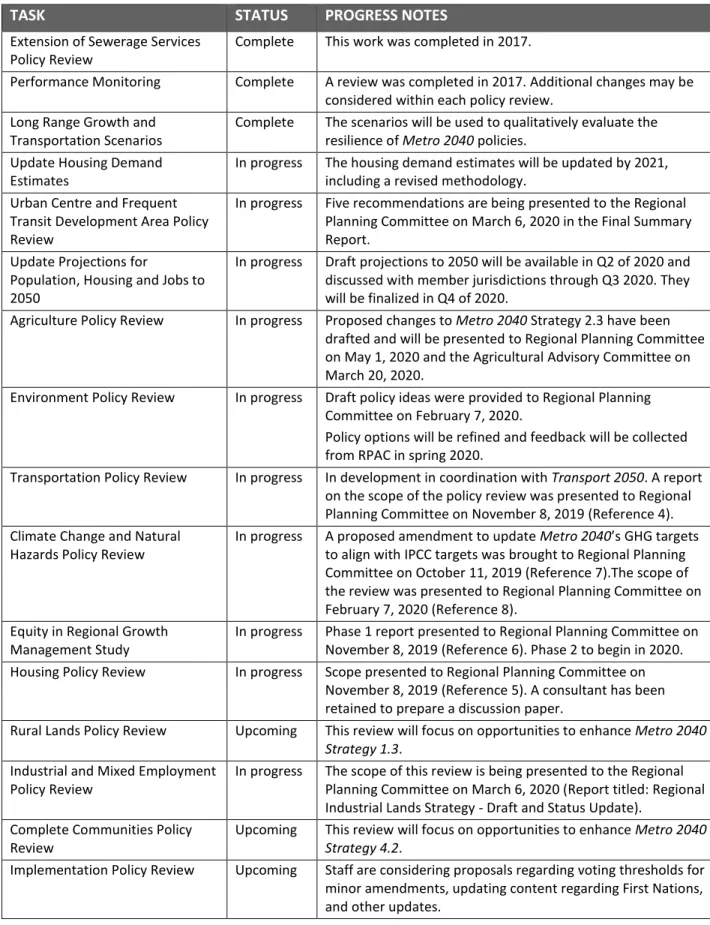
This work will also be considered as part of the Industrial and Mixed Employment Policy Review. Industrial lands and associated economic and employment matters are a key component of the regional growth strategy, and going forward will be the development of Metro 2050. Ongoing Five recommendations will be presented to the Regional Planning Committee on 6 March 2020 in the Final. Summary Report.
Ongoing The scope of this review will be presented to the Regional Planning Committee on 6 March 2020 (report entitled: Regional Industrial Lands Strategy – draft and status update). Metro Vancouver in the process of updating the Metro Vancouver 2040 regional growth strategy: Shaping our future.