Derby Reach Brae Island Parks Association Contribution Agreement Regional Parks Committee Regular Meeting Date: July 15, 2020 Page 3 of 4 Derby Reach Brae Island Parks Association Contribution Agreement Regional Parks Committee Regular Meeting Date: July 15, 2020 Page 4 of 4 .
INTERPRETATION
The recipient's aim is to promote appreciation, understanding and enjoyment of the Derby Reach and Brae Island Regional Parks, whilst preserving and enhancing their natural and historic features. Section 176(1)(c) of the Local Government Act provides that MVRD may provide assistance for the purpose of benefiting the community or any aspect of the community.
ATTACHMENT
The recipient has applied for the grant and MVRD has agreed to provide the recipient with funds for a purpose that benefits the community or aspect of the community; and. Plan” means the plan set forth in Annex A to this Agreement, which sets forth the specific purposes and/or activities for which the Recipient may use the funds provided to the Recipient pursuant to this Agreement.
TERM
SERVICES
FUNDING AND PAYMENT
REPORTING
TAXES
SEPARATE FUNDS AND FINANCIAL STATEMENTS
RIGHT OF AUDIT
INDEMNITY AND RELEASE
TERMINATION
NOTICE
Recipient hereby represents and warrants that the execution and delivery of this Agreement and the consummation of the transactions contemplated by this Agreement, if any, have been duly and validly authorized by all necessary corporate acts on the part of Recipient, and this Agreement constitutes a legal, valid and binding obligation of the Recipient, enforceable against the Recipient in accordance with its terms, and the persons signing this Agreement on behalf of the Recipient are duly authorized to do so.
TIME
BINDING
ASSIGNMENT
ENUREMENT
RELATIONSHIP OF PARTIES
WAIVER
AMENDMENTS
WHOLE AGREEMENT
LANGUAGE
CUMULATIVE REMEDIES
GOVERNING LAW AND JURISDICTION
COUNTERPARTS
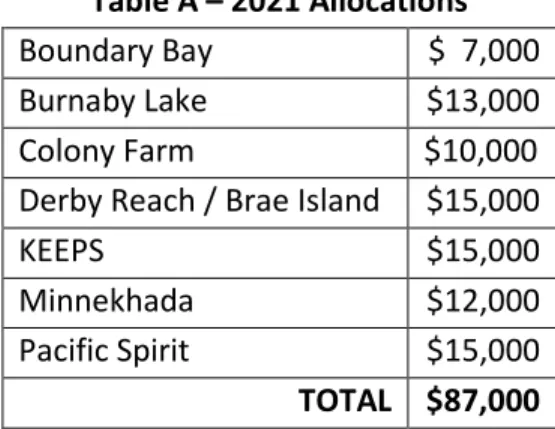
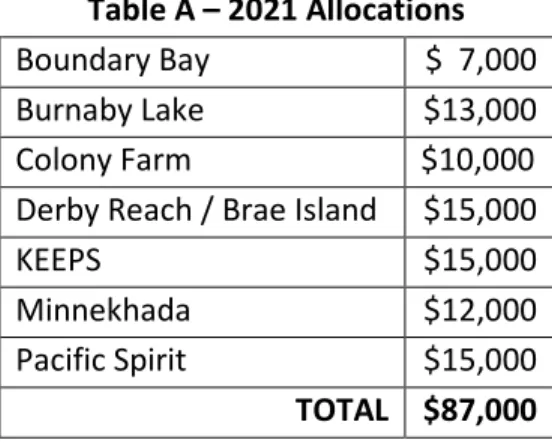
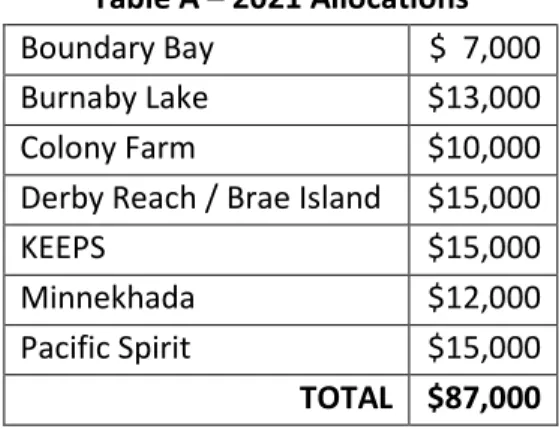
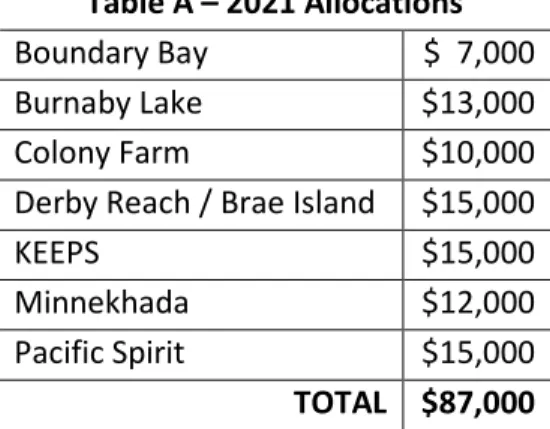
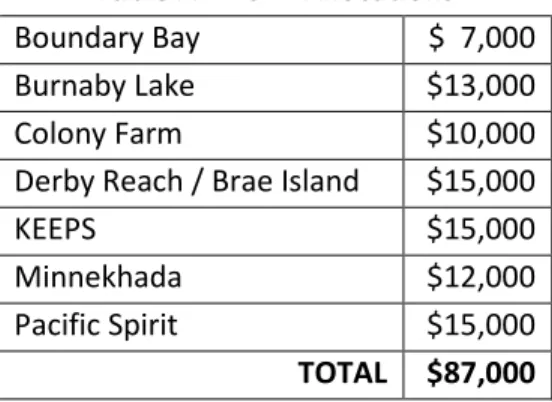
This contribution agreement proposes a one-year funding amount of $7,000 to the Boundary Bay Park Association. Boundary Bay Park Association Contribution Agreement Regional Parks Committee Regular Meeting Date: 17 June 2020 Page 4 of 4.
ATTACHMENT
Any liability for GST and/or PST claimed in connection with this Agreement shall be the responsibility of the Recipient. The recipient's business books are maintained in accordance with generally accepted accounting practices.
ATTACHMENT
The Recipient shall report to the MVRD in accordance with the reporting requirements of the Annex B attached hereto. At the end of the term, a member of the parks association must prepare a presentation to the regional parks committee with a summary of achievements.
ATTACHMENT
The grantee's goal is to protect and nurture, in perpetuity, Colony Farm Regional Park while maintaining the principles of the Agricultural Plan. Upon termination of MVRD in accordance with this Section 3.5, Recipient shall promptly return all funds not expended in providing the Services. It is the recipient's responsibility to determine whether it should be registered for GST and/or PST purposes.
The Minnekhada Park Association will submit an annual report to MVRD during the term of the agreement.
ATTACHMENT
This Agreement may not be amended or modified except by written agreement between the parties. This report provides an overview of the workshop and discusses next steps and specific considerations for regional parks. The organization's ability to benefit from potential stimulus funding Regional Parks considerations.
In response to the guidance received, staff will create a set of options to address the Board's concerns.
ENGAGEMENT PROCESS
The plan was intended to provide a framework for the plans and measures of municipalities, MVRD and other organizations by connecting greenways across municipal borders. Over the years, Metro Vancouver has implemented portions of five (5) regional greenways identified in sector plans. The planning framework defines the context of the plan and describes the plan's vision, goals and criteria for mapping.
The implementation framework outlines a collaborative management and funding approach, identifies the roles of Metro Vancouver, municipal jurisdictions and other partners to support the implementation of the plan, and a 5-year action plan.
ENGAGEMENT PROCESS
Regional Greenways 2050 - Draft Plan and Phase 2 Engagement Process Regional Parks Commission regular meeting date: July 15, 2020. That the MVRD Board approve the draft Regional Greenways 2050 Plan and authorize staff to proceed with the public engagement process as presented in the report dated June 11, 2020 entitled. That the MVRD Board receive the June 11, 2020 report entitled “Regional Greenways 2050 – Draft Plan and Phase 2 Engagement Process” for information purposes and provide staff with alternative directions.
This report provides the MVRD Board with a draft of the Regional Greenways 2050 Plan as well as a summary of the results of Phase 1 events that contributed to the development of the draft plan.
Regional Greenways 2050
ATTACHMENT 1
Contents
1 Summary
2 Covid-19
3 Introduction
- Greenways in Metro Vancouver
- Challenges & Opportunities
- Benefits of Greenways
- Metro Vancouver Context
1999 The Metro Vancouver Board adopted the Greater Vancouver Regional Greenway Vision, which detailed the region's goals for a network of recreational greenways. Realization of the regional greenway network can help protect some of these remaining natural areas and promote ecosystem connectivity. Development of the regional greenway network will protect some of the region's remaining natural areas, improve ecosystem connections, support biodiversity and make room for ecological restoration and blue-green infrastructure development.
The development of a regional network of greenways can help the region achieve its goal of reducing greenhouse gases.
4 Engagement
The regional district achieves this by serving as the regional federation, providing core services and planning for the region. Between 2001 and 2016, the regional population grew from 1.9 million to 2.5 million people and regional growth is expected to add another 1.2 million people by 2050. Metro Vancouver 2040: Shaping Our Region (Metro 2040), the regional growth strategy, represents the collective vision for how the region will accommodate this growth.
The Regional Greenways Plan supports ecological health framework strategies that aim to improve ecosystem connectivity, conserve habitat for species and ecosystems, promote green spaces within communities, and increase natural and built green infrastructure.
5 Inter-regional Trails & the Regional Cycling Network
- Major Bike Network
- Experience the Fraser
- The Great Trail
- Lochside Regional Trail
- International Trail Networks
First described in Cycling for All - the Regional Cycling Strategy (2011), the Major Bike Network (MBN) is TransLink's cohesive, well-connected network of major cycleways. The Great Trail traverses Metro Vancouver communities and portions of it are aligned with local greenway trails. This comfortable and scenic trail has a gentle grade and is a popular destination for Metro Vancouver cyclists.
Metro Vancouver borders Washington State along its southeastern edge, where three international border crossings with the United States are located.
6 Regional Greenways
This type of greenway segment tends to be found in low to medium density urban areas. This type of greenway segment tends to be located in Metro Vancouver's rural and agricultural communities. Often located on drainage structures such as levees, the paths in these segments tend to be unpaved, and the landscaped portion covers a larger portion of the cross section and is commonly composed of a.
This type of greenway segment is usually located in Metro Vancouver's rural communities or conservation areas.
7 The Regional Greenways Plan
- Vision
- Plan Goals
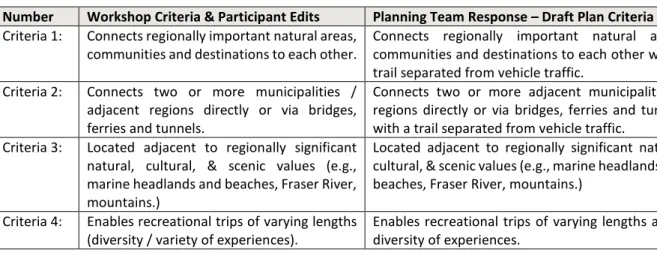
- Plan Criteria
- Greenway Network
- Existing Conditions – Greenway Operational Status Map
- Connections – Greenway & Bike Network Destinations Map
Based on the regional greenway definition and the above objective statements, these criteria were tested and refined during the joint planning process. The Regional Greenway Network is a 30-year vision for recreational trails that support walking, cycling and, where appropriate, horse riding (Map 1). The regional network of greenways consists of approximately 830 kilometers of multi-use paths, of which approximately 480 kilometers or 52% are currently operational.
Together, the Regional Greenway Network and Major Bike Network provide residents with cycling and walking connections to many major parks and protected areas, city centers and other important destinations.
8 Site Planning & Design
The following map (map 3) shows how the two networks work together to provide recreational and utility cycling links to many key regional destinations.
9 Governance & Funding
Municipalities are developing parts of the regional Greenway network, the large cycle network and the neighborhood and community routes that provide local links to the two regional networks. Reflecting the governance model described above, the development and operation of the regional Greenway network is funded collaboratively without formal coordination. The majority of funding is provided by agencies with direct responsibility for providing greenway services for recreation and active transportation (e.g., municipalities, TransLink, and Metro Vancouver Regional Parks).
The funding levels reflect available funding sources, land use development activities, as well as each agency's individual plans and priorities.
10 Implementation Strategies and 5 Year Action Plan
Work with TransLink on implementation where the regional Greenway network and the main cycling network overlap. Explore opportunities for grants from TransLink, the province and others to support the development of municipal portions of the regional Greenway network. Work with Metro Vancouver, TransLink and others to monitor and report on the expansion of the regional Greenway network.
BC Ferries to support the connection between the Tsawwassen and Horseshoe Bay terminals to the regional greenway network.
11 Tracking Performance
12 Appendix A: Definitions
Roads to prosperity; Economic Impacts of Investing in Bicycle Facilities: A Case Study of North Carolina's Northern Outer Banks. Effects of new urban greenways on transportation energy use and greenhouse gas emissions: A longitudinal study from Vancouver, Canada.
Greenways 2050
Engagement Report—Phase 1
- INTRODUCTION
- SUMMARY
- ENGAGEMENT PROCESS
- ENGAGEMENT RESULTS
- October 3 rd Stakeholder Workshop
- Goals
This document summarizes the results of the phase 1 engagement activities for the Regional Greenways 2050 update project. This report summarizes the results of engagement activities conducted between fall 2019 and spring 2020 and is a key supporting document for the submission of a draft Regional Greenways 2050 to the Regional Parks Committee for review in July 2020. Metro Vancouver has phase 1 of engagement coordinated process for the Regional Greenways 2050 update in 2019 and 2020.
The Metro Vancouver-coordinated engagement process for the Regional Greenways 2050 update began in the fall of 2019 and concluded in the spring of 2020.
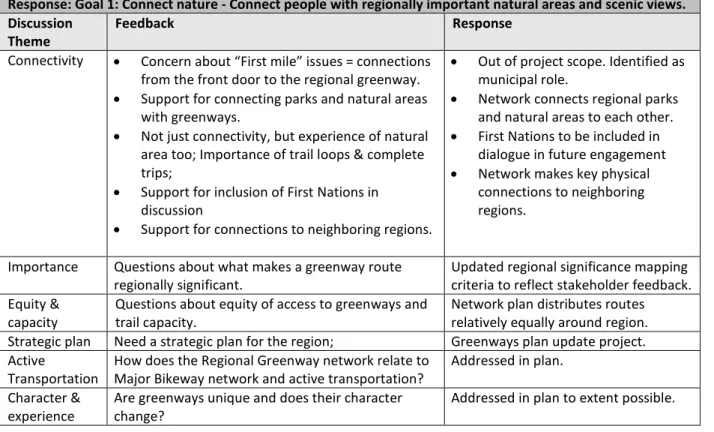
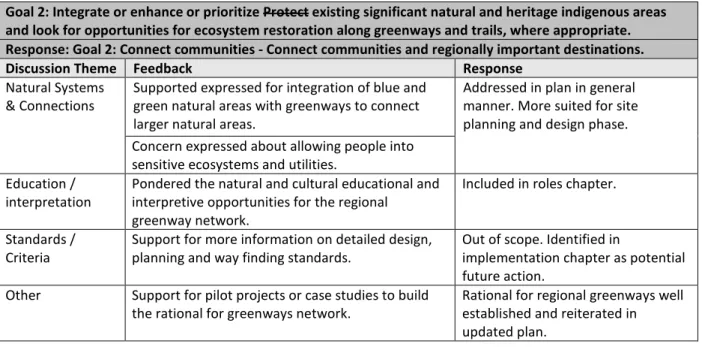
Proposed Goal 2: Protect existing natural areas and provide space for ecosystem restoration along greenways and trails
Proposed Goal 3: Provide Safe & Scenic Routes
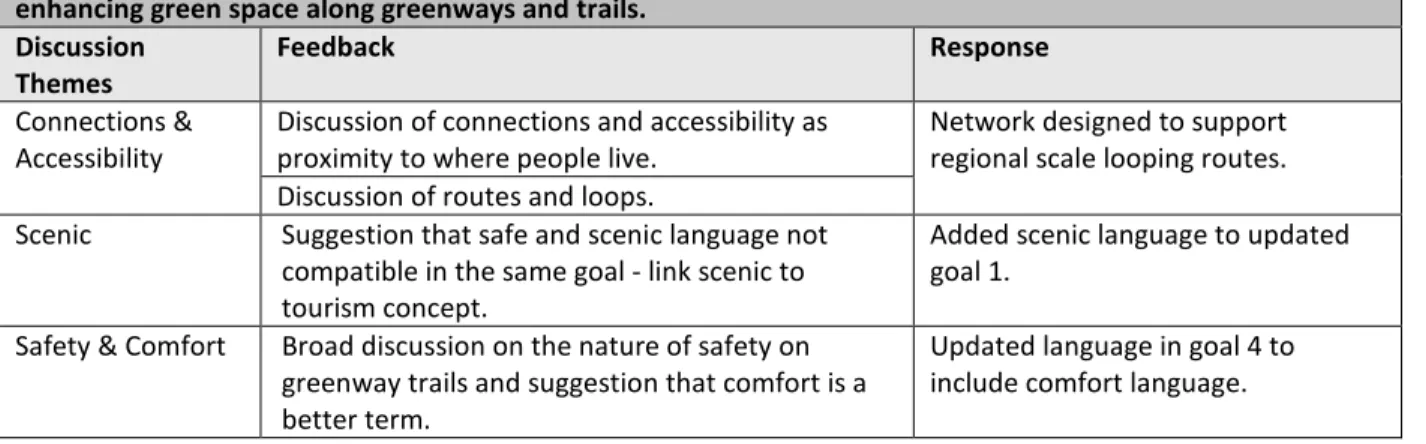
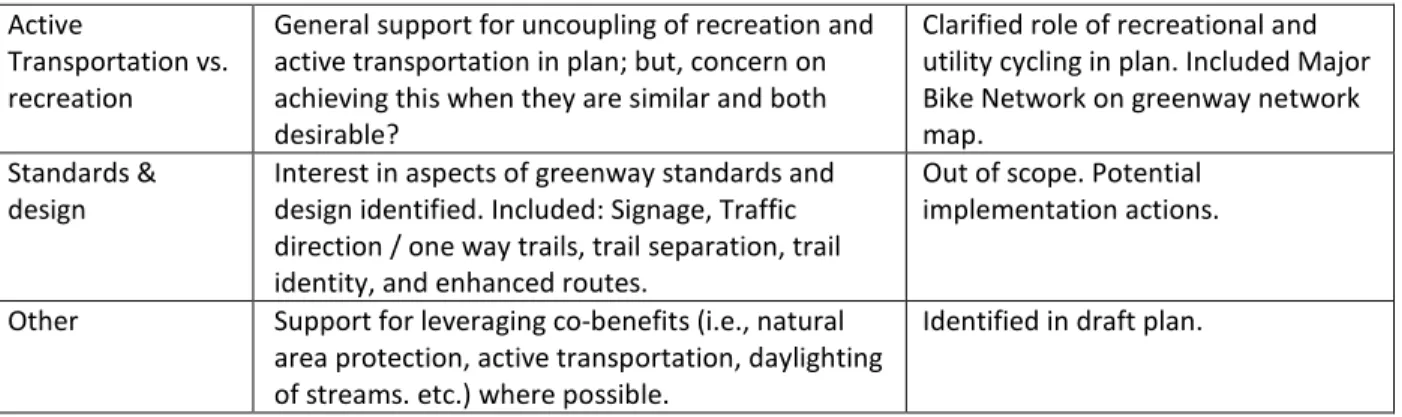
General support for decoupling recreation and active transport in plan; but worry about achieving this when they are similar and both are desirable. Other support for the exploitation of co-benefits (ie natural area protection, active transport, daylighting of streams, etc.) where possible.
Proposed Goal 4: Support a diversity of abilities and interests
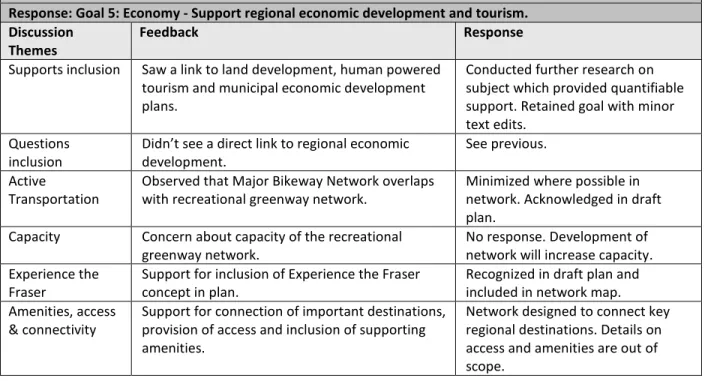
Proposed Goal 5: Promote Regional Economic Development and Tourism
Proposed Goal 6: Collaboratively Implement the Plan
- Criteria
- Roles
- Multi-use Pathway Market Survey
- Introduction
- Results
- Draft Plan Technical Review
- Regional Parks Advisory Committee
The State of the Assets Report for Buildings (Appendix 1) highlights future condition assessments for the next thirty years. Regional Parks – Asset Condition Report for the Building Parks Committee Regular Meeting Date: July 15, 2020 Page 2 of 3. The Building Asset Condition Report provides an overview of the inventory, condition and replacement cost of buildings in regional parks.
Regional Parks – State of the Assets Report for Buildings Parks Committee Regular Meeting Date: 15 July 2020 Page 3 of 3.
Regional Parks
State of the Assets
REGIONAL PARKS 5.8 ATTACHMENT 1
EXECUTIVE SUMMARY
CONDITION DEFINITIONS
Total cost of existing deficiencies Facility
Condition
Index = Replacement cost
BUILDINGS (MAINTAINED BY METRO VANCOUVER)
INVENTORY + ASSET VALUE
BUILDINGS BY GENERAL USE
BUILDINGS BY DETAILED USE
HERITAGE BUILDING STATUS
ASSET CONDITION (FACILITY CONDITION INDEX)
AVERAGE CONDITION BY DETAILED USE
6.8% FAIR
PROJECTED RENEWAL EXPENDITURE
30-year Facility Condition Index Models
30-year Funding Gap
BUILDINGS (MAINTAINED BY OTHERS)
TYPES OF BUILDINGS MAINTAINED BY OTHERS
Establishing asset management principles and a framework that balances asset performance, risk and cost when delivering regional park services. Metro Vancouver Regional Parks manages a system of regional parks, regional greenways, ecological conservation areas and regional park reserves. Built assets are built/designed to protect natural resources and allow people to connect to regional parks.
For example, buildings, bridges, and trails help provide regional park services, and retaining walls and barriers help protect natural assets.
BOARD POLICY
ATTACHMENT 1
The purpose of the park management plan is to outline the program, services, development and conservation priorities of the regional park. Alternative documents provide a fraction of the framework and guidance found in full park management plans.
ATTACHMENT 2