
Minutes of the regular meeting of the Metro Vancouver Regional District (MVRD) Regional Parks Committee held at 9:01 am. This Operating Agreement will automatically terminate on the end date of the MVRD Land Acquisition Agreement.
INTERPRETATION 1 Definitions
ATTACHMENT
ABBOTSFORD DISPOSAL OF EASTERN PORTION OF ALDERGROVE PARK LAND AGREEMENT THIS AGREEMENT shall take effect from the "Effective Date"). This Agreement shall be effective as of the Effective Date and shall terminate on the 1st anniversary of the Termination Date.
CONFIDENTIALITY 1 Public Announcement
Abbotsford acknowledges that the MVRD is receiving the fee simple lands for regional park purposes and hereby consents to any future dedication of the Fee Simple Lands as a regional park by the MVRD pursuant to section 278 of the Act or otherwise. The parties agree that, as of the Closing Date, the Aldergrove Park - East Operating Agreement shall automatically and without further instrumentality be void and fully terminated.
DISPUTE RESOLUTION 1 General
A decision of an arbitrator under this Agreement, including any decision as to costs, shall be final and binding on the Parties. Each Party agrees to continue to perform its obligations under this Agreement while any dispute is resolved, unless and until such obligations are terminated by the termination or expiration of this Agreement.
GENERAL 1 Notices
The preparation of the annual report is identified as a priority action in the 2019 work plan of the Regional Parks Commission. It provides an overview of the Regional Parks' visitor and facility use, programming, volunteerism and activities in 2018.
Regional Parks Annual Report
REGIONAL PARKS 5.3 ATTACHMENT
Part of the Aldergrove Regional Park land base was also transferred, but remains managed by Metro Vancouver. With our advisors we won an award for the innovative design of Surrey Bend Regional Park.
What a year it was for
Our regional park partners, along with more than 7,000 volunteers, have contributed nearly 26,000 hours of management, education and interpretation programs. Despite smoky skies in the month of August 2018 due to provincial wildfires, total visits to regional parks and greenways (excluding those transferred) increased to 11.7 million.
Metro Vancouver Regional Parks
2018 brought significant changes to our system, with the transfer of parks outside the Metro Vancouver Regional District to the Fraser Valley Regional District and the City of Abbotsford: Sumas Mountain Interregional Park, Matsqui Trail Regional Park and the eastern portion of Glen Valley Regional Park – 7% of our system. We have developed a bold Regional Parks Land Acquisition 2050 strategy to identify unprotected natural areas that have high conservation value and can become future park land.
The Necessity of Nature
The Sharing of Expertise StewardshipWellness
Our ValuesOur Role
Protecting Metro Vancouver’s natural areas and connecting people with them
Ecologically protected areas without public access LSCR (Lower Seymour Conservation Reserve) Regional Park Reserves Limited public access.
Growing our System
Regional Park Land
7.57 million
Our Foundation
2018 Accomplishments
Support from Pacific Parklands Foundation has
Regional Parks Provide Significant Value
Total 2018 Budget: $46.2 million
15.7 million
30.5 million
Building and Maintaining Park Facilities
Protecting Important Natural Areas
13,557 Hectares Protected Including 9,644 Hectares of
22 Regional Parks
5 Regional Greenways
3 Regional Park Reserves
2 Ecological Conservancy Areas
Regional Parks Ecosystems
Natural Resource Management
2018 Natural Resource
Management Accomplishments
Project Spotlight
Safe Regional Parks and Visitor Experiences
Managing Parks Today and into the Future
Grouse Mountain Regional Park
Connecting People with Nature
Visits
Park Visits in 2018*
Visitation was 3.2%
12% rise in Spring use from 2017
7 Regional Parks & 3 Regional Greenways Received Record Number of Visits
Record monthly use in March, May
Annual Trends
Visits by Month
Visits by Location
I feel this program motivated our group to connect more with nature
Programs and Events
Total Participants
Total Programs
Metro Vancouver Programs
2018 Highlights
49,857 Participants
Nature Houses
Group Programs
Public Programs
Events
905 Programs
Park Association Programs
10,762 Participants
152 Programs
128,322 guests
1,163 groups
We’ve been coming here for 40 plus years. They do a
Volunteering
Stewardship Volunteering
Total Volunteer Hours
Total Volunteer Instances
Stewardship Activities
28 tons of
11,922 Volunteer Hours 3,380 Volunteer Instances
Park Association Volunteering
3,102 Volunteer Hours 562 Volunteer Instances
Public Program Volunteering
1,332 hours to support the Campbell Valley Nature House and
Pacific Parklands Foundation - A registered charity dedicated to the preservation and enhancement of Metro Vancouver's regional parks. Catching the Spirit Youth Association - a non-profit organization dedicated to developing leadership and social responsibility in young people through environmental awareness, stewardship and outdoor recreation. 7 Park Associations – nonprofit groups that work with regional park staff on projects and activities ranging from habitat restoration to nature education.
Partnering with Communities
I feel like [teaching kids about their local creek] is something
In 2018, Metro Vancouver Regional Parks
Protected 13,557 hectares of natural areas and
Connected nearly 12 million visitors with nature
ATTACHMENT
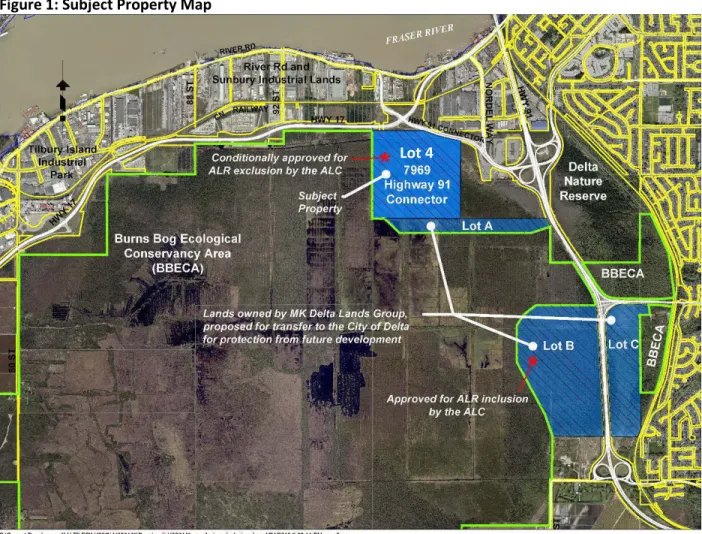
Subject: Request for change of use of Metro 2040 land by the City of Delta - MK Delta Lands. Subject: Request for change of use of Metro 2040 land by the City of Delta - MK Delta Lands. To provide Metro Vancouver staff analysis and recommendations for consideration by the Regional Planning Committee and MVRD Board of Directors regarding the proposed rezoning of the City of Delta's Type 3 land to Metro Vancouver 2040: Shaping Our Future (Metro 2040), a regional growth strategy, for MK Delta Lands ( Annex 1).
On February 12, 2019, the City of Delta submitted a proposed Metro 2040 amendment to Metro Vancouver for the property located at 7969 Highway 91 Connector (Attachment 2).
ATTACHMENT
Metro 2040 land use change request from the City of Delta – MK Delta Lands Regional Planning Committee regular meeting date: April 5, 2019 Page 2 of 9 Metro 2040 land use change request from the City of Delta – MK Delta Lands Regional Planning Committee regular meeting date: April 5, 2019 Page 3 of 9. Change of area designation Metro 2040 Request from Delta Municipality – MK Delta Lands Regional Planning Committee Ordinary meeting date: 5 April 2019 Page 4 of 9.
The City of Delta and the owner are working with Agricultural Land Commission staff to finalize the terms of the approval.
CREATE A COMPACT URBAN AREA
Metro 2040 states that an ALR exclusion must be granted before Metro Vancouver can process an application to change from the Metro 2040 agricultural designation (Section 2.3.4). The proposed Metro 2040 amendment also triggers the need for a revised Regional Context Statement from the City of Delta so that the mapping in the city's OCP, RCS and Metro 2040 will be consistent. Consideration has been given to each of the five Metro 2040 goals and applicable strategies, which are summarized below.
Metro 2040 Land Use Designation Change Request from Delta City – MK Delta Lands Regional Planning Committee Ordinary meeting date: April 5, 2019 Page 5 of 9.
SUPPORT A SUSTAINABLE ECONOMY Strategy 2.2: Protect the supply of Industrial land
PROTECT THE ENVIRONMENT AND RESPOND TO CLIMATE CHANGE IMPACTS Strategy 3.1: Protect Conservation and Recreation lands
The environmental impact assessment for the property in question was prepared by Environmental Dynamics as part of the proposal. The proposed development of the subject property will require up to 6 m (20 ft) of fill to raise the elevation and offset the expected 3 m of ground subsidence. Metro Vancouver staff recommends that additional information be sought from the City of Delta regarding potential impacts and planned mitigation efforts for the addition of fill.
Staff also recommends that the City Impact consult with the Burns Bog Scientific Advisory Panel regarding these potential impacts.
SUPPORT SUSTAINABLE TRANSPORTATION CHOICES
Metro 2040 land use change request from the City of Delta – MK Delta Lands Regional Planning Committee regular meeting date: April 5, 2019 Page 6 of 9 Metro 2040 land use change request from the City of Delta – MK Delta Lands Regional Planning Committee regular meeting date: April 5, 2019 Page 7 of 9. That the MVRD board reject the proposed change for MK Delta areas and notify the Delta city of the decision.
Metro 2040 Land Rezoning Request by City of Delta - MK Delta Lands Regional Planning Committee Regular Meeting Date: April 5, 2019 Page 9 of 9 .
Urban Containment Boundary and General Urban Areas
Industrial and Mixed Employment Areas
Local Centres, Hospitals and Post-Secondary Institutions
- ATTACHMENT 2
CITY OF DELTA
Promote land development patterns that support a diverse regional economy and employment close to where people live
These privately owned lands are currently located outside the Burns Bog Ecological Conservancy Area. A covenant would be registered on the subject property, which would require the implementation and monitoring of the proposed mitigation measures. A fence would be erected at the top of the slope to prevent public access to the perimeter buffer areas and the adjacent Burns Bog.
To provide the Regional Planning Committee and MVRD Board with an overview of the proposed scope and process for the Metro 2040 Environmental Policy Review.
ATTACHMENT
That the MVRD board receives for information the report dated 22 March 2019 entitled "Metro 2040 Environment Policy Review - Scope and Process". Metro 2040 Environmental policy review – Scope and process Regional planning committee ordinary meeting date: 5 April 2019 Page 2 of 3. Metro 2040 Environmental policy review seeks to determine whether and to what extent the policies in the regional growth strategy can be adjusted to better support the region's shared environmental goals.
The scope of the policy review will focus on Strategy 3.1 Protect conservation and recreation lands, and Strategy 3.2 Protect and enhance natural features and their connections, including related maps.
Evaluation and research (Spring 2019)
The policy review will consist of three main phases: 1) background research, 2) a policy forum, and 3) exploration of policy options, as described below. Staff will engage the RPAC, the RPAC Environmental Subcommittee, and the Regional Planning Commission throughout the process and report on the results at each stage.
Policy forum (Summer 2019)
Metro 2040 Environment Policy Review – Scope and Process Regional Planning Commission Regular Meeting Date: April 5, 2019 Page 3 of 3.
Policy options exploration (Winter 2019 – Summer 2020)
Together, the region's forests, fields, coastal and intertidal areas, wetlands and watercourses are integral parts of a habitat network for fish and wildlife. The region's diverse open space in mountain, coastal and river areas provides recreation and healthy lifestyle opportunities for residents and visitors. Protecting these natural features increases the region's ecological health and resilience in the face of climate change and natural hazard risks.
Designation of dedicated land use for conservation and recreation is intended to protect important environmental and recreational areas throughout the region.
Protect the Environment and
The strategies and actions recognize the importance of providing connectivity across the region that links important natural features and emphasize the joint efforts needed to protect and enhance natural assets. The strategy also addresses climate change in this section, noting that greenhouse gas reductions will be largely achieved through actions contained in the regional growth strategy, as well as actions in other Metro Vancouver management plans. The regional growth strategy's most important contributions to climate change mitigation will be achieved through a continued focus on urban retention and land use patterns that support sustainable transport and reduce energy consumption.
Climate change adaptation policies, such as protection for vulnerable coastal floodplains, are included.
Respond to Climate Change Impacts
Many of Metro Vancouver's ecosystems are of global importance, providing internationally important fish habitat and key feeding and resting areas for migratory birds along the Pacific Flyway. The natural environment is important for habitability and sustainability, as well as for our sense of space. The strategy also addresses other natural hazards such as floods, mudslides, interface fires and earthquakes.
Protect Conservation and Recreation lands
Conservation and Recreation Areas
Protect and enhance natural features and their connectivity
Creative eenways m, function, nutrition Greenway eenways routes are mined together with efference only, see section 6.13.2. The region's natural assets are present in all regional land use designations and include globally important mudflats and tidal flats.
Encourage land use and transportation infrastructure that reduce energy consumption and greenhouse gas
Note: Figure for reference only, see section 6.13.2 Numbers relate to the applicable strategy in the Regional Growth Strategy.
Encourage land use and transportation infrastructure that improve the ability to withstand climate change
METRO VANCOUVER REGIONAL PARKS Summary of Events
June 2019
CENTRAL VALLEY BLUEWAY
WHAT’S A BLUEWAY?
Goal: Three Cities, One Blueway
Roadmap for Success
Three Creeks, One Ecosystem
Still Creek
Brunette Creek
China Creek
China Creek is currently buried in the False Creek Flats, but is protected by easements on the addresses of all properties through which it flows. False Creek Flats apartments are expected to undergo significant renovations in the coming years, which could potentially begin to illuminate China Creek during the day. The establishment of blueways would contribute to Vancouver Parks and Recreation Services' master plan goal to "create a green network that will connect our parks, waterfronts and recreation areas."
China Creek Daylighting Opportunities
Still Creek Success
New Westminster city staff are working with the Brunette Creek Study Advisory Group and other experts to ensure that this area of heavy industrial use for the past 130 years can co-exist with a salmon bearing fresh creek. The work remaining on Brunette Creek includes addressing soil contamination, improving fish habitat and water quality, providing floodplain management and increasing access to water for local residents. There is also an opportunity to connect the blue road to New Westminster Quay with a floating bridge.
Brunette Creek Improvement Opportunities
Intermunicipal Success
Benefits
The Path Forward
OPPORTUNITIES
Looking forward to this journey together
THANK YOU
