That the Regional Planning Board receive for its information a report dated January 7, 2021, entitled "Manager's Report". Minutes of the Regular Meeting of the Metro Vancouver Regional District (MVRD) Regional Planning Committee at 9:00 a.m. Minutes of the Regular Meeting of the MVRD Regional Planning Committee Friday, November 6, 2020 Page 3 of 7 5.2 Metro Housing 2040 Policy Review - Policy Recommendations.
Minutes of the regular meeting of the MVRD Regional Planning Committee held on Friday, November 6, 2020 Page 4 of 7 5.4 Metro 2040 Full recommendations for community policy review. That the Regional Planning Commission receive for information the report dated October 22, 2020, entitled “Manager’s Report”. Minutes of the regular meeting of the MVRD Regional Planning Commission, held on Friday, November 6, 2020 Page 7 of 7 10.
Provide the Regional Planning Committee with the priorities and work plan for the year 2021.
ATTACHMENT 1
Draft Metro 2050 Policies – Objective 3 (Includes Climate Research and SEI) In Progress Draft Metro 2050 Policies – Implementation Section In Progress Population, Housing and Employment Projections (Data Projections) In Progress Cost Burden Study accommodation and transport – Extension pending. Regional Industrial Land Implementation Tools - Pending Scope Ecosystem Services from Agricultural Land - Pending Scope Regional Land Use Assessment - Implementation Tools - Pending Scope. Ecosystem Services from Agricultural Land – Report pending Housing and Transportation Cost Burden Study – Report pending.
Regional Planning Committee
Terms of Reference
- ATTACHMENT 2
- Climate change considerations are not well-integrated throughout all goal areas of the regional growth strategy – Climate change and natural hazards strategies comprise 50% of Metro 2040’s Goal
- The regional role related to climate change adaptation and natural hazards is not well-defined in the regional growth strategy – In Metro 2040, Metro Vancouver’s role related to climate change
- Apply a ‘climate lens’ to the regional growth strategy
- Member jurisdictions are to specify how they will meet the current regional GHG
- Quantify the influence of land use and carbon storage on regional GHG
- Ensure policies aim to reduce energy consumption and GHG emissions based
- Identify and map regional-scale natural hazards, risks and vulnerabilities, and
- Encourage regional growth patterns that incorporate emergency management,
- Support regional flood management via the Fraser Basin Council’s Lower Mainland
- ATTACHMENT 1
- Scoping and GHG Emissions Reduction Target Amendment (Q4 2019 – Q1 2020)
- Research and Analysis (Q4 2019 – Q4 2020)
- Recommendations (Q4 2020 – Q1 2021)
- Application of the Climate Lens (Q4 2020 – Q1 2021)
- Climate change considerations are not well-integrated throughout all goal areas of the regional growth strategy
- The regional growth strategy is underutilized as a tool to meet the region’s new MVRD Board - adopted GHG emissions reduction target (a carbon neutral region by 2050)
- The regional role related to climate change adaptation and natural hazards is not well-defined in the regional growth strategy
- Require member jurisdictions to specify how they will meet the current regional
- Update the policies that aim to reduce energy consumption and GHG emissions
The Metro 2040 Climate Change and Natural Hazard Policy Review is one of several thematic policy reviews being conducted to inform Metro 2050. The purpose of the review is to identify ways in which the Regional Growth Strategy's climate change and natural hazard policies can be strengthened. The purpose of the Metro 2040 Climate Change and Natural Hazard Policy Review is to identify opportunities to strengthen the reduction of greenhouse gas emissions, adaptation to climate change and natural hazard policies in the regional growth strategy.
Climate Change and Natural Hazards Policy Review - Recommendations Regional Planning Committee Regular Meeting Date: 14 January 2021 Page 2 of 5 Climate Change and Natural Hazards Policy Review - Recommendations Regional Planning Committee Regular Meeting Date: 14 January 2021 Page 4 of 5 Climate Change and Natural Hazards Policy Review - Recommendations Regional Planning Committee Regular Meeting Date: 14 January 2021 Page 5 of 5
The aim of the Climate Change and Natural Hazards Policy Review is to reduce GHG emissions, strengthen adaptation to climate change and natural hazards policies in the regional growth strategy. Evaluate existing policies in the regional growth strategy from a reduction of GHG emissions, adaptation to climate change and natural hazards perspective;. The secondary focus of the Climate Change and Natural Hazards Policy Review is to assess each policy area in Metro 2040 through a "climate lens".
Consultant Report in Support of Climate Change and Natural Hazard Policy Development in Metro 2050 and
ATTACHMENT 2
This finding shows that while local and regional resilience is making progress, much of that progress has been made since Metro 2040 was first adopted. Fewer GHG mitigation policy gaps were identified as GHG mitigation policy is more advanced and strongly reflected in the key principles of Metro 2040. Key gaps in natural hazard resilience include a better understanding of the hazard risk involved in land use, enhanced cross-disciplinary and cross-stakeholder collaboration and information sharing and integration of future risks exacerbated by climate change into Metro 2040 goals.
To provide the Regional Plan Committee with an opportunity to discuss and provide feedback on the policy ideas arising from the Metro 2040 Implementation Policy Review. The review of the implementation policy is one of a series of reviews that will provide input to the regional growth strategy update, which is expected to be completed in mid-2022. The report on the scope of work for the policy review was received by the Regional Planning Advisory Committee (RPAC) on 20 March 2020 and the Regional Planning Committee on 1 May 2020 (Reference 1).
Metro 2040 Implementation Policy Review: Ideas for Exploration Regional Planning Commission Regular meeting date: January 14, 2021 Page 2 of 7. The purpose of the Implementation Policy Review is to identify implementation issues and opportunities to improve the efficiency and effectiveness of governance. The shared knowledge and experience of Metro Vancouver's member jurisdictions and staff gained in managing, implementing and adapting Metro 2040 since its adoption in 2011, as well as research, best practices and regulatory requirements, are taken into account .
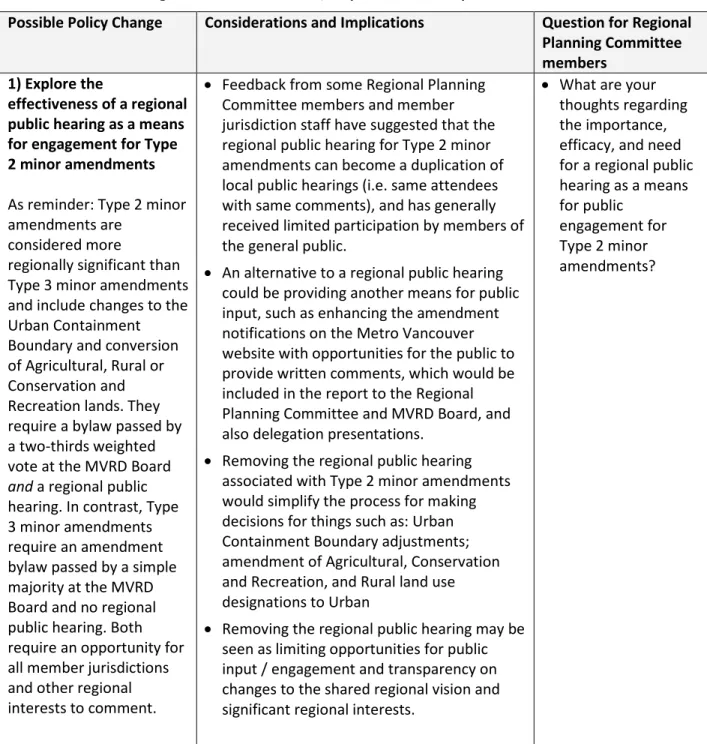
Metro 2040 Implementation Section Policy Review: Ideas for Exploration Regional Planning Committee Regular Meeting Date: January 14, 2021 Page 3 of 7 Some aspects of the Implementation Policy Review are based on the findings of the other thematic Metro 2040 Policy Reviews, such as . associated with voting thresholds, definitions and land use changes. Metro 2040 includes a three-step amendment process to guide the administration of proposed changes, both for policy changes and land use changes; in general, the more regionally significant the change, the more stringent the process.
Policy ideas should be considered in the context of recommendations from other Metro 2040 policy reviews. Metro 2040 Implementation Department Policy Review: Ideas for Research Regional Planning Committee Regular Meeting Date: 14 January 2021 Page 4 of 7 .
Explore the
Metro 2040 Implementation Section Policy Review: Ideas for Exploration Regional Planning Committee Regular Meeting date: 14 January 2021 Page 5 of 7.
Change the type of minor amendment from
Metro 2040 Implementation Department Policy Review: Ideas to Explore Regional Planning Committee Regular Meeting Date: January 14, 2021 Page 6 of 7 .
Increase MVRD Board weighted voting
Review the provision for municipal flexibility
- ATTACHMENT
That the MVRD Board receive the report dated January 5, 2021, entitled "Metro Vancouver Regional Industrial Lands Strategy - Endorsements" for information. The Metro Vancouver Regional Industrial Lands Strategy was approved by the MVRD Board on July 3, 2020. To provide the Regional Planning Committee and MVRD Board with a status report on the endorsements of the Metro Vancouver Regional Industrial Land Strategy by member jurisdictions and agencies.
After more than two years of research and collaboration, the Metro Vancouver Regional Industrial Lands Strategy (Strategy) was finalized and approved by the Metro Vancouver Board on July 3, 2020. The Metro Vancouver Regional Industrial Lands Strategy was approved by the MVRD Board on July 3, 2020 and was sent to member jurisdictions, agencies and other organizations for their approval and implementation. Metro Vancouver will continue to work with member jurisdictions and agencies to improve the recommendations of the Regional Industrial Lands Strategy.
Metro Vancouver Regional Industrial Lands Strategy – Executive Summary Metro 2050 Policy Overview Summary – Industrial and Mixed Employment Metro Vancouver – Industrial Lands website. The Squamish-Lillooet Regional District (SLRD) Council received blanket correspondence and the approved Metro Vancouver Regional Industrial Lands Strategy on August 6, 2020. THAT the Squamish-Lillooet Regional District Council supports the vision and general intentions of the Metro Vancouver Regional Industrial Lands Strategy. .
Thank you for providing a copy of the approved Metro Vancouver Industrial Lands Regional Strategy (“Strategy”) for approval and implementation by the Agricultural Land Commission (ALC). THAT the Regional Strategy for Industrial Lands be endorsed and staff be directed to consider options for implementing strategy measures as appropriate. Submitted by: Department of Community Development - Policy Planning Division Subject: Metro Vancouver Regional Industrial Lands Strategy.
To submit a request from Metro Vancouver Regional District Council for endorsement of the Regional Industrial Lands Strategy and implementation of relevant actions. On July 3, 2020, the finalized Regional Industrial Land Strategy (RILS) was approved by the Metro Vancouver Regional District Council (MVRD) and sent to member jurisdictions. Mayor Rob Vagramov and Council, City of Port Moody approved Metro Vancouver's Regional Industrial Land Strategy Page 2 of 2.
More information on the Regional Industrial Lands Strategy and related background material can be found on the Metro Vancouver website: www.metrovancouver.org (search "Industrial Lands").
Regional Industrial Lands Strategy – 10 Priority Actions for Implementation
The following events that fall under the remit of the Regional Planning Committee are included in the 2021 Leadership and Engagement Budget. Regional Planning Committee members are requested to submit their interest in virtually attending an event to the Committee Chair by January 24, 2021. The 2021 program for the conference has a number of sessions related to topics relevant to regional planning.
Many of Metro Vancouver's fastest-growing pre-pandemic industries were lower-skilled, temporary worker-dominated service industries, such as retail, tourism and hospitality. In the first six months of 2020, Metro Vancouver was one of the hardest-hit urban centers in Canada in terms of unemployment and economic output, as well as the hardest-hit region in British Columbia. Metro Vancouver as an organization also faces the challenge of ensuring that regional utility services are able to manage and respond to shocks and stresses and the urgent need to act on climate change.
Intended to cover the broad range of services undertaken by Metro Vancouver, the framework will capture synergies between departments and support continuous improvement. POLICY REVIEW SUMMARY - UPDATE TO METRO 2040: THE REGIONAL GROWTH STRATEGY Metro Vancouver has been working on a review and update of Metro Vancouver 2040: Shaping our Future (Metro 2040), the regional growth strategy, since mid-2019. The Regional Growth Strategy is the long-term plan for our regional federation, building on decades of shared regional planning goals and principles.
Summaries of the remaining policy review recommendations will be distributed as they are finalised. The purpose of the summaries is to provide all Regional Growth Strategy signatories (relevant member councils) with up-to-date information on the current process and policy guidelines for each thematic area in the Regional Growth Strategy. Metro Vancouver looks forward to continuing to work closely with member jurisdictions to update the Regional Growth Strategy and would be happy to meet with staff and/or council to present any policy areas or recommendations.
More information about the development of Metro 2050 and associated background material (Reference) can be found on the Metro Vancouver website: www.metrovancouver.org/metro2050. PRESENTATION ON COVID TRENDS AND INFORMATION AND IMPLICATIONS FOR PLANNING Staff is preparing a presentation, at the request of the Regional Planning Committee, to share data that provides insight into current trends related to CoVID-19 and long-term planning for our region.