That the Regional Planning Committee receives the report of 14. December 2021 with the title "Manager's report" for information. That the Regional Planning Committee receives for information the report of 18. October 2021 entitled "Increase of fines for illegal removal of trees".
ALTERNATIVES
That the Regional Planning Committee
Land Use Model Preparation and Software Purchase – Land Use Component: Regional Planning is developing a new regional land use model with the goal of improving population, housing, employment and land use forecasts, more accurate municipal distribution by traffic zone, and improved ability to model the land use of significant infrastructure investments and political portfolios. Behavioral model: In coordination with the regional land use assessment, this modeling work will seek to build assumptions that will inform the growth management and investment model by providing an analysis of what factors influence people's housing choices and the impacts that will have on urban growth and built form.
That the Regional Planning Committee endorse the work plan as presented in the report dated December 14, 2021, titled “2022 Regional Planning Committee Priorities and Work Plan” with the
Validation of data/projections: In support of Metro 2050, population projections and data require validation to ensure policy is prepared with the most up-to-date data. Planning Analytics staff will review this data and provide contextual analysis and reports based on the information released throughout the year.
FINANCIAL IMPLICATIONS
The committee will be updated on the status of the actions and projects in this work plan on a monthly basis according to the committee's schedule.
CONCLUSION
Regional Planning Committee 2022 Work Plan 2. Regional Planning Committee Terms of Reference
Regional Planning Committee 2022 Annual Meeting Schedule
Regional Planning Committee 2022 Work Plan Report Date: January 5, 2022
Priorities
Regional Planning Committee
Terms of Reference
Committee Responsibilities
Committee Membership and Meetings
Committee Management
Regional Planning Committee 2022 Annual Meeting Schedule
From: Sean Galloway, Director, Regional Planning and Constituency Services, James Stiver, Divisional Manager, Regional Land Use Policy, and. Subject: Comment on the concept of Metro 2050 and proposed next steps RECOMMENDATION .. a) receive for information the report entitled, "Comment on the concept of Metro 2050 and proposed next steps," dated January 7, 2021; and.. b) directed staff to present the Metro 2050 Bylaw for consideration of 1st and 2nd readings at the February 2022 Regional Planning Committee and MVRD Board meetings.
EXECUTIVE SUMMARY
PURPOSE
BACKGROUND
METRO 2050
RECENT ENGAGEMENT EFFORTS (JAN-NOV 2021)
Many presentations and meetings with Planning, Engineering and other staff groups at affiliated jurisdictions and other organizations in the region.
COMMENTS ON METRO 2050
Comments Received
Areas of Support
In addition, the vast majority of members, when expressing support for the update of the regional growth strategy, noted that Metro 2050 successfully builds on the existing regional growth strategy, promotes collective action on the critical issues facing the region, allows for necessary coordinated policy responses and is consistent with the strategic priorities and policies of the member jurisdiction.
Areas of Mixed Support and Concern
To assist with the review, Surrey Council is requesting that Metro Vancouver staff schedule a workshop with Surrey Council to provide an opportunity to review and ask questions regarding the draft Regional Growth Strategy - Metro 2050. In addition, Metro Vancouver staff have met with the District of North Vancouver and meet with Coquitlam staff to work through any outstanding areas of concern.
REVISIONS TO METRO 2050
- Removal of the Frequent Transit Development Area Sub-Types: The draft Metro 2050 included the addition of two FTDA sub-types called Corridor FTDAs and Station Area FTDAs
- Additional content related to Indigenous perspectives and priorities: Comments submitted by local First Nations and others identified multiple ways that Metro 2050 could better reflect
- Refinement of the Regional Affordable Housing Target: Policy Actions 4.2.3 and 4.2.7 a) have
- Refinement of policy 2.2.9 d) vi) allowing limited residential uses on Employment lands
That Surrey Council request that Metro Vancouver allow additional time for Surrey Council to review and fully understand Metro Vancouver's draft Regional Growth Strategy - Metro 2050, before the City comments on the strategy; and. In response to the decisions, Metro Vancouver staff worked with Surrey staff to schedule the workshop with Council as soon as possible.
PROCEEDING WITH METRO 2050 TIMELINE FOR APPROVALS
- That the MVRD Board
- That the MVRD Board
- Metro 2050 Issue-Response Table - Signatory
- Comment Letters and Emails Received on the July Draft Version of Metro 2050 7. Additional Edits Recommended by Metro Vancouver Staff
If the MVRD board chooses Alternative 2, Metro 2050 will not be completed within the board-directed timeline. Metro Vancouver received, reviewed and responded to more than 900 comments on the concept of Metro 2050.
Draft Metro 2050: Referral for Comment, Staff report dated May 25, 2021
If the MVRD Board chooses Alternative 1, Metro Vancouver will advance the approval process for Metro 2050 and strive to complete the update within this local government cycle (ie, before October 2022). Costs associated with the adoption of Metro 2050 including the required public consultation are included in the approved Regional Planning Budget for 2022.
Towards Metro 2050: Updating Metro Vancouver 2040: Shaping our Future, Staff report dated March 28, 2019
Metro 2050 does not propose any change to Metro Vancouver's role in land use planning. Map 11 (Sensitive Ecosystem Inventory) of Metro 2050 is not a concept map, as was the case for Map 9 (Regional Recreation Greenway Network) and Map 10 of Metro 2040. (Natural Features and Land Cover).
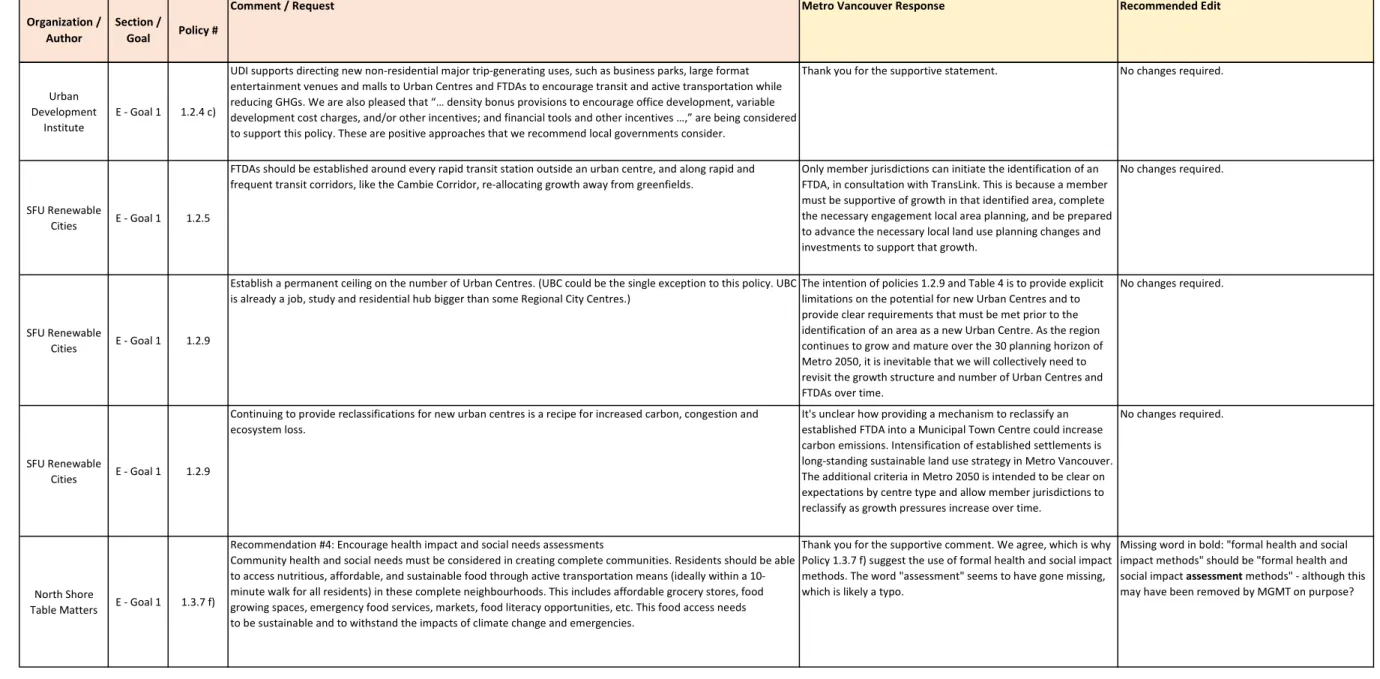
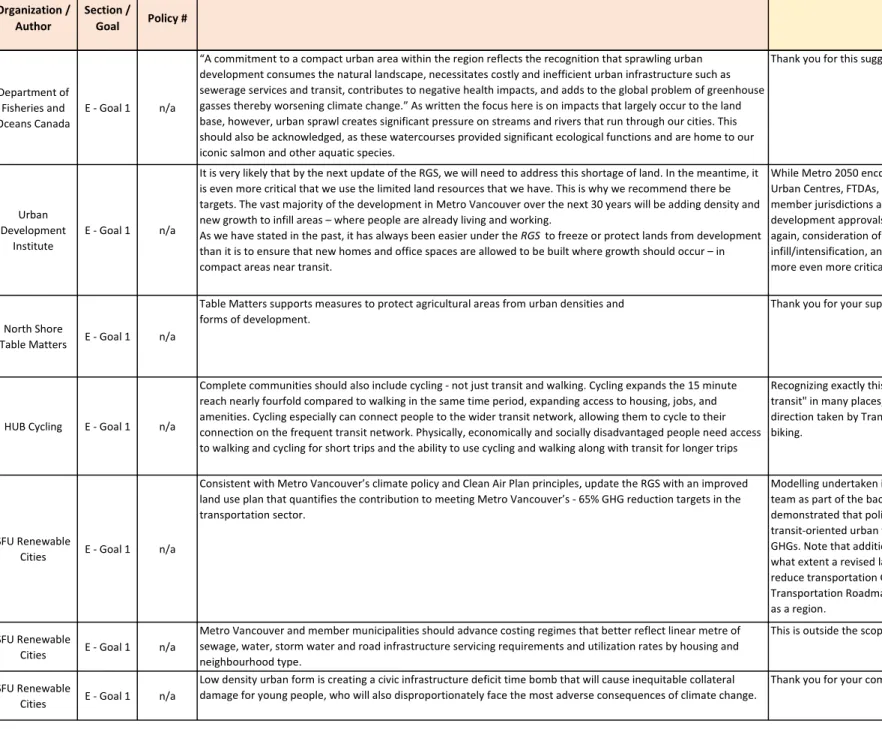
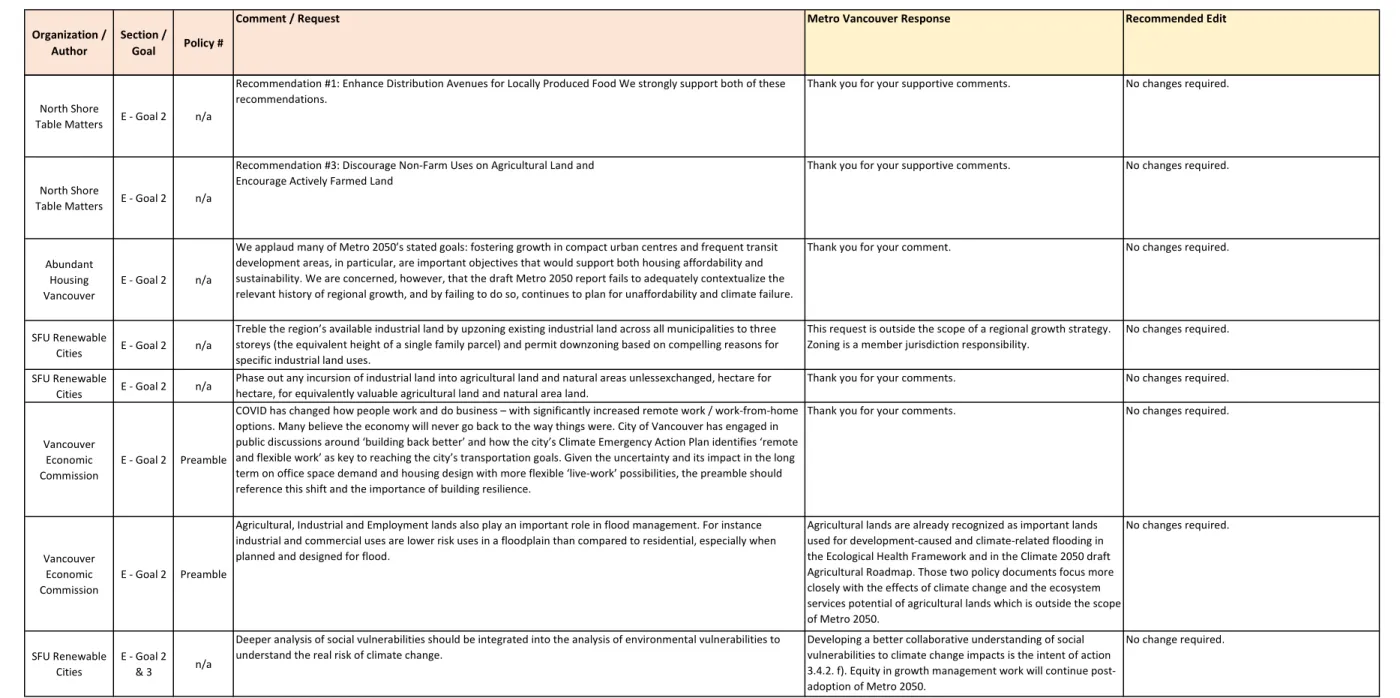
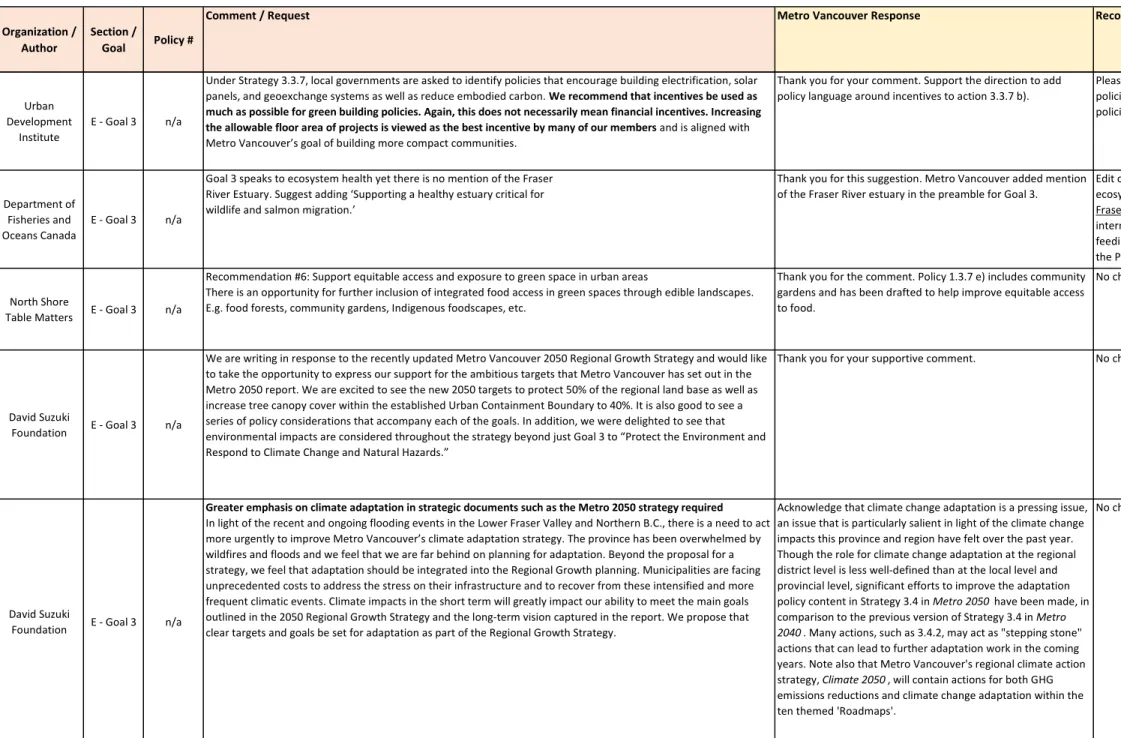
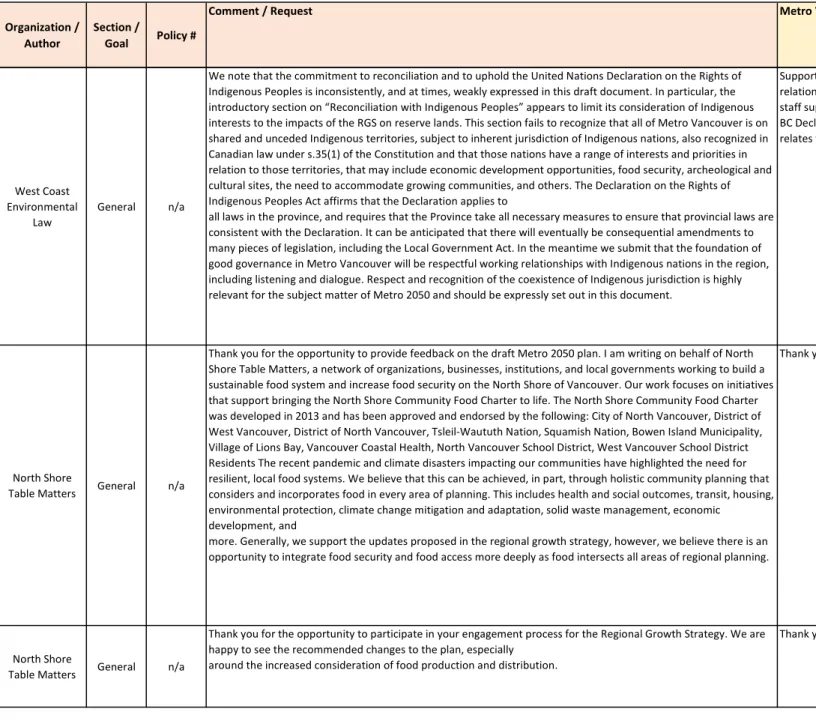
Organization /
Author Section /
Support a Sustainable
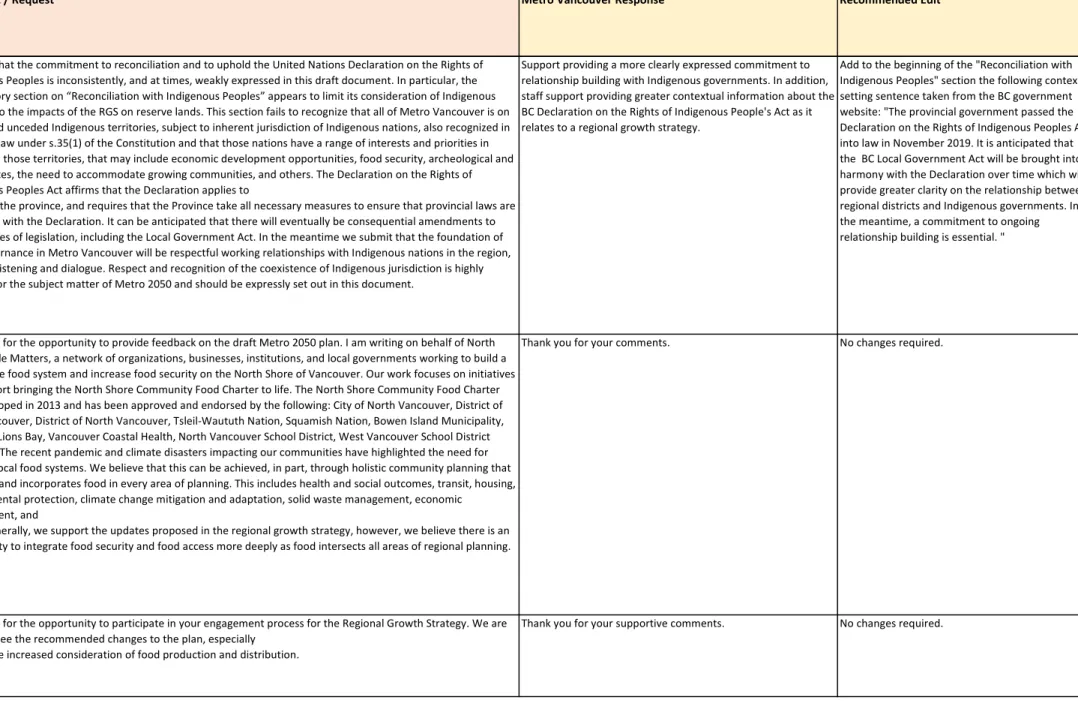
It is noted that some of the applications proposed here are mentioned in the Metro Vancouver Regional Food System Strategy, and the use of agri-tech solutions is widely supported in the Climate 2050 draft Agricultural Roadmap. Staff support in changing the photo on page 27 to better illustrate the Metro 2050 vision. An increased emphasis on rural areas within Metro Vancouver – the focus appears to be on urban centres; rural areas remain an integral part of the fabric that makes Metro what it is.
Inclusion of local production, distribution, and consumption of healthy food (in particularly where they are easily accessible to housing and transit services)
VCH does not consider community gardens to be key tools to support food security or local food production for those most in need. Community gardens provide many community benefits (eg social interaction, are teaching tools and help residents learn about food production, giving them improved food skills and food knowledge, and can improve access to fresh produce for some people), but the most meaningful actions towards ensuring food secure communities are those that will help reduce the high costs of living in the region. This will do more to ensure that diverse residents of all incomes have access to affordable, nutritious and culturally appropriate foods.
Inclusion of affordable and accessible options with a key goal of addressing food security, particularly for those who are food insecure
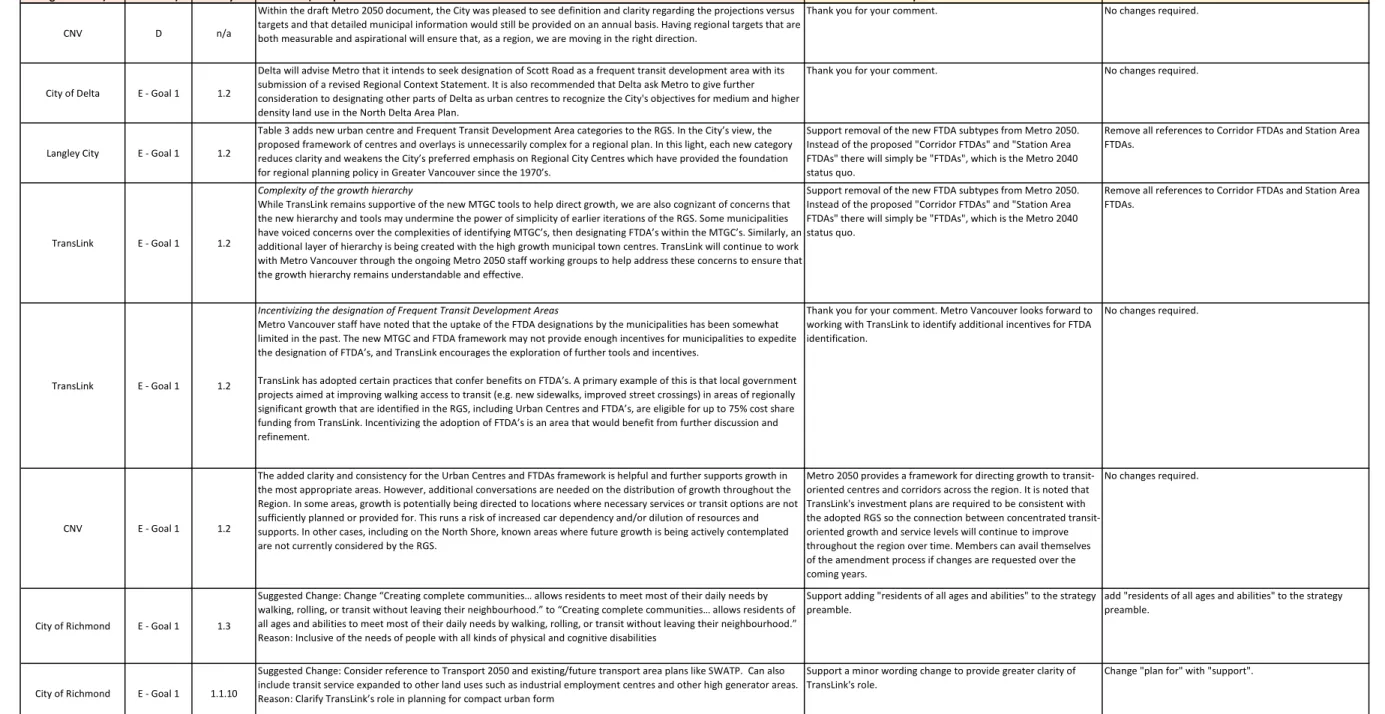
Suggest mentioning the challenges that COVID and climate change have exacerbated in the region throughout the strategy and/or opening the most appropriate sections. MUNI – Land Use Planning and Management Branch Table 3 – Location for both types of FTDA says “up to 1,000m” but Table 4 criteria for becoming an FTDA says 800m for Corridor FTDA and 1,200m for Station Area FTDA. MUNI – Land Use Planning and Management Branch Table 4 – Criteria for High Growth City Municipal Center – states “Existing rapid rail transit service”. But situations – like currently with SLS – where rail rapid transit is planned (or under construction) but not yet in service.
Section 2.2 of Metro 2050 as well as the approved actions in the Regional
The University is interested in ensuring that the new measures of population + employment density also reflect the student population. Capturing them in measures to estimate campus population would also allow UBC to explore reclassification to a City Center or High Growth Center under Metro 2050, reflecting the University's significant role as a regional destination, employer and provider housing.
Strategy 2.3 Protect the supply of agricultural land and strengthen agricultural viability, page 48 “Protecting land for agricultural production is essential for the viability of the agricultural industry and a resilient region
Farms that use seasonal foreign workers are required to provide housing for workers who are often in- Notwithstanding the caveats in a) and b) of 2.3.1, suggest consideration of potential conflicts between the policy articulated here and possible future changes in housing standards for foreign workers (eg, reports more high bathroom-worker). Following the adoption of Metro 2050, any future application to expand regional sewer services may consider changes that may have been made to federal regulations or provincial legislation regarding the housing of seasonal foreign workers on agricultural land.
Page 42 ‐ first paragraph, change 2nd sentence to read
Moreover, the implementation of the approved actions of the Regional Strategy for Industrial Countries is ongoing. Once Metro 2050 is adopted, the implementation of the trade-oriented overlay will be up to Member States to use in their own context. This and all Metro 2050 objectives and strategies must be implemented over the life of the plan.
Replace 2.2.9d v) and vi) with this new text for 2.2.9 d)v)
- Agree that indicating where the ALR boundary falls within the member
- In this policy review summary, Metro Vancouver states that, “the recommendation to prevent such conflicts can be achieved by carefully planning the edges of agriculture and adjacent properties and adding buffers
It is essential that the region follows the Metro Vancouver 2050 Climate and Clean Air Plans to meet the 45% Climate 2050 goal. Metro Vancouver has previously advocated for the province to provide policy guidance or establish a provincial program to acquire existing affordable rental housing . Housing availability and affordability continues to be one of the most pressing issues in Metro Vancouver.
G ‐ Performance
Policy 6.7.1 indicates that Metro Vancouver will work with the Fraser Valley Regional District, the Squamish‐
UDI is not opposed to Metro Vancouver maintaining the current boundaries of the Urban Containment Boundary (UCB). Metro Vancouver's role is to advocate for the use of the HIA practice in general. Metro 2050 is the first Metro Vancouver regional growth strategy to include a stand-alone housing goal, a reflection of the increasing urgency of housing affordability pressures across the region.
UDI recommends Metro Vancouver review the Panel's work to determine if Metro 2050 growth projections should be reassessed. Metro Vancouver has a new service, Invest Vancouver, specifically aimed at addressing economic and employment issues in the region.
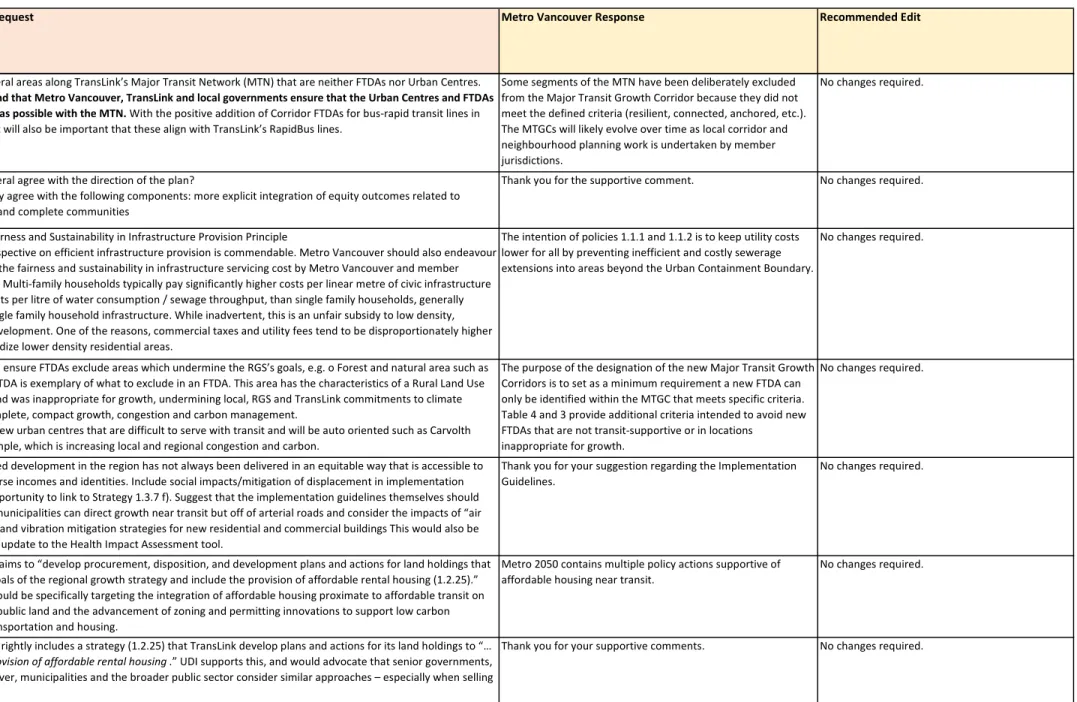
Author Section / Goal Policy #
Action 3.2.3 commits Metro Vancouver to "Manage Metro Vancouver assets and collaborate with member jurisdictions,
The actions in 3.2.7 are for affiliated jurisdictions. Metro Vancouver will share your comments for consideration. This comment has also been forwarded to Metro Vancouver's Department of Air Quality and Climate Change for consideration in the Climate 2050 Energy Roadmap. Note that these solutions are within the scope of Metro Vancouver's Climate 2050 Nature and Ecosystems Roadmap (forthcoming). Please refer to Table 1 in the Climate 2050 Nature and Ecosystems.
PAGE 8: ‘CHANGING GENERATIONAL PREFERENCES AND BEHAVIOURS’
EQUITY LANGUAGE
The biggest driver of population growth in Metro Vancouver is immigration, which is beyond the control of a regional district. The primary driver of population growth in Metro Vancouver is immigration, which is beyond the control of a regional district. The legal requirement that most of the region's residential areas be SFH only must be ended.
SFU ‐ REM 642
Section 2.1. 3 makes reference to exploring fis cal measures including report to ensure that the property
And if desired, the municipality can initiate a regional land use designation change for a specific area through a change process established in the regional growth strategy. If desired, the municipality can initiate a zoning change for land outside this area through a change process that is laid down in the regional growth strategy. And if desired, the municipality can initiate a regional land use designation change for a specific location through a change process defined in the regional growth strategy.
Delete 2.2.9d)vi) and revise 2.2.9d)v) to read
A n d the wish, the municipality can initiate a regional land use ... designation change for specific sites through an amendment process defined in the regional growth strategy. If desired, the municipality can initiate a land use designation change for lands outside of these through an amendment process defined in the regional growth strategy. The site is approximately 200 meters, as the crow flies to the northwest, from Rupe rt Skytrain station on the Millennium Line.
Delete 2.2.9d)vi) and revise 2.2.9 v) to read
We own 2625‐2645 Skeena Street and 2772 Natal Street (site) in the Renfrew‐Collingwood neighborhood of the City of Vancouver. We recognize the importance of employment-generating land uses in the city, especially near transit, and will not seek to replace employment land with residential in this area. If we are pushing the growth of employment in the plan, we will have to plan a head of where all these new.
SFU ‐ RE M 642
Goals 2 (Economy) and 4 (Affordable housing). Caution about encouraging 'flexibility for affordable rental residential on employment lands near rapid transit stations.' Value of residential uses will uptick
There is also no mention of how Metro Vancouver will relinquish its role in managing regional parks. This comment will be forwarded to Metro Vancouver Regional Parks as it is outside the scope of the Regional Growth Strategy. Note that Metro 2050 establishes a commitment to meeting science-based GHG emission reduction targets (Strategy 3.3) as well as a renewed focus on resilience to climate change and natural hazards (Strategy 3.4) and there are many sides involved and must participate in the promotion of climate action in the region.