Consideration of the Village of Anmores Amended Regional Context Statement Regional Planning Committee Regular Meeting Date: 8 March 2019 Page 2 of 6 Consideration of the Village of Anmores Amended Regional Context Statement Regional Planning Committee Regular Meeting Date: 8 March 2019.
AN MORE ATTACHMENT
Refer Village of Anmore Official Community Plan Amendment By-law 590-2019 to the City of Port Moody, the Village of Belcarra, and School District No. Attached is a copy of the Official Community Plan Amendment Bylaw, which contains the amendments to the regional context statement, and the accompanying staff report outlining the Resort's rationale.
VILLAGE OF ANMORE REPORT TO COUNCIL
Purpose I Introduction
In the absence of any further information from the Ministry, the Anmore Village Council decided to start looking at the various processes that would need to be completed in order to connect AGE to the GVS&DD system. The Village has been communicating with AGE strata representatives since early December to reach an agreement on a Memorandum of Understanding (MOU).
Discussion
Office Development in Metro Vancouver's Urban Centers – Regional Planning Commission Update 2018 Regular Meeting Date: March 8, 2019 Page 5 of 7. The Office Development in Metro Vancouver's Urban Centers report is an update of the previous report completed in 2015.
Executive Summary
Introduction
Report Purpose
Methodology and Research Questions
What are the regional directions and trends for office development location?
Rapid transit station locations attract office development because they can offer downtown transit accessibility, but at a lower cost. Urban centers offer a full range of features and amenities that stand-alone transit station locations may not.
What are the benefits of locating office space within Urban Centres?
While access to rapid transit stations is becoming increasingly desirable, the appeal of transit locations is not the same. Proximity to a rapid transit station (i.e. SkyTrain) is an improvement over a freeway location with limited transit service, but these rapid transit station locations alone do not always provide a mix of supportive land uses and the presence of urban amenities.
What are the problems with locating office space outside of Urban Centres?
Reflecting market demand, there are relatively few new office parks in the region outside urban centers in locations with poor transport and limited amenities; And. Finally, locating office jobs and activities in office parks may hinder the growth of the region's urban centers.
How are office market trends evolving?
For employees too, it is preferable to be in a city center rather than working in an office park, both in terms of the larger facilities and transport options. Office tenants are increasingly selecting and paying a premium for urban areas in an effort to attract and retain a talented workforce.
What tools do governments have to support office development in Urban Centres?
- Stakeholder Perspectives
- Interview Participants
Given the steady population, employment and economic growth in Metro Vancouver's limited land base, focusing development in urban centers is an important element of a regional growth strategy. For reference, map 1.1 shows the location of city centers and the frequent transport network (rail and bus) (FTN) in the region.
Metro 2040 Urban Centres and Frequent Transit Network
- Metro Vancouver Office Market Profile and Characteristics
- Sub-Regional Profiles
- Regional Office Market Conditions
- New Office Supply - Significant Developments
- Office Tenant Types – Growth of Tech Sector
- Average Size of Office Tenants
- Growth of Co-working in Vancouver
- Growth of Strata Office Tenure
- International Investment in Real Estate
- Office Building Inventory
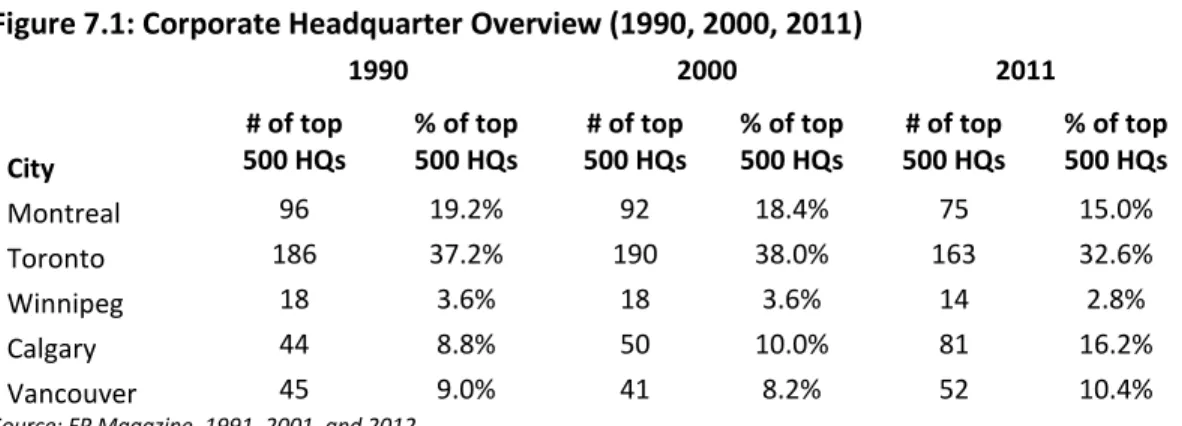
In terms of business headquarters, of the relatively few major headquarters in the region, most are located in downtown Vancouver. The database includes all buildings in the Metro Vancouver region with at least 10,000 square feet of office space.

Inventory Distribution by Sub-Region
The amount of office space near West Coast Express Stations was negligible and was not analyzed for this inventory. Based on the comprehensive inventory compiled by Metro Vancouver, there was approximately 80 million square feet of office space in the region at the end of 2018, located in 1,392 buildings with more than 10,000 square feet of office space.
Office Building Inventory in Metro Vancouver Map (2018)
- Office Inventory by Sub-Region and Land Use Designation
- Office Building Size
- Office Building Inventory Year Built
The buildings over 250,000 square meters are fewer but much larger, thus comprising 20% of the total new space for the period. Based on the available data, the age of the building has been compiled per year of construction (in the form of completions) (see Map 3.3). For the inventory of office space of 80 million square meters, data on the year of construction is known for all but approximately 2 million square meters (2% of the inventory).
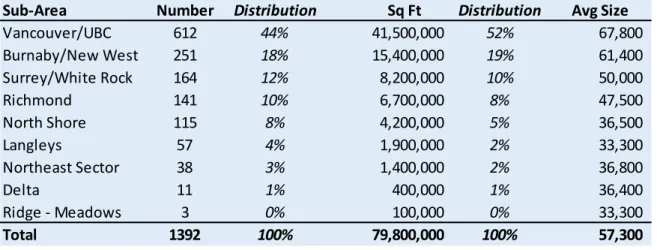
Inventory by Building Age
- Office Inventory Relative to Urban Centres and Transit Service
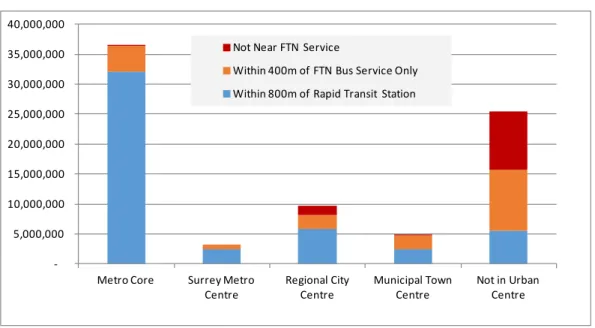
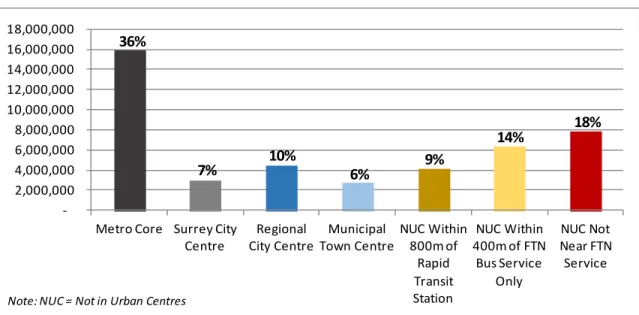
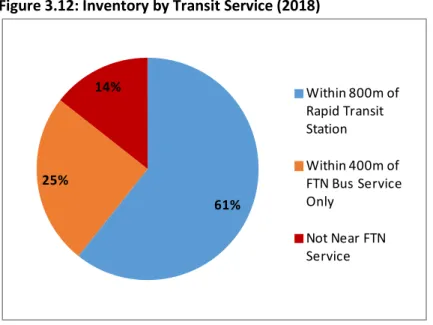
Most (88%) office space is located within either urban centers or within 400 meters of FTN bus / 800 meters of rapid transit service. Of the stock not in urban centers (25 million square feet), 62% is close to FTN transit service (bus or rapid transit). Of the total stock in the region (80 million sq ft), 68% or 55 million sq ft was located in urban centres.
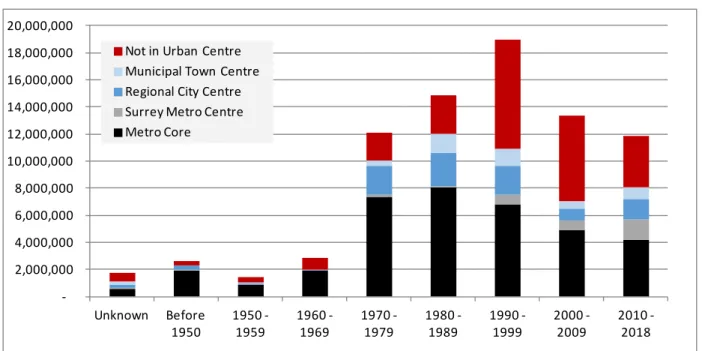
Inventory by Urban Centre Map
- Newer Inventory Relative to Urban Centres and Transit Service
- Office Tenant Considerations
- Overview of Tenant Considerations Workforce Demographics and Residential Location
- Amenities
- Accessibility and the Value of Locating in Urban Centres or Near Transit
Most of the office spaces in the city of Vancouver are close to rapid transit, and the rest are served by the FTN bus. As office space in urban centers tends to be more expensive (both rent and operating costs) compared to other locations, business tenants are only willing to pay a premium if there is value or benefit to them. Since office space for large companies is not plentiful in urban centers, finding the desired large spaces can be a challenge.
Metro Vancouver Transit Network Map
- Extent of Tenant Movement Between Geographic Areas
- Office Developer Considerations
- Overview of Considerations Developer Objectives
- Development Risks
- Landlord Tenanting Decisions
- Office Development from the Municipal Perspective
- The Changing Nature of Office Work
- Corporate Headquarters - Canada and Vancouver
- Suburban Office Obsolescence?
- The Evolution of Employment
- Attracting Employees - The War for Talent
- Flexibility - From ‘Workplaces’ to ‘Places To Work’
- Rise of Co-working Operators
- Office Space Design – Open Concept
- Office Space per Employee - Drive for Efficiencies
- Future Considerations for Office in Urban Centres
- Priority Actions
- Other Areas for Exploration
146 BOMA BC Leasing Guide: Commercial Real Estate Office Space - Peter Mitham, “Shared Space - Co-working providers are changing how tenants lease space”, 2018. While traditional office space contains elements of the co-working environment, many landlords are embracing it's not complete. 167 BOMA BC Leasing Guide: Commercial Real Estate Office Space - Peter Mitham, “Shared Space - Co-working providers are changing the way tenants lease space,” 2018.
Appendix A: List of Interviewees
Appendix B: Interview Discussion Questions
Appendix C: Supplemental Office Inventory Data Tables
Appendix D: 2001 Urban Centres Strengths and Weaknesses
This will encourage office tenants to locate nearby and make city centers more attractive. This is critical to efforts that model city centers as smaller versions of the central business district. Any increase in the cost of car travel makes transit more attractive, which in turn makes office development in some city centers more attractive.
Appendix E: Bibliography
Colliers, “SPACES, the Amsterdam-born creative workspace, officially opens its first co-working location in Vancouver,” September 11, 2018. Cornell University / Cornell Real Estate Review - Daniel Wright, “Match Made in Heaven: Investment Benefits of Co-working Spaces and Historic Sacred Places', 2018. University of Sydney, 'Coworking Spaces Australia: New places where people work, businesses grow and businesses connect', 2017.
Regional Planning Committee - On Table Item
- Learn about the influence of B-Line on community development patterns and travel behaviour 2. Learn about Growth Corridors
- Inform Policy and Track Progress
- Learn about the relationship between B-Line and community development patterns and travel behaviour
- Learn about Growth Corridors
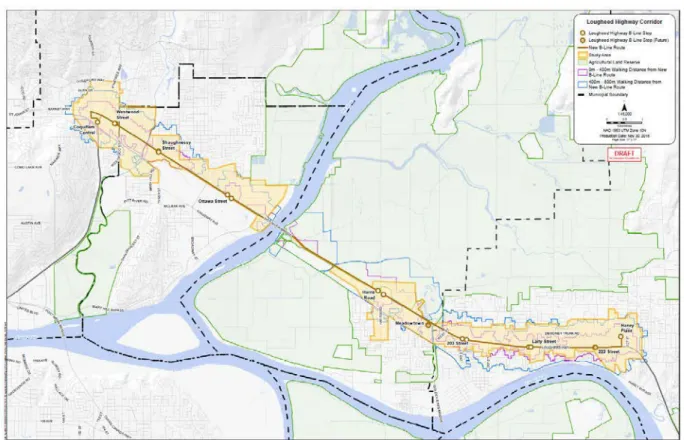
To inform the Regional Planning Committee and the MVRD Board of the procedures, findings and next steps of the Lougheed Corridor Use and Monitoring Study. The purpose of the study area boundary was to inform future analysis including the monitoring program and assessment of market potential. This monitoring program was developed as a component of the Lougheed Corridor Use and Monitoring Study.
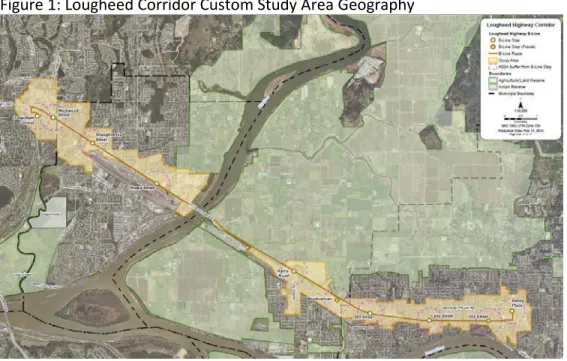
ATTACHMENT - TABLE 1
The 2018 Regional Parking Study (Study) was co-led by TransLink and Metro Vancouver to expand the knowledge base of supply and demand for multi-dwelling (apartment) parking in various areas of the region. The key findings of the 2018 Regional Parking Study are consistent with those in the 2012 study, with some new insights into on-street parking. That the MVRD Board receive for information the report dated February 15, 2019, entitled “Regional Parking Study – Key Findings” and provide alternative direction to staff.
The 2018 Regional Parking Study
Technical Report
Prepared by TransLink and Metro Vancouver March 2019
ATTACHMENT
Introduction
The first region-wide survey of apartment parking was completed by Metro Vancouver in 2012 and examined the supply and use of apartment parking at 80 apartment locations across the region. While these survey results continue to be referenced, there are renewed requests from Member States1 for updated information on apartment parking, especially for purpose-built rental apartments. With the support of the MVRD Board, the Mayor's Council and relevant advisory committees, such as the Regional Planning Advisory Committee and the Regional Transportation Advisory Committee, TransLink and Metro Vancouver jointly conducted a second region-wide survey of apartment parking spaces, updating the 2012 report. study in.
Study Context
- Regional Planning and Policy Context
- Key Findings from the 2012 Apartment Parking Study
Residential parking demand near the Frequent Transit Network bus stops was similar to the demand seen near SkyTrain / SeaBus stations, but the parking supply was higher. The 2012 study highlighted the implications for new apartment development near the Frequent Transit Network. The biggest opportunities for change are new apartment sites close to the Frequent Transit Network (usually within 400 meters of a regular bus stop and/or within 800 meters of a SkyTrain station).
Encourage Parking Supply to Match Demand Near the Frequent Transit Network: Parking requirements should be set based on actual or expected demands with further reductions based on
Treat parking and street parking as a system: A more holistic approach to parking supply and parking demand management for new apartment projects is warranted. Consideration should be given to the availability, type and relative permanence of street parking (eg free, paid, permit only and/or time limited) and surrounding land uses, in conjunction with any reduction in on-site parking.
Encourage Parking Unbundling / Opt‐Out: Selling parking stalls separate from apartments or allowing consumers to opt out of a parking stall will increase choice, and provide the opportunity for
Encourage Rental Apartments Near the Frequent Transit Network: Apartment renters generally have lower parking demands than do owners, and living close to the Frequent Transit Network provides an
Encourage Expansion of Car Share Programs where Feasible: Municipalities and developers should encourage car share providers to expand beyond current operating boundaries to such places as
Conduct Regular Post‐Occupancy Surveys: Regular and frequent post-occupancy surveys of apartment projects should be conducted to provide timely information on parking demand in recently
Coordinating Frequent Transit Network Expansion: Uncertainties in the future stop or station locations of the Frequent Transit Network, and the staging of expansion, can be addressed effectively
- Fall 2012 Supplemental Surveys
- Updating the Apartment Parking Study
In the fall of 2012, Metro Vancouver commissioned additional field surveys of about two dozen apartment sites around the region. The strategy also highlights the role of parking management as a means of achieving the regional goals in the plan. In 2016, Metro Vancouver adopted an update to the Regional Affordable Housing Strategy, which also emphasizes the role of parking reductions in improving the economic viability of apartment development in general.
Key Findings
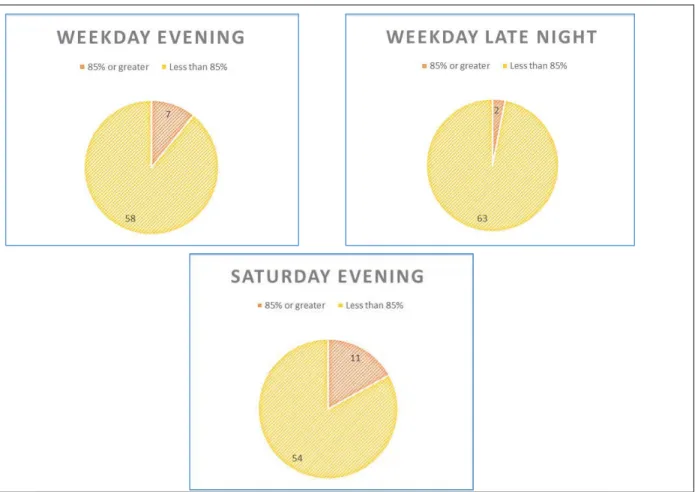
Some of the factors that contribute to on-street parking use in mixed-use neighborhoods include: visitors to non-residential land uses in the evenings; apartment visitors on weekends, holidays and special occasions; and some apartment residents park on a nearby street. In general, on-street parking usage is higher in the evening (weekday or Saturday) than on a weekday evening. Visitors to apartments usually experience greater difficulty in finding a parking space in the apartment's parking garage or on the nearby street on weekends, holidays and special occasions.
Study Methodology
- Project Advisory Group
- Apartment Site Selection
- Parking Facility Survey Design and Conduct
- Street Parking Survey Design and Conduct
- Household Survey Design and Conduct
The purpose of the Survey was to measure the supply and utilization of apartment parking in the selected locations. As with the 2012 Survey, the Household Survey data set was not weighted to match the demographics of the region. Households residing in apartment units with two or fewer bedrooms accounted for 93 percent of respondents.

Apartment Residential Parking Supply and Utilization Analysis
- Apartment Residential Parking Supply and Utilization
- Relationship with Apartment Unit Size
- Relationship with Year Built
- Relationship with Transit Proximity
- Relationship with Transit Proximity and Unit Size
- Relationship with Transit Boardings
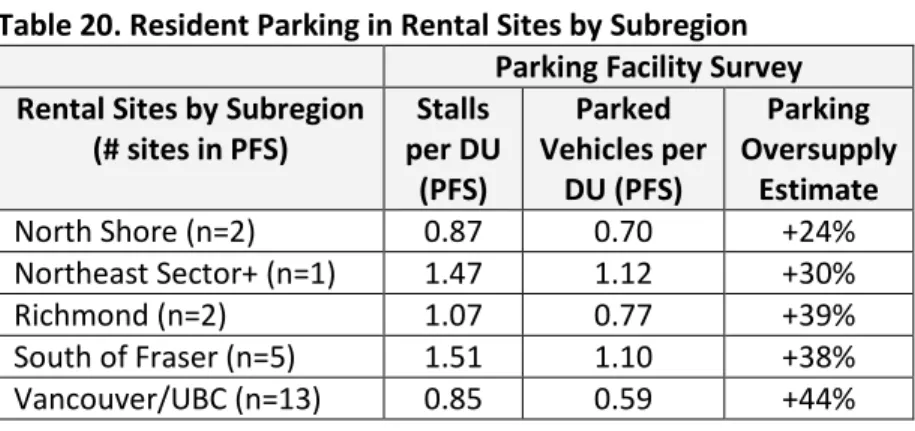
Parking and vehicle locations for market rental locations by proximity to FTN and unit size. Parking and vehicle possessions for rental locations by proximity to FTN and unit size. The "inverse" relationship is much stronger for rental sites compared to strata sites (Figures 9 and 10).
Street Parking Analysis
- Street Parking Utilization Patterns
- High Street Parking Utilization (85% or Higher)
- Street Parking and Apartment Parking Utilization
- Apartment Residents and Visitors Parking on the Street
- Street Parking and Optional Parking in Rental Apartment Sites
The studies did not show any clear patterns between the use of street parking and the use of apartment parking. For non-Vancouver street network attached rental spaces where resident parking is not included in the rent, street parking utilization is higher. For the street network in Vancouver connected to rental spaces where resident parking is not included in the rent, the difference in street parking utilization is minimal.
Other Analysis
- Bicycle Parking
- Presence of Electric Vehicle Charging Infrastructure
- Willingness to Forgo a Parking Stall
The provision of public infrastructure for electric vehicle charging in the region is steadily increasing. The household survey shows that the presence of electric vehicle charging appears to be associated with a slightly higher proportion of residents expressing the likelihood that they will consider purchasing a plug-in electric vehicle in the next five years. 11 This is potential evidence consistent with prior research showing that investments or requirements aimed at increasing the availability of domestic charging infrastructure could have a greater impact on the adoption of plug-in electric vehicles than those focusing on public charging infrastructure. 12 It should be noted that a self-selection effect cannot be ruled out – ie.

Looking Ahead
- Shared Use Parking Opportunities
- Mobility Trends, Consumer Preferences, and an Aging Population
- Monitoring and Managing Street Parking Supply and Utilization
- Commercial and Institutional Parking
The implementation of automated license plate reading technology is an emerging tool for accounting for street parking. The data can be useful in supporting local authorities' understanding of the amount of parking utilization and the nature of utilization – whether vehicles are parked for excessive periods and whether parked vehicles originate from a nearby home, in the neighborhood, or elsewhere. Dynamic pricing of street parking based on congestion levels or other criteria can be an opportunity to shape driving demand, but also to promote fair access to a scarce resource (parking) in popular destinations.
Conclusions
Apartment Sites
Anketa North Vancouver City Vista Place - 1329 Civic Place Mews 1329 Civic Place Mews Blvd Po Po.