
An alternative way of movement is to automatically transfer between two locations in the game using a vehicle that takes players between the two points. The designers used a text interface with very limited graphics, as these games were created for computers in the late 1980s. Details will be provided for each game, including the plot or story the game is based on, how it compares to other titles, and features of its map, including the fidelity of the rooms reproduced in the game, compared to the real places it tries to recreate.
Also, distinctive elements in its keyboard control or specific properties in movement modes will be mentioned. Aventuras AD was a Spanish video game company founded in 1988 in the city of Valencia, where its headquarters were located. Aventuras AD games were mainly produced for eight computer models, which were the most common in Spanish home computers in the late 1980s.

Supervivencia
Analyzing the rooms, we begin on the bridge of the damaged ship, with access to our cabin as the only way out. Here you can see how cardinal points are used, even to move around inside a moving structure, like a spaceship, but which is now static. When using commands such as go left, the opposite command, go right, cannot be used to return to the previous location.
Instead, it would be necessary to move backwards, because our point of view changes with each move. From the cabin you can access a new location, the decompression room, which has a very realistic function with a double door, to isolate the interior of the ship from the external vacuum through a gap, since both hatches cannot be opened. the same time. Sometimes players change locations or move through a location by being moved directly by means of a vehicle, or by mounting a creature that players cannot control.
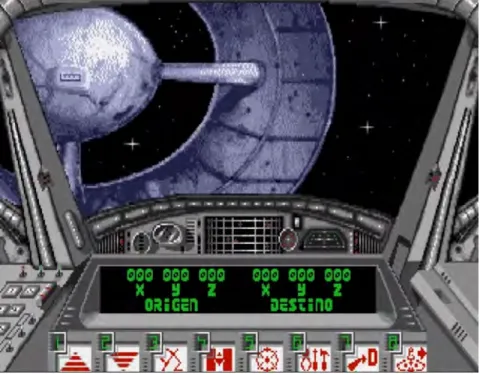
In Figure 3, the footage from Supervivencia shows the bridge of our ship, dangerous creatures outside, a firfurcio being assembled, and the AD escape pod.
La Aventura Original
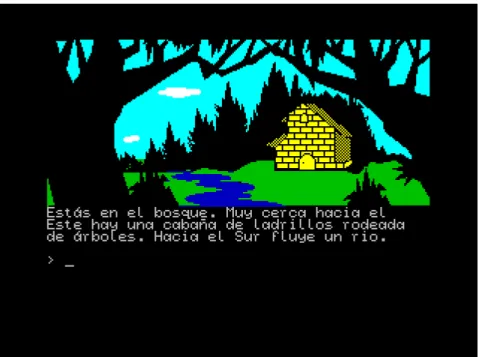
The first part of the game, The Search, is a very simple adventure that takes place on the surface, and we have to gain access to the underground world where the second part takes place, The Encounter. Above ground we can easily explore the valley, which is located above the cave system where the intricate part of the wildlife is found. Due to our initial appearance in an open space of a world similar to ours, we can move without problems using cardinal points.
However, it is also possible to specify the cardinal point where the construction is located. In this case, we can enter the brick hut shown in the graph of the first location, both through the enter command and with the eastern cardinal point. Once inside, we find a new way to move down a well with a ladder that we can go down using the down command.
To return to the cabin, simply type up, which changes the vertical plane of movement. In this case, our only recourse is to return to the starting point, but it is common to find multiple locations on a higher level, for example in a house with two floors and more rooms. We can take a circular route along the caldera, and if we choose east as direction, we return to the starting point.
This choice of direction leads the player to realize that creating a map is necessary to make sure where the points of interest in the game are and how to move towards them. In the second part of the game, due to the existence of magic, it is possible to move instantly between different specific points in the cave complex by using magic words.
Jabato
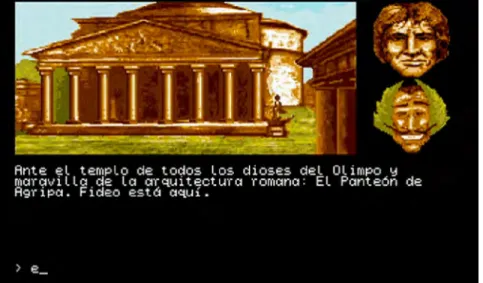
In this way, the exterior and interior of the House of the Vestals are shown in the game. To gain access, players must retrieve an item from the Appian Way, which is correctly located south of the house, as this road left Rome to the southeast. We can also see the interior and exterior of the Pantheon of Agrippa and later the Colosseum, although their locations are not based on reality: the Colosseum is located southeast of the Pantheon, while in the game we move north and later west to reach it.
An interesting detail is the correct appearance next to the Colosseum of the Colossus of Nero, of which no mention would exist around the 4th century, as well as the reliefs on the tympanum of the Pantheon, which are missing today. One difference between reality and representation is the Doric capital letters of the columns in the game; in the Pantheon they are Corinthian. Rather than an error or artistic license, this was due to the low graphical resolution available, and thus the difficulty of displaying the order of the columns correctly.
The first part of the game is divided into three areas, Rome, Gaul and Hispania. The journey continues to Saguntum, where Hannibal's Carthaginian army is besieging the city, ending the first part of the game as it heads to the city of Caesarea, the capital of the Roman province of Mauretania Cesariense in North Africa, from which the second begins a part of the game. A general perspective of Caesarea is shown, and we can leave it to the south, heading towards the Atlas Mountains, where we find the solution to a maze, thanks to the clues obtained earlier.
These actions will allow us to cross the labyrinthine spaces that stretch through the Sahara Desert of North Africa, and then reach the next stop on the way, Alexandria, the capital of the Roman province of Egypt, from where you can make a short visit to the pyramids, the entrance to the Pyramid of Cheops (where you we can see the hypostyle halls and real and false tombs with the associated sarcophagus) and the neighboring Sphinx. To the right east of it, we reach Deir el-Bahari (Deir-el-Bahori in the game), where the temple of Hatshepsut is located, which differs greatly from the original due to complications.
La Aventura Espacial
Vertical movement adds a new feature by allowing space changes through accesses not available from the ground due to the ability of some player-controllable characters to fly or levitate.
Cozumel
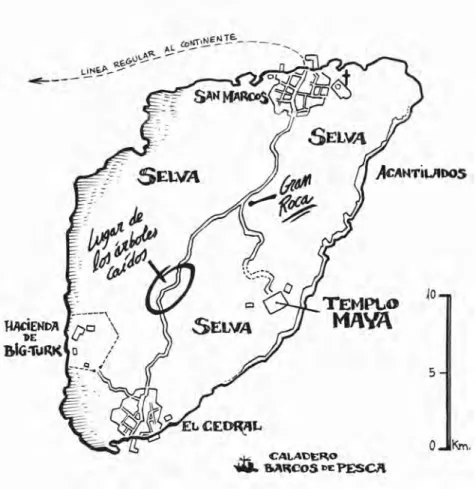
The reason is that we are in an ocean, and swimming in any direction does not take us to a new place, but rather keeps us in the same place, in this case one of considerable size. The island is generally represented in the same way as the real one, stretching from northeast to southwest. The game begins in the northern part, next to the city of San Marcos, and we have to leave the island from a pier in the southern area, in El Cedral.
In the central part of the island there is a Mayan temple where you will meet a Mayan deity, Ix-chell. This in-game reference follows the lineage of the Chilam Balam where she is called Ix Chel, although in academia the name is usually spelled Ixchel. The majority of the population on the island of Cozumel lives in San Miguel, a city on the west coast of the island.
Similarly, the Atlas shows the town of Santa María as having a harbor (which currently does not exist) south of the island, in the same location where El Cedral is located in the game. There is a small archaeological site under this name in the southwestern part of Cozumel, but it is not a permanent settlement or has access to the sea. Finally, the design of the temple is not compared to the temple dedicated to the goddess located in the site of San Gervasio, the largest on the island, but to the structure located in the site of El Cedral, the oldest in Cozumel.
The inhospitable nature of the roads connecting the main venues where the match takes place is real, as indicated by Sanders Transport facilities in most of this area are almost non-existent. It is worth noting that the documentation for this game was completed in the mid-1980s, using previously published material.
Los Templos Sagrados
The rest of the first part is a collection of using items in adventure games, exploring and crafting tools. There are no complications in moving until we reach a series of rooms that form a spiral structure, in the center of which we find the cenote. Cenotes are natural open chambers in the limestone bedrock, typical of the Yucatan, which provide access to groundwater.
Our goal is to build a raft in the central cenote so that the underground water flow takes us to the Macanxoc Lagoon in Cobá. For this we need vines and logs to transport them one by one due to space and load capacity issues. Similarly, it is a mistake to build the raft outside the cenote, as the drop is too steep.
It is necessary to lower the logs down to the cenote after using one as a platform, and then build the raft underneath. Our inventory cannot include items that are too bulky, nor can we transport them due to their weight. We may even have limited access to certain locations if the size of what we are transporting is excessive.
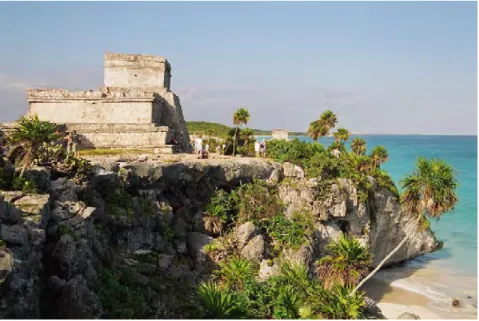
Chichén Itzá
CONCLUSIONS
BIBLIOGRAPHY