
In Canada, the main focus was on literacy and health, while in the United States it was on health literacy. The former focus is more. The emphasis on literacy and health as opposed to health literacy may also influence the nature of the research we do.
Les perceptions des adolescents à l’égard de la dépendance à la nicotine
Adolescent Constructions of Nicotine Addiction
Many of the participants who believed that nicotine addiction is related to repeated use introduced the idea of degrees of addiction - mild, moderate and severe. Addiction to nicotine as the body and brain "get used to it". Some teenagers suggested that addiction occurs when the body and brain.
Les programmes de recherche sur les interventions multiples
Multiple Intervention Research Programs in Community Health
1999). A systematic review of the effectiveness of primary prevention programs for adolescent pregnancy. Effective Public Health Practices Project, 1–55. -based programs for smoking prevention.Cochrame Database of Systematic Reviews, 3. 1999).A systematic review of peer/paraprofessional effectiveness 1:1.
Considérations d’ordre conceptuel et analytique relatives à la recherche multiniveaux
Multilevel Health Promotion Research: Conceptual and Analytical
Considerations
Subsequent models may include dummy variables to represent various communities (Diehr et al., 1993), or may include variables that measure specific characteristics of the community. The Alameda County Study (Haan et al., 1987) was one of the earliest studies to include data from individual and contextual levels. This technique enables the researcher to determine the overall meaning of the two levels and to consider individual and contextual characteristics in the analysis.
O'Campo et al. 1997) studied the influence of individual and community factors on low birth weight. They found that all observed relationships between individual-level variables and low birth weight varied across communities (e.g., cross-level interactions). MLM enables the modeling of separate and joint effects of individual and contextual trajectories. Although the latest software has been developed to address problems at multiple levels (Goldstein et al., 1998), its capabilities have also advanced the conceptualization of the problems. problem. Interestingly, the availability of the software has also increased our understanding of the nature of the problem.
Phantom of the area: Poverty-area residence and mortality in the United States.American Journal of Public Health.
Une intervention ponctuelle en vue d’accroître l’activité physique
A Brief Intervention to Increase Physical Activity
However, clinics assess physical activity in only 19% of women (USDHHS, Office of Health Promotion and Disease Prevention, 1991). Precontemplation participants discussed their views on the benefits of physical activity and were encouraged to increase their physical activity. This study used variables from the Paffenbarger Physical Activity Questionnaire: (1) number of stairs climbed per day, (2) number of blocks.
Of note, compared to baseline, both the control and intervention groups increased nine out of 10 physical activity variables. As discussed, both the intervention and control groups showed an increase in many of the physical activity variables at 6 weeks. A limitation of this study was the use of self-report measures of physical activity.
Social desirability bias can influence self-reported levels of physical activity (Warnecke et al., 1997).
Les in rmières agissant comme soignantes auprès d’un proche âgé
Nurses as Caregivers of Elderly Relatives: Negotiating Personal
Much of the theoretical literature dealing with the interface between work and family life conceptualises the two spheres as either separate or integrated. However, care work in the formal system cannot be fully understood unless one recognizes that it is women who do the bulk of the work and that this is integrated into women's unpaid care (Armstrong et al., 2003). Most research on employment and family care has focused on the effects of caregiving on paid work. The impact of caregiving on participation in the workplace includes absenteeism, reduced productivity, neglect.
It is interesting to note that all participants viewed their caregiving as a natural extension of their nursing duties. They felt obliged to use their nursing knowledge to care for their family members. Exploring the discourse on women's care in professional and personal lives reveals two conflicting storylines. Exploring the intersection between personal and professional care among nurses revealed four storylines related to caring about and caring for (see Figure 1, part A).
2003).Reading Romanow:The implications of the Final Report of the Commission on the Future of Health Care in Canada for women.Toronto: Canadian Women's Health Network.
Conceiving Action,Tracking Practice, and Locating Expertise for
Health Promotion Research
In my research program, the individuals whose health promotion is of greatest interest are children, and the health-promoting outcome or health determinant of greatest interest is healthy child development. I will use this model to provide a practical description of health promotion interventions and the research required to document the effects of programming on health promotion practices at different levels. In this case, the primary focus will be the health promotion programming used to create community action and reorient the health system, and the secondary focus will be the effects of this programming on children's and families' access to health determinants.
The results of this review of home visiting programs illustrate the challenges facing health promotion research. Within the primary research focus, there was an incomplete description of the practices and outcomes associated with healthy child development and the supportive family environments linked to this health determinant. The secondary research focus, the effects of home visiting programming on other levels of health promotion, namely community intervention and health service realignment, was non- existing. Nurses are well placed in each of the ecological subsystems to promote the range of health promotion measures that influence the control of healthy child development. The health promotion initiatives linked to the microsystem (child development and family support), the mesosystem (strengthening community efforts) and the exosystem (reorganization of health services) are used to categorize the challenges of health promotion research.
Health promotion challenges and methodological solutions associated with research focus on home visiting programming.
Le traitement des plaintes contre les in rmières, une approche éducative axée sur le consommateur
Mediating Complaints Against Nurses
A Consumer-Oriented Educational Approach
In 1994, the CNO introduced the Participative Resolution Program (PRP) for less serious complaints at the entry point of the disciplinary process. The college controls the process. Participants discussed their experiences with PRP, opinions about the process and the future of PRP. Data were collected on participants' experiences with the instrumental and affective aspects of PRP.
One of the College's goals was to humanize the PRP process and ultimately improve relations between the public and the profession. The study found that many of the CNO's objectives were achieved through the PRP, but the process was more complex than expected. They wouldn't comply at all.” This exposes the weakness of the PRP.
Furthermore, members are demanding more information about the disciplinary process and the college's legal obligations.
Le choix d’un modèle de soins pour les patients exigeant un autre niveau de soins : le point de
Choisir un modèle de soins pour les patients nécessitant un deuxième niveau de soins : l’essentiel.
Choosing a Model of Care for Patients in Alternate Level Care
Caregiver Perspectives with Respect to Staff Injury
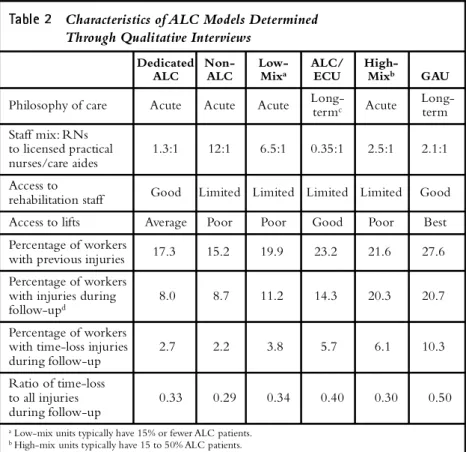
Despite the increase in ALC patients in many hospitals, few studies have investigated the management of these patients. Extensive qualitative interviews were conducted with workers and managers at each facility to identify all nursing units caring for ALC patients and to characterize the type of ALC model used. Interviews were conducted with managers and staff involved with ALC patients to determine each unit's: (1) philosophy of care; (2) type, number and acuity of ALC patients typically on each unit; (3) availability and.
A total of 84 nursing units in four acute care hospitals were involved in the care of patients with ALC. These 44 units were categorized into ALC patterns: units in which ALC patients were mixed into the general medical/surgical patient population. or (1) sporadically (low mixing), or (2) widely (high mixing), (3) dedicated ALC units, (4) extended care units (ECUs) that had ALC patients, and (5 ) geriatric assessment unit (GAU). This is because dedicated ALC units and ALC/extended care units received patients with ALC who had already been evaluated and stabilized. Thus, the GAU was at the frontline in the hospital in terms of ALC patients.
These results show that most units cared for relatively stable ALC patients (extended care units, low- and high-mix units, and dedicated ALC units).
PORT – Psychosocial Oncology Research Training:A Newly Funded
Interventions in the field of psychosocial oncology are aimed at softening the impact of cancer diagnosis and treatment for those affected and their relatives, as well as mitigating the intergenerational impact of cancer. As the incidence of cancer increases, there is increasing pressure to nd innovative, effective and patient-centred strategies to promote optimal psychosocial adjustment across the spectrum of cancer prevention, screening, diagnosis, treatment and follow-up. PORT – Psychosocial Oncology Research Training PORT is a transdisciplinary postgraduate research training program aimed at preparing a new generation of scientists to develop, implement, evaluate and transfer theoretically grounded and state-of-the-art psychosocial approaches to oncology care. The Canadian Society for Psychosocial Oncology (1999) defines the rapidly developing field of psychosocial oncology as an area of spe-.
Initially, the PORT program will incorporate the core disciplines of nursing, psychology, and health care management to enhance capacity for high-impact research in psychosocial oncology. To date, the fields of psychology and nursing have contributed significantly to the advancement of psychosocial oncology as a specialty in healthcare. As a first step, PORT brought together scholars who share a common perspective on theoretically informed psychosocial oncology interventions. The fields of education, engineering, epidemiology, journalism, occupational/physiotherapy, nutrition and social work will be gradually integrated to increase opportunities for interdisciplinary exchanges, multi-method research and the development of innovative materials and technologies for health education. The four PORT program leaders, one from each of the participating universities, are all nurse scientists who are nationally and internationally recognized for their research in psychosocial oncology.
PORT is currently accepting applications from those interested in pursuing doctoral or postdoctoral studies in psychosocial oncology at the four participating universities.
