School District 79 Cowichan Valley
Achievement Contract 2009/10
1 Achievement Contract 2009/2010 z School District 79 zCowichan Valley
Page
District Context... 2
District and School Connections... 5
Goal and Objectives ... 8
Objective 1: Literacy... 9
Rationale ... 9
Performance Indicators/ Summary of Progress/ Evidence ... 10-12 Literacy Actions... 13
Objective 2: Improved Transition Rates... 14
Rationale ... 14
Performance Indicators/ Summary of Progress/ Evidence ... 15-17 Actions ... 18
Appendices ... 19
Appendix 1 - Data Tables for Literacy ... 19-21 Appendix 2 - Data Tables for Transition ... 23
Appendix 3 - Reference Links ... 24
Appendix 4 - School Goals Chart ... 25-26 Appendix 5 - Families of Schools... 27
Appendix 6 - District Review Response ... 28
Table of Contents
S
chool District 79 (Cowichan Valley) is located on the east coast of central Vancouver Island, extending north to Saltair, south to Spectacle Lake on the Malahat, and west to the Lake Cowichan region, includingHoneymoon Bay and Youbou. A majority of students use the school district transportation system to get to school.
Over the past 10 years, the district has experienced a steady decline in enrolment and it is anticipated to continue until approximately 2010. Serving a population of approximately 8400 students in 31 school sites, the district has an operating budget of approximately $72 million.
Community Demographics:
The Cowichan Valley is predominately a rural (63%) community of approximately 63,000 people. Approximately 2.5% of homes are non-English speaking and about 9% are Aboriginal. The major industries in the area are pulp and paper, forestry, fishing, farming, tourism and wineries.
Award winning athletics and fine arts productions at the district secondary schools are a big part of the community pride, and approximately 120 local businesses support the District's Work Experience Programs.
School District 79 Profile We are places to learn...
Enrolment for September 2009 is projected to be 8255 students attending:
• 18 Elementary schools
• 4 Middle schools
• 4 Secondary schools
• 7 Alternate satellite programs
• 2 Adult Education Centres
District Context
Students at a Glance
The Cowichan Valley is about people…
Who are we?
• 63,000 Cowichan Valley people
• Predominately rural (63%)
• 8,959 K-12 students (8,415 FTE)
• 800 part time adult learners
• 250 summer session learners
• 1200 staff
• 310 alternate school students
• 1229Aboriginal students
• 14 per cent of student population is Aboriginal
• 368 ESL/ESD students
• 101 SSA/ ACE-IT program students
• 325 low incidence/ high cost students
• 589 high incidence/ low cost students
• 659 French Immersion students
• 50 international learners
3
Characteristics Unique to Cowichan Valley School District
T
he Cowichan Valley has had declining enrolment since 1997. In order to meet the diverse needs of all of our learners within this challenging environment, some unique delivery models have been implemented.Some examples include:
• A self-paced delivery program at Frances Kelsey Secondary, which also houses a college culinary arts program on site.
• Participation with the community in programs such as, Success by Six, Literacy/ Numeracy Nights, PALS, Ready, Set, Learn (sponsored by the Ministry), Ready, Set, Go, Books for Babes, Resiliency Project, and Roots of Empathy.
• A strong and growing French Immersion program (K-12), located at four sites.
• Expanding partnerships at the Secondary level with Vancouver Island University and Camosun College offering programs including chef
training, residential framing, carpentry, HVAC, welding, residential home support care and our newest program, joinery at Lake Cowichan.
• A growing evening Adult Education program.
Programs of Choice
• French Immersion
• Online Learning
• Career Programs (Post- Secondary Partnerships)
• Self Paced Delivery Program (Frances Kelsey)
• Rural Traditional school
• International Education
• Alternate Education
• Adult Education
• Partners in Learning Program (Chemainus Elementary Community School)
Aboriginal Education
Ongoing support includes:
• Hwulmuhw Mustimuhw/
Aboriginal Support Workers (ASW) and Cultural Teaching Assistants (CTA)
• Coordinators
• 6 Aboriginal Education Teachers
• 4.5 English as a Second Dialect Teachers
• 4 Student Achievement Teachers
Cowichan Valley School District Strengths
• District success on the required and optional provincially examinable courses is at or above the provincial average for both aboriginal and non-aboriginal students.
• Transition rates to grade 10 have shown steady improvement.
• A focus on early learning programs is a significant strength.
• The District Review Team (2007) identified many innovative programs as effective initiatives to support student success and performance. Some examples include:
• The district-wide administration of DART assessment and its connection to informing instruction.
• The collection and use of individual student data to track success for each student at some schools. (Early Success Assessment Grades K-12, EDI, Institute of Safe Schools Grades 8-12 Secondary Survey, Problem Solving Math Assessment Grades 7-8, District Wide Write Grades 1-8, DART assessment). The number of schools tracking individual student data continues to expand.
We are partners in learning...
• Our Aboriginal Enhancement Agreement, originally developed in 2001, was implemented in the spirit of improving Aboriginal student achievement. With the guidance and support of the Hwulmuhw Mustimuhw Education Council a second Enhancement Agreement will be developed.
• A collaborative pilot project to develop a K-7 Aboriginal Education culture and language program that focuses on aboriginal student achievement and grade to grade transition continues for September 2009. In addition, a school based Wireless Learning Project will continue to focus on improving student reading
comprehension and encouraging student engagement.
• Significant school involvement in the Performance Based Network of Schools supports and reinforces the use of BC Performance Standards in our classrooms.
• Active partnership with the community in the development of the Cowichan Community Literacy Plan.
• Collaborative development of a Teacher Leadership program with other island districts (ILC).
5 Achievement Contract 2009/2010 z School District 79 z
District and School Plans Connection
S
chool Improvement Plans are developed annually by the school communities through collaborative processes inclusive of staff, School Planning Councils, parents, and at the secondary level, students.School District 79 provides support for members of the School Planning Councils (SPC) to build a broader understanding of student achievement. Special training sessions for School Planning
Councils and District Partners are held annually to provide each school's SPC information about the process involved.
The School Improvement Plans are submitted to and reviewed by District Staff by April 30th each year and endorsed by the Board of Education in June. The information within the School Improvement Plans then assists the Senior Management Team in determining
priorities for the District, including goals and objectives, budget, learning resources and staff development initiatives. It is interesting to note that each of our District's schools have at least one, and often all, of their goals aligned with the District Achievement Contract.
Schools throughout the district are organized into families of schools to facilitate collaboration and sharing of impetus. This structural alignment allows schools to focus on K-12 student achievement, transitions, and the development of common language and practices. The opportunity to meet regularly as a family enables schools to develop integrated structures for our vulnerable students. In addition, it fosters a
shared responsibility for the successful achievement of a six year graduation cycle.
This year (May 2009) schools gathered as families of schools and presented their school improvement goals, objectives and action plans to trustees, senior staff and other schools in their “family”. This was very productive and promoted a strong sense of
interconnectedness and shared practice.
District and School Connections
Other Connections
Aboriginal Education
D
uring the spring and summer of 2008, the seven local Aboriginal bands and the Metis community organized into a council known as the Hwulmuhw Mustimuhw Education Council. This group approached the Board of Education and asked to be recognized as theofficial voice of the local Aboriginal people in matters relating to the educational services provided to children of Aboriginal descent in SD79 (Cowichan Valley). This structure was recognized by the Board of Education as the preferred communication structure for the local band education coordinators.
The school district will be working with the Aboriginal community to renew the currently expired Enhancement Agreement (2001-2006).
We intend to map the services we provide and to collaboratively review services with a goal to improve student success levels for our Aboriginal students.
As we renew our communication structures with the Aboriginal community, we will continue to move toward a renewal of the Enhancement Agreement with support structures to improve our success data.
The Cowichan Valley School District is strongly committed to improving the life’s chances for all of our Aboriginal students and is working to achieve this in a collaborative and focused manner.
Early Learning Programs
School District 79 has been very committed to Early Learning for many years. The District Review Team (2007) identified Early Learning Programs as a significant strength. We have continued to fine-tune and expand these programs over the last two years.
The District has had an Early Learning Liaison Teacher in place for five years. The position includes time to work with Early Primary teachers and a variety of community groups to support early learning initiatives and school readiness as well as to promote the use of the Early Learning Framework and the Early Learning Continuum.
The focus continues to include supporting a variety of pre-school literacy programs such as PALS, Play and Learn, Fun Family Literacy Nights, Books for Babes, Story and Play Time, Mother Goose.
7
Community/ District Literacy Plan
A Literacy Now Cowichan Task Group, made up of School District 79 and community stakeholders, was formed in May 2007 to develop a Community Literacy Plan using the Provincial Literacy Now Community Planning Process. The group worked diligently throughout the 2007-2008 school year to identify goals, objectives and strategies to address literacy needs in the Cowichan region. The first Community Literacy Plan was finalized in June 2008.
During 2008-09, participants of Literacy Now Cowichan worked together to implement the goals of the Community Literacy Plan. School District 79 has been well represented in this collaborative process.
The School District 79 Literacy Plan and the Community Literacy plan have now been amalgamated to form the new Cowichan Literacy Plan 2009. There is a strong connection between the Cowichan Literacy Plan and the revised District Achievement Contract. Both speak to the on-going commitment to improve literacy across the Cowichan School District for people of all ages. An important part of building the Cowichan Literacy Plan has been developing and extending the networking, collaboration and partnerships within the broader community.
District Review Response
The recommendations of the District Review in 2007 continue to be a focus of our efforts to improve student achievement. Recent highlights include:
• A renewed emphasis to improve success for Aboriginal students
• The creation of “families of schools” to enhance student achievement and transition rates particularly for our vulnerable students.
• Integrating Assessment for Learning into our focus on instructional strategies.
• Increasing the number of StrongStart Centres.
• Increasing public consultation with the community.
• A focused effort on developing a Strategic Plan for the district with input from the community.
We will continue to improve our ability to track individual student achievement to address learning needs on a student by student basis. Our transition rates, while improving at grades 8 to 10, have reached a plateau in the grade 11 and 12 years. While strategies will be focused directly on these students, we must also examine our interventions at earlier years before students reach the Graduation Program.
The improvement in transition rates will ensure an increase in Graduation rates as our success with first time grade 12’s is above the provincial average in achieving Graduation.
Our inquiry will be driven by the following four points:
1. How are the needs of vulnerable students reflected in your action plan?
2. Which evidence-based interventions that we know make a difference are you using in your action plan?
3. How will classroom instructional practice make a difference to student achievement and transitions?
4. How will Assessment for Learning Strategies make a difference to student achievement and transitions?
Objectives
1. Literacy - Improve student literacy skills (K-12) with a focus on reading achievement.
2. Transitions - Improve middle/secondary grade to grade transitions and increase the number of students successfully transitioning through Grade 12 within six years.
District Goal and Objectives
District Goal: Improve Success for each student with a focus on vulnerable learners
Rationale
9 Achievement Contract 2009/2010 z School District 79 zCowichan Valley
Objective 1: Literacy - Improve student literacy skills (K-12) with a focus on reading achievement.
Rationale
In order to improve success for each student, especially vulnerable learners, we need to focus on literacy skills K-12 and develop students ability to “read to learn” across all curricular areas. Performance targets and strategies are designed to include all students K-12, including our most vulnerable learners.
The district believes the integration of Assessment for Learning strategies into daily classroom instruction will enhance overall student achievement including for literacy. The increased focus on Oral Language in the new English Language Arts IRP will support development of literacy skills K-12 especially for Aboriginal students. Literacy and a concern for vulnerable students is a focus in all schools. This focus is also a key part of the Cowichan Community Literacy Plan.
Concerted efforts to increase participation rates requires us to evaluate/ fine tune out administrative practices for collecting all assessment data. Although our performance on the required English exams is at or above the provincial average, we continue to be concerned about those students who do not write the exam or who are delayed in writing. Primary achievement data indicates female students are closer to meeting targets than male students and Aboriginal learners. DART Reading Assessments indicate a need to increase the focus on Fall DART as Assessment For Learning, especially for grades 6-9.
Objective 1: Improve student literacy skills (K-12) with a focus on reading achievement
Performance Indicators
• District Early Success Assessments K-2
• Primary Reading Assessments based on BC Performance Stan- dards
Summary of Progress
• District Early Success Assessments indicate fewer number of grade 1 students and fewer grade 1 & 2 Aboriginal students at risk
• Primary Reading As- sessments indicate students fully meeting or exceeding has in- creased over three years.
• Data indicates female students are close to meeting target while male students and Aboriginal learners are not
District Early Success Assessment
(% at risk in one or more areas of oral language, phonemic awareness, concepts of print)
Performance Target
• Decrease percentage of students at risk to 15% or less within three years.
District Primary Reading Assessment
(based on BC Performance Standards % fully meeting, & exceeding)
Performance Target
• 75% or more of all grade 1-3 students will fully meet or exceed expectations in reading within three years.
• 50% or more of all grade 1-3 Aboriginal students will fully meet or exceed expectations in reading within three years.
10%
15%
20%
25%
30%
At Risk At Risk At Risk
Kindergart en Grade 1 Grade 2
Jun-07 Jun-08 Jun-09
10%
20%
30%
40%
50%
60%
70%
80%
All St udent s Aboriginal All St udent s Aboriginal All St udent s Aboriginal Grade 1 Reading Grade 2 Reading Grade 3 Reading
2006 2007 2008 2009
11 Achievement Contract 2009/2010 z School District 79 zCowichan Valley
Objective 1: Improve student literacy skills (K-12) with a focus on reading achievement.
Performance Indicators
• DART Reading Assess- ments grade 3 - 9
• FSA reading comprehen- sion grade 4 & 7
Summary of Progress
• Noticeable gains noted in Grade 7-9 DART for Aboriginal and all stu- dents over last 4 years.
• Need to further explore inconsistencies of our DART Assessment (i.e., administration and data collection practices, participation rates.
(more details in appendix)
DART
(Snapshot Assessment of Reading Data - % fully meeting & exceeding)
Performance Target
• 70% or more of all grade 3-9 students fully meeting or ex- ceeding expectations within three years.
• 50% or more of all grade 3-9 Aboriginal students fully meet- ing or exceeding expectations within three years.
Grade 4 FSA Reading Grade 7 FSA Reading
Performance Target
• 70% or more of students meeting or exceeding expectations within three years.
NOTE: new baseline for FSA 2008
* Participation rates for 2009 showed significant improvement over 3 years.
0%
10%
20%
30%
40%
50%
60%
70%
All St udent s
Abor All
St udent s
Abor All
St udent s
Abor All
St udent s Abor
Grade 3 Grade 4 Grade 5 Grade 6
2007 2008 2009*
0%
10%
20%
30%
40%
50%
60%
70%
All Students Abor All Students Abor All Students Abor
Gr ade 7 Gr ade 8 Gr ade 9
2007 2008 2009*
30%
40%
50%
60%
70%
80%
2004 2005 2006 2007 2008* 2009
30%
40%
50%
60%
70%
80%
2004 2005 2006 2007 2008* 2009
All Students Aboriginal
Objective 1: Improve student literacy skills (K-12) with a focus on reading achievement.
English 10
(% of students whose blended final mark is C+ or better)
Performance Target
• Maintain or exceed exam results and increase the participation rate to 80% within three years.
English 12
(% of students whose blended final mark is C+ or better)
Performance Target
• Maintain or exceed exam results and increase the participation rate to 80% within three years.
30 40 50 60 70 80
04/05 05/06 06/07 07/08 08/09
30 40 50 60 70 80
Apr-09 May-09 Jun-09 Jul-09 Aug-09
Performance Indicators
• English 10 & English 12 required Provincial exam results
Summary of Progress
• Although our perform- ance on the required English exams is at or above the provincial average, we continue to be concerned about those students who do not write the exam or who are delayed in writ- ing the exam.
(more details in appendix)
All Students District All Students Provincial Aboriginal District Aboriginal Provincial
13 Achievement Contract 2009/2010 z School District 79 zCowichan Valley
Literacy Actions
Changing Teacher
Practice Interventions
Assessment Instruction Elementary
years
Middle/
Secondary years
Building Capacity
• Expand use of Six Big Assessment For Learning Strategies through web- casts, Performance Based Schools Network and ILC
• Support teachers in group marking and analysis of assessment data to inform instruction
• Teams of teachers re- searching, analyzing data and creating AFL tools
• Expand use of Professional Learning Rounds focused on improving instruction
• Continue and expand focus on Instructional Intelligence Strate- gies and SMART Learning
• Expand opportunities for coach- ing, mentoring and demonstration lessons provided by District Spe- cialist Teachers and others
• Expand support for teachers to develop and implement strategies for differentiation of instruction and increase achievement for vulnerable learners
• Support collaborative teamwork through Professional Learning Community Early Dismissal Days and School Based inservice funds
• Performance targets/strategies designed to include all K-12 students, including most vulnerable
• “Families of schools” created with common goal of improving student achievement and transition rates.
Monthly meetings to discuss vulnerable students and design interventions
• Schools creating “who we are worried about” lists and building connections with their action plans
• District/ School tracking of vulnerable students in order to design interventions
• Evening classes for secondary students offered through Adult Education
• “Catch up opportunities” provided for middle students falling behind in English
• Self-paced “open learning” classrooms created to en- courage reconnection to secondary schools and allow students to keep pace
• Increase support for DART as AFL with training and group marking; Quamichan DART AFL project
• Support secondary English teachers in integrating Abo- riginal content
• Intensified interventions and resources in schools with vulnerable populations
• Performance targets/strategies designed to include all K-12 students including most vulnerable
• “Families of schools” created with common goal of improving student achievement rates. Monthly meetings to discuss vulner- able students and design interventions
• Schools creating “who we are worried about” lists and building connections with their action plans
• Continue to support the implementation of the Early Learning initiatives
• Increase support for DART as AFL with training and group marking
• Support grade 2/3 Phonemic Awareness project and the development of Oral Lan- guage /PWIM strategies
• First Steps in Math inservice to increase teachers’ ability to intervene early with vulnerable students
• Intensified interventions and resources in schools with vulnerable populations
Grade-to-grade transitions have been a focus of our conversation since the introduction of our “families of schools” model in October of 2008. In order to improve our six-year school completion rate, it is clear that we must improve the retention of students along the way as once students arrive in grade 12 we do an excellent job of getting them through to graduation. Clearly, this is a K-12 challenge that we are embracing through our literacy efforts and focus on transitions.
Rationale
Objective 2: Transitions - Improve middle/secondary grade to grade transitions and increase the number of
students successfully transitioning through Grade 12 within six years.
15
Objective 2: Improve middle/secondary grade to grade transitions and increase the number of students successfully transitioning through Grade 12 within six years.
Gr ad es 11- 12
50 60 70 80 90 100
2003/ 04 2004/ 05 2005/ 06 2006/ 07 2007/ 08 Grad es 7- 8
50 60 70 80 90 100
2003/ 04 2004/ 05 2005/ 06 2006/ 07 2007/ 08
Grad es 9 - 10
50 60 70 80 90 100
2003/ 04 2004/ 05 2005/ 06 2006/ 07 2007/ 08 Grad es 8 - 9
50 60 70 80 90 100
2003/ 04 2004/ 05 2005/ 06 2006/ 07 2007/ 08
Gr ad es 10 - 11
50 60 70 80 90 100
2003/ 04 2004/ 05 2005/ 06 2006/ 07 2007/ 08 Gr ad es 6 - 7
50 60 70 80 90 100
2003/ 04 2004/ 05 2005/ 06 2006/ 07 2007/ 08
Transition Rates - All Students
Performance Target
To meet or exceed the provincial average for grade to grade transitions within three years.
Performance Indicators
• District grade to grade transitions compared to provincial averages.
Summary of Progress
• Through the middle years and up to grade 10 transition has con- sistently risen to near the provincial aver- age.
• Grade 11 continues to be a place where a significant number of students struggle to successfully transition to grade 12.
District Provincial
Objective 2: Improve middle/secondary grade to grade transitions and increase the number of students successfully transitioning through Grade 12 within six years.
Transition Rates - Aboriginal
Performance Target
To meet or exceed the provincial average for grade to grade transi- tions within three years.
Summary of Progress
• Through the middle years and up to grade 10 transition has consis- tently risen to near the provincial average.
• Grade 11 continues to be a place where a signifi- cant number of students struggle to successfully transition.
Performance Indicators
• District grade to grade transitions compared to provincial averages.
District Provincial
Grad e 9 - 10
40 50 60 70 80 90 100
2003/ 04 2004/ 05 2005/ 06 2006/ 07 2007/ 08 2008/ 09 Grad e 7- 8
40 50 60 70 80 90 100
2003/ 04 2004/ 05 2005/ 06 2006/ 07 2007/ 08 2008/ 09 Grad e 6 - 7
40 50 60 70 80 90 100
2003/ 04 2004/ 05 2005/ 06 2006/ 07 2007/ 08 2008/ 09
Grad e 8 - 9
40 50 60 70 80 90 100
2003/ 04 2004/ 05 2005/ 06 2006/ 07 2007/ 08 2008/ 09
Grad e 10 - 11
40 50 60 70 80 90 100
2003/ 04 2004/ 05 2005/ 06 2006/ 07 2007/ 08 2008/ 09
G r ad e 11- 12
40 50 60 70 80 90 100
17 Achievement Contract 2009/2010 z School District 79 zCowichan Valley
Objective 2: Transitions
First Time Grade 12 Graduation Rates
Performance Target
To meet or exceed the provincial average for six year completion rates for all students within three years.
District Six-Year School Completion Rate
Performance Indicators
• First Time Grade 12 Graduation
• Six-year completion Rate
Summary of Progress
• While those students who reach grade 12 continue to outper- form their provincial counterparts in suc- cessfully graduating, our six-year rate is below the provincial average because of attrition along the way. .
30 40 50 60 70 80 90 100
2003/04 2004/05 2005/06 2006/07 2007/08 2008/09
All Students District All Students Provincial Aboriginal District Aboriginal Provincial
30 40 50 60 70 80 90 100
2003/ 04 2004/ 05 2005/ 06 2006/ 07 2007/ 08 2008/ 09
Transition Actions
Changing Teacher Practice
Intervention Strategies
Assessment Instruction Middle years Secondary
years
• AFL Professional Development opportunities expanded through internal teacher leadership mentors
• Teams of teachers researching and creating AFL tools
• Expanded use of Professional Learning Rounds focused on linking instruction and assess- ment
• First Steps in Math inservice in- crease teachers’ ability to intervene early with vulnerable students
• Continuation of Instructional Intel- ligence Initiative, Performance Based Schools opportunities and SMART Learning
• Tribes training introduced for teach- ers at summer institute
• Enhanced focus on Advisory Sys- tems at Middle/Secondary
• Increased student engagement with expanded use of SMART BOARD technology
• “Families of schools” created with common goal of improving transition rates.
Monthly meetings to discuss vulnerable students
• District/ School tracking of vulnerable students
• Middle/Secondary transition process enhanced with increased earlier connections for teachers to discuss, and increased awareness opportunities for students
• Expanded community connections to collaboratively reconnect disengaged youth
• Schools creating “who we are worried about” lists and building connections
• IBIT (Intensive Behaviour Integration Teacher) to support student needs
• Increasing Trades/ Technology opportunities
• Increasing IDS and DL opportunities particularly at the small secondary schools
• Evening classes for secondary students offered through Adult Education
• “Catch up opportunities” provided for middle students falling behind in math and English
• Self-paced “open learning” classrooms created to encourage reconnection to sec- ondary schools and allow students to keep pace
Building Capacity
19 Achievement Contract 2009/2010 z School District 79 zCowichan Valley
Appendix 1 - Data Tables for Literacy
TABLE 1: District Early Success Assessment % at Risk
(data from one or more areas of oral language, phonemic awareness, concepts of print)
Kindergarten Grade 1
At Risk Male Female Aboriginal At Risk Male Female Aboriginal At Risk Male Female Aboriginal
Jun-07* 22% 25% 24%
Jun-08 20% 23% 16% 38% 26% 31% 20% 72% 20% 24% 18% 71%
Jun-09** 23% 29% 17% 64% 23% 29% 19% 38% 23% 34% 16% 67%
Grade 2
TABLE 2: District Early Success Assessment % at Risk - Cohort Groups
(data from one or more areas of oral language, phonemic awareness, concepts of print)
All Students Male Female Aboriginal
Kindergarten 2006* 28%*
Grade 1 2007* 25%
Grade 2 2008 20% 24% 18% 71%
Kindergarten 2007* 22%
Grade 1 2008 26% 31% 20% 72%
Grade 2 2009** 23% 34% 16% 67%
Kindergarten 2008 20% 23% 16% 38%
Grade 1 2009** 23% 29% 19% 38%
Grade 2 2010
* Incomplete data
** Increased participation rates
Appendix 1 - Data Tables for Literacy
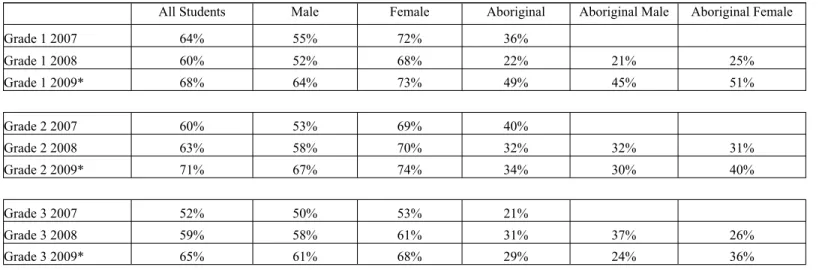
TABLE 3: District Primary Reading Assessment
(based on BC Performance Standards, % fully meeting and exceeding)
All Students Male Female Aboriginal
Grade 1 2007 64% 55% 72% 36%
Grade 1 2008 60% 52% 68% 22%
Grade 1 2009* 68% 64% 73% 49%
Grade 2 2007 60% 53% 69% 40%
Grade 2 2008 63% 58% 70% 32%
Grade 2 2009* 71% 67% 74% 34%
Grade 3 2007 52% 50% 53% 21%
Grade 3 2008 59% 58% 61% 31%
Grade 3 2009* 65% 61% 68% 29%
Aboriginal Male
21%
45%
32%
30%
37%
24%
Aboriginal Female
25%
51%
31%
40%
26%
36%
*Participation rates improved significantly over the last three years
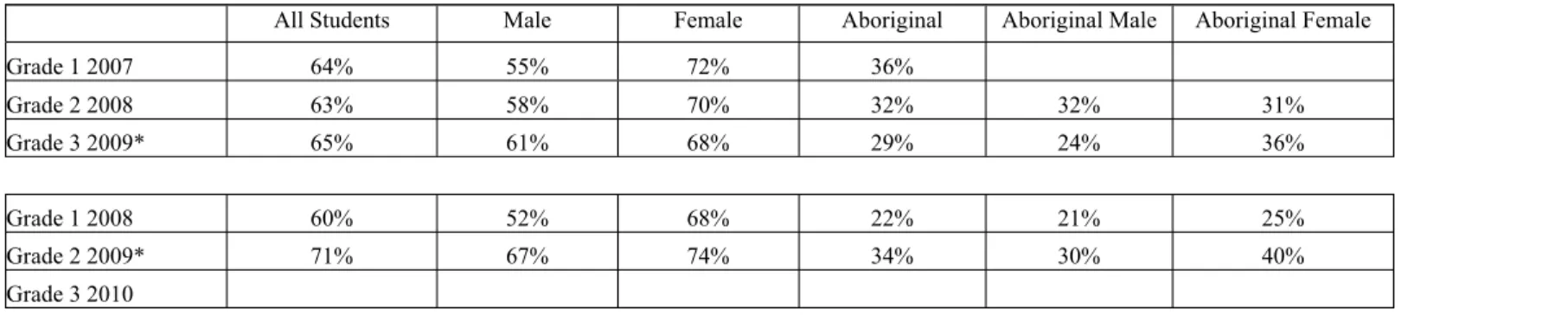
TABLE 4: District Primary Reading Assessment - Cohort Groups
(based on BC Performance Standards, % fully meeting and exceeding)
All Students Male Female Aboriginal Aboriginal Male Aboriginal Female
Grade 1 2007 64% 55% 72% 36%
Grade 2 2008 63% 58% 70% 32% 32% 31%
Grade 3 2009* 65% 61% 68% 29% 24% 36%
Grade 1 2008 60% 52% 68% 22% 21% 25%
Grade 2 2009* 71% 67% 74% 34% 30% 40%
Grade 3 2010
21 Achievement Contract 2009/2010 z School District 79 zCowichan Valley
Appendix 1 - Data Tables for Literacy
TABLE 5: DART
(Snapshot Assessment of Reading - % fully meeting, exceeding)
Grade 3 Grade 4 Grade 5 Grade 6 Grade 7 Grade 8 Grade 9
All
Students Abor All
Students Abor All
Students Abor All
Students Abor All
Students Abor All
Students Abor All
Students Abor
2007 55% 26% 65% 45% 63% 30% 65% 31% 52% 7% 48% 12% 36% 9%
2008 67% 41% 57% 30% 58% 34% 63% 40% 54% 28% 46% 16% 39% 13%
2009* 54% 18% 51% 22% 61% 34% 61% 41% 57% 28% 54% 28% 53% 17%
* DART participation rates improved significantly over three years
All Students Aboriginal
Grade 3 2007 55% 26%
Grade 4 2008 57% 30%
Grade 5 2009* 61% 34%
Grade 4 2007 65% 58%
Grade 5 2008 65% 58%
Grade 6 2009* 61% 41%
Grade 5 2007 63% 30%
Grade 6 2008 63% 40%
Grade 7 2009* 57% 28%
Grade 6 2007 65% 31%
Grade 7 2008 54% 28%
Grade 8 2009* 54% 28%
Grade 7 2007 52% 7%
Grade 8 2008 46% 16%
Grade 9 2009* 53% 17%
TABLE 6: DART COHORT GROUPS
(Snapshot Assessment of Reading - % fully meeting, exceeding)
English 10
All Students Aboriginal Dist % Prov % Dist % Prov %
c+ c+ c+ c+
04/05 69 65 39 38 05/06 72 65 47 39 06/07 74 65 36 40 07/08 71 65 44 41 08/09
English 12
All Students Aboriginal Dist % Prov % Dist % Prov %
c+ c+ c+ c+
04/05 78 68 55 52 05/06 69 68 56 50 06/07 70 68 50 49 07/08 71 69 50 49 08/09
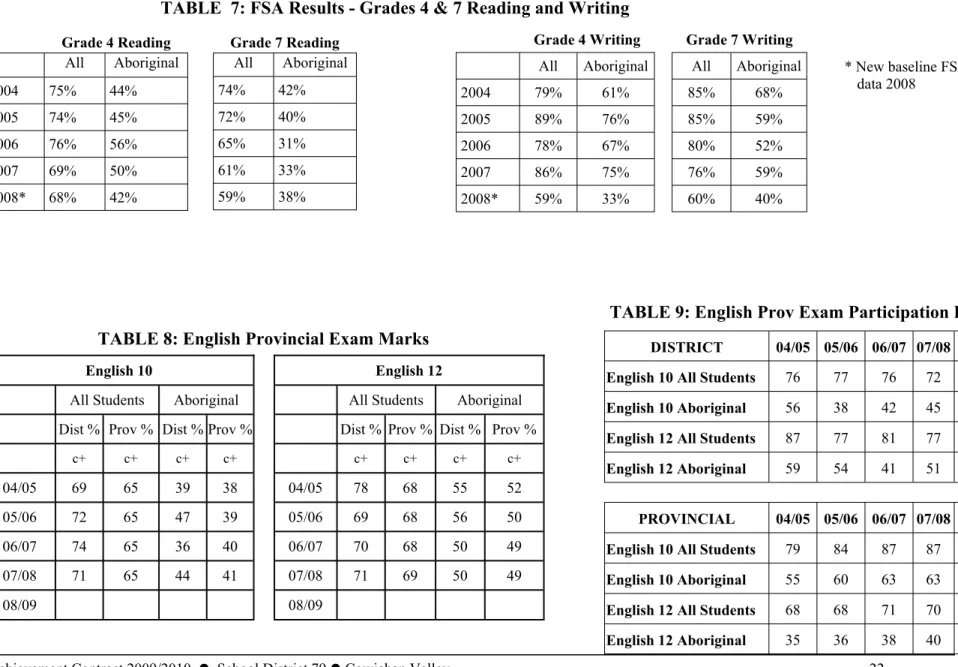
TABLE 8: English Provincial Exam Marks
Grade 7 Writing All Aboriginal
85% 68%
85% 59%
80% 52%
76% 59%
60% 40%
All Aboriginal
2004 79% 61%
2005 89% 76%
2006 78% 67%
2007 86% 75%
2008* 59% 33%
Grade 4 Writing
TABLE 7: FSA Results - Grades 4 & 7 Reading and Writing
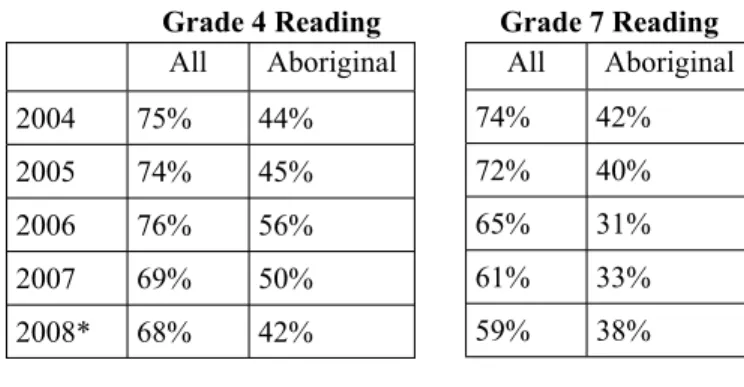
Grade 4 Reading
All Aboriginal
2004 75% 44%
2005 74% 45%
2006 76% 56%
2007 69% 50%
2008* 68% 42%
Appendix 1 - Data Tables for Literacy
DISTRICT 04/05 05/06 06/07 07/08 08/09 English 10 All Students 76 77 76 72
English 10 Aboriginal 56 38 42 45
English 12 All Students 87 77 81 77
English 12 Aboriginal 59 54 41 51
PROVINCIAL 04/05 05/06 06/07 07/08 08/09 English 10 All Students 79 84 87 87
English 10 Aboriginal 55 60 63 63
English 12 All Students 68 68 71 70
TABLE 9: English Prov Exam Participation Rates
Grade 7 Reading All Aboriginal
74% 42%
72% 40%
65% 31%
61% 33%
59% 38%
* New baseline FSA data 2008
23 Achievement Contract 2009/2010 z School District 79 zCowichan Valley
Gr 6-7 Gr 7-8 Gr 8-9 Gr 9-10 Gr 10-11 Gr 11-12
Dist Prov Dist Prov Dist Prov Dist Prov Dist Prov Dist Prov
2003/04 97 97 96 97 93 95 84 94 86 90 75 80
2004/05 98 97 95 97 94 95 93 94 89 90 75 81
2005/06 98 97 97 97 96 95 92 94 84 89 73 82
2006/07 97 97 96 97 96 95 92 95 85 90 74 83
2007/08 98 97 98 97 97 96 94 95 89 90 73 83
2008/09
TABLE 10: District/Provincial Transition Rates - All Students
(percentages)
Gr 6-7 Gr 7-8 Gr 8-9 Gr 9-10 Gr 10-11 Gr 11-12
Dist Prov Dist Prov Dist Prov Dist Prov Dist Prov Dist Prov 2003/04 97 97 84 96 72 88 57 84 69 78 54 63 2004/05 95 97 84 96 79 89 74 85 76 75 52 60 2005/06 96 97 94 96 89 90 79 85 58 76 54 64 2006/07 93 97 92 97 84 89 79 86 60 76 49 67 2007/08 98 98 96 97 88 91 86 88 75 78 47 67
2008/09
TABLE 11: District/Provincial Transition Rates - Aboriginal Students
(percentages)
Appendix 2 - Data Tables for Transition
TABLE 12: First Time Grade 12’s Graduation Rates
2003 2004 2004
2005 2005 2006 2006
2007 2007 2008 2008
2009
All Students (District) 84 88 82 85 83
All Students (Provincial) 75 76 77 78 78 Aboriginal Students (District) 57 80 65 60 78 Aboriginal Students
(Provincial)
51 52 52 57 58
TABLE 13: Six-year School Completion Rates
*Adjusted for international & school completion certificate students
2003/04 2004/05 2005/06 2006/07 2007/08 2008/09
All Students District 71 72 72 70 72
All Students Provincial 79 79 79 80 79
Aboriginal District 35 39 41 33 35
Aboriginal Provincial 46 48 47 48 47
*District Adjusted 75
• District Data Summary:
• Ministry of Education Required Provincial Exam data - Cowichan School District:
•
• Ministry of Education Grade to Grade Transition data:
• Ministry of Education Gr
• Ministry of Education Six-Year Completion Rate data:
• District Aboriginal Report data:
• Ministry of Education FSA data:
• School Goal Plans:
• Cowichan Literacy Plan:
• Adminfo District Key Information
Appendix 3 - Reference Links
25 Achievement Contract 2009/2010 z School District 79 zCowichan Valley
Appendix 4 - School Goals Chart
SCHOOL GOAL 1 GOAL 2
Central Family
Cowichan Sec To implement plans and programs that will help to improve the success for all vulnerable or “at risk” students
Quamichan Middle Improve literacy skills across the curriculum Alex Aitken To develop in our students a strong sense of personal and social responsibility Alexander To improve students’ reading performance
Maple Bay To improve student achievement in reading comprehension in non-fiction and
content areas To improve students’ understanding and engagement in Science and the scientific
process Koksilah To increase First Nations’ cultural knowledge and Hul’q’umi’num’ use for stu-
dents and staff in every classroom and throughout the school.
To increase reading comprehension
Mt Prevost Middle To strengthen and entrench the multigrade advisory system into the culture and traditions of Mt Prevost
To increase the success of our most vulnerable students
Ecole Duncan El To improve student achievement through differentiation of Literacy Instruction K-12 with a focus on Reading Comprehension / Reading for Learning. Through this goal, we will improve French Oral Language abilities of all students.
Drinkwater To improve student achievement in reading comprehension through differenti- ated instruction
Khowhemun To improve student achievement through the “Differentiation of Literacy Instruc- tion, With a Focus on Reading Comprehension / Reading For Learning”
Family of Schools Goal #1 – Action Plan reflects the Khowhemun School focus
Somenos To improve student Literacy through a focus on Reading Comprehension /
Reading for Learning through Differentiated Instruction Social Responsibility: To develop personal responsibility, with a focus on respectful and considerate behaviour.
Tansor Improve Student Achievement with a focus on Reading Comprehension and Reading for Learning through differentiated instruction
Social Responsibility: solving problems in a peaceful way
Alternate Education To increase success of all learners To improve attendance and retention of all learners Adult Education To improve the student success of all adult and school aged learners Improve the recruitment and retention of all students
Appendix 4 - School Goals Chart
SCHOOL GOAL 1 GOAL 2
West Family Lake Cowichan Midlle/Secondary
Improved student learning
AB Greenwell To improve the quality of student writing Palsson To improve students’ reading skills
South Family
Frances Kelsey Sec To increase student performance by improving wellness, recognizing the im- portance of physical, social and emotional health
To work as a South End Family of Schools to support District Transitions.
George Bonner Mid-
dle To further develop written communication skills using purposeful, thoughtful, persuasive, critically reflective language
Bench To improve student success in numeracy To improve student success in reading
To assist students to make healthy life choices, encourage good nutrition, physical activity and improve student physical fitness
Cobble Hill To meet the learning needs of our students in literacy
Ecole Mill Bay Improve all students’ reading skills Discovery Increase the percentage of students whose writing fully meets or exceeds ex-
pectations North Family
Chemainus Sec
To Improve the grade to grade transition rate and graduation rate of all our students
To increase student enrolment through all grade levels Chemainus El Will a focus for instruction on the oral language outcomes in the English Lan-
guage Arts curriculum improve student achievement in reading and writing at each level?
Crofton Will teaching metacognitive reading strategies to grade 4-7 students using fiction and non-fiction text result in improved reading comprehension, particu-
Will using the student friendly performance standards and the “6 Traits of Writing”
result in improved writing ability?
27 Achievement Contract 2009/2010 z School District 79 zCowichan Valley
Appendix 5 - Families of Schools
The North Family Chemainus Sec
Chemainus El Crofton
The West Family Lake Cowichan Middle
Secondary AB Greenwall
Palsson The Central Family
Cowichan Secondary Cowichan Adult Learning Cowichan Valley Open Learning Mt Prevost Quamichan Tansor Alexander Drinkwater Alex Aitken Khowhemun Maple Bay Somenos Koksilah Ecole Duncan
The South Family Frances Kelsey George Bonner Discovery Cobble Hill
Bench Ecole Mill Bay