ATC : Application de recherche de contacts TNC : Abréviations de la théorie du niveau de représentation en anglais. La recherche des contacts (ou contact tracing) consiste à mettre en œuvre des moyens de retrouver et, le cas échéant, de traiter les personnes ayant eu un contact étroit ou intime avec une personne infectée par une maladie épidémique afin d'en ralentir la progression (Office québécois de la langue). française, 2019).
Traçage de contact
Définition et utilité
Pour ce faire, sera présenté dans un premier temps le concept de contact tracing et ses applications en cas de crise sanitaire. Ensuite, les différents types de recherche des contacts seront décrits pour finalement fournir une synthèse de la littérature sur l'adoption et l'acceptation de l'ATC.
Formes de traçage de contact
Il existe donc plusieurs types de recherche de contacts qui peuvent ou non inclure le recours à la technologie. Enfin, la recherche de proximité est une forme efficace de recherche des contacts lorsqu'elle est largement utilisée par la population (Urbaczewski & Lee, 2020).
Application de traçage de contact : fonctionnement et enjeux d’acceptation
Fonctionnement et exemples d’ATC durant la pandémie de COVID-19
Des exemples d’applications utilisant cette architecture d’information sont TousAntiCOVID (France) ou TraceTogether (Singapour) (Howell O’Neill et al., 2020). Cependant, la faible utilisation de ces technologies conduit à un processus de recherche des contacts défectueux qui ne limite pas la propagation du virus (Ferretti et al., 2020 ; Urbaczewski & Lee, 2020).
Enjeux d’acceptation de masse et problème d’action collective
Ainsi, l’adoption massive des ATC (adoption volontaire) soulève une question d’acceptation majeure (Trang et al., 2020) qui sert à remettre en question l’utilité de ces technologies (Rowe, 2020). En effet, ces technologies génèrent des bénéfices sociaux uniquement si elles sont largement adoptées (Ferretti et al., 2020 ; Urbaczewski & Lee, 2020).
Synthèse de la littérature sur l’adoption des ATC
- Privacy Calculus Theory comme fondation théorique récurrente
- Rôle du Gouvernement dans l’Adoption des ATC
- Rôle du contexte pandémique sur l’acceptation des ATC
- Rôle du design des ATC sur leur adoption
La nature naissante de la littérature sur l’adoption de l’ATC montre que ces technologies sont nouvelles et ont émergé en réponse à la pandémie de COVID-19. Cet article contribue à la littérature sur l'adoption de l'ATC en démontrant que les décisions de conception technologique influenceront son adoption.
Conclusion de la revue de littérature
18 habitudes de vie de la population, qui influencent la perception de l'ATC par la population. En revanche, les articles examinés sur l’adoption de l’ATC suggèrent plusieurs limites ainsi que des suggestions pour des recherches futures.
Introduction
This study aims to expand the literature on the social acceptance of these technologies by drawing on the lens of Construct Level Theory (CLT). Overall, this emerging literature suggests that people's acceptance of CTAs is likely conditioned by their CL.
Background Literature
Contact tracing and contact tracing technologies
Drivers of CTA acceptance
Mutual benefits, corresponds to "an individual's perception of the mutual benefits everyone will experience from using the application" (Hamari et Koivisto 2015 cited in Fox et al. 2021). The psychological rationale behind such effects is that if a CTA is used effectively, it will make it possible to manage a pandemic with less need for strict social distancing measures such as curfews or lockdowns (Ferretti et al. 2020).
Drivers of CTA reluctance
Research Model and Hypotheses Development
- CTA Acceptance
- Privacy Uncertainty and Societal Utility
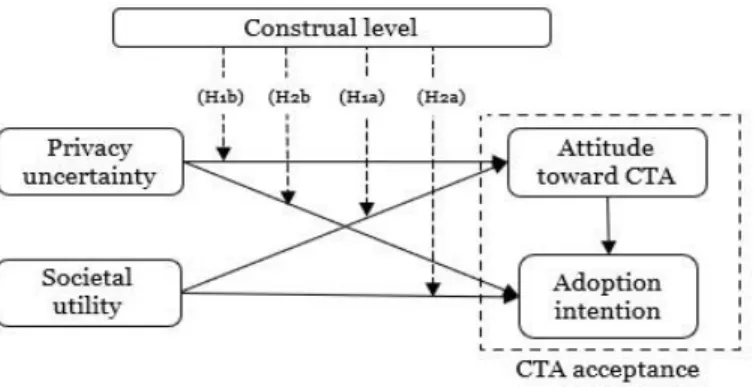
- Construal Level
- Hypotheses
Fox et al. 2021) to capture an individual's self-assessed likelihood of adopting a CTA (Hassandoust et al. 2021). PU corresponds to the extent of difficulty a person experiences in assessing the privacy of the information they entrust to the CTA developer (Al-Natour et al. 2020).
Methodology/study plan
H1: Abstract CL strengthens the positive effect of SU on individuals' attitude toward CTA (H1a), and it weakens the negative effect of PU on individuals' attitude toward CTA (H1b). H2: Abstract CL strengthens the positive effect of SU on individuals' intention to adopt a CTA (H2a), and it weakens the negative effect of PU on individuals' intention to adopt a CTA (H2b).
Potential implications for research and practice
27 by subtracting the mean of the items at the concrete construal level from the mean of the abstract CL items. After being exposed to the construal level manipulation, participants are shown mockups of the fictitious contact tracing application and asked to complete a survey asking questions about the construal level (for manipulation checking purposes), PU, SU, attitude. towards the use of the new app and the adoption intention.
Exploring the Competing Influences of Privacy Concerns and Positive Beliefs on Citizen Acceptance of Mobile Contact Tracing Applications. Individuals' privacy concerns and adoption of mobile contact tracing applications in a pandemic: A situational privacy calculus perspective. Adopting digital contact tracing in the COVID-19 pandemic: IT governance for collective action at the societal level.
Méthodologie initiale
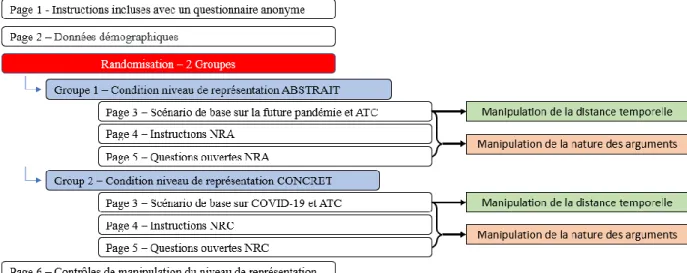
Comme indiqué dans le premier article (voir section 2.1, page 20), CLT propose que le degré d'abstraction d'un individu varie en fonction (1) de la distance temporelle séparant l'individu et l'objet d'évaluation (proximal vs distal) et (2) la nature des arguments, utilisés pour juger l'objet de l'évaluation (arguments de faisabilité (comment ?) versus désirabilité (pourquoi ?) (Trope & Liberman. La procédure expérimentale décrite dans le premier article (voir section 2.4, page 26) est celle utilisé pour réaliser le prétest pour valider la manipulation au niveau présentation décrite dans la section suivante. Les détails de la manipulation et les visuels de l'application fictive sont développés dans un autre article (voir chapitre 4).
Déroulement du prétest
En revanche, les participants amenés au niveau de représentation concrète devaient fournir les moyens qu’ils utiliseraient pour se protéger contre la nouvelle variante du coronavirus. Enfin, les répondants ont été invités à remplir le formulaire d'identification comportementale (BIF), une échelle conçue pour évaluer les différences individuelles dans le niveau d'identification des actions (Vallacher et Wegner, 1989) et qui a gagné en popularité dans la littérature et qui manipule le niveau d'identification des actions. représentation (Lee et al., 2019). Cet instrument permet de capter le niveau de représentation chronique d'un individu, c'est-à-dire le niveau d'abstraction en temps normal.
Résultats du prétest
Par conséquent, nous l'avons utilisé comme instrument de contrôle pour garantir qu'il n'y avait pas de différence significative dans le degré de représentation chronique entre les deux groupes expérimentaux. Les participants du groupe induisant un niveau de représentation abstrait ont également perçu un niveau d'abstraction inférieur à ceux assignés au groupe induisant un niveau de représentation concret, contrairement aux résultats attendus. Bref, pour manipuler le degré de représentation des répondants, il faudrait modifier la conception de l’expérience, notamment en ce qui concerne la manipulation de la distance temporelle.
Présentation des résultats au GReSI et réorientation méthodologique
Title: Mobile contact tracing applications and fear of government surveillance: A moderated mediation model to explain social acceptance. The current study aims to expand our understanding of the social acceptance of tracking technologies by examining privacy uncertainty and social benefits as two important influential beliefs that exert their effects on social acceptance through people's fear of government surveillance, a longer-term social risk. The results of this research can be used to inform the public as well as governmental and non-governmental institutions about how these technologies' immediate social benefits, privacy trade-offs, and their longer-term social risks play out in their social acceptance under varying conditions of emotional salience .
Introduction
Contact tracing takes three main forms: manual contact tracing, controlled tracing, and proximity tracing (Riemer et al., 2020). This approach greatly intrudes on people's privacy and is similar to government mass surveillance (Riemer et al., 2020). One of the key challenges to the success of digital contact tracing is that it relies on mass adoption (Trang et al., 2020).
Background Knowledge
- The Social Acceptance of CTAs
- Perceived Societal Benefits and CTA Social Acceptance
- Perceived Privacy Risk and CTA Acceptance
- Role of the Government as CTA Promotor
- Role of the Context Surrounding the Use of CTAs
Moreover, the role of government in public acceptance of CTA is part of the broader picture. The research into the social acceptance of the CTA falls within the specific context of the humanitarian crisis. On the other hand, the research on the social acceptance of CTA calls for attention to the context of the use and management of CTAs.
Research Model and Hypotheses Development
Research Model Overview
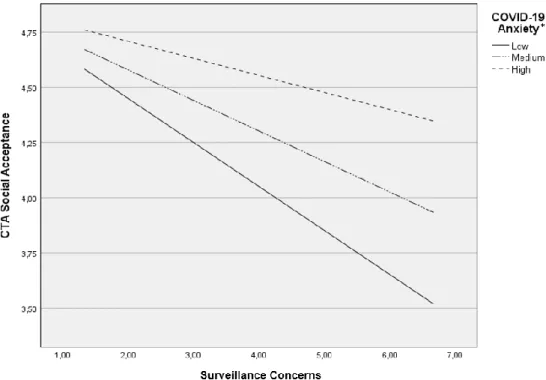
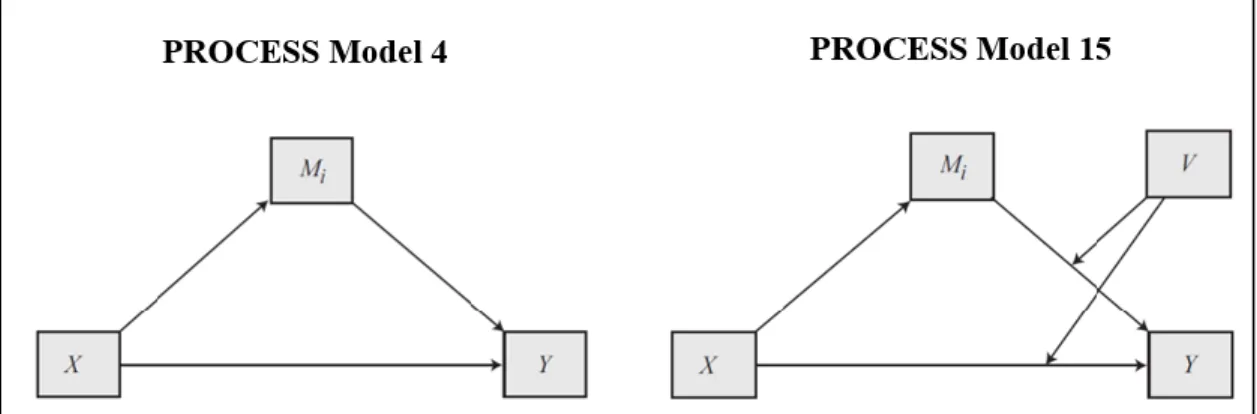
First, we expect that the negative effect of privacy uncertainty on social acceptance is mediated by the perception of surveillance concerns and that it is moderated in the second stage by the perception of COVID-19 anxiety. Consequently, we also expect the negative indirect effect of privacy uncertainty on social acceptance through surveillance concerns to increase when anxiety about COVID-19 is low. Consequently, we also predict that the positive indirect effect of social utility on social acceptance through surveillance concerns increases when anxiety about COVID-19 is low.
Research objective 1: Surveillance Concerns as a Mediator of the Effect of Privacy
As a result, there is a perception of privacy insecurity that negatively affects their adoption intentions (Al-Natour et al. 2020). Indeed, surveillance concerns are likely to be associated with a higher level of distrust of the government, leading to an avoidance response to the monitoring measures it implements (Rowe et al., 2020). Such information asymmetry causes perceptions of privacy insecurity as it becomes difficult for users to assess how their data is managed by the government (Al-Natour et al., 2020).
Research objective 2: COVID-19 Anxiety as a Mitigating Factor (Second Stage
This implies that since the indirect effects of privacy uncertainty and social utility on social acceptance are mediated by long-term/high-level considerations (surveillance concerns), their importance is likely to depend on emotional intensity. Mediated by surveillance concerns, privacy uncertainty has an indirect effect on the acceptance of CTAs that is stronger when anxiety about COVID-19 is low. As mediated by surveillance concerns, social utility has an indirect effect on the acceptance of CTAs that is stronger when anxiety about COVID-19 is low.
Methodology
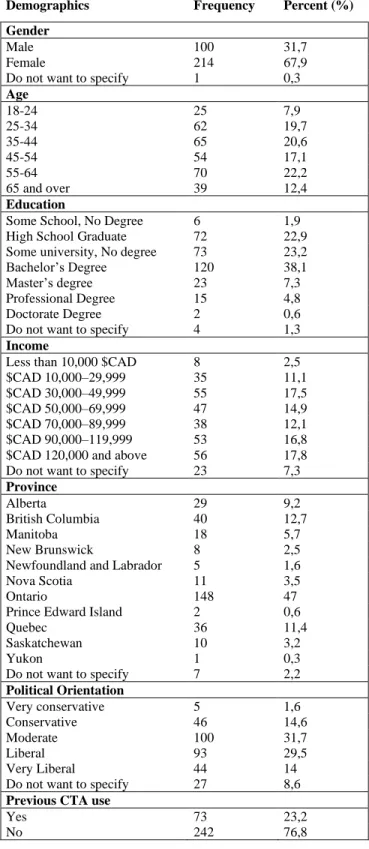
Study Setting and Data Collection
Experimental design
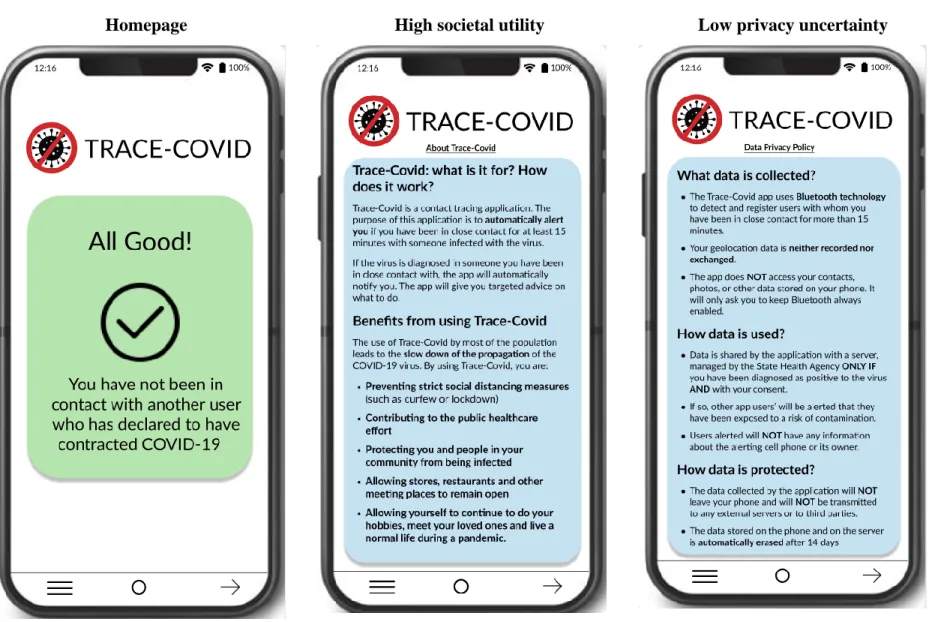
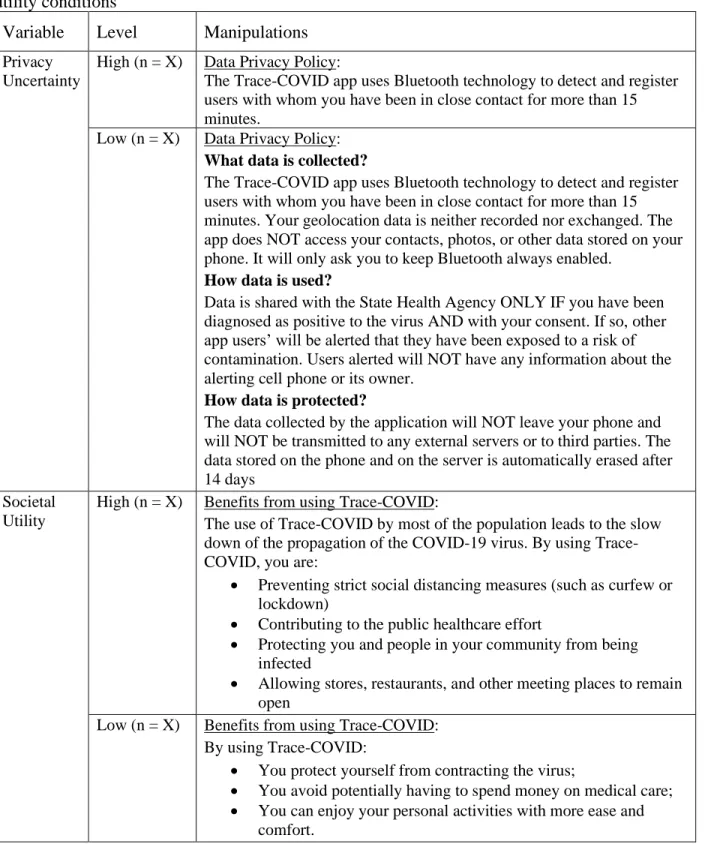
To avoid any effect of past experience related to the application provider, three model interfaces of a fictitious contact tracing application called Trace-COVID were developed (see Appendix B for an example of Trace-COVID model interfaces). The level of social utility was manipulated through the presentation of the benefits of using the app. A participant placed in the low SU condition could read information about the personal benefits of using the app while a participant who was in the high SU condition could read information about the collective benefits of using the app that increased perception his for the social benefit (see table A1).
Experimental procedure and construct measurement
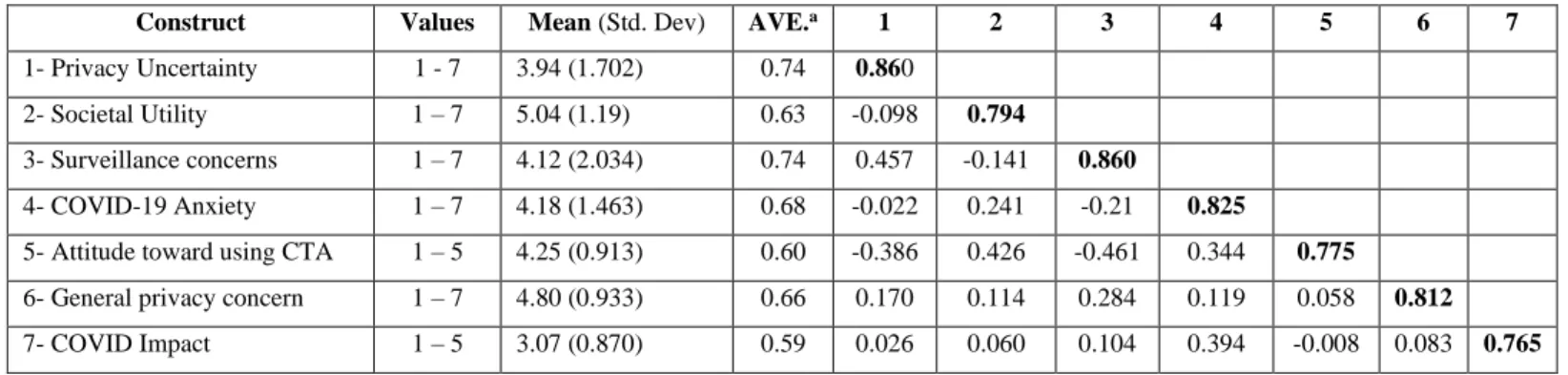
Analysis and Results
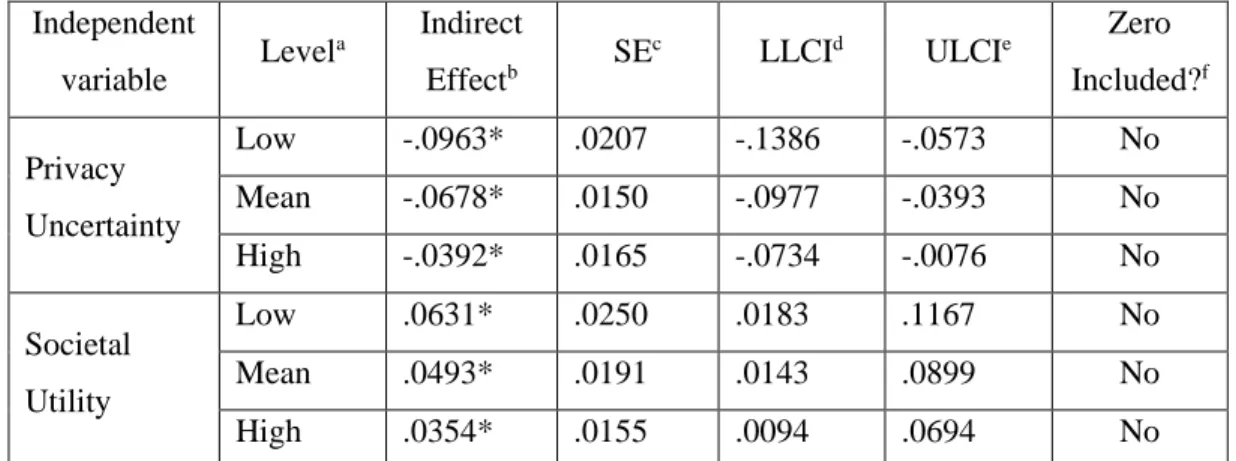
The data reported in Table 4-2 show the role of COVID-19 anxiety as a moderator of the indirect effect of privacy uncertainty and social utility on CTA social acceptance by way of surveillance issues. Indeed, the negative indirect effect of privacy uncertainty on social acceptance by way of surveillance concerns is significant at all levels of COVID-19 anxiety. Conditional effect of COVID-19 anxiety on the impact of observational issues on social acceptance with social utility as the independent variable.
Discussion
Theoretical Contributions
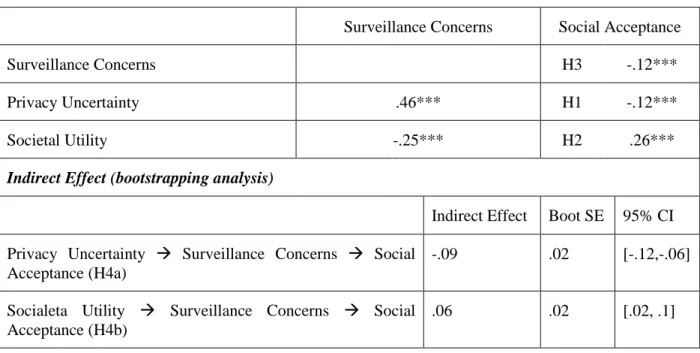
Explain that part of the effect of privacy uncertainty and social utility is determined by surveillance considerations. Theoretical Contribution #1: Surveillance Concerns as a Mediator of Privacy Insecurity and Social Utility in the Social Acceptance of CTA. The results show that part of the effect of privacy uncertainty and social utility on the social acceptance of CTA is explained by concerns about surveillance.
Practical Implications
Indeed, much research studies CTA adoption through the prism of individual costs/benefits related to the technology (Abramova et al., 2022; Carlsson & Nilsson, 2021; Hassandoust et al. calls for expanding the study of CTA adoption by considering the broader context in which these technologies are embedded in order to better understand the privacy paradox that surrounds them. These findings respond to the call for greater consideration of contextual and sociocultural factors in the evaluation of CTA adoption (Lin et al., 2021). that emphasizing the social utility of a CTA when promoted to the public will have a beneficial effect on its acceptance and reduce concerns about mass surveillance.
Limitations and Future Research Directions
The findings of this study suggest that government decisions about how to apply and design a CTA will directly affect the perception of privacy risks as well as the perceived benefits of using the technology. This will result in reducing the user's perception of privacy insecurity, and thus, the fear of mass surveillance by maximizing the social acceptance of CTA. 66 concerns in CTA acceptance, as well as the interplay between privacy concerns, social utility, and other external variables, such as demographic and cultural factors.
Conclusion
Privacy concerns may explain the reluctance to download and use contact tracing apps when concern about COVID-19 is high. Information Technology and the Pandemic: A Preliminary Multinational Analysis of the Impact of Mobile Tracking Technology on the Control of COVID-19 Infection. Digital Contact Tracing in Pandemic Cities: Problematizing the Traceability Regime in South Korea.
Appendices
In this study, we'd like you to think about WHY you would use Trace-Virus, a new contact-tracing app that could help manage future pandemics. REMEMBER: in this study, we want you to think about WHY you would use Trace-Virus, a new contact-tracing app that could help manage future pandemics. In this study, we want you to think about HOW you would use Trace-COVID, a new contact tracing application to be used in the management of the new BA.2 variant.
The Impact of Manual and Digital Contact Tracing on COVID-19 Outbreaks: A Study on Empirical Contact Data. Deciding whether and how to use a COVID-19 contact tracing application: Influences of social factors on individual use in Japan.