This difference is even more significant when looking at participation abroad in the Canadian college sector. Discussed approaches to increase the participation of students with disabilities in study abroad provide accessible home environments and planned pairing with teachers and guides (Ladika, 2009).
Inclusion of people with disabilities in international exchange is essential
Internationalization at Home (IaH)
Beelen & Jones define IaH as "the purposeful integration of international and intercultural dimensions into the formal and informal curriculum for all students within domestic learning environments" (2015). While the literature is extensive on the subject of IaH, and COIL is widely recognized as an integral part of the IaH movement (Beelen & . Jones, 2015), mention of COIL within IaH literature is sparse and.
IaH “formed in response to the challenge of providing
The increasingly recognized value of an internationalized education, together with the many barriers and inequalities for traditional international student mobility, has created an increased focus on International at Home (IaH) initiatives (CBIE, 2016). Whatever the case, the rationales for both IaH and COIL are similar, with both initiatives.
Collaborative Online International Learning (COIL)
- Overview of COIL Practices
COIL becomes part of the class, enabling all students to have a significant intercultural experience within their course of study”. At the end of the course, credit is then given to students by their home institutions.
Benefits of COIL
- Enhancing Digital Media Literacy
COIL presents a rich learning experience for students particularly during the
Team-Building and Cross-Cultural Communication
As one scholar explains, “COIL courses provide pluralistic viewpoints and academic freedom” by creating spaces where you can learn from every point of view. 7 Additionally, 50% of these students reported that “they enjoyed sharing ideas for a common goal from different perspectives,” 36% reported that “COIL makes the project easier to complete,” and 21% “enjoyed making new friends and learned from other people. ” (Appiah-Kubi &. Annan, 2019).
This experience was different that the other university experiences because I had the
- Language Learning
- Affordability
- Increased Performance Outcomes
- Benefits for Instructors
- Improving Intercultural Competence
It is discussed that "one of the disciplines that most eagerly adopted virtual exchange as a learning tool was foreign language teaching". One study points out that "COIL is unique in the world of e-learning because it requires co-teaching" (Strand Mudimu, 2020).
Citizens of today’s world need to recognize that people situated in different spatial, cultural,
Interculturally Effective Persons (IEPs) have been defined as being able to "live contentedly and work successfully in another culture," including "the ability to cope personally, professionally, and in a family context with the conditions and challenges of another culture" with several core competencies including with the ability to “handle the stress of culture shock and the constant challenges of living in. 10 Experts claim that “in addition to mastering EIPS, they actually enjoy enrichment.
The next two sections take a more detailed look at the literature discussing two of the most well-publicized benefits of COIL: improving intercultural competence and increasing graduate employability. While the essential skills “needed to be successful in a multicultural environment” are cited as “difficult to learn in the traditional classroom,” the literature also points out “one of the most effective approaches to acquiring intercultural competency skills is through experiential learning” (Appiah-Kubi & Annan, 2019).
At the start I had my doubts about the exchange and its effectiveness at breaking
Increasing Graduate Employability
In a 2014 study, Universities Canada found that "82% of hiring managers of Canadian Small and Medium Enterprises (SMEs) believe employees possess intercultural knowledge and an understanding of the world. 12 According to Statistics Canada's projections of the diversity of the Canadian population, the proportion of the total population born abroad will continue to increase, reaching between 25% and 28% by 2031.
I learnt how to cope with difference. I learnt how to work in a multinational
One researcher states that "globalism is not only about the trade of products" but also about the "exchange of ideas and values" (Holquist, 2006, as cited in Dubinsky, 2008). Locally, local corporations agree that “maximum efficiency in the workplace depends on good ethnic relations among their employees” with specific fields such as social work and medicine, asserting that “effective care requires sensitivity to culture.
I learnt asking personal questions is way less rude than assuming similarities. I
Improving Equity for Historically Underrepresented Students
For example, one study found that "more than half of the group surveyed expressed a sense of 'wanting' to study abroad after taking a COIL course," with the majority being students who had not yet studied in abroad (Reed, 2016). The potential for COIL to increase the representation and inclusion of students historically underrepresented in international mobility opportunities is important, especially given that “the cultural diversity through.
Enacting Target 4.7 of the Uns SDG Framework
These perspectives must be diverse and inclusive to foster an even greater variety of collaborative voices and ideas in the COIL arena.
Reflections
When individuals are able to
More research needs to be done to ensure that COIL achieves what it sets out to do, particularly in terms of improving diversity and equity in international education and better serving underrepresented students. It should be noted that while COIL is widely discussed throughout the literature as an effective method for developing key competencies, this discussion and shared understanding is primarily that of and.
Though COIL is being adopted as an Internationalization at Home strategy,
Study
- COIL Design
To initiate the development of an international education program within Sheridan College's intercollegiate liberal arts elective curriculum, curricular partnerships were established with partner institutions pairing Sheridan College's breadth of degree electives with appropriate.
Course Institution B Institution B Course
Research Methodology
This Pre-COIL Survey aimed to assess students' expectations of the COIL module and their perceptions of their intercultural competence. The second survey, referred to as the Mid-COIL Survey, was administered in the middle of the COIL module and sought to elicit the experiences students were gaining during the module.
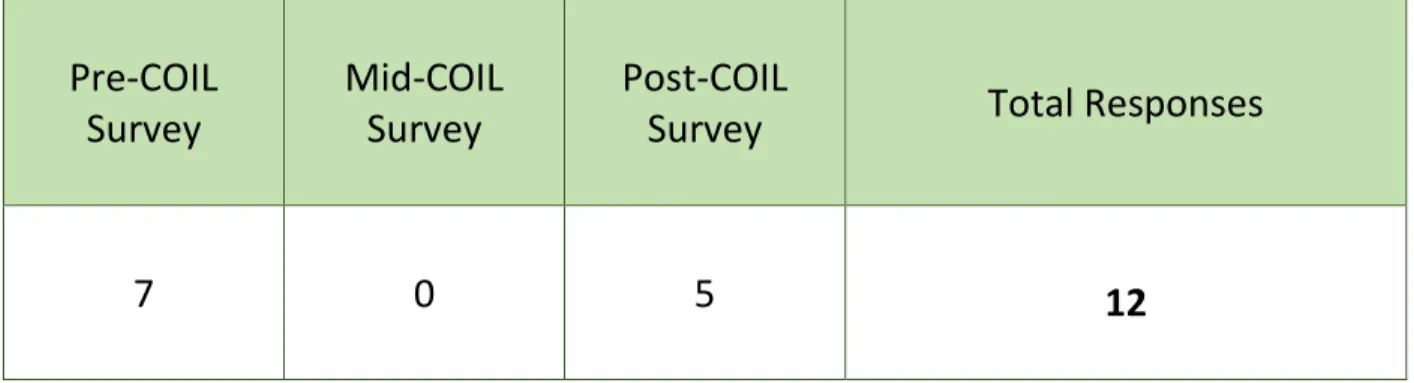
Survey Questions Table 3: Pre-COIL Survey Questions
Q4- How did your cultural background influence your understanding of this course material and shape your interaction with your partner(s). Q7- What will you explore further as a result of this connection to students from another country.
Pre- and Post- Coil Survey Findings
This set of questions sought to clarify the skills and knowledge the students acquired, what perceptions may have changed, and what insights emerged as a result of this experience. Q6- Was any aspect of this COIL enhanced course stressful in any way.
Respondents’ Characteristics
It should also be noted that most survey questions were open-ended, as opposed to the short, multiple-choice variety that can result in and encourage greater participation. While participation in these surveys was limited, the responses received will support the expansion of the COIL model across Sheridan faculties and contribute to the data collection and capacity-building efforts necessary for the eventual launch of highly supportive and accessible opportunities for outbound studies abroad within the interdisciplinary elective.
Do you identify as being indigenous to North America?
Do you identify as having an exceptionality/disability?
Are you a Canada Student Grant recipient?
Pre-COIL Survey Findings
To me, the idea of seeking to improve students’ intercultural understanding and competence means to teach students
I think intercultural understanding is firmly rooted in communication and open-mindedness. It would be sharing
To me, this means that I have the opportunity to learn about another culture by collaborating with another student from
To learn about other people’s culture and heritage. To share my view and to learn from other students from another
Q2- When asked how their interaction with students from another country might affect what they learned in this course, 7 responses were received from students. Interacting with students from another country would really help to bring a different perspective of ideas within.
The interaction with students from another country would really help to bring in a different perspective of ideas within
All respondents viewed future interactions with students in another country as positive and beneficial, with most emphasizing hopes of gaining different perspectives and ideas.
So far, what we’ve learned in the course has been very local (e.g., around the Toronto area), so it will be interesting to
Seeing things from another point of view will be helpful in understanding how their cities came to be, and vice versa.”
My interaction with other students from another country would impact my learning in a positive way as I would new
It will allow me to get a larger view on things.”
Question 3- Students were asked how they anticipated the way they see and understand the world could change by connecting with students in another country. 3 respondents indicated that they were born and raised in Canada, with multi-generational family members also born and raised here.
I’d like to learn about the different cultural aspects of the idea of the city outside of Canada.”
Question 4 – When asked to describe their own cultural background, seven responses were received representing a variety of backgrounds including African, Canadian, Chinese and European. Two respondents indicated that they had grown up in another country, with one respondent noting that they had grown up in Africa, and another respondent noting that they were an international student from China, adding that “Canadian culture is also very is new to me.” One respondent indicated that he was a first-generation Canadian with parents who had immigrated from Europe, while another respondent indicated that he was a second-generation Canadian with family that had immigrated from Austria.
I just really want to get to know other people and the differences in their and our cultures and just share
7 responses were received, representing a general optimism about COIL's potential power to broaden worldviews and positively inform views and opinions. I would like to learn more about the different cultural aspects of the idea of a city outside of Canada.”
I want to learn as much as I can about where the students live, what their cities are like, what the art scene looks like
I would like to make some new friends.”
I want to learn about Russia’s cultural background and creativity. Understand more of creativity in both the
Canadian and Russia cities.”
To meet new people and learn new things.”
Post-COIL Survey Findings
Communication is key.”
Patience goes a long way.”
That working online and with different time zones is extremely difficult.”
Meeting new people and seeing new places.”
How cities functions. As well how certain factors may influence its creativity and also make them hard to live in
When one respondent described how working with international partners positively affected their learning experience, 1 respondent noted that they “learned more about international culture” and another respondent explained that “it was good to see people from Russia and get new perspectives. " Another student responded that "working with international partners affected me in that way, as I have learned a lot of things about the place they come from and see the big difference between the country I'm in and the one they are in." . When 1 respondent described how collaboration with international partners negatively affected their learning experience, 1 respondent noted that this collaboration “tested my patience and anxiety due to lack of communication between international classmates” and another said that it was.
We all live relatively the same.”
Q2- Students were asked to describe "how the impact of this course in collaboration with international partners had on your learning experience?" 5 responses in total were received, with the majority of those responses (3) highlighting positive impacts and the remainder (2) detailing negative impacts.
Interacting with students who are from another country made me view the world as something that is so beautiful
Question 6- When asked, “Was there any aspect of this extended course with COIL that was stressful in any way. Lack of communication made assignments stressful as some classmates seemed to ignore them.
Lack of communication made the assignments stressful since it felt like some classmates didn’t take into account
Working together on different time zones and having our assignments marked on time.”
Finding time we could all meet and different due dates between countries.”
The only part that was stressful for me was only finishing the assignments and making sure it includes
Q7- Students were asked what they wanted to "further research because of this connection with students from another country?" 4 responses were received and included:.
Explore Russian culture and sites.”
I want to explore different places around the world and see the difference between the places that I have lived
I would want to explore more interactive approaches to collaboration such as synchronous assignment software.”
Reflections
Problems reported included a "lack of communication", confusion because students had "slightly different tasks", and feeling that group work was challenging because some students "didn't consider the needs of other classmates" because they "didn't knew". good." Most reported difficulty in "working together across time zones," a major challenge discussed in the literature and expected for collaborative online international learning programs of this type. As pointed out by SUNY COIL (2021) , “COIL is about connecting across differences,” and while those connections aren't always seamless, they're worth the effort.
Appendix
Tyumen
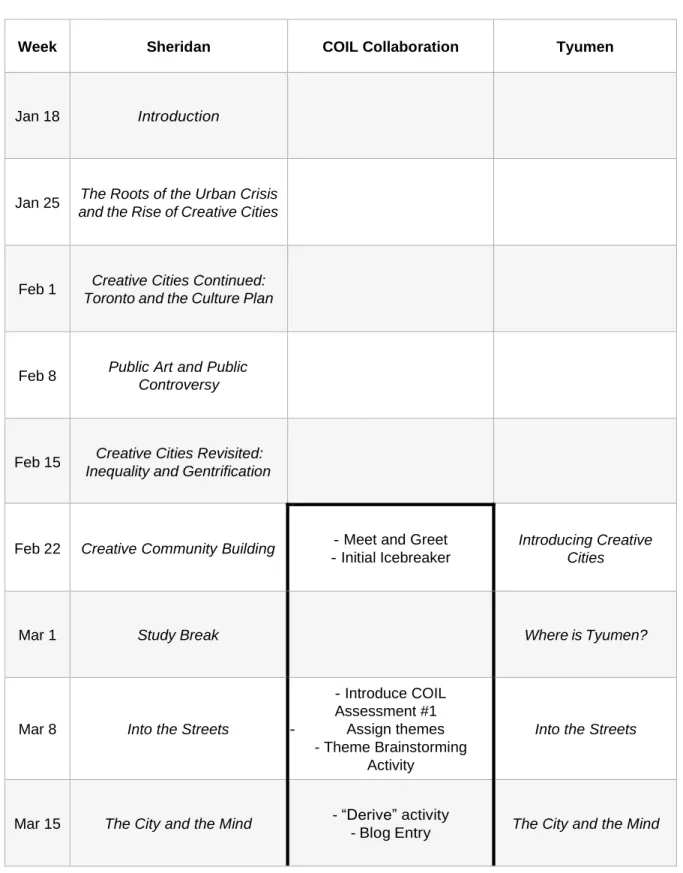
Assessments and Activities
In a shared document, compiled by the group members at both Sheridan and SAS (as best as possible), the report should. The report is also an opportunity to reflect on the things you have learned over the course of your international collaboration, and to acknowledge any challenges you have faced.
From telecollaboration to virtual exchange: State-of-the-art and UNICollaboration's role in the development.