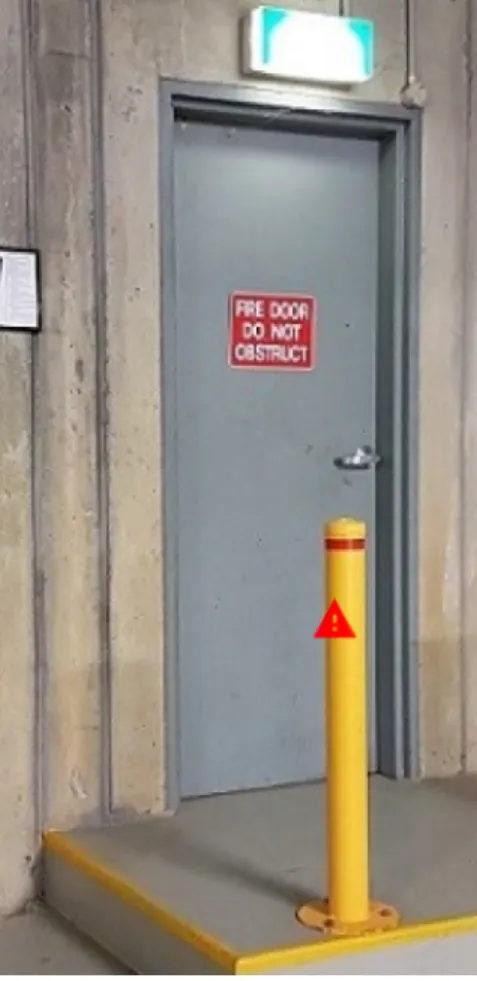
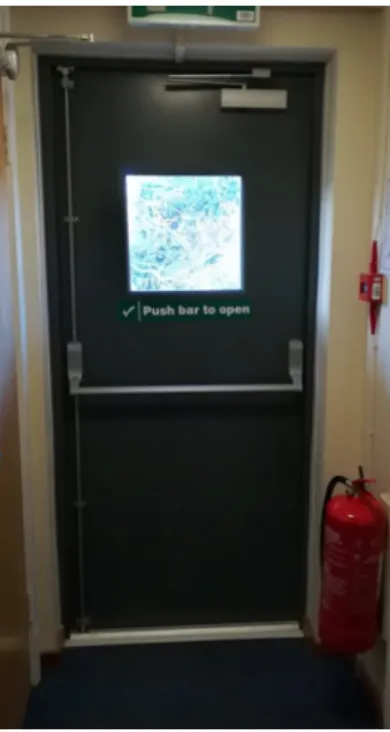
This paper explores the creation of an object detection system for mobile using the YOLO(You Only Look Once) algorithm, a real-time object detection model developed to run on a portable device such as a mobile phone that does not have a graphics processing unit. (GPU). This algorithm is used to detect fire code violations, specifically the blocked door in a fire separation: the areas surrounding the doorway must be kept clear of anything likely to block. The author has run several experiments to determine the best accuracy levels, highlighting the importance of hyperparameter optimization to improve the performance of an object detection model.
The results of the experiments also showed that training more than 5000 iterations can produce an overfitting model. Furthermore, the author discusses the combination of depth detection with object detection, to increase the accuracy of the violation detection. Keywords: object detection, fire code violation, fire code violation detection, depth detection, machine learning, YOLO.
Ghassem Tofighi for his support on this article and providing the author with all the necessary tools to make this article a reality. The author also thanks his family members for their exceptional support and encouragement during the preparation of this article. This chapter provides an overview of the article, a brief introduction to the technology used, and reveals the current detection of fire code violations and its importance.
Background
History of Fire Code Violations
Mock-up
Contribution
Thesis Statement
Since the introduction of machine learning to the tech world, there has been an increase in demand for machine learning to make tasks simpler and reduce human need/errors as much as possible. Machine learning, deep learning and neural networks are all crucial parts in technology, and this paper. In section 2.1, machine learning, deep learning and neural networks are further explained and how they come together.
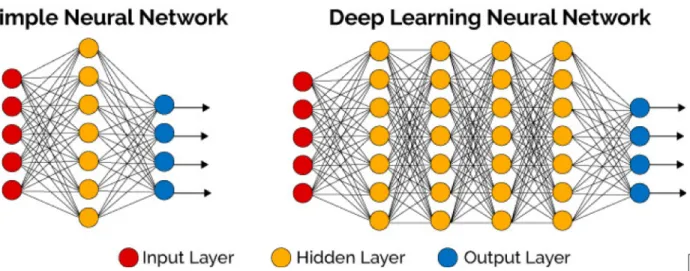
One of the techniques that machine learning uses to discover structures in data sets is deep learning. Before deep learning, machine learning methods were made to solve a single task by designing specific algorithms to extract features that were mapped to features in the data; however, with deep learning this is no longer necessary[6][7], algorithms learn using a general process that is not specific to one task can solve many problems. In a deep learning neural network, there are more layers between the output and input layers [4][10] compared to standard neural networks shown in Figure 2-1.
The specific type this paper focuses on is the convolutional neural network, which is able to generalize much better than other networks. One of the reasons that the convolutional neural network has been widely adopted is because it is designed to process data that comes in the form of multiple strings, similar representations of images[11]. This neural network has proven successful when it comes to detecting, segmenting and recognizing objects and regions in images.
With the advancement of deep neural networks[12], it is able to use traditional machine learning approaches for several fields, such as speech, recognition, machine translation and NLP (natural language processing)[4][10 ].
YOLO Algorithm vs Mobile-net
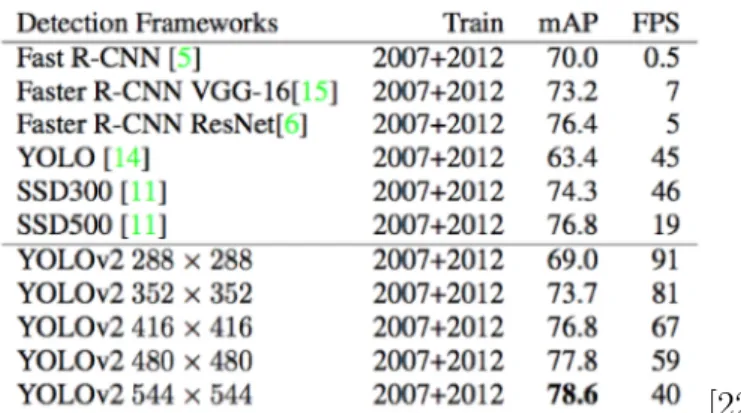
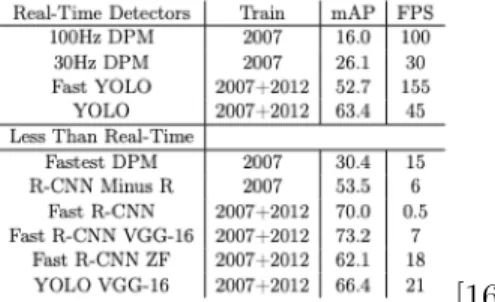
This is what makes the YOLO algorithm one of the fastest real-time algorithms with almost twice the accuracy of any other real-time detector. Table 2.2 above shows a comparison of the performance of different object detectors on the PASCAL VOC dataset (dataset commonly used as a benchmark in visual object detection)[17]. The YOLO network takes the image and splits it into a grid of SxS cells[18], and then the grid generates N predictions for bounds boxes (GxGxN boxes in total)[19].
Just like YOLO, mobile-net also uses a simple convolutional neural network that learns to predict boundary cache and classify the locations in one pass. Although both algorithms work in a similar way, YOLO remains a faster algorithm than SSD[21]. In the figure 2.2 below, we can note that the FPS in YOLOv2 is much significantly better than SSD, but SSD is able to get a higher mAP due to its depth focus, thus allowing more objects to be detected and sometimes higher accuracy[ 22].
Depth Detection
Current Tech for Fire Saftey
Process of YOLOv4
In this step, the Google Open Images datasetV6 was used to collect multiple datasets. Hyperparameter optimization: Changed the configuration for the YOLOv4 model by changing the batch size, height, width, and filters.
Application Process
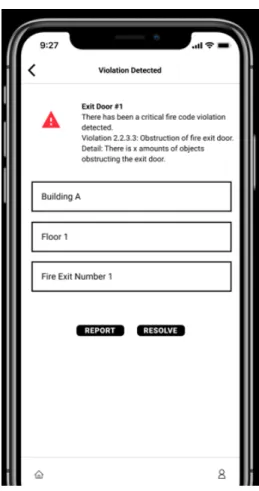
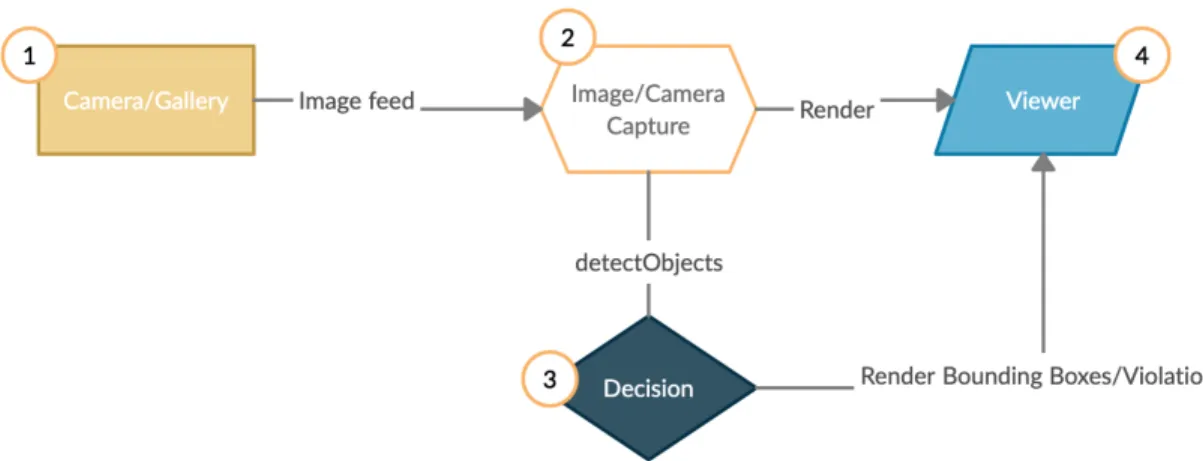
This is the application process that the user must go through to determine the existence of a violation.
Tools
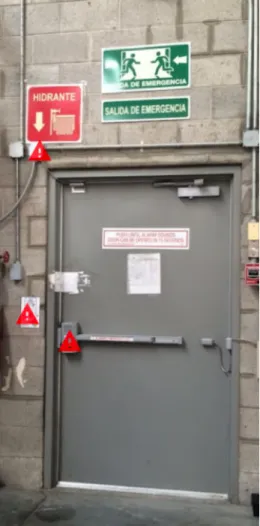
The model had to be improved to ensure full detection of some ports. Both of Figure 4-1 show a clear gate, but the algorithm detected this as a violation because the objects were inside the bounds of the box. What needed to be done was to change the height and width to ensure better accuracy.
After experimenting with the height and width hyperparameters, the algorithm performed with a higher success rate. This indicates that there is a direct correlation between the accuracy of the algorithm and the hyperparameters. Increasing the input layer increases the accuracy of detection, but at the expense of speed.
Additional Findings
This shows the importance of depth sensing, which should be used to correct this error in the algorithm. Creating a YOLOv4 model for facility detection, specifically fire code violation detection, has its pros and cons. In conclusion, this thesis demonstrated the practical application of machine learning and deep learning beyond standard technology.
However, to improve an integration with the depth detection algorithm, it could further improve the detection of violations and unlock other violations to be detected as well. Integrating Program in Surveillance Cameras/Cameras in Buildings in General Regarding the second point, implementing this program in cameras in commercial buildings will not only save people man hours but will also provide a safer environment that is both automated and manual. opportunity for us to step in and confirm. Github: https://github.com/salimelewa/firecodeviolationdetectionGoogleColab: https://colab.research.google.com/drive/1V GM8IM T2qqRqIm5M5bSZLa0W J5l0CcB5?usp=.
A comparative study on the effectiveness of using popular dnn object detection algorithms for marrow detection in parawood cross-sectional images.